

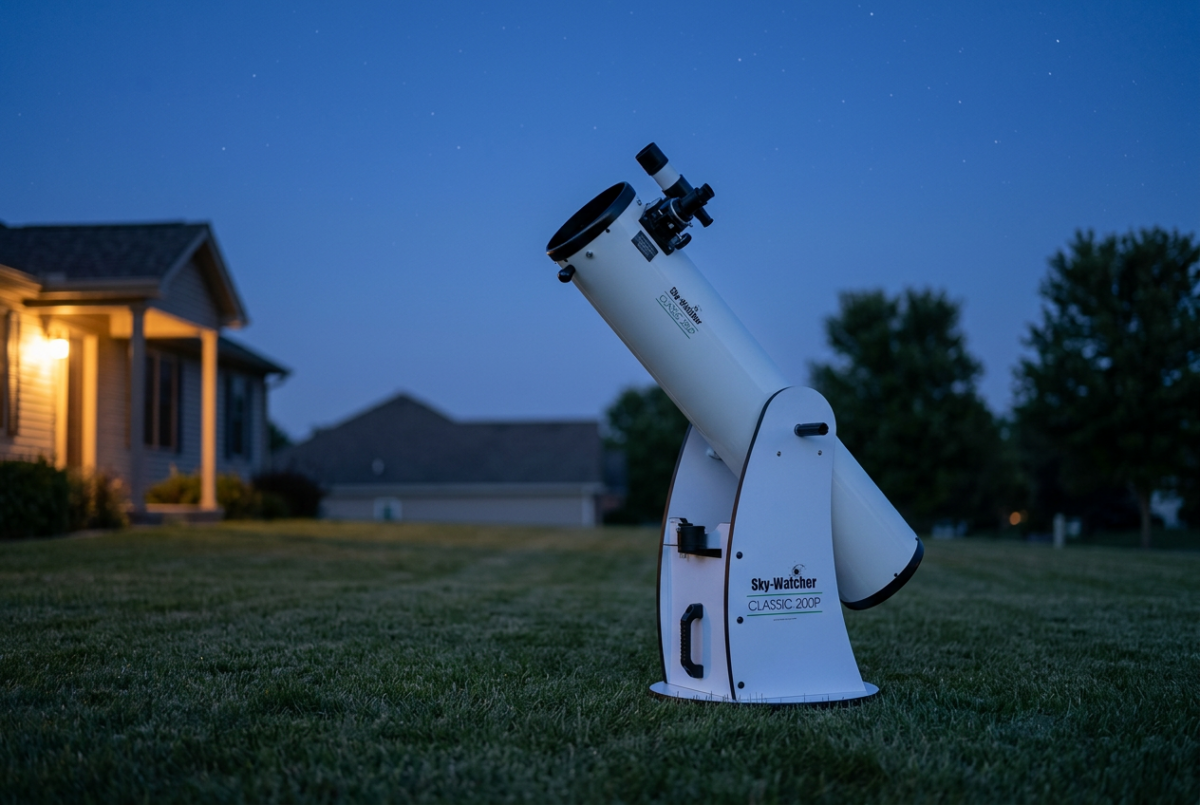
Quick Answer: The Sky-Watcher Classic 200P is the best set of optics you can buy for about $725, and it is not the 8-inch Dobsonian I would tell most beginners to buy. The mirror is excellent and the scope will show you more than you expect, but Sky-Watcher ships it stripped — straight-through finder, two mediocre eyepieces, no collimator, no cooling fan — and the Apertura AD8 costs less while including every one of those things.
That is an uncomfortable verdict to lead with, so let me explain how I got there. I am an engineer by training (B.S., Penn State), I came back to amateur astronomy at 50 after a long absence, and I observe from a York, Pennsylvania backyard that sits somewhere around Bortle 5 to 6 on a decent night. When I evaluate a telescope I care about two things: what the optical train can actually deliver, and what it will cost me — in dollars and in friction — to get it delivering that. On the first count the 200P is superb. On the second, it asks you to pay for parts twice.
What is the Sky-Watcher 8-inch Dobsonian, exactly?
It is a 203mm f/5.9 Newtonian reflector on a simple alt-azimuth rocker box — the design John Dobson popularized to put big apertures in the hands of ordinary people. Sky-Watcher sells three different 8-inch Dobs and the naming has drifted over the years, which trips buyers up constantly.
- Classic 200P (SKU S11610) — solid tube, manual. This is the one this review is about. Sky-Watcher used to call it the “Traditional 8-inch”; in the UK and Europe it is the Skyliner 200P. Same telescope, three names.
- FlexTube 200P (S11700) — identical optics on a collapsible truss tube, about $850.
- FlexTube 200P SynScan GoTo (S11800) — collapsible plus motorized GoTo, roughly $1,200 to $1,450 depending on sale.
One clarification, because I see it asked constantly: there is no 8-inch Virtuoso GTi. That Wi-Fi push-to tabletop line stops at 130mm and 150mm. If you want an 8-inch Sky-Watcher with any kind of electronic pointing, the FlexTube SynScan is your only option in-house.
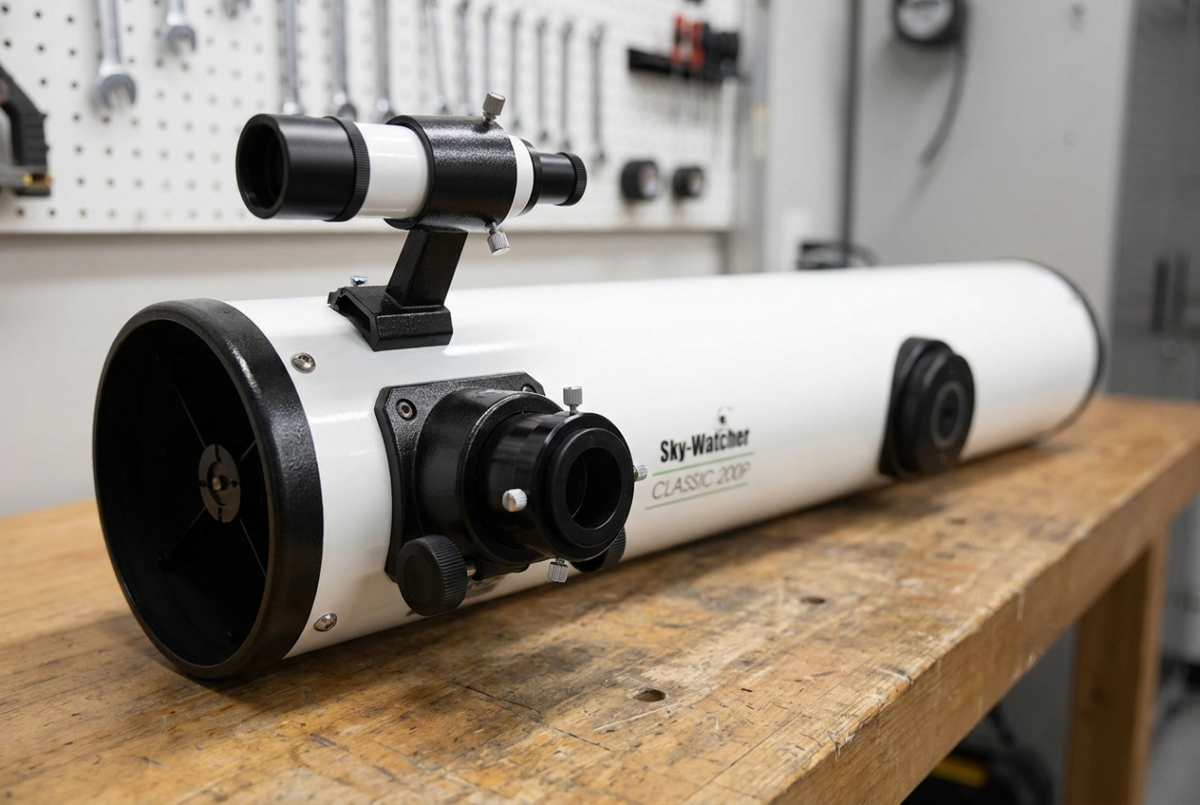
Sky-Watcher Classic 200P specifications
Here are the numbers that actually matter, with a note where the published specs genuinely disagree with each other.
| Specification | Sky-Watcher Classic 200P |
|---|---|
| Aperture | 203mm (8 inches) |
| Focal length | 1200mm |
| Focal ratio | f/5.9 (several review sites print f/6 — it is f/5.9) |
| Optical design | Parabolic Newtonian, borosilicate primary |
| Coatings | Radiant Aluminum Quartz, ~94% reflectivity |
| Secondary obstruction | 48mm — 24% by diameter, about 6% by area |
| Resolution (Dawes) | 0.57 arcseconds |
| Highest useful magnification | ~406x on paper; ~200x in real seeing |
| Focuser | 2″ single-speed, 1.25″ adapter included (see note below) |
| Finder | 9×50 straight-through |
| Tube weight | ~20–24 lb (sources differ) |
| Base weight | ~25 lb |
| Assembled weight | ~45–50 lb |
| Tube length | 43 inches |
| Eyepiece height at zenith | ~45 inches |
| Warranty | 2-year limited |
| Street price (Aug 2026) | about $725, held at MAP across retailers |
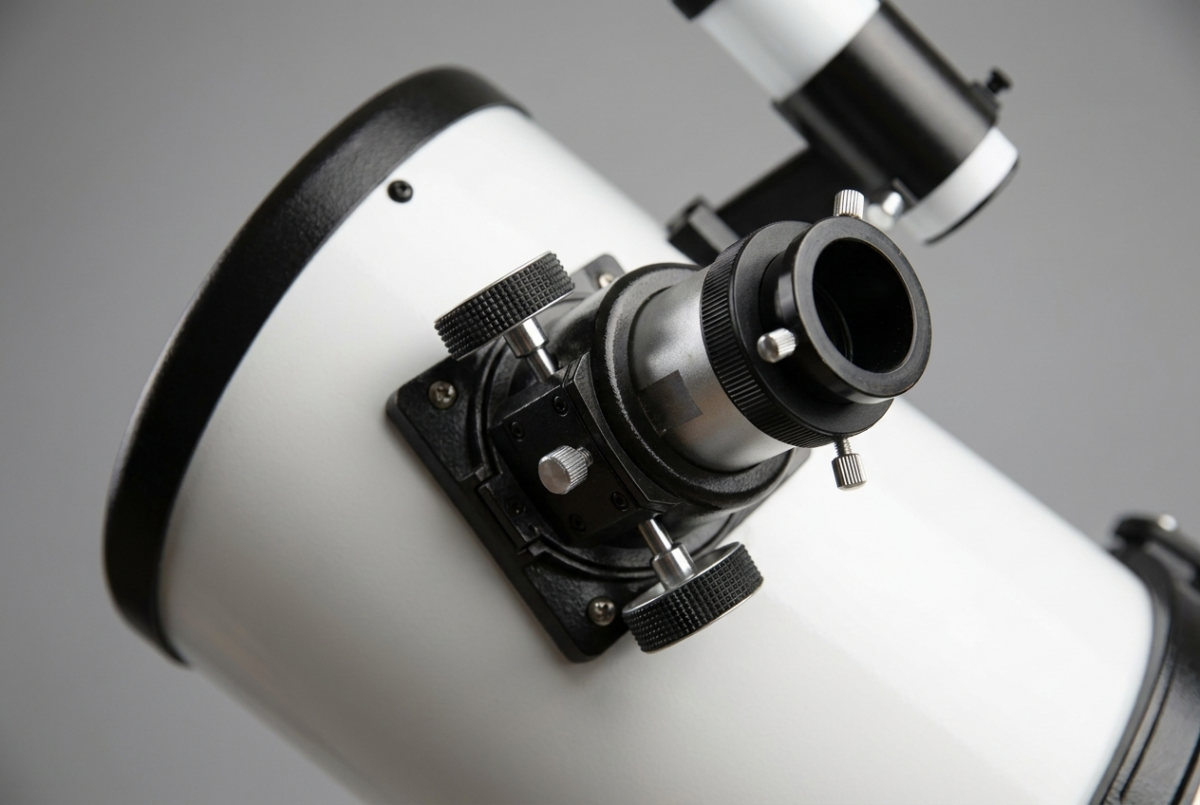
A focuser note I have not seen any other review make. Sky-Watcher and every retailer call it a “Crayford-style” focuser, and the owner complaints are worth reading carefully, because they do not all point the same way. A Crayford holds the drawtube by friction alone — a smooth shaft pressing it against opposing bearings, no gear teeth anywhere. So two of the three things owners report are exactly what a Crayford does when it is under-tensioned: sag under a heavy 2-inch eyepiece, and a barrel that slides when the tension screw is backed off too far. Gravity simply wins against too little friction. The third complaint, slop, is backlash — and backlash is a rack-and-pinion trait, because it comes from gear teeth having somewhere to move.
Worth keeping in perspective, though, because a Dobsonian is the mildest case of this. A Newtonian needs no star diagonal — the secondary already turns the light 90°, so the eyepiece sits directly in the drawtube with no adapter hanging off the back and no lever arm working against you. The horror stories about drawtubes surrendering under weight come mostly from refractors and Schmidt-Cassegrains, where a heavy eyepiece sits at the end of a diagonal. On top of that, a Newtonian focuser points radially out of the side of the tube, so its axis is almost never vertical and gravity only ever gets a component along it. What you get is slow creep during a session, not a drawtube falling out on the lawn.
The useful takeaway is better news than the forum threads suggest: friction tension is adjustable. Before deciding the focuser is junk, find the tension screw and set it properly — a slipping Crayford is usually just a loose one, and that is a thirty-second fix, not a defect. What you cannot adjust is that it is single-speed, and that is the first thing serious owners replace.
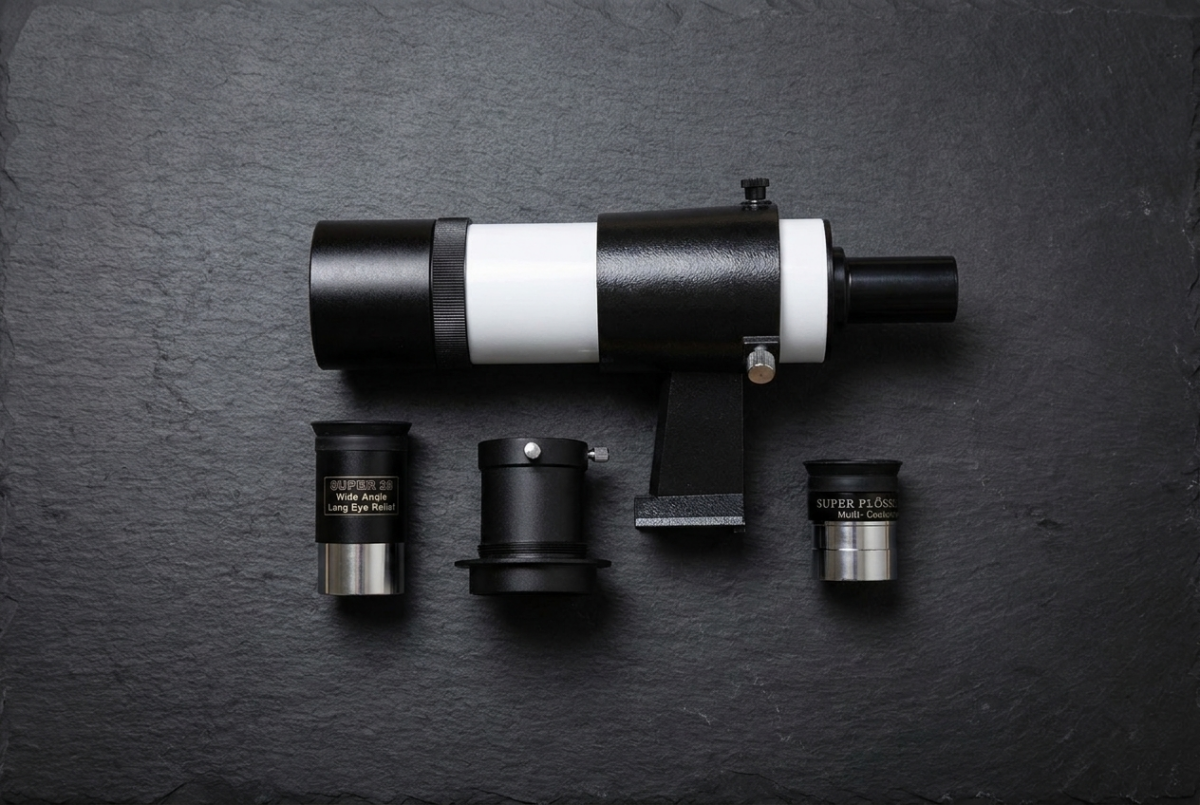
The included eyepieces are similarly murky. B&H and Agena list a 25mm and 10mm; High Point Scientific’s box contents say 20mm and 12.5mm. That looks like a running production change rather than an error. Either way you are getting two entry-level eyepieces, the low-power one is usable and the high-power one is not, and you should plan on buying better glass. Our beginner eyepiece guide covers what to get first.
What can you actually see with an 8-inch Dobsonian?
An 8-inch aperture is the point where deep-sky observing stops being an exercise in faith. Photons scale with area, and 203mm collects roughly 850 times more light than your dark-adapted eye — that is the whole argument for this class of telescope.
From my Bortle 5–6 backyard, an 8-inch shows:
- Planets. Jupiter’s two main equatorial belts at 50x, festoons and belt structure at 150x, the Great Red Spot when it is on the meridian and the South Equatorial Belt is dark. Saturn’s rings as an obvious ellipse, and the Cassini division on nights when the seeing cooperates. See our planetary telescope guide for how aperture and seeing trade off.
- Globular clusters. M13 resolves into individual stars across the core — this is the single most convincing “the aperture was worth it” moment for most new owners.
- Bright nebulae. M42 shows the trapezium plus real nebulosity structure. M57 is a clear smoke ring. M27 is genuinely dumbbell-shaped.
- Galaxies — honestly. M31’s core and dust lane, M81 and M82 in the same low-power field, M51 as two fuzzy patches. You will not see spiral arms from a Bortle 6 sky. Anyone telling you otherwise is selling something.
What you will not see is color in nebulae. The eye’s color receptors do not work at those light levels. Every photograph you have ever seen of the Orion Nebula was a long exposure. Set that expectation now and the telescope will delight you; carry it in and it will disappoint you. If you are unsure what your sky will support, start with our guide to judging the darkness of your own sky.
What owners actually complain about
I read through several hundred posts across Cloudy Nights, Stargazers Lounge and r/telescopes before writing this, and the complaint pattern is remarkably consistent. Ranked by frequency:
1. The altitude tension handles and azimuth stiction. This is the signature Sky-Watcher Dob complaint. Owners report the tube slowly drooping once they let go of the tension handle, and the azimuth motion sticking at awkward moments — particularly near the zenith. The root cause owners keep landing on is that the rocker box center bolt is not fixed solidly, allowing lateral play. It is fixable with about $10 to $25 of PTFE pads and washers, and multiple owners note that the manual’s tightening procedure is simply wrong. Annoying, not fatal.
2. The straight-through 9×50 finder. Near-universal, and the complaint is always about posture, never image orientation. A straight-through finder on a 45-inch-tall Dob means kneeling and craning your neck at targets high in the sky. This is the single most common reason experienced observers steer beginners toward the AD8, which ships with a right-angle correct-image finder. Budget for a Telrad or a RACI finder — and read our finderscope alignment guide before your first night out.
3. Collimation. Sky-Watcher’s 6- and 8-inch solid-tube primary cells use O-rings rather than springs — a detail Sky-Watcher has confirmed in writing to owners while acknowledging their own manual describes it incorrectly. Adjustment is push-pull with a Phillips and a hex lock, it requires tools, and it feels sticky compared to a sprung cell. Seized secondary grub screws are a recurring out-of-the-box failure. No collimation tool is included. Our reflector collimation walkthrough applies directly.
4. Weight and portability. Not a defect — a lifestyle filter. Roughly 45 to 50 pounds in two pieces, a 43-inch tube. Owners are blunt: if you have to carry it up and down stairs, you will stop using it. The tube fits in the trunk of a compact car; a 10-inch does not. If stairs or a small apartment are your reality, look at our small-space telescope picks instead.
5. The particleboard base. Melamine over low-density particleboard with vulnerable T-molding edges. Wet grass and heavy dew are the enemy. Cloudy Nights treats swelling as “a matter of when, not if” — though plenty of owners report years of dew and frost with no problem. Store it indoors, keep it off wet lawn, and it is a non-issue.
One counter-finding worth stating plainly, because review sites love manufacturing regret: in the r/telescopes threads that specifically ask 8-inch Dob owners what they wish they had done differently, the overwhelming answer is nothing. The only regret people express is not buying a bigger scope.
The real price: total cost of ownership
This is the section I most wanted to write, because nobody publishes it and it changes the buying decision. The $725 sticker is not what an equipped 200P costs.
| Item | Why you need it | Approximate cost |
|---|---|---|
| Sky-Watcher Classic 200P | The telescope | ~$725 |
| Telrad or RACI finder | The stock straight-through finder is a neck-breaker | $45–$60 |
| Collimation tool | None included; a Newtonian needs collimating | $30–$50 |
| 2″ wide-field eyepiece (~30mm) | Unlocks the 2″ focuser you paid for | $60–$130 |
| High-power eyepiece (~6mm) | The stock high-power eyepiece is not usable | $25–$70 |
| 80mm cooling fan | See the tip below | ~$15 |
| Adjustable observing stool | 45″ eyepiece height means you sit | ~$40 |
| Realistic all-in | ~$940–$1,090 |
The tip nobody publishes: the rear cell of the Classic 200P has four pre-tapped holes that accept a standard 80mm computer case fan. A 15-dollar fan and a USB battery pack turn a 90-minute cooldown into 30 minutes and eliminate most tube currents. The single most-cited advantage the Apertura AD8 has over this scope is that it includes a fan — and you can close that gap for the price of lunch.
How the Sky-Watcher 200P compares in 2026
The 8-inch Dobsonian market changed dramatically and almost nobody has updated their comparison tables. Orion is gone. Optronic Technologies — parent of Orion, Meade and Coronado — ceased operations in July 2024, assets went to auction, and High Point Scientific bought the remaining inventory and liquidated it. You cannot buy a new Orion SkyQuest XT8 in 2026; anything you find is used or leftover stock. Be aware that a storefront marketing itself as “Orion Telescopes, since 1975” is not the original company — treat it with suspicion. Zhumell’s Z8 has been effectively unavailable since 2025 as well.
That leaves a three-way race.
| Telescope | Price | What’s included | Best for |
|---|---|---|---|
| Apertura AD8 | ~$700 | Dual-speed 2″ Crayford, RACI 8×50 finder, laser collimator, cooling fan, 30mm + 9mm Plössls, moon filter, extension tube | Almost everyone. Cheaper and better equipped. |
| Sky-Watcher Classic 200P | ~$725 | Single-speed 2″ focuser, straight-through 9×50, two basic eyepieces | Buyers who want Sky-Watcher optics and don’t mind kitting it out |
| Celestron StarSense Explorer 8″ Dob | ~$880 (approximate, B&H, Aug 2026) | Smartphone plate-solving push-to, otherwise comparable | Anyone who struggles to find objects manually |
| Sky-Watcher FlexTube 200P | ~$850 | Same optics, collapsible tube | Storage-constrained buyers; shorter when stowed |
| — | Discontinued | Used market only |
Product links, for when you’re ready to compare current pricing:
- Sky-Watcher Classic 200P Dobsonian
- Apertura AD8 Dobsonian
- Celestron StarSense Explorer 8″ Dobsonian
- Sky-Watcher FlexTube 200P
Who should buy the Sky-Watcher 200P — and who should not
Buy it if you specifically want Sky-Watcher’s optics and coatings, you already own decent eyepieces and a finder from a previous scope, you have ground-floor storage and a car that fits a 43-inch tube, and you are comfortable spending an evening tuning a rocker box. Under those conditions it is a genuinely excellent telescope and I would not talk you out of it.
Do not buy it if this is your first telescope and you are buying blind. You will pay $725, discover you need another $250 of accessories to use it comfortably, and end up at a higher total than the better-equipped AD8. Do not buy it if you live up a flight of stairs, and do not buy it if you are primarily interested in astrophotography — a manual alt-az Dob is the wrong tool for that job, and our smart telescope vs. traditional comparison explains why.
My verdict: 4 out of 5 for the telescope, 3 out of 5 for the package. The mirror deserves better accessories than Sky-Watcher gives it.
From experience: I get more usable nights out of 150× than 200×. On a 1200mm Dobsonian that is an 8mm eyepiece. A 6mm or 7mm will show you more on the rare night the atmosphere fully cooperates, but the 8mm is the one that works most nights — and a view you actually get to use beats a sharper one you keep waiting for.
Frequently asked questions
Is an 8-inch Dobsonian too big for a beginner?
No, provided you can store and move it. An 8-inch Dob is the most commonly recommended first serious telescope precisely because the mount is simple — push it where you want to look. The limiting factor is never complexity, it is the 45 to 50 pounds and the 43-inch tube. Be honest about your stairs and your car before you order.
Is the Sky-Watcher 200P better than the Apertura AD8?
Optically they are very close — both are quality parabolic mirrors and you would struggle to tell them apart at the eyepiece. The AD8 wins decisively on the package: it includes a dual-speed focuser, a right-angle finder, a laser collimator and a cooling fan for slightly less money. If you are buying one 8-inch Dob and nothing else, buy the AD8.
Can you do astrophotography with a Sky-Watcher 8-inch Dobsonian?
Only in a limited way. An alt-azimuth mount has no tracking and introduces field rotation, so you are restricted to short-exposure lunar and planetary imaging with a webcam-style camera — which the scope actually does well. Deep-sky imaging requires an equatorial mount or a smart telescope. Our mount comparison covers the trade-off.
How often does an 8-inch Dobsonian need collimation?
Check it every session, adjust it when it needs it — which for a solid-tube Dob that stays in one place is perhaps every few outings. The secondary rarely moves; the primary drifts with transport and temperature. Two minutes with a collimation cap before you observe is a good habit and prevents the “my telescope is blurry” panic.
What magnification does the Sky-Watcher 200P support?
The theoretical maximum is around 406x, but atmospheric seeing will cap you near 200x on most nights from most backyards, regardless of how good the mirror is. Plan your eyepiece set around 50x to 200x and treat anything higher as an occasional treat on unusually steady nights. See our magnification guide.
Will the particleboard base fall apart?
Not if you keep it dry. The melamine surface is water-resistant but the exposed edges and T-molding are not. Store it indoors, avoid parking it on a wet lawn all night, and consider running a bead of clear silicone along the bottom edges. Owners who do this report bases that last a decade or more.
Bottom line
The Sky-Watcher Classic 200P is a very good telescope sold as an incomplete package. If you already have accessories, or you enjoy the tinkering, it will reward you with excellent views for a decade. If you are starting from zero, the Apertura AD8 gets you to the same eyepiece experience for less total money and less fuss. At TelescopeSchool we would rather tell you that up front than sell you the upgrade path afterward.
Either way, get an 8-inch. It is the aperture where amateur astronomy stops being a novelty and starts being a hobby. For a wider look at the class, see our roundup of the best Dobsonian telescopes and our best telescopes under $500 if this one stretches your budget too far. And if you’re still deciding whether a Dob is the right design at all, start with what a Dobsonian telescope actually is.
Prices in this review are approximate and were checked in August 2026. Telescope pricing moves with tariffs, sales and stock — verify before you buy.
I judge a telescope on what it actually shows and how easily it gets used, not on the spec sheet. An engineer’s eye helps; the eyepiece decides.
These May Help Too...
Can You Use a Telescope Through a Window? (And Why You Should Not)
Using a telescope through a window ruins the view: bad glass, heat currents and reflections. Here is what actually happens, and what to do instead.
Telescope will not come to focus? The cause is almost always spacing, not optics. Work out whether you ran out racking in or out, then fix that end.