

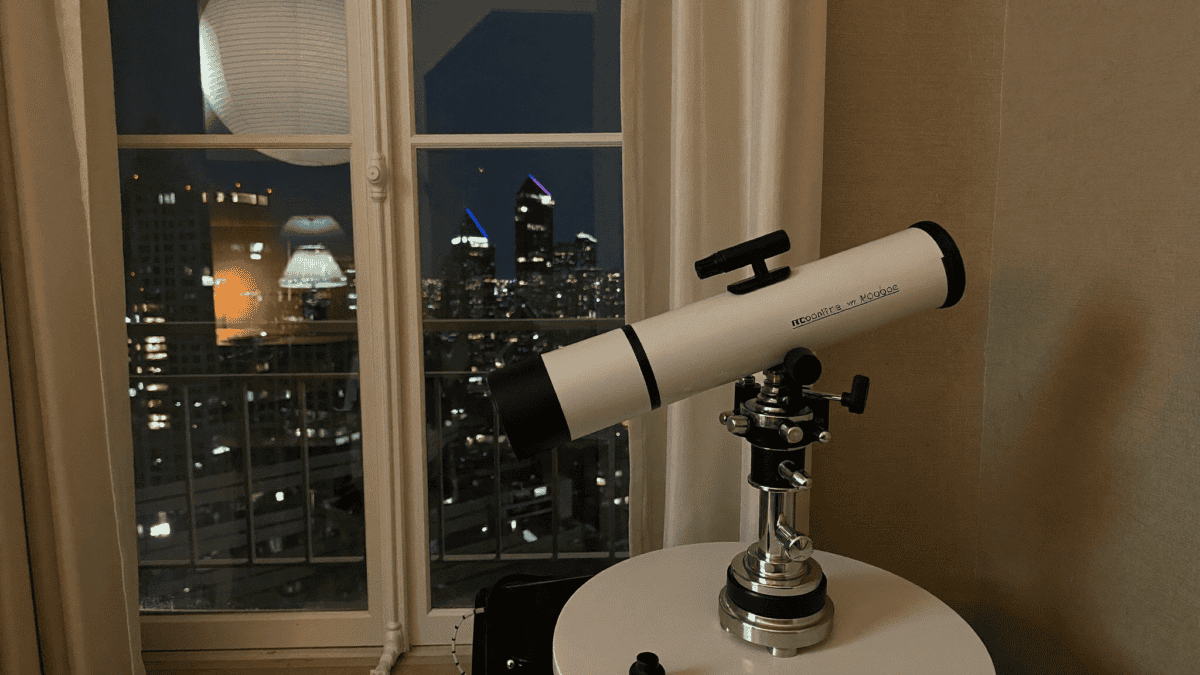
The best telescope for an apartment or small space is the Celestron StarSense Explorer LT 114AZ (around $200) — it’s compact, breaks down small, and its phone app finds targets for you even under city lights where you can barely see the guide stars. If storage is your tightest constraint, a collapsible Sky-Watcher Heritage 130P tabletop Dob stores on a closet shelf; if you want to beat light pollution for deep-sky, the ZWO Seestar S50 Pro smart telescope is the pick. I’ve observed for years from Bortle 5–6 suburban skies in exactly these cramped, light-washed conditions, and this TelescopeSchool guide ranks the telescopes that genuinely work in a small space — and names the ones to avoid. For the how-to of observing from a balcony, see my apartment & balcony astronomy guide; this article is about which telescope to buy.
Quick Answer: The best telescope for an apartment is the Celestron StarSense Explorer LT 114AZ (~$200): app-guided, compact, and enough aperture for the Moon and planets. For closet storage, the tabletop Sky-Watcher Heritage 130P is ideal; to beat light pollution, the ZWO Seestar S50 smart telescope.
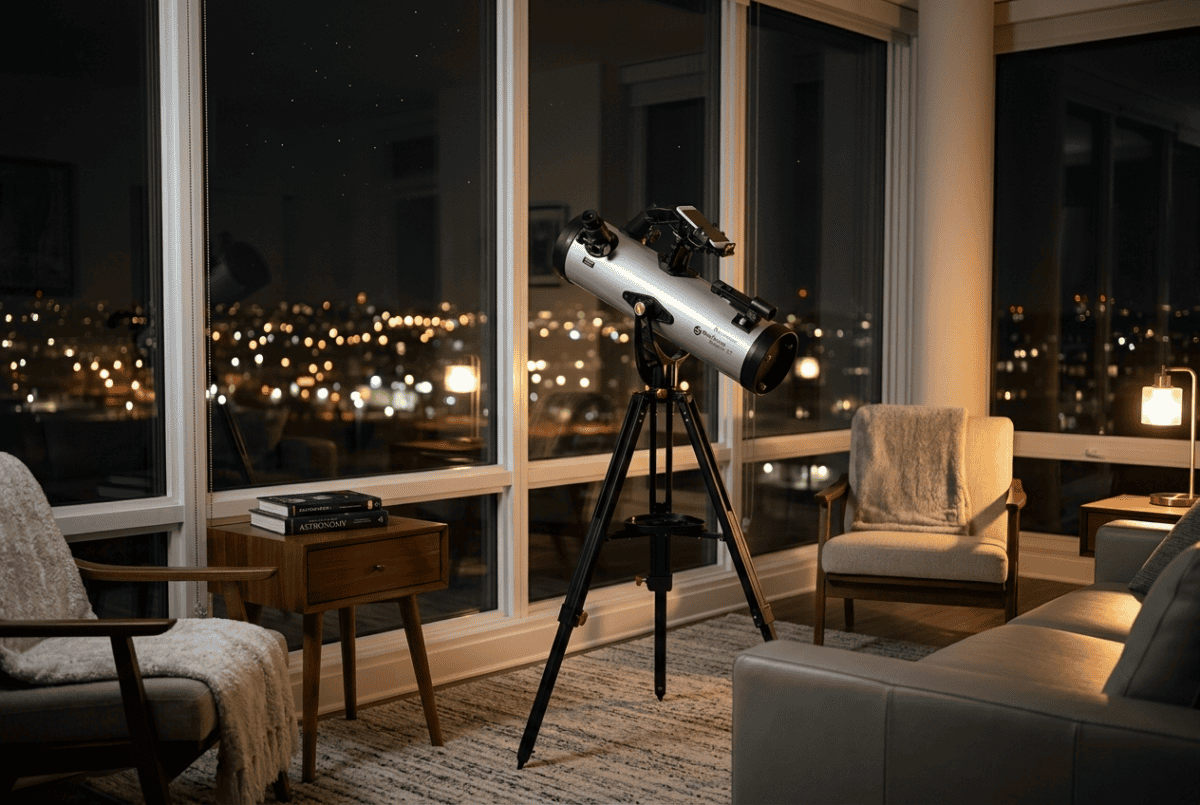
Model update — September 2026
The Seestar S50 named here has been discontinued. Its replacement is the Seestar S50 Pro — same 50mm aperture, upgraded sensor and autofocus — at an introductory $899. It is newly released: High Point Scientific is taking orders, B&H lists it as coming soon. We will update here once it is confirmed in stock. If you want a smart telescope you can buy today, the Seestar S30 Pro at $699 is in stock now.
Best telescopes for apartments and small spaces at a glance
The right small-space telescope depends on your storage, your budget, and whether you want to find objects, beat light pollution, or pull maximum detail from the Moon and planets. Here are the picks.
| Telescope | Aperture | Approx. price | Best for |
|---|---|---|---|
| Celestron StarSense Explorer LT 114AZ | 114mm | ~$200 | Best overall — compact + phone finds targets |
| Sky-Watcher Heritage 130P | 130mm | ~$260–305 | Best tabletop — closet-storable aperture |
| ZWO Seestar S50 Pro | 50mm | ~$899 (updated Sept 2026) | Best smart / light-pollution beater |
| Sky-Watcher Skymax 102 Maksutov | 102mm | ~$335 | Best Moon & planets in a tiny tube |
| Celestron Travel Scope 70 | 70mm | ~$80 | Best budget / travel starter |
What makes a telescope good for apartments and small spaces
A good small-space telescope balances aperture against footprint, and the mount matters as much as the optics. You want the most light-gathering you can store and carry, on a mount that’s quick to set up and stable on a hard floor. Prioritize four things: storage (does it fit a closet shelf or a drawer?), portability (can you carry it out set up in one trip?), fast setup (a scope that takes 10 minutes on a fiddly equatorial mount gets used far less than one that’s ready in one), and stability (tall flimsy tripods shake badly on concrete and composite decks). Light pollution shapes your targets more than your telescope choice — the Moon and planets punch through any city sky, while faint deep-sky needs a smart scope or a dark-sky trip.
Best overall for small spaces: Celestron StarSense Explorer LT 114AZ (~$200)
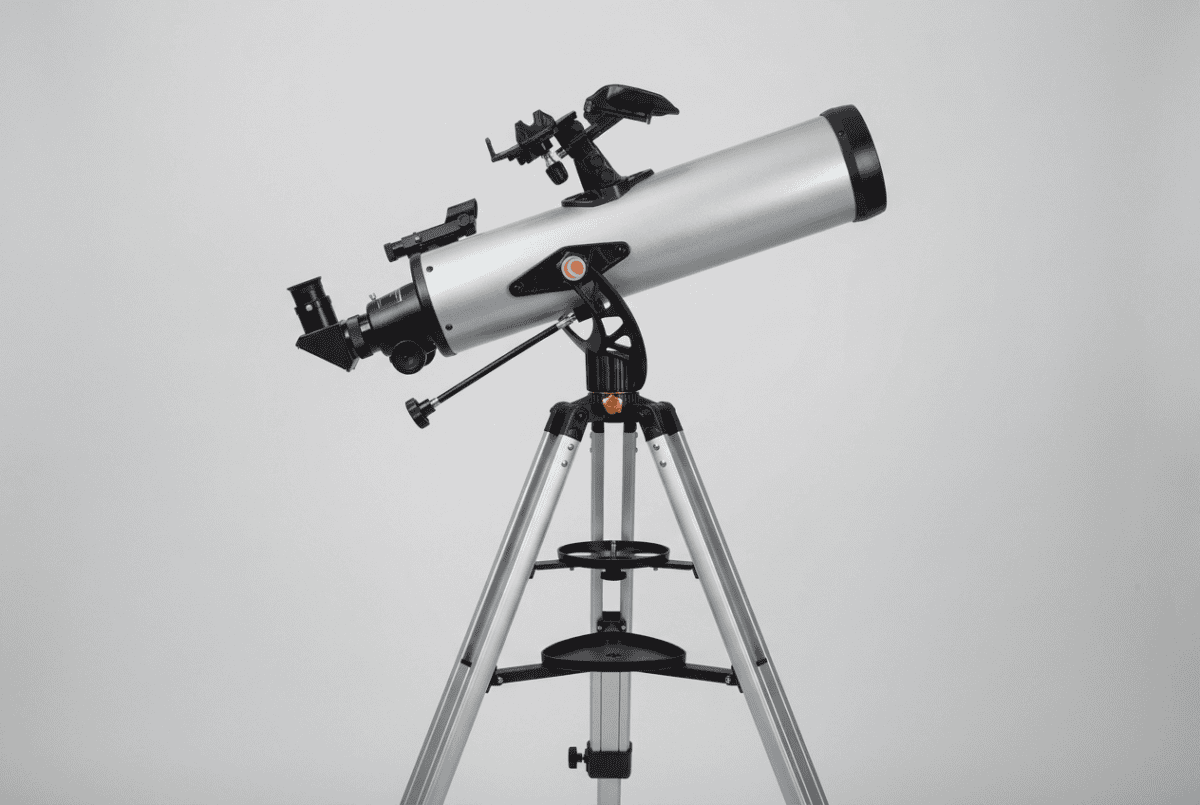
The StarSense Explorer LT 114AZ is the best all-around apartment telescope because it combines a genuinely useful 114mm aperture with a phone app that finds objects for you — the single biggest hurdle in a light-polluted city, where there aren’t enough visible stars to star-hop. You dock your phone, the app reads the sky and plate-solves, and arrows guide you to any target. It breaks down into a compact tube and a light mount, sets up fast, and stores easily. For a renter who wants results without a steep learning curve, it’s the safe, proven hero pick.
- Pros: App finds targets under city lights; compact and light; fast setup; great value.
- Cons: Manual push-to (you nudge it by hand); modest mount; phone must fit the dock.
Best tabletop (closet-storable): Sky-Watcher Heritage 130P (~$260–305)
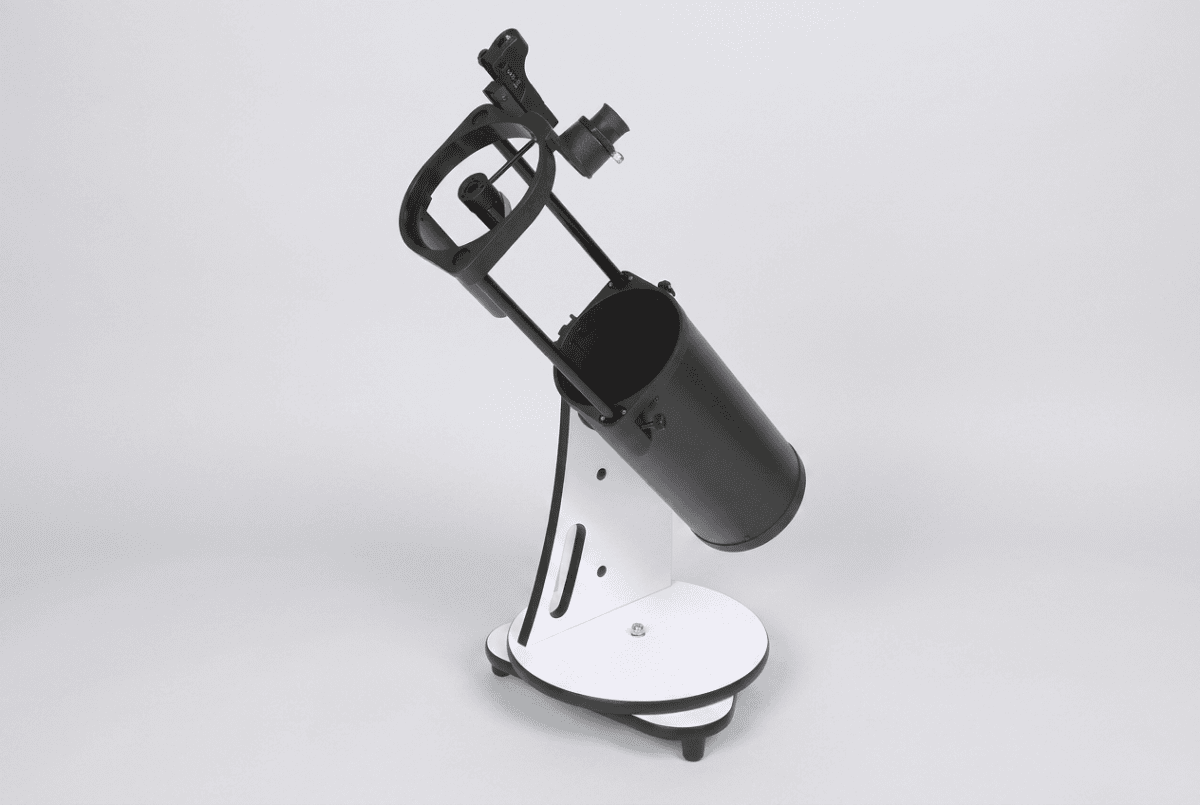
For the most aperture you can store in a closet, the collapsible Sky-Watcher Heritage 130P tabletop Dobsonian is unbeatable. Its 130mm mirror rides in a tube that collapses down to about 15 inches — it fits a coat-closet shelf and sets up in seconds on a table, stool, or the balcony rail. That portability and real light-gathering make it my favorite first telescope for small spaces; I cover it fully in my Heritage 130P review. Step down to the Heritage 100P (~$160) for an even smaller footprint and budget. The one catch: it’s a tabletop scope with no tripod, so it needs a solid surface at the right height.
- Pros: Big aperture per cubic inch; collapses for closet storage; fast, simple, affordable.
- Cons: Needs a table or stool; open tube catches stray city light; basic focuser.
Best smart / light-pollution beater: ZWO Seestar S50 (~$899 (updated Sept 2026))
From experience: for a small space I have been leaning toward the Seestar S50 — when the priority is effortless, phone-based images rather than time at the eyepiece, it simply makes life easier.
If your goal is deep-sky objects from a light-polluted apartment, the ZWO Seestar S50 is the answer, because it stacks many short exposures to pull galaxies and nebulae out of a bright city sky. It’s an all-in-one, phone-controlled smart telescope that sets up in about a minute, finds its own targets, and builds a color image on your screen — overcoming skyglow that no eyepiece can beat. For a tiny balcony or a window-lit room, it’s often the highest-payoff purchase you can make. The smaller Seestar S30 (~$399) fits in a backpack. See how it compares in my best smart telescopes of 2026 guide and the full Seestar S50 review. The trade-off: it’s imaging on a screen, not eyepiece viewing, and it’s weak on planets.
- Pros: Beats light pollution for deep-sky; ~1-minute setup; fully phone-controlled; tiny footprint.
- Cons: Imaging, not visual; weak on planets; you watch a screen, not an eyepiece.
Best for the Moon and planets: Sky-Watcher Skymax 102 Maksutov (~$335)
When the Moon and planets are your priority — and they’re the light-pollution-proof targets that shine from any balcony — a compact Maksutov like the Sky-Watcher Skymax 102 is the sharpest choice in a tiny package. Its long focal length is built for high-magnification Solar System detail, the tube is barely over a foot long and stores like a thermos, and it cools quickly. Lunar craters, Saturn’s rings, and Jupiter’s belts look crisp and high-contrast. The narrow field makes it poor for large faint deep-sky objects, and it needs a mount, but for planetary detail from a small space it’s a precision instrument. If you want motorized GoTo in the same optical class, the Celestron NexStar 4SE (~$700) is the step up.
- Pros: Superb Moon/planet detail; very compact; immune to light pollution for its targets; fast cool-down.
- Cons: Narrow field — weak on big deep-sky; needs a separate mount; higher cost per inch of aperture.
Best budget and travel: Celestron Travel Scope 70 (~$80)
For testing the waters or a truly tiny budget, the Celestron Travel Scope 70 is an honest little starter that fits in a backpack or a drawer. Set expectations correctly and it delivers: the Moon in crisp detail, the phases of Venus, and Jupiter’s four bright moons from a patio or balcony. It won’t show galaxies, and the included tripod is lightweight, but it’s a real telescope for the price. For a meaningful step up while staying small, the Heritage 100P (~$160) gives you far more aperture in a still-tiny package.
- Pros: Very cheap; backpack-portable; genuinely shows the Moon and bright planets.
- Cons: Small aperture; wobbly tripod; not for deep-sky.
Telescopes to avoid in an apartment
The wrong telescope will sit unused, so avoid anything big, wobbly, or dishonestly marketed. Skip large Dobsonians (8-inch and up) — they’re too bulky to store and move in a small space. Avoid the Celestron PowerSeeker 127EQ and the flood of generic Amazon house-brands (HEXEUM, SOLOMARK, Koolpte, and similar) sold on shaky equatorial mounts — they market huge “magnification” numbers, but on a hard apartment floor their vibration makes high power unusable and the optics disappoint. Any box screaming “675x!” on a small tube is a red flag. Spend the same money on the compact, stable picks above and you’ll actually use the telescope.
Setup, storage, and vibration tips for tight spaces
A few small habits make apartment observing far more pleasant. For storage, favor collapsible tabletop scopes and short Maksutovs that live on a closet shelf; keep a small bag with your eyepieces, a red flashlight, and an app-loaded phone ready to grab. For vibration, a tabletop scope on a sturdy low table or stool beats a tall tripod on concrete every time; if you use a tripod, add anti-vibration pads and keep the legs short and wide, and don’t touch the tube while viewing. And never observe through a closed window — the glass wrecks the image; open the door and observe over the balcony rail instead. The full observing playbook, including which way your balcony should face, is in my apartment & balcony astronomy guide.
Frequently asked questions
What is the best telescope for an apartment?
For most people it’s the Celestron StarSense Explorer LT 114AZ — it’s compact, breaks down small, and its app finds targets for you even under city lights. For the smallest storage footprint, a collapsible Heritage 130P tabletop Dob is the alternative.
Can you use a telescope from a balcony or through a window?
Yes from a balcony, but never through closed glass — window panes distort the image badly. Observe over the open rail and expect to see only the slice of sky your balcony faces.
What can you actually see with a telescope in a light-polluted city?
The Moon, planets like Jupiter and Saturn, double stars, and bright clusters all look great; faint nebulae and galaxies mostly wash out unless you use a smart telescope that stacks images.
What’s the most compact telescope for storage?
A collapsible tabletop Dobsonian like the Heritage 100P or 130P, or a small Maksutov like the Skymax 102, stores on a closet shelf, and the ZWO Seestar S30 fits in a backpack.
Are smart telescopes like the ZWO Seestar worth it for apartments?
Yes for city dwellers — they set up in about a minute, are controlled entirely by phone, and stack images to reveal deep-sky objects the light pollution would otherwise hide.
How do I stop my telescope from shaking on a hard apartment floor?
Use a tabletop scope on a sturdy low table or stool, add anti-vibration pads under any tripod, keep tripod legs short and wide, and avoid touching the tube while viewing.
The bottom line
A small apartment is no barrier to a great telescope — you just need one built for compact storage, fast setup, and stability. For most people the Celestron StarSense Explorer LT 114AZ is the smartest first buy: compact, capable, and app-guided for city skies. Choose a Heritage 130P if closet storage is everything, a ZWO Seestar S50 to beat light pollution for deep-sky, or a Skymax 102 for pin-sharp Moon and planet views. Avoid the big Dobs and the wobbly Amazon specials, and you’ll have a telescope you actually reach for. For how to observe once you’ve got it, read my apartment & balcony astronomy guide. Explore more buying guides here at TelescopeSchool, and clear skies.
I’m Will Montgomery, an engineer who returned to astronomy at 50 and observes from Bortle 5-6 skies near York, Pennsylvania. I favor scopes that set up fast, store small, and still show the Moon and planets from a tight space.
These May Help Too...
Can You Use a Telescope Through a Window? (And Why You Should Not)
Using a telescope through a window ruins the view: bad glass, heat currents and reflections. Here is what actually happens, and what to do instead.
Telescope will not come to focus? The cause is almost always spacing, not optics. Work out whether you ran out racking in or out, then fix that end.