

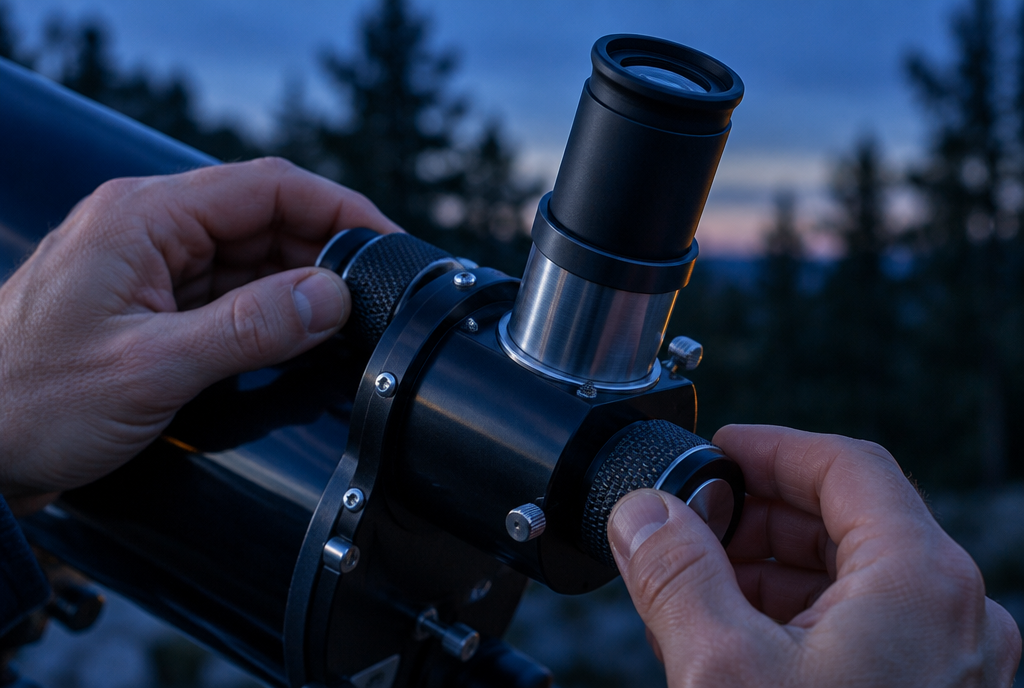
Quick answer: If your telescope will not come to focus at all — you run the focuser to one end, then the other, and the image never snaps sharp — the cause is almost always spacing, not optics. Something behind the telescope is adding or removing length, and the point where the image forms has ended up outside the range your focuser can reach.
That is a different fault from a blurry view, and it has a different fix. This guide covers the unreachable-focus case, and it starts with the one question that splits nearly every instance of it in two.
Last Updated: September 2026 | Will Montgomery observes with an Astronomers Without Borders 130mm reflector and a 9mm Plössl and has used the same scope for imaging Jupiter and the Orion Nebula. Telescope School exists to give beginners the realistic version of what a telescope actually shows.
“Will not focus” is not the same problem as “blurry”
These get lumped together constantly, and they should not be.
Blurry means you can find a best focus — there is a point where the image is as sharp as it gets — but that best point still looks soft. That is a quality problem: too much magnification, collimation, tube currents, or poor seeing. Our guide to a blurry telescope handles that case in detail.
Will not focus means there is no best point at all. You rack the focuser to its inner stop and the image is a big soft disc; you rack it to its outer stop and it is a big soft disc again; somewhere between the two it gets slightly better, but it never resolves. That is a geometry problem, and that is what the rest of this page is about.
A quick way to tell them apart: point at a bright star and run the focuser slowly from one stop to the other. If the out-of-focus disc shrinks to a minimum and then grows again, you are finding focus — read the blurry guide. If the disc is still shrinking when you hit the stop, you have run out of travel.
The one question that splits every cause
Which end did you run out at? That single answer tells you whether to remove length or add it, and it eliminates half the possible causes immediately.
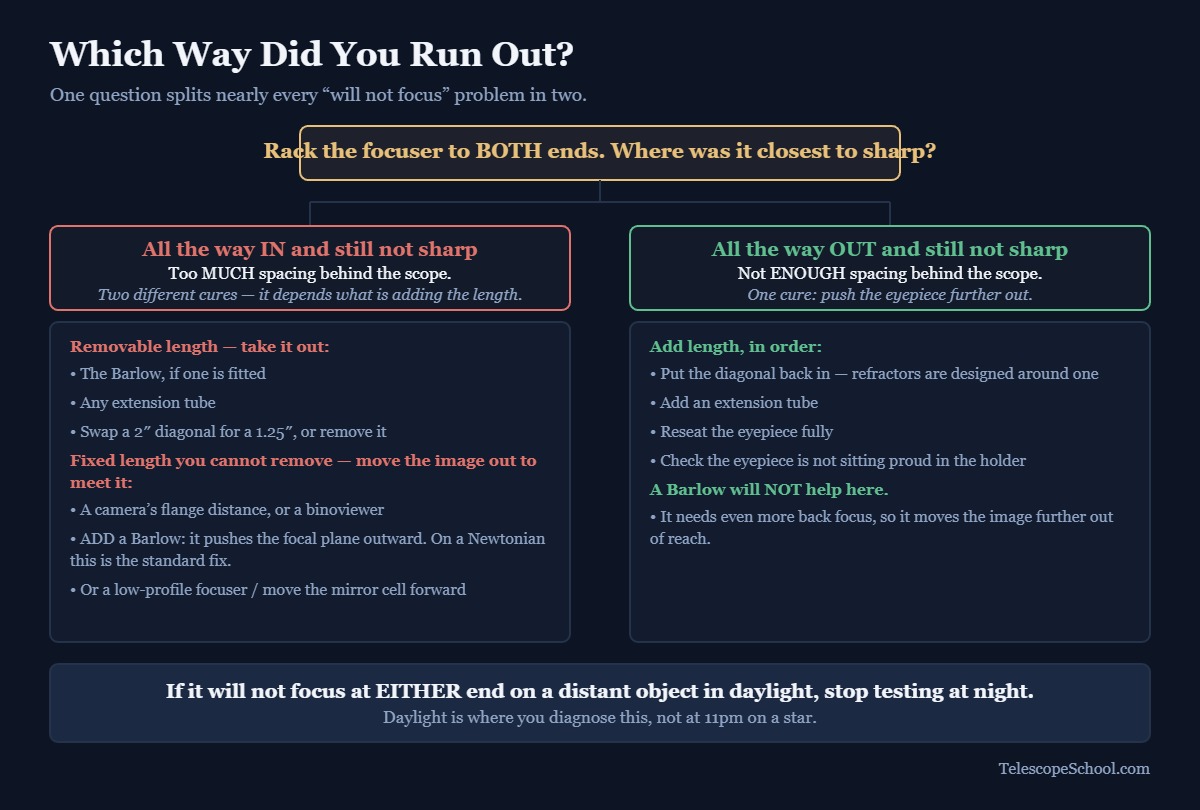
Run the focuser all the way in and all the way out, and note which end gave the smaller, tighter image. That end is the direction focus is trying to get to — you just cannot follow it far enough.
You ran out racking IN: too much spacing
The image is forming behind where your eyepiece sits, and you cannot pull the eyepiece any closer to the telescope. Something in the light path is too long. Work through these in order, testing after each one:
- Take the Barlow out. A Barlow adds physical length and pushes the focal point outward. It is the most common single cause, and it is the fastest thing to test.
- Remove any extension tube. Some telescopes ship with one already fitted and owners never notice it is there. Look at the focuser and count the joints.
- Swap a 2-inch diagonal for a 1.25-inch one. Some 2-inch diagonals place the focal plane too deep inside the diagonal for a short 1.25-inch eyepiece to reach it. Celestron calls this out specifically, and switching to a 1.25-inch diagonal normally solves it.
- Take the diagonal out entirely. On a reflector this is usually the right move. On a refractor it may cause the opposite problem — see the next section.
- On a Newtonian, if you are trying to fit a camera, you may simply be out of room. The two standard fixes are a low-profile focuser or moving the primary mirror cell forward in the tube, and neither is a five-minute job.
- If the length cannot come out, move the image instead. A camera’s flange distance or a binoviewer is fixed — there is nothing to unscrew. The fix is to push the focal plane outward to meet it, which is exactly what a 2x Barlow does. That is why a Barlow T-adapter — a camera adapter with the Barlow optics built into it — is the standard answer for putting a camera on a Newtonian. Our guides to what a Barlow actually does and the best Barlow lenses go deeper if you are choosing one.
You ran out racking OUT: not enough spacing
The image is forming in front of your eyepiece and you cannot pull it back far enough. You need to add length:
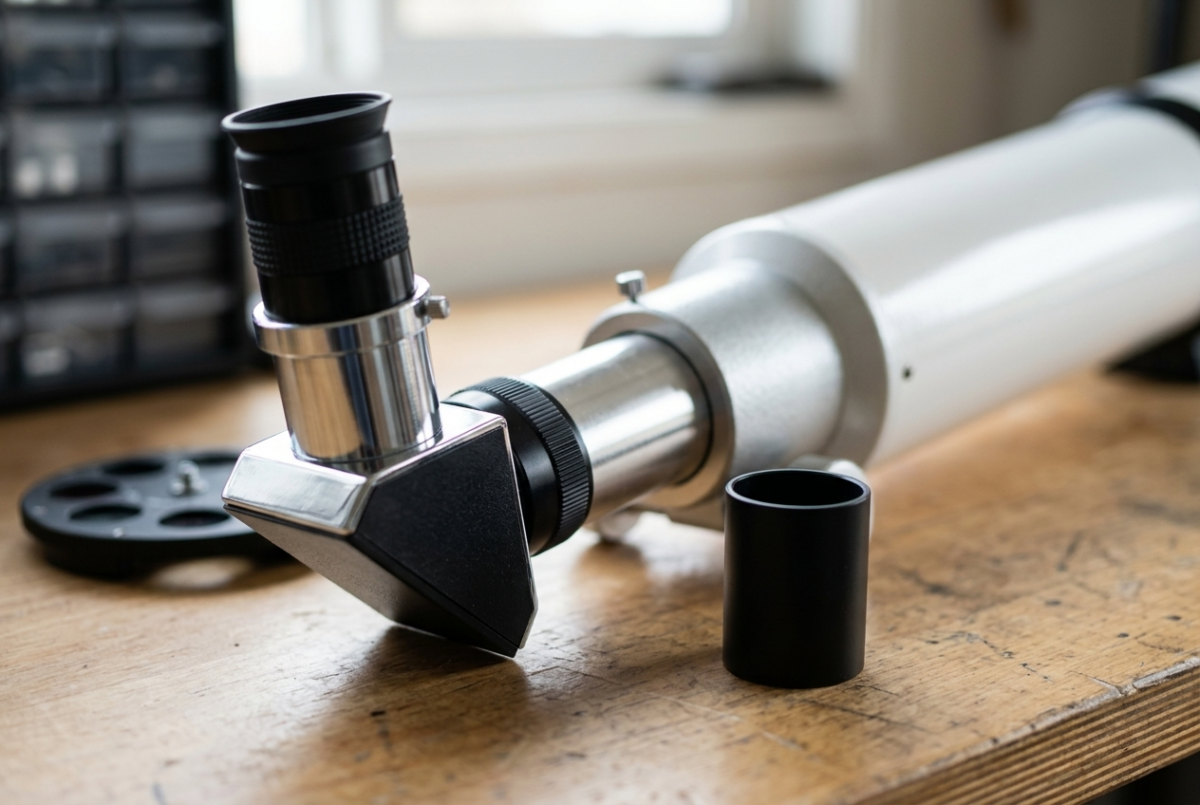
- Put the diagonal back in. This is the big one for refractors. Many refractors are designed on the assumption that a star diagonal will be in the light path, and the diagonal’s own optical path length is part of the design. Take it out for straight-through viewing and the eyepiece may sit too far back to reach infinity focus.
- Add an extension tube. If you want straight-through viewing without a diagonal, an extension tube fills exactly that gap.
- Check the eyepiece is fully seated. An eyepiece sitting proud in the holder — held by one thumbscrew catching the chamfer rather than dropped fully home — sits several millimetres too high. Loosen, push down firmly, retighten.
Back focus, and why your telescope type decides this
Back focus is the distance from the end of the focuser drawtube to the point where the telescope forms its image. Every telescope has a fixed amount of it, and it varies enormously by design — which is why an accessory that works perfectly for one owner refuses to focus for another.
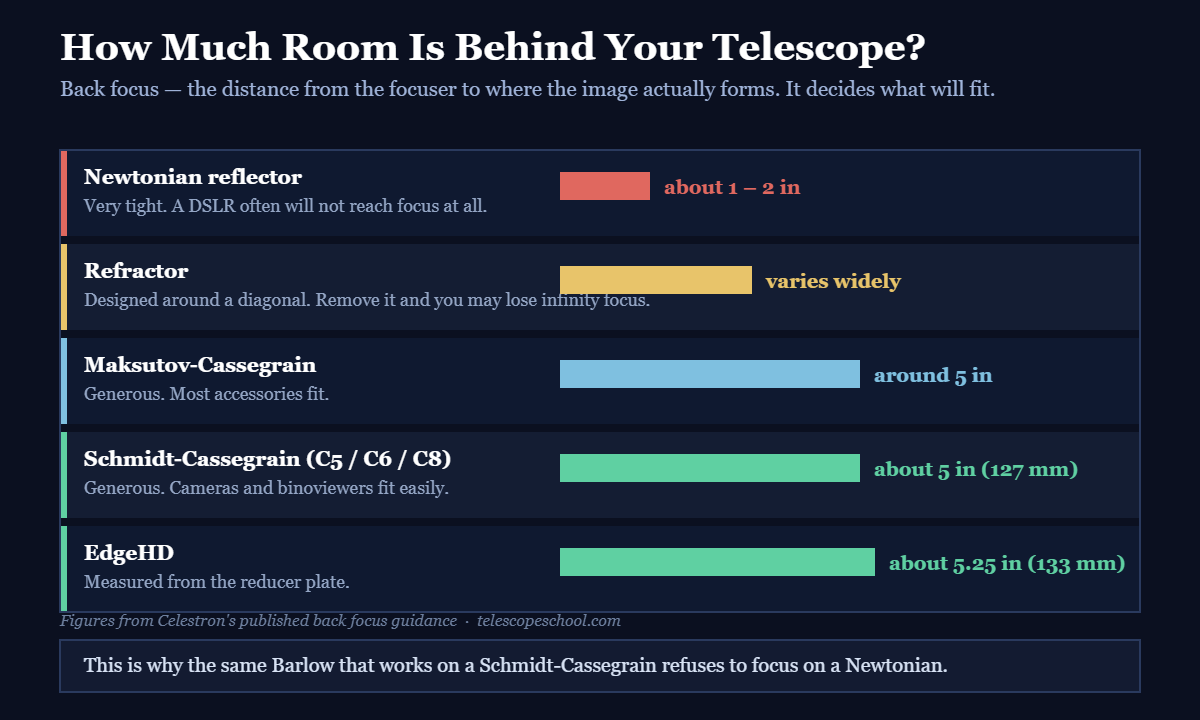
Celestron’s published figures make the pattern clear. Schmidt-Cassegrains like the C5, C6 and C8 offer roughly 5 inches — about 127 mm — of back focus, and EdgeHD models about 5.25 inches from the reducer plate. Maksutov-Cassegrains are similarly generous. Newtonian reflectors, by contrast, typically have only about 1 to 2 inches, because their focal plane sits close to the tube wall by design.
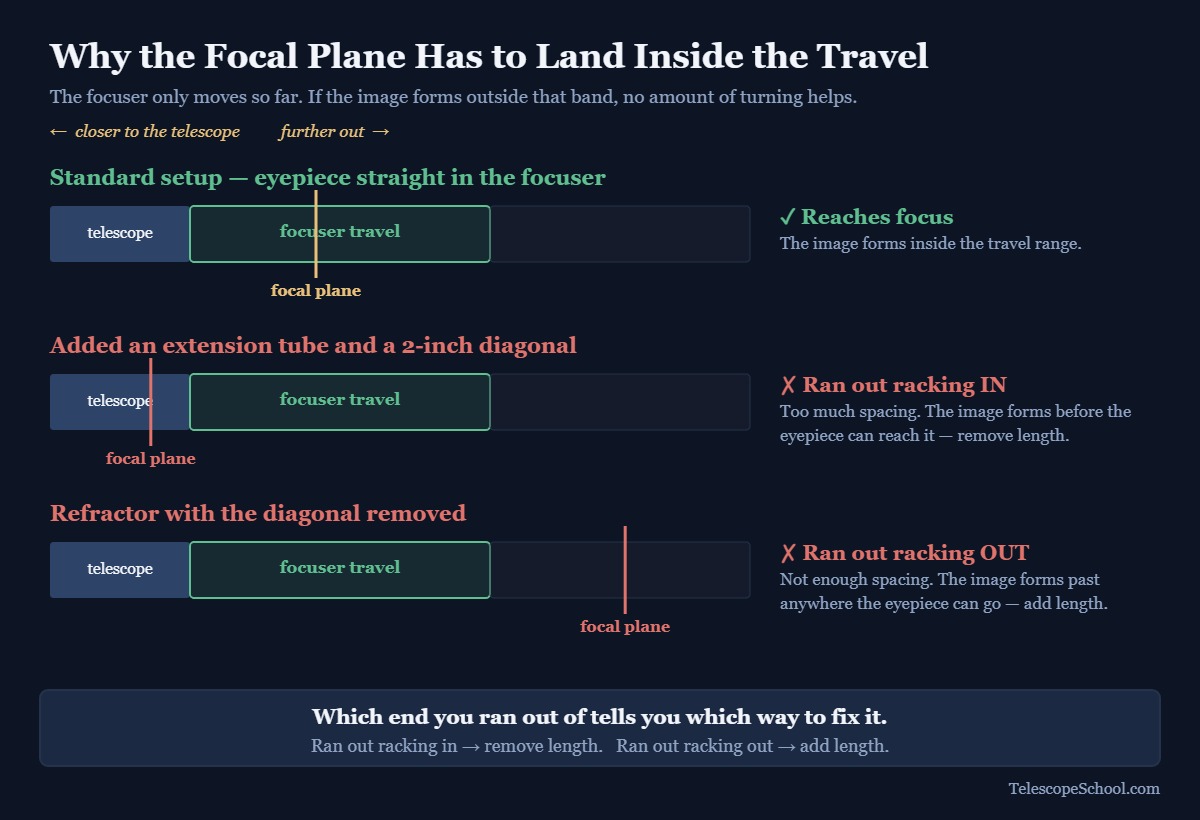
Two practical consequences. First, if you own a Newtonian, you have very little margin — adding almost anything to the light path can push focus out of reach, and this is the single most common reason a camera will not focus on one. Second, if you own a Cassegrain, spacing problems are rare for visual use and you can stack accessories freely.
Visual observing is also far more forgiving than photography. Dropping an eyepiece into a Newtonian focuser, or putting a diagonal on a refractor or Cassegrain, normally lands you close enough. It is when you add a camera that exact spacing starts to matter.
The daytime test that saves your night
Do not diagnose this in the dark. Set the telescope up in daylight, point it at something at least half a mile away — a treeline, a roof ridge, a distant pole — and try to focus on that. A distant object is close enough to infinity for this purpose, and you get to see exactly what the focuser is doing.
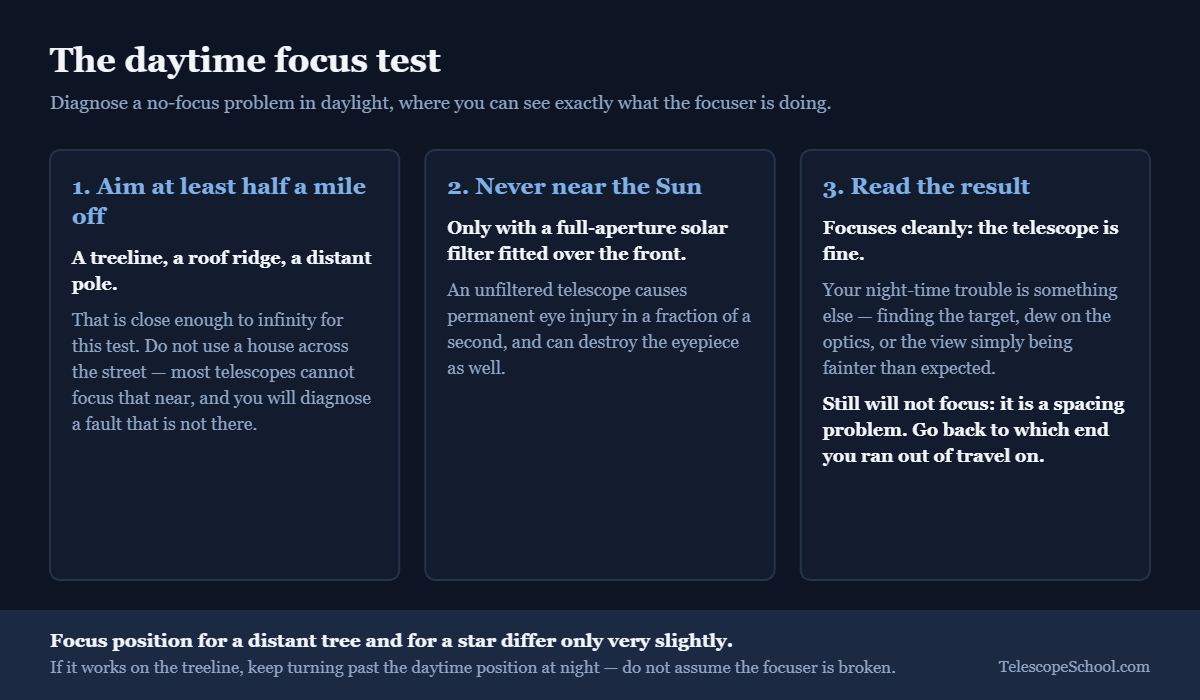
Two cautions. Never point the telescope anywhere near the Sun without a proper full-aperture solar filter fitted over the front — it has to cover the whole front of the tube and match your aperture, so check the size before you buy, and never use an eyepiece-end “solar” filter. Our guide to safely viewing the Sun with a telescope covers this properly — an unfiltered telescope will cause permanent eye injury in a fraction of a second, and it can destroy the eyepiece too. And do not test on something close by, such as a house across the street, because most telescopes cannot focus that near and you will diagnose a fault that does not exist.
If it focuses cleanly on a distant treeline in daylight, the telescope is fine and your night-time trouble is something else — finding the target, dew on the optics, or the view simply being fainter than expected. If it will not focus in daylight either, you have confirmed a spacing problem and you can solve it indoors at a sensible hour.
The cases that are not a spacing problem
A few things masquerade as a focus failure and need naming, because no amount of extension tubes will fix them.
Dew or frost on the optics. A dewed corrector or mirror gives a soft, low-contrast image that never sharpens, and it comes on gradually through the night. Look down the front of the telescope with a red light. Our guide to telescope dew control covers prevention.
The telescope has not cooled down. Warm optics stir up air currents inside the tube, and the image boils rather than resolves. Set the telescope outside well before you plan to observe.
Badly out of collimation. A reflector with the mirrors seriously misaligned will not produce a clean focus point anywhere in the travel. If your out-of-focus star disc is lopsided rather than a concentric ring pattern, start with collimating the reflector.
You are looking at the wrong thing. If the field is completely empty, there may be nothing in it to focus on. Align the finder in daylight and check it is pointing where the main telescope points — our finderscope alignment guide walks through it.
Eyeglasses and eye relief. If you wear glasses for astigmatism and the eyepiece has short eye relief, you may not be able to get your eye close enough to see a properly focused field. That is an eye relief problem, not a focus problem — see our guide to using a telescope with glasses.
The accessory that fixes most of these
If you routinely run out of travel in the “add length” direction, a set of extension tubes is the cheap answer, and they cost a fraction of a new focuser. A 1.25-inch extension tube set covers most refractor cases and is worth having in the case regardless.
If you are short in the other direction on a refractor, a good 1.25-inch star diagonal both restores the spacing the telescope was designed around and makes viewing near the zenith far more comfortable. Worth comparing a few before buying, since prism and mirror types behave differently.
From experience: with the 130mm, most no-focus problems come from needing more inward travel. Cameras and some Barlows may focus if I slightly shorten the trusses, while a diagonal usually adds too much length and makes the problem worse.
Frequently asked questions
Why will my telescope not focus with a Barlow?
Because the Barlow adds physical length and pushes the focal point further out, and your focuser may not rack in far enough to compensate. Try removing the diagonal and connecting the Barlow and eyepiece straight to the telescope — the viewing angle is awkward but it frees up the spacing the Barlow needs. If that works, you have confirmed the diagnosis.
Why will my camera not focus when eyepieces work fine?
A camera sensor sits at a very different distance from the mounting face than an eyepiece’s focal plane does, so a setup that is comfortable visually can be nowhere near right for imaging. Newtonians are worst affected because they have only 1 to 2 inches of back focus. The usual fixes are a Barlow T-adapter, a low-profile focuser, or moving the primary mirror cell forward.
Do I need the star diagonal?
On a refractor, usually yes — most are designed assuming one is fitted, and removing it can put infinity focus out of reach. On a Newtonian you do not use one at all. On a Cassegrain you normally do, for comfort as much as anything, and there is enough back focus that it is not critical either way.
My telescope focuses on trees but not on stars. What is wrong?
Almost certainly nothing. Focus position for a distant tree and for a star are very slightly different but well within the travel, so if daylight focus works, the telescope is fine. The likely issue is that you have not actually got the target in the field, or the object is fainter than you expected. Start on the Moon or a bright planet, which are impossible to miss.
Can the focuser itself be broken?
It can, though it is uncommon. Signs are a drawtube that slips under the weight of an eyepiece, a rack and pinion that skips, or a knob that turns without moving anything. Tighten the tension screw first — most focusers have one — before assuming a failure.
Getting to a sharp point
Three things to take away. First, separate “will not focus” from “blurry” before you do anything, because they have nothing in common. Second, note which end of the travel you ran out at — that single observation tells you whether to add length or remove it. Third, diagnose it in daylight on a distant object, where you can see exactly what the focuser is doing.
Once you know your telescope’s back focus habits, accessory choices stop being guesswork. For more on getting the best out of the setup you already own, browse the rest of the how-to guides here at Telescope School.
I hold an engineering degree, and a telescope that will not reach focus is a tolerance and spacing problem long before it is an optical one.
These May Help Too...
Can You Use a Telescope Through a Window? (And Why You Should Not)
Using a telescope through a window ruins the view: bad glass, heat currents and reflections. Here is what actually happens, and what to do instead.
Everything looking dim through your telescope? Exit pupil is the number that explains it. Here is the arithmetic, the 2-5mm target, and what to change.