

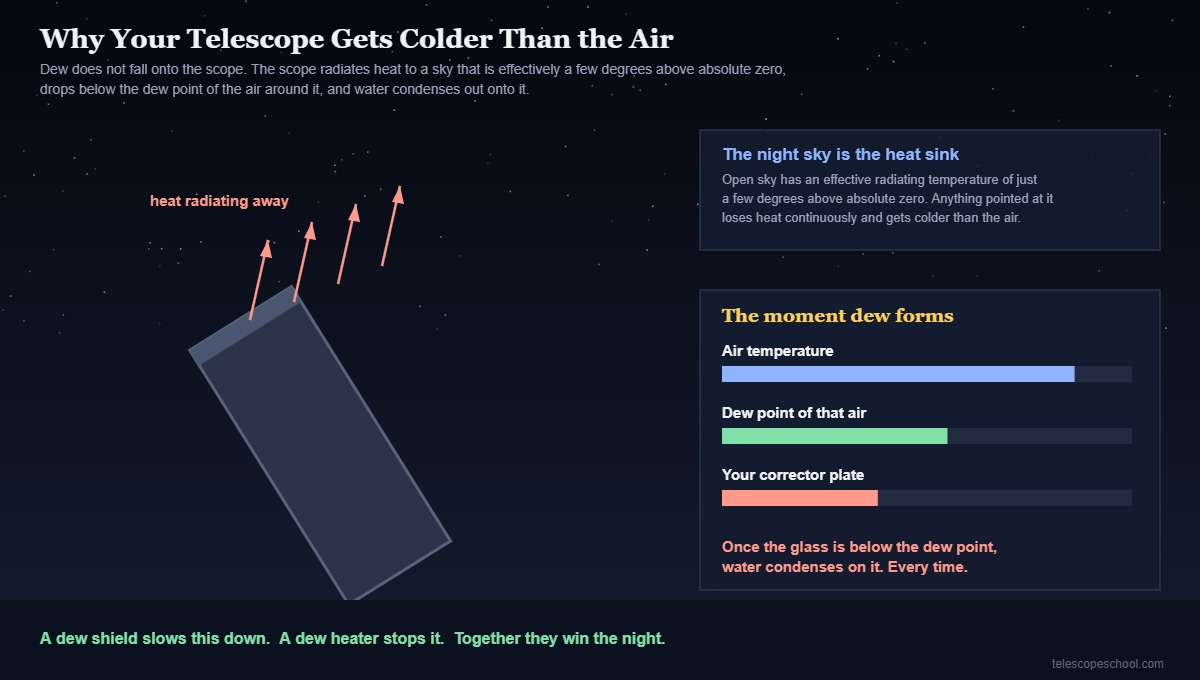
Dew does not fall onto your telescope — it condenses out of the air onto glass that has already made itself too cold. Every surface pointed at open sky radiates heat away to a sky whose effective temperature is only a few degrees above absolute zero. The glass drops below the dew point of the surrounding air, and water comes out of that air onto the coldest thing available. Which, on a clear still night, is your corrector plate.
That mechanism explains everything that follows. A dew shield slows the process by blocking the view of open sky. A dew heater prevents it outright by keeping the surface above the dew point. Used together they are close to unbeatable. This guide covers what dews first on each telescope type, how to size a shield, how to work out the battery you actually need, and the free tactics that solve a surprising number of nights.
Last Updated: September 2026 | Will Montgomery holds a B.S. in Engineering from Penn State and came back to amateur astronomy at 50, observing from suburban York, PA (Bortle 5–6).
Why Your Telescope Gets Colder Than the Air Around It
Radiative cooling is the whole story. Heat leaves any object that has a clear view of the night sky, and because the sky is effectively an enormous cold body, nothing you do stops that transfer — you can only reduce how much sky the glass can see, or replace the heat as fast as it leaves.
Two definitions are worth having straight. The dew point is the temperature at which air becomes saturated and has to give up its water. At 100% humidity the dew point equals the air temperature, which is why misty nights are hopeless. Below freezing you get frost instead of dew, and frost begins to be a risk any time the outside temperature drops below 32°F.
Two consequences follow that surprise people. First, a slight breeze helps, because heat exchange with moving air happens far faster than radiative cooling, so the glass stays closer to ambient. Still, clear nights are the worst dew nights. Second, anything overhead makes a measurable difference — Sky & Telescope reports that a thermometer under an umbrella can read more than 10°F (6°C) warmer than one under open sky. That is free physics, and you can use it.
Which Parts of Your Telescope Dew First
Thin, exposed surfaces with little heat capacity go first, which is why a finderscope objective usually dews before anything else on the mount. Where you are vulnerable depends heavily on the design you own.

Schmidt-Cassegrains and Maksutovs are the notorious case. The corrector plate sits right at the front of the tube, thin and fully exposed, and dew on it ends the session. A dew shield is the accessory SCT owners most often come back to buy after their first frustrating night out.
Refractors have the same geometry problem but usually ship with at least a short retractable shield. Whether it is long enough is a separate question, covered below.
Newtonians are the design people misunderstand. You will see it claimed flatly that reflectors do not need dew protection because the primary sits at the bottom of the tube. That is half right. A solid tube does act as its own dew cap for the primary mirror — genuinely, and it is a real advantage. But it does nothing for the secondary, which is mounted near the open front of the tube and is fully exposed, and a dewed secondary ruins the view just as thoroughly as a dewed corrector. And an open-truss Dobsonian loses the advantage entirely unless you fit a cloth shroud around the truss, which is exactly what the shroud is for.
Do not forget the accessories. A Telrad’s window is a classic early casualty. Eyepieces dew because your face warms them and then they re-cool; the practical fix is to keep spares in a closed case or an inside pocket and rotate them, never to wipe a dewed eye lens with whatever is in your pocket.
Dew Shields: the Cheap Fix That Solves Most Nights
A dew shield is a tube extension in front of the objective, and the long-standing rule of thumb is that it should be at least one and a half times the aperture in length. An eight-inch SCT therefore wants roughly twelve inches of shield in front of the corrector. Shorter shields help; they just help less.
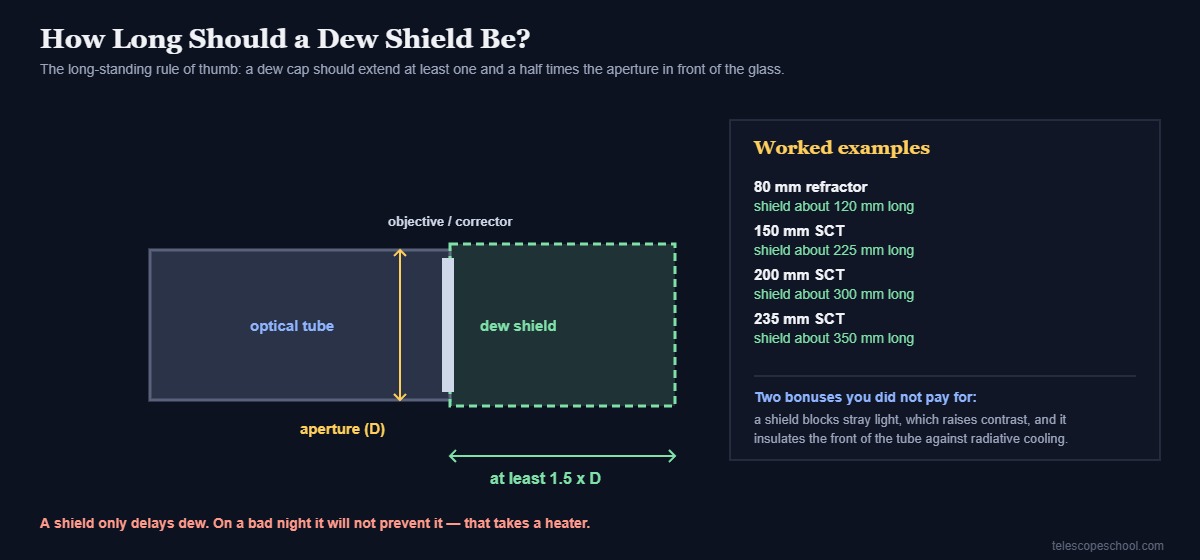
The shield works in two ways at once. It physically restricts how much open sky the glass can see, which cuts the radiative losses driving the whole problem, and it acts as a thermal barrier that keeps the front of the tube marginally warmer than ambient. You also get a bonus nobody pays for: blocking stray light from streetlamps and neighbours’ windows raises contrast noticeably, particularly on faint objects. If you are observing from a bright site, that alone can justify the purchase — see our guide to observing from light-polluted skies for what else helps there.
Shields come flexible or rigid. A flexible wrap-around dew shield rolls up small and fits a range of tubes; rigid ones hold their shape better in wind. Either works. Home-made shields out of camping-mat foam or thin plastic sheet work perfectly well too, and plenty of people never buy one.
What a shield cannot do is prevent dew. It buys you time — sometimes the whole night, sometimes two hours. On a humid, dead-still night the glass will eventually get there anyway. When it does, you need heat.
Dew Heaters: the Only Thing That Actually Prevents Dew
A dew heater is a resistive band that wraps around the tube near the objective and holds the glass a degree or two above the dew point. Unlike a shield, it does not slow condensation — it removes the condition that causes it. For small refractors in particular it is close to a complete solution, and it works on larger instruments too.
Bands come in two connection styles. RCA-terminated bands are designed to plug into a dedicated controller. USB bands run directly off a power bank, which is simpler and increasingly popular. Both approaches work; the difference is control.
That control matters more than it sounds. A band run flat out all night wastes a great deal of power and can, in principle, put more heat into the tube than you want. A controller — several manufacturers make multi-channel units — modulates output based on conditions, and the better ones use a thermistor on the band itself plus an ambient sensor so that they heat only as much as the night actually requires. Celestron’s controller line does this explicitly, and the stated purpose is to reduce power draw.
Owners of larger reflectors have two extra options worth knowing about: secondary mirror heaters, which target the exposed surface directly, and cooling fans behind the primary, which are aimed at a different problem (thermal equilibrium) but help keep the mirror at ambient rather than below it.
Prices move, so treat any figure you read as indicative. At the time of writing, mainstream heater rings for 8-inch class SCTs list in the region of fifty to sixty dollars, a good multi-channel controller runs to a few hundred, and a flexible dew shield sits around thirty-five. If budget is tight, buy the shield first — it is a fifth of the price and solves a large share of nights on its own.
Working Out Your Power Budget
The question every guide dodges is “what battery do I need?”, and the honest answer is that it depends entirely on your bands — so here is the calculation rather than a number.
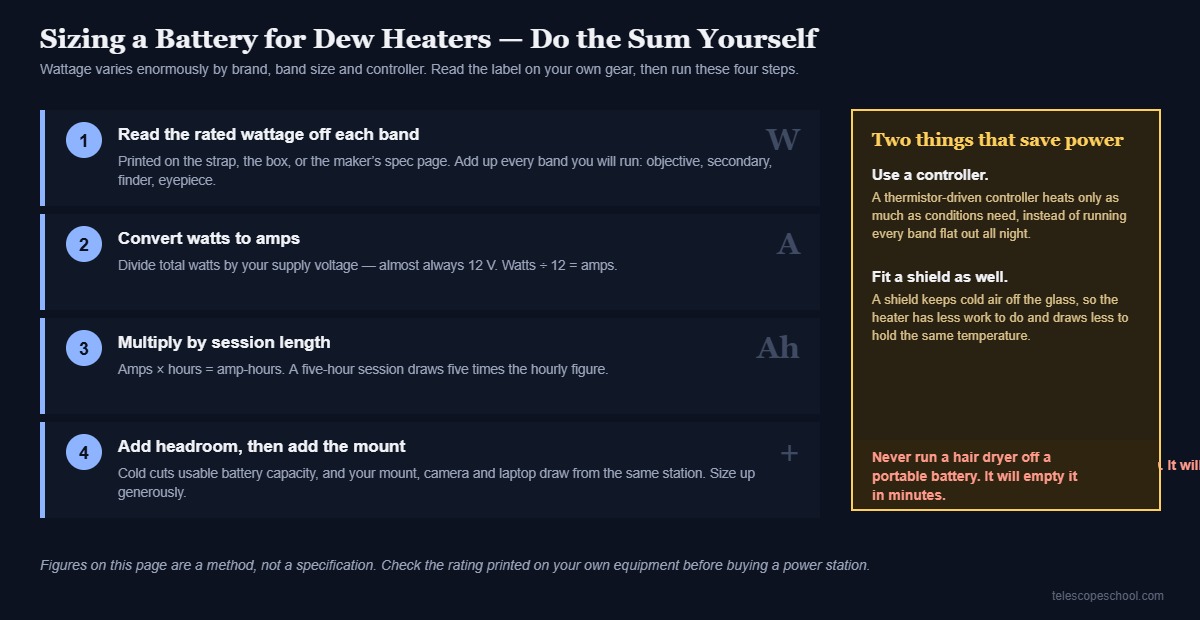
Add up the rated wattage of every band you intend to run — objective, secondary, finder, eyepiece heater if you use one. Divide the total by 12 to get amps, because dew heaters almost universally run from 12 volts DC. Multiply by the number of hours you expect to observe to get amp-hours. Then add generous headroom, because cold weather reduces usable battery capacity and because your mount, camera, focuser and laptop are all drawing from the same supply.
Two practical notes. A controller genuinely reduces consumption, so the honest budget for a controlled system is lower than the flat-out figure. And do not plan to run a hair dryer off a portable battery. A hair dryer will clear dewed optics in a minute or two and is a legitimate emergency measure on mains power, but its draw will flatten a field battery almost immediately.
From experience: I usually set up close enough to the house to run a cord out to the scope.
Free and Low-Cost Tactics That Work
Before you spend anything, use the sky itself. Radiative cooling only happens where the glass can see open sky, so anything you put between the two helps.
Set up where a wall, a hedge or the side of the house blocks part of the sky rather than in the middle of an open lawn. Between targets, point the tube at a tree or a building instead of leaving it aimed at the zenith — a few minutes of that genuinely slows the process. If you observe from a fixed spot, an umbrella or a temporary canopy over the setup exploits the same effect that gives the 10°F reading difference mentioned earlier.
Cap the tube whenever you step away. Keep spare eyepieces in a sealed box rather than loose on a table where they will dew as fast as the telescope. Bring the finder in if you are not using it.
And accept the weather. Dew is far less of a problem in dry climates and on breezy nights than in humid still air. If you live somewhere genuinely arid, you may go years without needing a heater at all.
What to Do When Dew Has Already Won
Do not wipe it. Wiping dewed optics drags whatever dust is on the surface across the coating and is one of the more common ways people scratch a corrector plate. Our guide to cleaning telescope optics safely covers why dry contact is the thing to avoid.
The correct response is heat and air. If you have a heater band, turn it up and wait — dewed glass clears from the inside out. A 12V hair dryer or a mains hair dryer on the lowest setting, held well back and kept moving, clears optics in a minute or two, but watch the power draw and never point hot air at a cold corrector for long.
If the image has gone soft and you are not certain dew is to blame, it is only one of several usual suspects — our six fixes for a blurry telescope covers the rest. And if you are seeing nothing at all rather than something soft, that is a different problem entirely.
Once you pack up, the important step is what happens indoors. Bring the telescope inside, take every cap off, and let the whole thing warm to room temperature before you cap or case it. Capping a cold, damp instrument seals moisture against the optics for hours, which is how dew turns into the fungus that permanently etches coatings. Leave eyepieces uncapped until they are dry too. The full routine is in our guide to storing a telescope between sessions.
Frequently Asked Questions
Do reflector telescopes need a dew shield?
A solid-tube Newtonian’s tube already acts as a dew cap for the primary mirror, so it needs less protection at the front than a refractor or SCT. But the secondary mirror sits exposed near the open end and can absolutely dew, and an open-truss Dobsonian gets none of the tube’s benefit unless you fit a shroud. So the honest answer is: less than other designs, but not none.
Can I use a hair dryer to clear dew?
Yes, carefully, and it is fast. Use the lowest heat setting, keep it moving, and hold it well back so you are not thermally shocking cold glass. The catch is power: a hair dryer draws far too much to run from a field battery, so treat it as a mains-only or in-the-car solution.
Will a dew heater hurt image quality?
It can if you massively overheat, because warm air rising through the light path creates tube currents that soften the image. That is precisely the argument for a controller, which supplies only as much heat as the dew point requires rather than running the band at full output all night.
Do I need dew control in a dry climate?
Often not. Dew requires humid air, and desert or high-altitude sites frequently go entire seasons without a problem. A breezy night is also much safer than a still one. Buy a shield first, see how many nights you actually lose, and only then decide about heaters.
What about the finderscope and my eyepieces?
Both dew, and the finder often goes first because its objective is small and completely exposed. Small heater strips are made for finders, and a short home-made shield works too. For eyepieces, rotate them out of a closed case rather than leaving them exposed on a table, and never wipe a dewed eye lens in the field.
The Short Version
Three things to take away. First, dew is caused by radiative cooling, not by falling moisture — everything that works either blocks the sky or replaces the lost heat. Second, buy the shield before the heater; it is far cheaper, needs no power, and solves a large fraction of nights on its own. Third, never wipe dewed optics, and never cap a cold telescope — those two habits do more long-term damage than dew ever will.
If a dewed session has you looking at the rest of your setup, Telescope School’s complete guide to telescope eyepieces and our Dobsonian buying guide are the natural next reads.
I observe close enough to the house to run a cord out to the scope, which settles the power question for me. Dew is beatable if you plan for it.
These May Help Too...
Can You Use a Telescope Through a Window? (And Why You Should Not)
Using a telescope through a window ruins the view: bad glass, heat currents and reflections. Here is what actually happens, and what to do instead.
Telescope will not come to focus? The cause is almost always spacing, not optics. Work out whether you ran out racking in or out, then fix that end.