

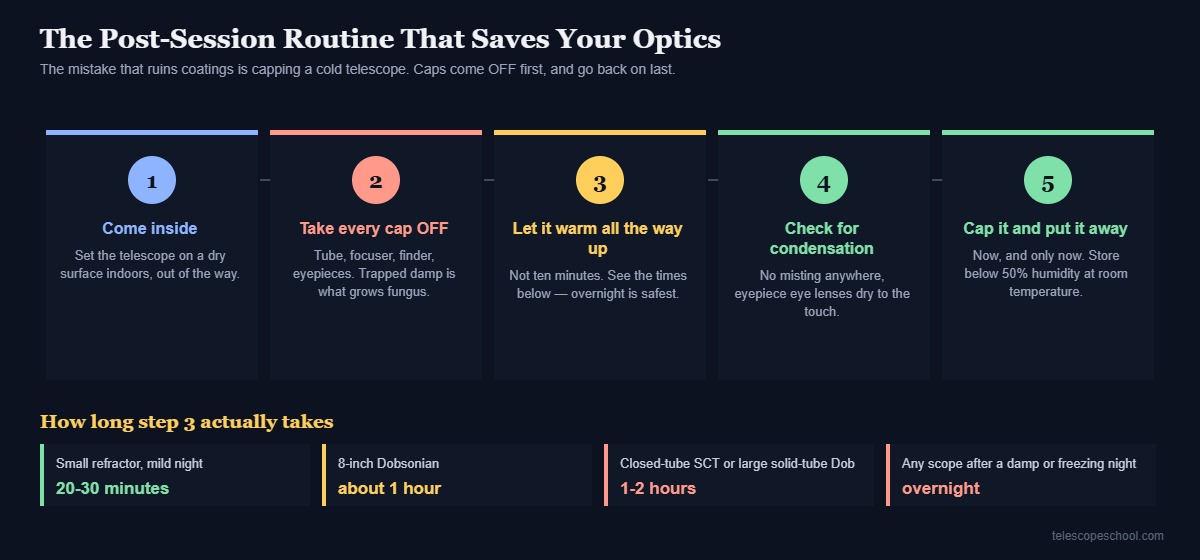
Bring the telescope indoors, take every cap off, let it warm all the way to room temperature, and only then cap it and put it away. That single sequence prevents most of the storage damage amateur telescopes ever suffer. The mistake that does the harm is the intuitive one — capping a cold, damp instrument the moment you come in from the cold, which seals moisture against the optics for hours.
Storage is not a glamorous subject, but it is the one maintenance task that touches every telescope every time it is used. Get it right and coatings last decades. Get it wrong for a couple of humid summers and you can end up with fungus etched permanently into the glass. Here is the routine, the numbers behind it, and an honest account of the one point where the standard advice contradicts itself.
Last Updated: September 2026 | Will Montgomery holds a B.S. in Engineering from Penn State and came back to amateur astronomy at 50, observing from suburban York, PA (Bortle 5–6).
The 60-Second Routine That Prevents Most Damage
Five steps, and only one of them takes any real time.
One: bring everything inside and set it on a dry surface out of the traffic. Two: remove every cap and cover — tube, focuser, finder, eyepieces, diagonal. Three: leave it alone until it is fully at room temperature. Four: check that nothing is misted and that eyepiece eye lenses are dry to the touch. Five: cap it, cover it, and store it somewhere stable and dry.
Step two is the one people skip, and it is the one that matters. A cold telescope brought into a warm house will pull condensation out of the room air onto and inside it. If the caps are on, that moisture has nowhere to go and sits against coated surfaces for as long as it takes to evaporate — which, sealed, can be a very long time. Uncapped, it clears on its own in an hour or two.
There is no need to wipe anything. Let it dry naturally. Wiping dewed or condensed optics is a leading cause of scratches, which our guide to cleaning telescope optics covers in detail.
How Long Your Scope Needs to Warm Up
Thermal mass decides this, so a small refractor and an eight-inch Dobsonian are not remotely the same job. As a working guide: roughly 20 to 30 minutes for a small refractor after a mild night; about an hour for an 8-inch Dobsonian; one to two hours for a closed-tube SCT or a large solid-tube Dob. After a genuinely cold or damp night, leave it overnight and deal with it in the morning.
Two practical consequences follow. The first is that the “let it warm up” step usually means going to bed and capping the telescope tomorrow, which is fine. The second is that storing the telescope somewhere close to the outdoor temperature cuts your set-up time at both ends — a scope kept in an unheated but dry space needs far less cooling before it gives sharp images. That is a real trade-off against the humidity risk covered next, and it is why some observers accept a garage over a spare room.
Why Humidity Is the Real Enemy
Dust is cosmetic. Fungus is fatal. Mould growing on optics feeds on the dust and skin oils already present on the glass and releases acids as it grows — including hydrofluoric acid, which etches glass. That damage does not clean off. The coating and sometimes the glass beneath it are permanently marked.
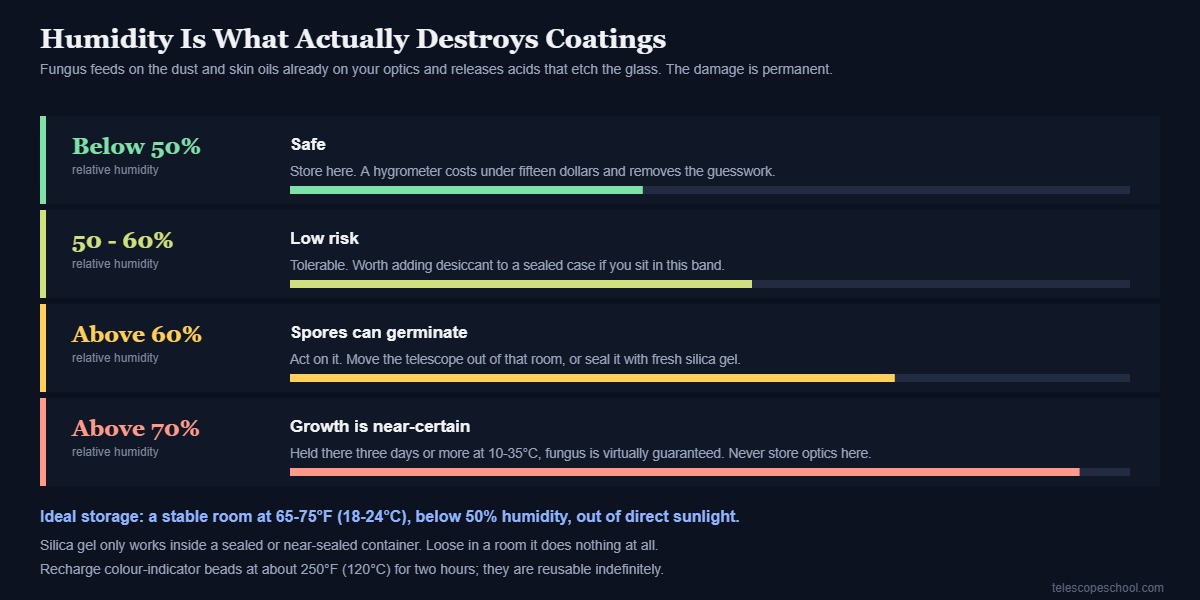
The published thresholds are specific enough to act on. Below 50% relative humidity is the safe zone. Between 50 and 60% the risk is low. Above 60%, spores can germinate. And held above 70% for three days or more, at ordinary room temperatures of 10 to 35°C, fungal growth is close to guaranteed.
That last figure is the one that catches people out, because a garage or basement can sit above 70% for weeks at a time in summer without ever feeling wet. You cannot judge humidity by how a room feels. Put a cheap hygrometer where the telescope lives and look at it occasionally.
To check for existing growth, shine a bright torch across the optics at a shallow angle and look for a fine web-like or branching pattern, quite unlike the random scatter of dust. If you find it, that is a job for a professional, not for a cotton wad.
Where to Store a Telescope — and Where Never To
The best place for a telescope is the same place you would be comfortable sitting: a stable room at 65 to 75°F (18 to 24°C), below 50% humidity, out of direct sunlight. A living room, dining room or spare bedroom beats every specialised alternative, because it is already climate-controlled, low-dust and free of pests.
Direct sunlight deserves its own mention. Beyond the obvious heat, sunlight falling on a stored telescope drives temperature swings that stress the adhesives holding optics in place and lengthens acclimation time before every session.
A conditioned garage or a dry utility room is a reasonable second choice, and the shorter cool-down time is a genuine benefit. An unconditioned one is a gamble. Garages bring three specific problems that most people underestimate: exhaust fumes leave a hydrocarbon haze on optics that is difficult to remove; starting a car stirs up dust; and mice and spiders find open telescope tubes extremely inviting.
Attics, basements, sheds and anywhere outdoors are the places to avoid. Attics cook in summer. Basements are damp almost by definition. Metal and plastic sheds reach extreme temperatures in summer sun, and no shed is humidity-controlled. And a mount left outdoors — especially a motorised one — is being slowly destroyed whatever cover you throw over it.
If space is the constraint rather than climate, the equipment choice matters more than the storage plan. Our guide to telescopes for apartments and small spaces covers instruments designed to live indoors, and a solid-tube 8-inch Dobsonian needs roughly two feet by two feet of floor to stand in.
Storage Position by Telescope Type
Position matters mostly for keeping dust off coatings and lubricants where they belong. For most designs the guidance is settled. For one, it is not — and it is worth being straight about that.
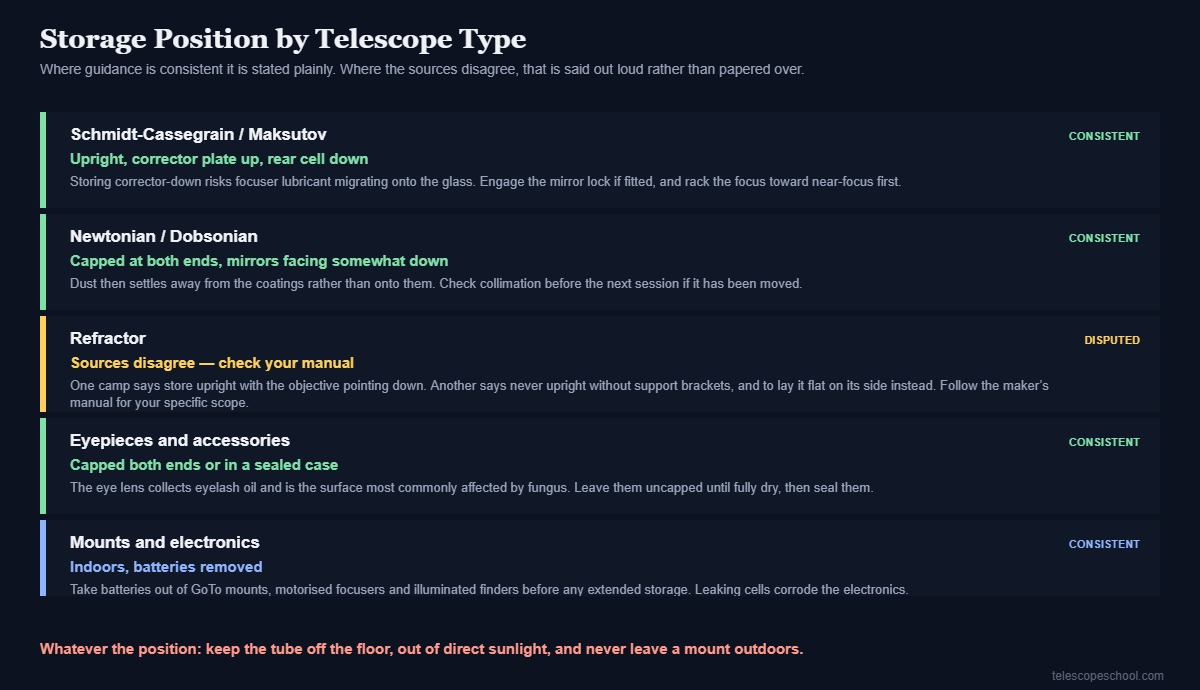
Schmidt-Cassegrains and Maksutovs should be stored upright with the corrector plate uppermost and the rear cell down. Stored the other way up, focuser lubricant can migrate forward onto the corrector over time. If your scope has a mirror lock, engage it, and rack the focus toward near-focus before storing. Never attempt to remove or clean the corrector yourself — it is shimmed and matched to that specific telescope at the factory.
Newtonians and Dobsonians want caps on both ends and, ideally, the mirrors facing somewhat downward so dust settles away from the coatings rather than onto them. Reflector dust caps are not a perfect seal; there is often an open gap at the rear where the mirror cell meets the tube, and covering that gap is worth doing for long-term storage. If the scope has been moved, check collimation before your next session — our guide to collimating a reflector covers the check.
Refractors are the disputed case. One well-regarded source recommends storing them upright with the objective pointing down; another states plainly that refractors should not be stored upright without support brackets and should be laid flat on their side. Both arguments are reasonable — dust falls away from a downward-facing objective, but an unsupported vertical tube puts load on the mount connection. Nobody in the top search results cites a manufacturer manual to settle it. So follow the manual that came with your telescope, and in its absence, lay it flat and supported, which is the lower-risk option mechanically.
Whichever position you choose, keep the tube up off the floor and off its base, out of sunlight, and rotate it occasionally if it is going into genuinely long-term storage.
Eyepieces, Electronics and Batteries
Eyepieces are the most fungus-prone item you own, because the eye lens collects skin and eyelash oils every time you use it and that residue is food. Leave them uncapped until they are completely dry, then cap both ends or seal them in a case. Cheap eyepiece cases are widely sold; small sealed food containers work just as well.
Take the batteries out of anything that has them before extended storage — GoTo hand controllers and mount bases, motorised focusers, illuminated reticle finders, red torches. Leaking alkaline cells corrode contacts and can destroy the electronics around them, and it is a completely avoidable failure. Lithium power stations are happier stored part-charged than either flat or full, and none of them like being left in a freezing garage over winter.
This is also the point to note that used motorised gear deserves scrutiny for exactly this reason: a mount that has spent years in a damp shed with batteries in it may have problems that no photograph will show. Our guide to buying a used telescope covers what to check before money changes hands.
From experience: nothing fancy at my end. I collapse the AWB 130mm down with all the caps on and it goes into a bag, with a few of those silica gel pouches that say do not eat on them tucked in alongside it.
Silica Gel, Cases and Covers — What Actually Helps
Silica gel only works inside a sealed or near-sealed container. A sachet dropped into an open room, or into a soft cover with gaps, does nothing at all — it will saturate within days and then simply sit there. Inside a closed hard case, or inside a capped tube, it genuinely controls the microclimate.
Use colour-changing indicator beads so you can see when they are spent; the common types run orange to green, or blue to pink. Recharge them at around 250°F (120°C) for two hours and they are reusable indefinitely. One experienced observer describes keeping a three-quarter-pound bag inside the tube cap of a 12.5-inch reflector and finding it needs recharging every one to two months — a useful sense of the scale involved.
On cases: avoid leather, fabric-lined and wooden cases for long-term storage. They harbour spores and trap moisture against the very thing you are trying to protect. Plastic, aluminium or clean nylon are the safer materials. Hard cases suit transport and long-term storage; a soft cover is fine for a telescope that lives assembled indoors and gets used weekly.
Leaving a telescope assembled under a cover is perfectly acceptable if the room is dry — it removes the main friction that stops people observing on a clear Tuesday. If you do, point the tube upward rather than horizontally so there is less leverage on the mount’s connection point.
What Actually Helps for Long-Term Storage
Short list, and most of it is cheap. These are the things that earn their place if the scope is going to sit for weeks or months at a time.
- Colour-changing indicator silica gel — the one item that does the most work, provided it is inside something closed. A quart of orange indicating desiccant beads runs about $17, turns green when it is spent so you can see the state at a glance, and recharges in the oven indefinitely. Buy the loose beads rather than sealed sachets — you want to be able to put a decent quantity inside a tube cap or a case, and remember the scale from earlier: three-quarters of a pound for a 12.5-inch reflector.
- A hygrometer — about $11 for a basic digital indoor hygrometer, and it settles the argument. If you are wondering whether a closet, a basement or a conditioned garage is dry enough, stop guessing and measure it for a week. This is the cheapest way to find out whether you have a storage problem at all.
- A case or a cover, matched to your scope — hard case for transport and long dormant spells, soft cover for a telescope that lives assembled and gets used most weeks. High Point Scientific’s cases, covers and Dobsonian shrouds are sorted by scope type and size, which is the only sensible way to shop for these — a cover is useless if it does not fit your tube and mount. Stick to plastic, aluminium or clean nylon, and remember the warning above about leather, fabric-lined and wooden cases.
What not to buy: a dehumidifier for the sake of the telescope alone. If the room is dry enough for you to sit in comfortably it is close enough for the scope, and a sealed container with fresh desiccant solves the problem for twenty dollars instead of two hundred. Dust caps are worth having, but yours came with the telescope — find them before you buy replacements.
Frequently Asked Questions
Can I store my telescope in the garage?
A conditioned garage that stays below 50% humidity is workable, and the shorter cool-down before each session is a real advantage. An unconditioned one is risky: summer humidity, exhaust residue on optics, dust stirred up by cars, and rodents or spiders in open tubes. If the garage is your only option, seal the telescope in a hard case with fresh silica gel and put a hygrometer next to it.
Should I store my telescope assembled or take it apart?
Whichever you will actually do. Assembled under a cover in a dry room is fine and removes the biggest barrier to observing on short notice. Broken down into a case is safer for transport, for damp environments and for long gaps between sessions. Neither choice damages a telescope on its own; leaving it damp does.
How do I stop mould growing on my optics?
Keep relative humidity below 50%, let the telescope dry fully before capping it, and store it somewhere with stable temperature. Fungus needs moisture plus the organic residue already on the glass, so keeping fingerprints off the optics helps too. Silica gel inside a sealed case handles the humidity side in rooms you cannot otherwise control.
Do I need a hard case?
Not for a telescope that lives indoors and travels no further than the back garden — caps and a dust cover are enough. A hard case earns its cost if you transport the scope regularly, or if you need a sealed environment with desiccant because the storage room is damp.
Can I leave a telescope outside overnight?
You can leave it out under a cover during a run of observing nights if the weather is dry and settled, and many people do. It is not good practice as a habit, particularly for anything motorised. Dew, temperature swings, insects and the risk of it being knocked over all accumulate, and a mount left outdoors deteriorates faster than the optics do.
The Short Version
Three things to take away. First, uncap before you store, not after — trapped moisture is what turns a good night into permanent damage. Second, humidity below 50% is the number that matters, and a fifteen-dollar hygrometer removes all the guesswork. Third, when advice contradicts itself, follow your telescope’s own manual rather than the internet’s average opinion.
Storage, dew and cleaning are really one subject seen from three angles: keeping water and grit off coated glass. Telescope School’s companion guides cover dew control in the field and cleaning optics without causing damage — read them together and you will very likely never need a recoat.
My own setup is nothing fancy: collapsed tube, caps on, a bag and a few silica packets. Protecting a telescope is a habit, not a shopping list.
These May Help Too...
Can You Use a Telescope Through a Window? (And Why You Should Not)
Using a telescope through a window ruins the view: bad glass, heat currents and reflections. Here is what actually happens, and what to do instead.
Telescope will not come to focus? The cause is almost always spacing, not optics. Work out whether you ran out racking in or out, then fix that end.