

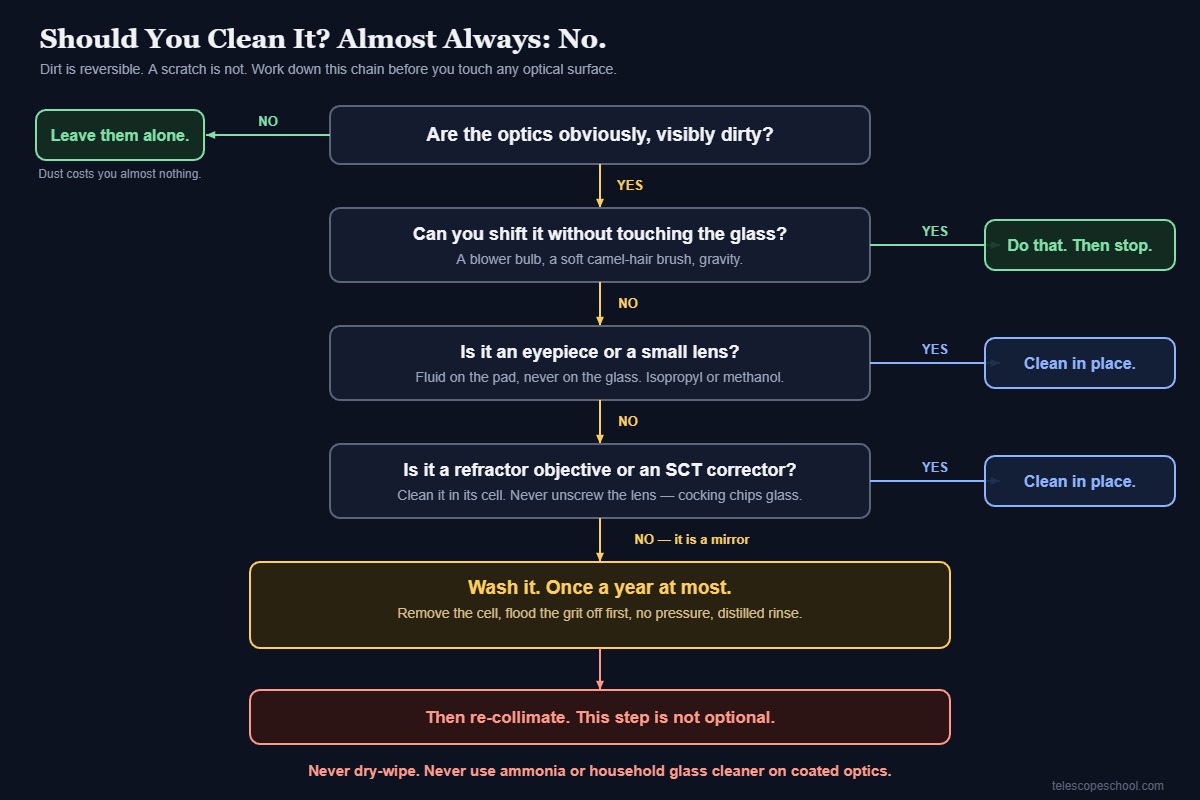
Most telescope mirrors never need cleaning, and most that get cleaned are cleaned too often. Dust scatters a trace of light and costs you nothing you will ever notice. A scratch is permanent. So the honest answer to “how do I clean my telescope mirror” starts with a question in the other direction: are you sure you need to?
When cleaning genuinely is justified — pollen, sap, mould, salt spray, a decade in a damp garage — there is a right order to do it in, and almost every step exists to get grit off the glass without touching it. This guide covers eyepieces, refractor objectives and SCT correctors, and the full wash procedure for a Newtonian primary, along with the one consequence people forget: cleaning a reflector commits you to re-collimating it.
Last Updated: September 2026 | Will Montgomery holds a B.S. in Engineering from Penn State and came back to amateur astronomy at 50, observing from suburban York, PA (Bortle 5–6).
How Dirty Does a Mirror Have to Be Before It Matters?
Far dirtier than it looks. In Star Testing Astronomical Telescopes, optical analyst Harold Suiter worked through the effect of contamination mathematically and concluded that even a perfectionist should tolerate obstruction covering roughly one thousandth of the surface area. On a ten-inch mirror that works out to a completely opaque blot about a third of an inch across, with no measurable effect on the image.
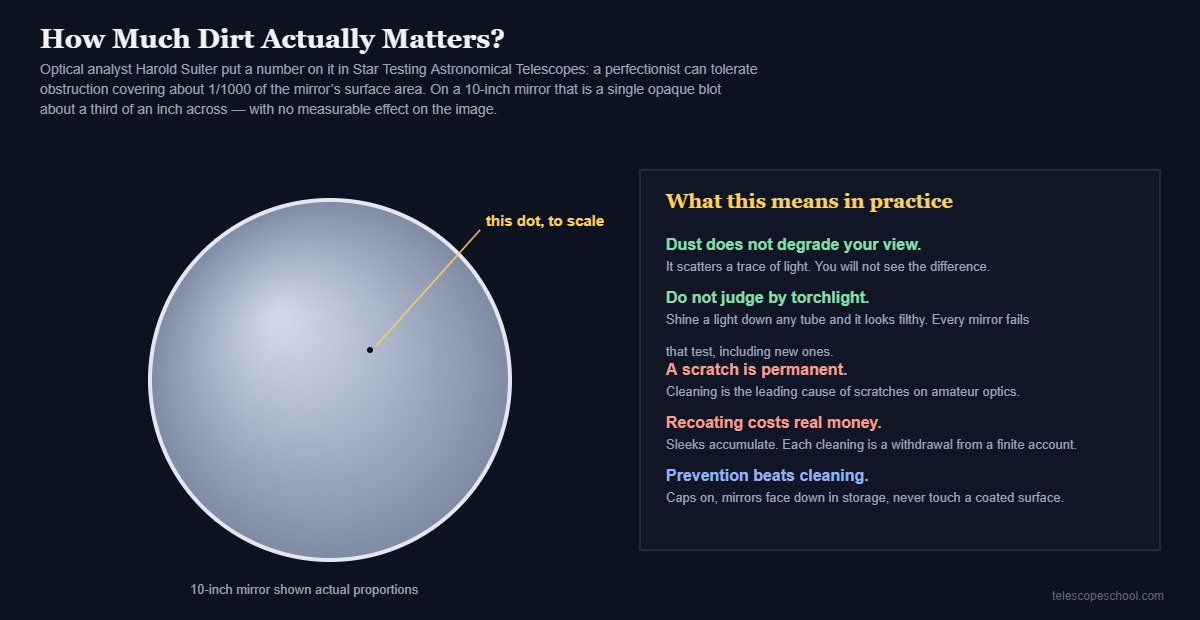
Suiter also gives the single most useful piece of advice on the subject: do not decide to clean a mirror on the basis of shining a torch down the tube at night. Every mirror fails that inspection, including brand new ones. Grazing light picks out dust that is doing nothing at all to your view.
The asymmetry is the whole argument. A dirty mirror can always be made clean. A scratched one is scratched forever. Cleaning produces fine scratches — sleeks — if you get it wrong, and sometimes even if you get it right. A handful of sleeks does not matter. Accumulated over years of unnecessary cleaning, they do, and the fix is a professional recoat that costs real money.
The practical rule: clean at most once a year, and only when there is contamination you can see in ordinary room light without hunting for it.
What Never to Put on Telescope Optics
Ammonia is the one to memorise. Household glass cleaners contain ammonia and other additives, and ammonia can work through pinholes in a mirror’s protective overcoat and attack the aluminium layer underneath. That is not a smear you can polish out; it is the reflective coating being destroyed. Nothing sold for windows belongs anywhere near a telescope.
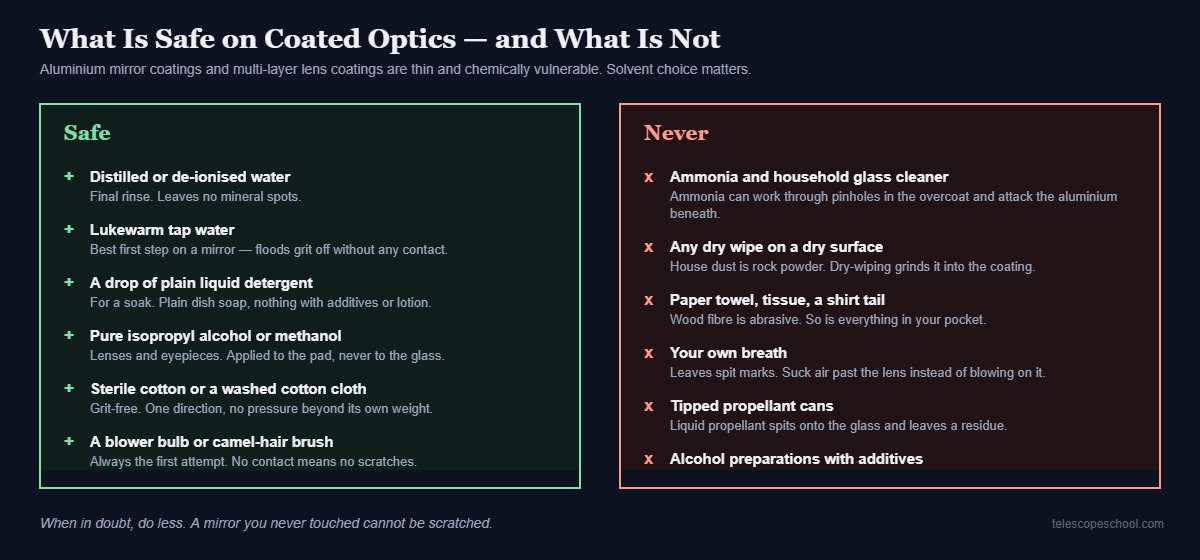
The second rule is about mechanics rather than chemistry: never wipe a dry surface. Ordinary house dust contains rock powder. Dragging a cloth across a dry, dusty mirror grinds that powder into the coating, which is exactly how sleeks are made. Grit is far less abrasive wet than dry, which is why every step in the wash sequence below happens under running or standing water.
A few more that catch people out. Paper towel and tissue are wood fibre and are abrasive. Blowing dust off with your own breath deposits saliva. Canned propellant duster can spit liquid onto the glass if the can is tipped or shaken. And alcohol preparations with fragrances, glycerine or moisturisers in them will leave stains that pure isopropyl or methanol will not.
Cleaning Eyepieces and Small Lenses — the 90% Case
Most cleaning you will ever legitimately do is on an eyepiece, and most of it takes about a second. Eyepieces collect eyelash oil and fingerprints because your face is pressed against them, and they are the one optical surface that genuinely does need attention from time to time.
For dust, lay a finger across the eye end without touching the glass and suck air past the lens. Do not blow — you will leave spit on it. If that does not do it, brush very lightly with a camel-hair brush and keep the brush in a bag between uses so it does not pick up grit of its own.
For fingerprints and oil, use pure isopropyl alcohol or methanol on a soft, grit-free pad — well-washed pure cotton works well. Two rules matter more than the choice of fluid. Apply the fluid to the pad, never to the glass, because liquid dropped on a lens can seep around the edge into the cell and carry dissolved grime onto interior surfaces you cannot reach. And swirl gently with no pressure, then dry with a fresh piece if needed.
If something goes wrong inside an eyepiece, leave it. Taking one apart nearly always cocks a lens element, and forcing a cocked element chips its edge. Contact the manufacturer about a professional clean instead.
Refractor Objectives and SCT Correctors: Clean Them in Place
Do not remove a large front lens or a corrector plate from its cell. Refractor objectives are multi-element assemblies with specific spacing and orientation; SCT correctors are shimmed and matched to the individual telescope at the factory. Both can be cleaned exactly like a small lens — same fluids, same no-pressure technique — it simply takes more fluid and more patience across the larger area. Resist the urge to hurry.
This is worth knowing before you buy, incidentally, because it is one of the practical differences between designs. If you are still choosing, our comparison of refractors, reflectors and compound telescopes covers the maintenance trade-offs alongside the optical ones.
Washing a Newtonian Primary Mirror, Step by Step
Only attempt this if you are comfortable dismantling the telescope, reassembling it, and collimating it afterwards. If any of those three is unfamiliar, the mirror is safer dirty.
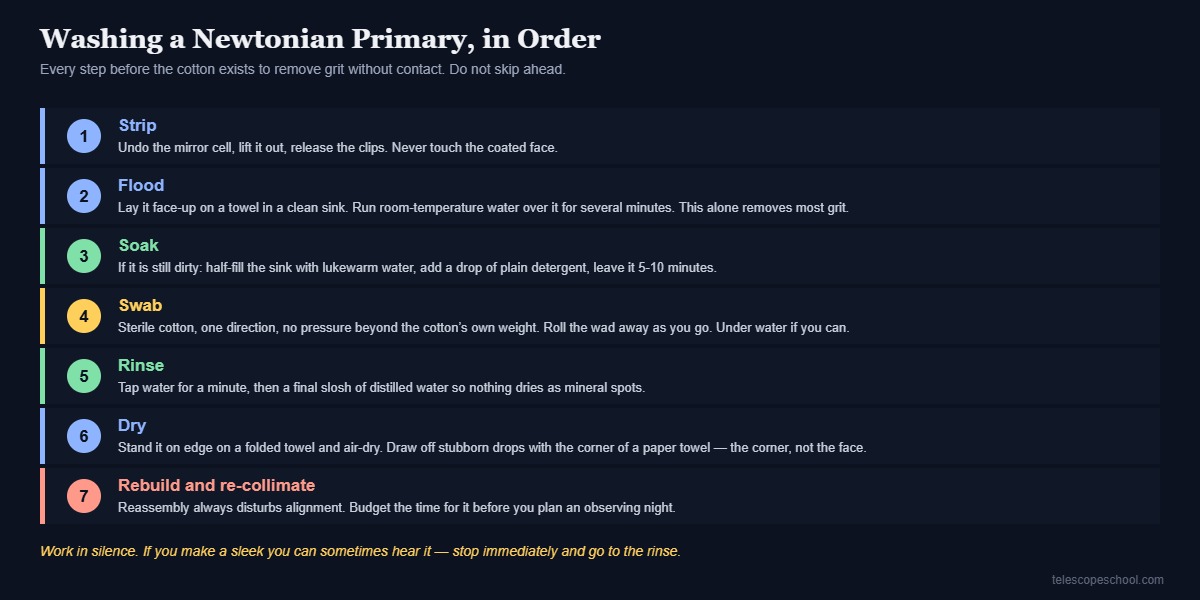
Undo the screws holding the mirror cell to the back of the tube and draw the cell out. Release the clips and push the mirror out from behind, handling it by the edges only. Take off any rings, watches or bracelets first — a metal edge dragged across a mirror is the classic disaster.
Wash the sink out, rinse it thoroughly and lay a folded towel in the bottom. Put the mirror face-up on the towel with the drain open and run room-temperature water across the surface for several minutes. This step alone removes most dust and grit, and it does it without anything touching the glass. Follow with a slosh of distilled or de-ionised water so nothing dries as mineral spots, stand the mirror on edge on a towel, and let it dry.
If it looks clean at that point, stop. You cannot scratch a mirror you have not touched.
If it is still visibly cruddy, plug the sink, half-fill it with lukewarm water, add a squirt of plain liquid detergent and let the mirror soak for five or ten minutes. Then, holding it under the water, swirl it gently for a last chance at floating loose grit away.
Only now does anything touch the surface. Take a wad of sterile cotton — sterile because it is more likely to be grit-free — and swab from one edge in a single direction, applying no pressure beyond the weight of the cotton itself. Roll the wad backwards as you travel so that the part which has just touched the glass is lifted away and never returns. Discard the wad once it has turned completely; a large mirror will use a lot of cotton. Do this under water if you can, since wet grit is much less abrasive than dry.
Work in silence. If you are producing sleeks you can sometimes hear them. If you do, stop and go straight to the rinse.
Finish with a minute under lukewarm running water, then a final rinse of distilled water, and stand the mirror on edge to air-dry. Stubborn droplets can be drawn off with the corner of a paper towel — touched to the drop, not wiped across the face. Repeat the whole process for the secondary.
From experience: what finally prompted me to wash the AWB 130mm primary was dust that had stopped behaving like dust — it looked as though the mirror had got damp at some point and the grit had adhered to the coating rather than sitting loose on it.
Reassemble, Then Re-Collimate
A reflector that has been apart is a reflector that is out of alignment. This is not a maybe. Removing and refitting a primary cell shifts the mirror’s tilt, and a Newtonian that is even slightly off will give you soft, comatic stars that look exactly like the “dirty optics” you set out to fix. Plan the cleaning for an afternoon when you have time to collimate afterwards, and walk through our guide to collimating a reflector telescope before you put the tube back together.
There is a mildly demoralising corollary here: a great many people who clean a mirror and then report that the view is worse have not damaged anything. They have simply skipped collimation.
What You Actually Need — the Short List
Nothing here is exotic and you probably own half of it already. This is everything the method above calls for, and nothing it does not.
For eyepieces and small lenses
- A soft natural-hair brush — for lifting dust without dragging anything across the glass. A retractable natural-wool lens brush is about $7 on Amazon. Keep it in a bag between uses so it does not collect grit of its own.
- Pure 99% isopropyl alcohol — the plain technical-grade kind, nothing added. Amazon Basics does a 16 oz bottle for around $8. Steer clear of anything scented or sold as skin-friendly: fragrance, glycerine and moisturisers all leave stains that pure alcohol will not.
- A rubber air blower — the right answer to dust, and the one this article has been implying all along. Your breath leaves saliva and a can of propellant can spit liquid if it is tipped. A Giottos Rocket-Air blower is about $22 and moves plenty of air without a drop of anything landing on the glass.
For washing a Newtonian primary
- Sterile cotton balls, more than you think — sterile because it is far more likely to be grit-free. A 130-count box runs about $8, and a large mirror will get through a lot of it.
- Distilled or de-ionised water — for the final rinse, so nothing dries as mineral spots. Buy this at the grocery store, not online. A gallon jug is a dollar or two locally and paying to ship water is a waste of your money.
- Plain liquid dish detergent — a squirt of the cheapest additive-free kind, already under your sink. Do not buy anything special for this.
- Two clean towels — one folded in the bottom of the sink, one to stand the mirror on edge to dry.
One more thing to have ready before you start: whatever you normally collimate with. The scope will need it the moment the mirror goes back in.
The one-purchase shortcut — and an honest caveat
If you would rather buy one box than five separate things, High Point Scientific sells the Apertura 20-piece optics and sensor cleaning kit for around $50. It is a genuinely useful box — microfibre cloths, lens paper, a carrying case, and a rubber air blower that is a much better answer to dust than your own breath or a can of propellant.
Here is the part we will not gloss over: we do not know what is in the cleaning solutions. Those formulas are proprietary. They are made by an optics retailer, for optics, so they are unlikely to contain anything that would hurt a coating — but “unlikely” is not the same as the short, known safe list this article has stuck to the whole way down. If you want to be certain what is touching your coatings, use your own pure isopropyl on the glass and treat the kit as a very good source of cloths, lens paper and a blower.
How to Avoid Ever Needing to Do This Again
Prevention is cheap, permanent and almost entirely a matter of habit. It is also most of the reason a telescope lasts for decades rather than years.
Keep caps on whenever the telescope is not in use. If a cap has gone missing, improvise — a shower cap, or a plastic bag or dishcloth held on with a rubber band, works perfectly well over the front of a tube. Cap the focuser too.
Store reflectors with the mirrors facing somewhat downward so that dust settles away from the coated surfaces rather than onto them. Keep eyepieces capped at both ends, or in small sealed containers; cheap eyepiece cases are widely sold and worth the money.
Never touch a coated surface with your fingers. Skin oils are mildly acidic and can attack coatings over time. If you do leave a fingerprint, clean that one spot properly rather than living with it for years.
And control the environment the telescope lives in, because damp storage is what turns a dusty mirror into a genuinely contaminated one. Mould on optics is far worse than dust, and it is entirely preventable — we cover the humidity thresholds and the post-session routine in our guide to storing a telescope safely between sessions.
Frequently Asked Questions
How often should I clean my telescope mirror?
Once a year at the very most, and for most telescopes in reasonable storage, considerably less than that. Cleaning is the leading cause of scratches on amateur optics, so every wash you skip is a small win. Eyepieces are different — they collect skin oil and may want attention every several sessions.
Can I use rubbing alcohol on telescope optics?
Pure isopropyl alcohol and methanol are both widely used on lenses and eyepieces, applied to the pad rather than the glass. Standard diluted isopropyl works too. Avoid any alcohol preparation with added fragrance, glycerine or moisturiser, and never use anything containing ammonia on a coated surface.
Will a dirty mirror actually hurt my views?
Much less than you think. Contamination covering around a thousandth of the surface area has no measurable effect. Dust scatters a little light, which slightly reduces contrast on faint objects, but the difference between a dusty mirror and a spotless one is invisible in normal observing. If your views really have gone soft, the cause is almost always something else — start with our six fixes for a blurry telescope.
Can I clean the secondary mirror on its own?
Yes, using the same wash method, and it is often the dirtier of the two because it sits exposed near the front of the tube. Removing the secondary holder disturbs alignment just as removing the primary does, so the same rule applies: budget time to re-collimate.
When does a mirror need recoating rather than cleaning?
When the aluminium itself is damaged — visible pinholing, clouding that does not wash off, or patches where the coating has lifted. That is a job for a professional coating service, and it is worth getting a quote rather than assuming a telescope is finished. A rescued instrument is nearly always cheaper than a new one.
The Short Version
Three things to remember. First, dirt is reversible and scratches are not — when in doubt, do less. Second, every step before the cotton exists to remove grit without contact, so never skip the flood and never wipe anything dry. Third, cleaning a reflector means collimating a reflector; treat them as one job, not two.
If your optics were fine and the views still are not, the problem is usually alignment, cooling or the atmosphere rather than dirt. Telescope School’s guide to collimation is the first place to look, and our complete guide to telescope eyepieces covers the other end of the light path.
I have washed the primary on my own AWB 130mm. It is less frightening than it reads here, and most mirrors should simply be left alone.
These May Help Too...
Can You Use a Telescope Through a Window? (And Why You Should Not)
Using a telescope through a window ruins the view: bad glass, heat currents and reflections. Here is what actually happens, and what to do instead.
Telescope will not come to focus? The cause is almost always spacing, not optics. Work out whether you ran out racking in or out, then fix that end.