

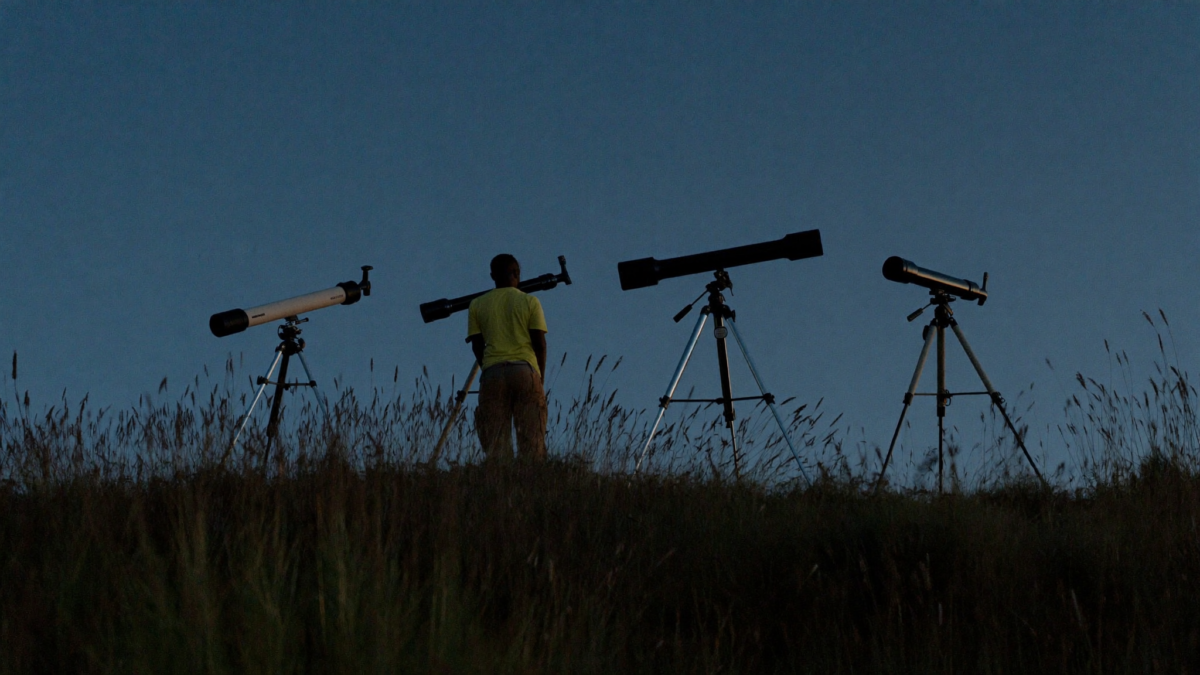
For most beginners who want to observe visually, a reflector — specifically an 8-inch Dobsonian — is the best-value first telescope because it buys the most aperture per dollar. If you value low maintenance and grab-and-go sharpness, a small refractor is the better fit, and if you want a long focal length in a compact, travel-friendly tube for planets and imaging, a compound (catadioptric) scope is worth the higher price. There is no single “best type” — there is a best type for your goal, budget, and how much upkeep you will tolerate.
I am an engineer (B.S., Penn State) who returned to astronomy at 50, and I think about telescopes the way I think about any tool: as a set of tradeoffs. The three optical designs are just three different answers to the same problem — gathering and focusing light. Let me walk you through how each one works and who each one is for.
Quick Answer: For most visual beginners, an 8-inch Dobsonian reflector is the best-value first telescope because it delivers the most aperture per dollar. Choose a small refractor for low-maintenance, grab-and-go sharpness, or a compound (catadioptric) scope for a compact, long-focal-length tube suited to planets and imaging. The right type depends on your goal, budget, and tolerance for upkeep.
The three telescope types, in one table
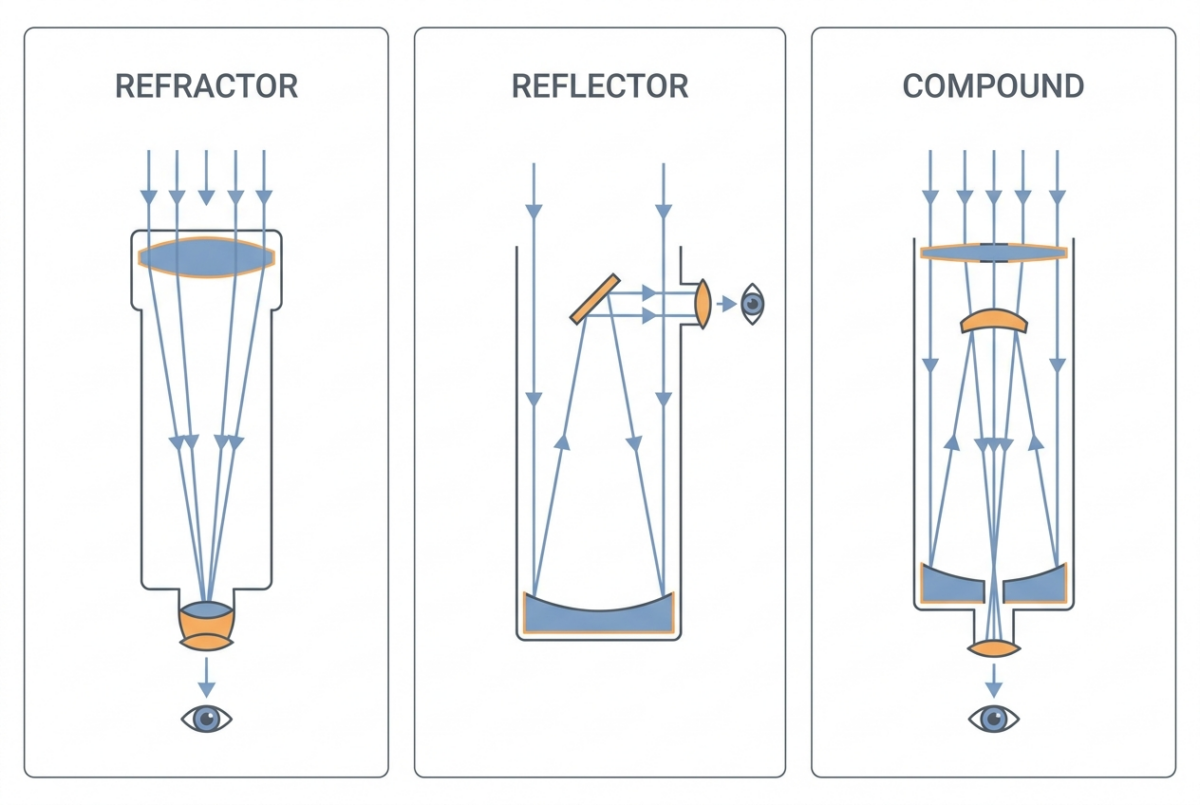
Every telescope is essentially a refractor, a reflector, or a compound design that combines both. Here is the whole decision at a glance before we dig in.
| Design | How it works | Best for | Aperture per $ | Maintenance | Portability |
|---|---|---|---|---|---|
| Refractor (lens) | Front lens bends light down a sealed tube | Moon, planets, wide-field, imaging | Lowest | Lowest (no collimation) | High at small sizes |
| Reflector (mirror) | Curved mirror reflects light to a side eyepiece | Deep-sky, best overall value | Highest | Periodic collimation | Bulky but simple |
| Compound (lens + mirror) | Corrector plate + mirrors fold a long focal length into a short tube | All-round: planets, imaging, GoTo | Middle | Low–moderate | Best for the aperture |
Refractor telescopes: sharp, sealed, and low-maintenance
A refractor uses a lens at the front of the tube to bend (refract) light to a focus, and its great strength is delivering sharp, high-contrast views with almost no upkeep. Because the tube is sealed and there is no mirror to align, a refractor holds its collimation essentially forever, keeps dust out, and is ready the moment you carry it outside. That makes it a superb Moon, planet, and double-star instrument, a lovely wide-field scope, and — in its premium form — the go-to design for wide-field astrophotography. You can read my primer on what a refractor telescope is for more.
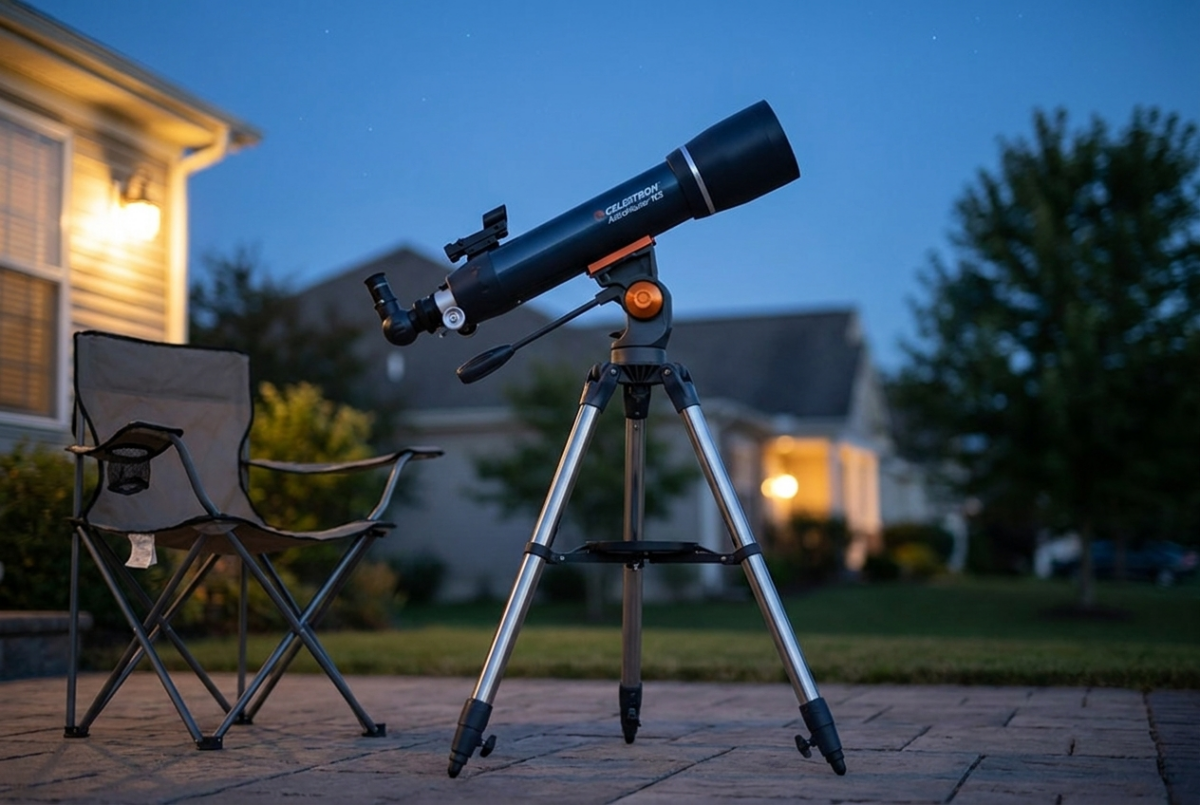
The catch is cost per inch of aperture. Refractors are the most expensive design for a given aperture, and large refractors become impractically long and heavy. There is also chromatic aberration — the purple or blue color fringing you see around bright objects in cheaper “achromatic” refractors.
Achromat vs apochromat
The difference between an achromat and an apochromat is how well the lens controls color, and it drives most of the price gap. An achromat uses a two-element lens and shows some color fringing, worse at fast focal ratios and larger apertures. An apochromat (APO) uses special ED or fluorite glass in two or three elements to bring the colors to a common focus, producing near color-free, crisp images — the astrophotography standard, but significantly pricier for the same aperture. A tip from the field: a long, “slow” achromat controls color far better than a short, fast one.
Reflector telescopes: the most aperture for your money
A reflector (Newtonian) uses a concave mirror at the base of the tube to gather and reflect light up to a small diagonal mirror and out to a side-mounted eyepiece, and it delivers more aperture per dollar than any other design. Because mirrors reflect all wavelengths to the same point, a reflector has zero chromatic aberration, and the money you save on optics goes straight into light-gathering aperture — which is what actually reveals faint galaxies and nebulae. When you mount a reflector on a simple, sturdy alt-az base, you get a Dobsonian, and that combination is why I recommend an 8-inch Dob as the best first visual telescope for most people. My best Dobsonian telescopes guide goes deeper.
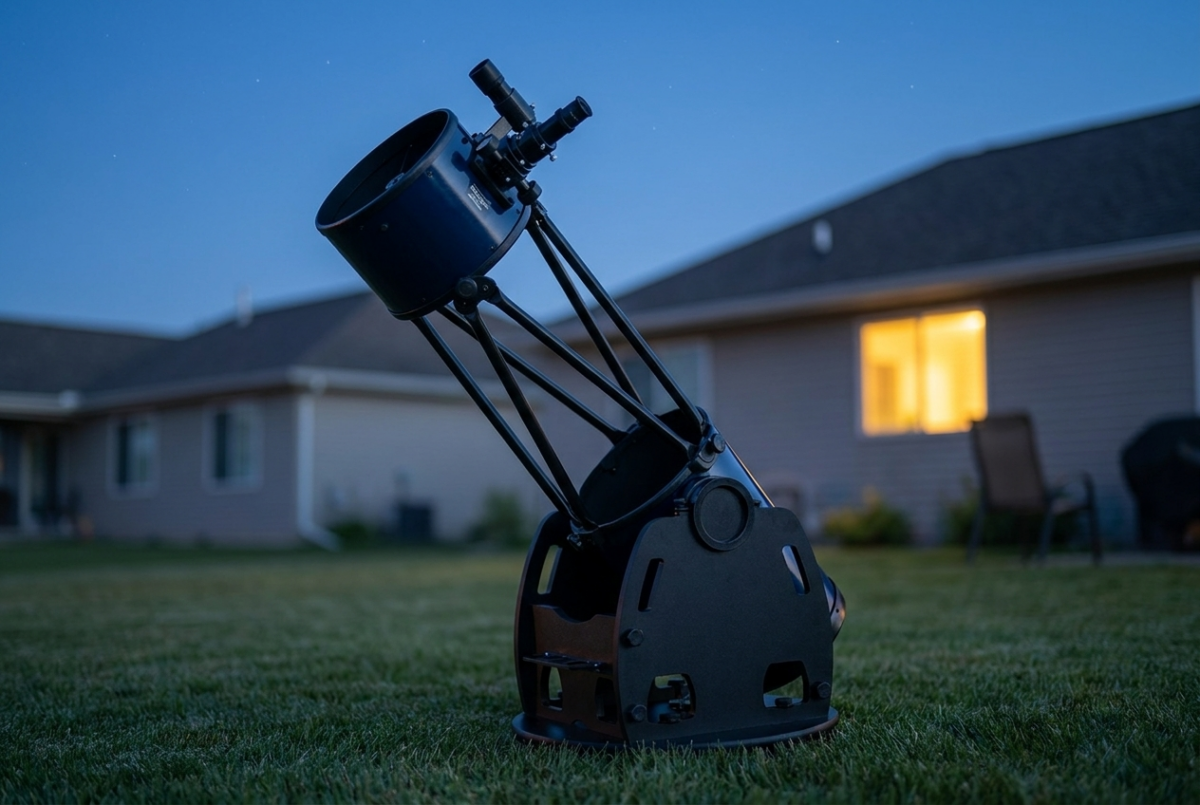
The tradeoffs are maintenance and bulk. A reflector needs periodic collimation — a five-to-ten-minute alignment of the mirrors with an inexpensive tool — and its open tube collects dust and needs time to cool to the air temperature before views get sharp. Fast Newtonians also show a little coma (slightly elongated stars) toward the edge of the field. For a deeper look at the design, see what a reflector telescope is.
Compound (catadioptric) telescopes: long reach in a short tube
A compound telescope uses both a lens (a front corrector plate) and mirrors to fold a long focal length into a short, sealed, portable tube, which makes it the most versatile and travel-friendly design of the three. Because the light path bounces back and forth inside, a compound scope packs, say, 1250mm of focal length into a tube barely a foot long. The sealed tube keeps dust out like a refractor, the design handles planets, the Moon, brighter deep-sky, and planetary imaging well, and it pairs naturally with computerized GoTo mounts. My article on what a compound telescope is covers this family in detail.
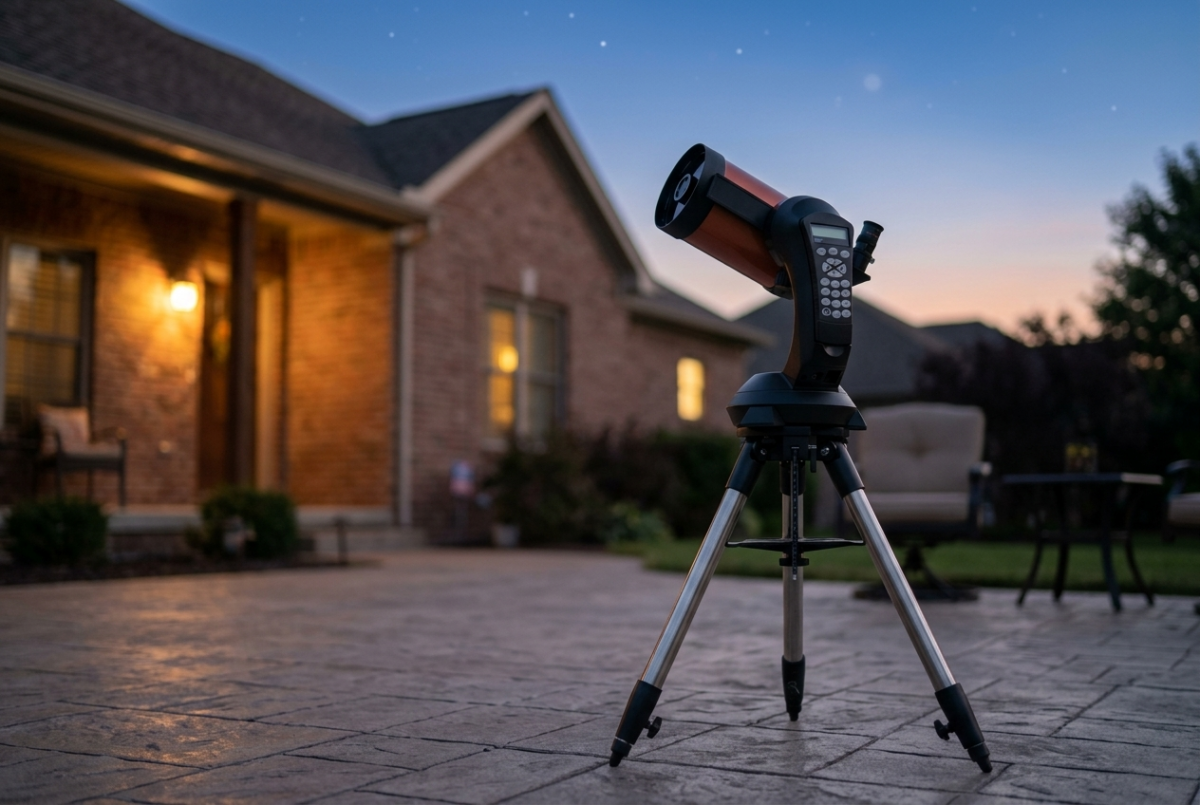
The price you pay is literal — compounds cost the most per setup — plus a narrower field of view (they run slow, typically f/10 to f/15), an exposed corrector plate that is prone to dew and needs a shield or heater, and a longer cool-down time.
SCT vs Maksutov-Cassegrain
The two common compound types trade field of view against contrast. A Schmidt-Cassegrain (SCT) uses a thin corrector plate, usually runs around f/10, comes in larger apertures (6 to 14 inches) at manageable weight, cools faster, and is the do-everything imaging and observing choice. A Maksutov-Cassegrain (“Mak”) uses a thick meniscus corrector and a longer focal ratio (f/12–f/15) for pinpoint, high-contrast, essentially color- and coma-free views — a superb planetary, lunar, and double-star specialist — but that heavy corrector limits practical aperture (mostly seven inches and under) and gives the longest cool-down of any design.
Which telescope type should you buy?
Choose by your primary goal and your tolerance for maintenance, not by chasing the “best” label. If you mainly want visual observing on a budget, buy a reflector, and specifically a Dobsonian — you will see more for your money than with any other design. If you want low fuss, sharp planetary and lunar views, wide-field sweeping, or a scope you can grab and go in seconds, buy a refractor. If you want one compact, versatile instrument that does a bit of everything, handles GoTo, and travels well — and you will pay for it — buy a compound. Remember that aperture and steady mounting matter more than the label; if you are unsure how much aperture you need, see my guide to telescope aperture, and to sanity-check the whole decision, start with the best telescope for beginners. This kind of tradeoff-first thinking is exactly what we try to teach at TelescopeSchool.
From experience: My dream go-to is a triplet apochromatic refractor, but on a real visual night I reach for my reflector — it simply has the biggest aperture, and at the eyepiece aperture is what wins.
Frequently asked questions
Which telescope type is best for beginners?
For visual observing, an 8-inch Dobsonian reflector is the most-recommended first telescope — big aperture, low cost, simple to use. Beginners who prize low maintenance and grab-and-go simplicity often prefer a small 70–102mm refractor instead.
Refractor or reflector for planets?
Both work well. A quality refractor gives sharp, high-contrast planetary views with no collimation, while a larger reflector shows more surface detail for the money. For serious planetary detail, aperture wins, so a big reflector or a Maksutov often beats a small refractor.
What is a compound (catadioptric) telescope?
It is a hybrid that uses both a lens (corrector plate) and mirrors to fold a long focal length into a short, portable, sealed tube. The two common types are the Schmidt-Cassegrain (SCT) and the Maksutov-Cassegrain (Mak).
Do refractors need collimation?
Generally no. Refractors hold their alignment and rarely need user collimation, a major low-maintenance advantage. Reflectors, and occasionally SCTs, do need periodic collimation.
Which telescope is best for astrophotography?
For wide-field deep-sky imaging, a small apochromatic refractor is the standard choice thanks to its flat, color-free field. For small galaxies and planetary imaging, a long-focal-length SCT is preferred; fast Newtonian astrographs are a budget deep-sky option.
Reflector vs refractor for deep-sky?
Reflectors usually win for visual deep-sky because they deliver far more light-gathering aperture per dollar, revealing fainter galaxies and nebulae. Refractors are favored for deep-sky astrophotography (especially APOs) rather than for maximum visual aperture.
Common picks by design: reflector — 8-inch Dobsonian; refractor — 80mm apochromatic refractor; compound — Maksutov-Cassegrain.
I came back to this hobby at 50 and had to work these differences out again from scratch. This is the comparison I wish I had read first.
These May Help Too...
Can You Use a Telescope Through a Window? (And Why You Should Not)
Using a telescope through a window ruins the view: bad glass, heat currents and reflections. Here is what actually happens, and what to do instead.
Telescope will not come to focus? The cause is almost always spacing, not optics. Work out whether you ran out racking in or out, then fix that end.