

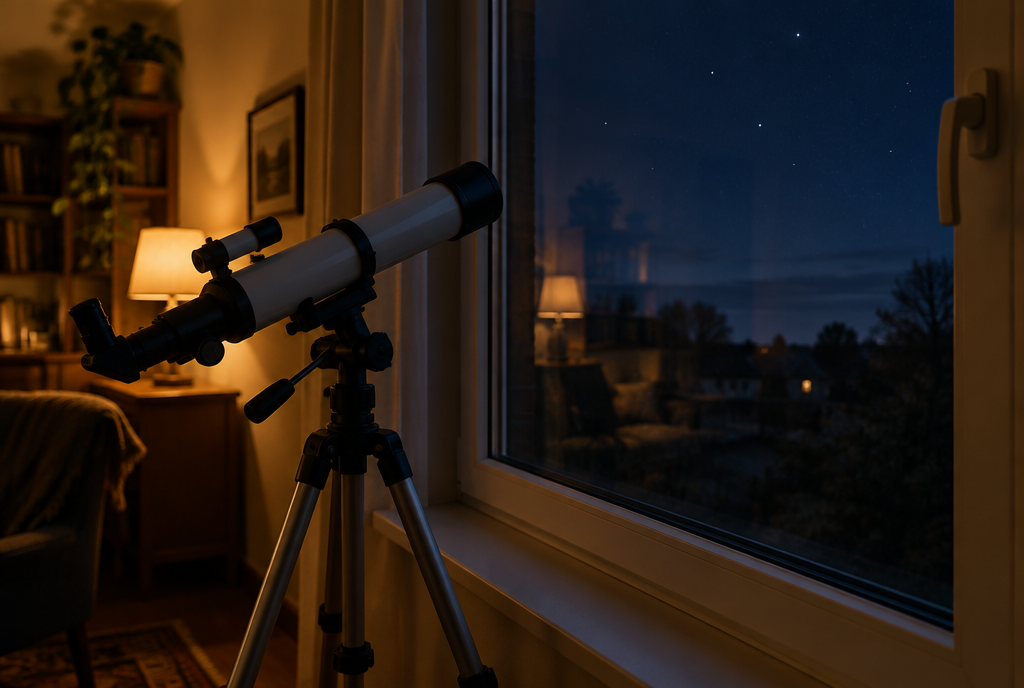
Quick answer: You can point a telescope through a window, but you should not expect it to work — and the reason is not the glass so much as the air. Window glass was never made to optical standards, and the temperature difference between a heated room and a cold night sets up a flow of turbulent air that sits directly across the light path.
There is also a counterintuitive twist that most advice gets backwards: opening the window usually makes things worse, not better. This guide explains why, what each problem actually costs you, and what to do instead if getting outside is genuinely not an option.
Last Updated: September 2026 | Will Montgomery observes with an Astronomers Without Borders 130mm reflector and a 9mm Plössl, and finds even the move from his own yard out to a darker work property a real improvement. Telescope School exists to give beginners the realistic version of what a telescope actually shows.
The short answer
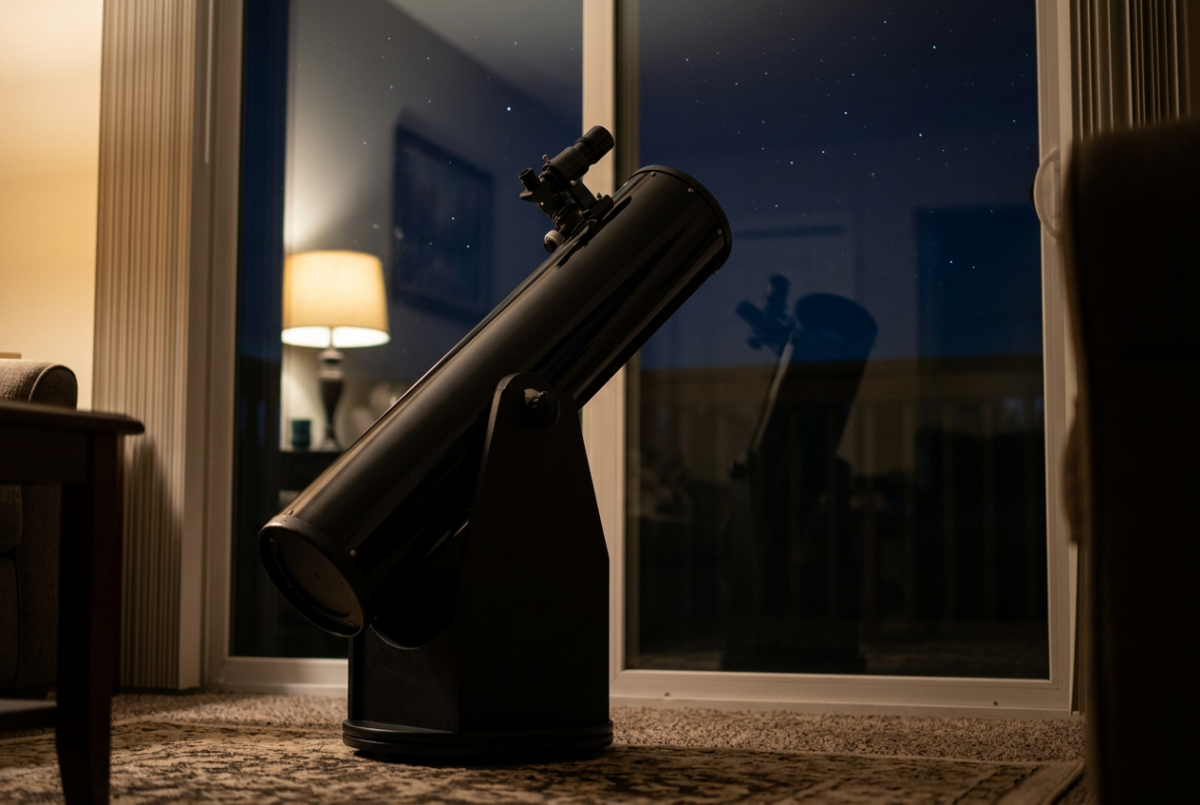
For the Moon and the brightest planets, a window will give you something — a recognisable, wobbling, low-contrast image. For anything fainter, and for any view where fine detail matters, it will not. The combination of uncorrected glass and moving air destroys exactly the thing a telescope exists to deliver.
And if you are going to do it anyway, the glass usually causes less harm than an open window does, which is the opposite of what most people assume.
Problem 1: the glass was never made to be an optical surface
The issue with window glass is not that it blocks light. Ordinary glazing passes most visible light perfectly well, and a telescope has plenty of light to spare on bright targets.
The problem is flatness. A telescope mirror is figured to a fraction of a wavelength of light — the manufacturing tolerance is measured in millionths of an inch. Window glass is float glass, manufactured to be clear, strong, and cheap. It is flat enough that your eye never notices, and nowhere near flat enough for a telescope.
Two things follow. Gentle waviness across the pane acts like a very weak, very bad lens, smearing detail. And if the two faces of the pane are not exactly parallel — a slight wedge — the glass behaves like a thin prism, splitting starlight into a small coloured fringe. Neither is visible to the naked eye, and both are obvious at 100x.
Problem 2: heat pouring through the gap
This is the bigger of the two, and it is the one people underestimate. Indoor air is warmer and less dense than the night air outside. Open a window between them and you have built a chimney: warm air flows out through the top of the opening, cold air slides in along the bottom, and the two mix in a churning layer right where your telescope is looking.
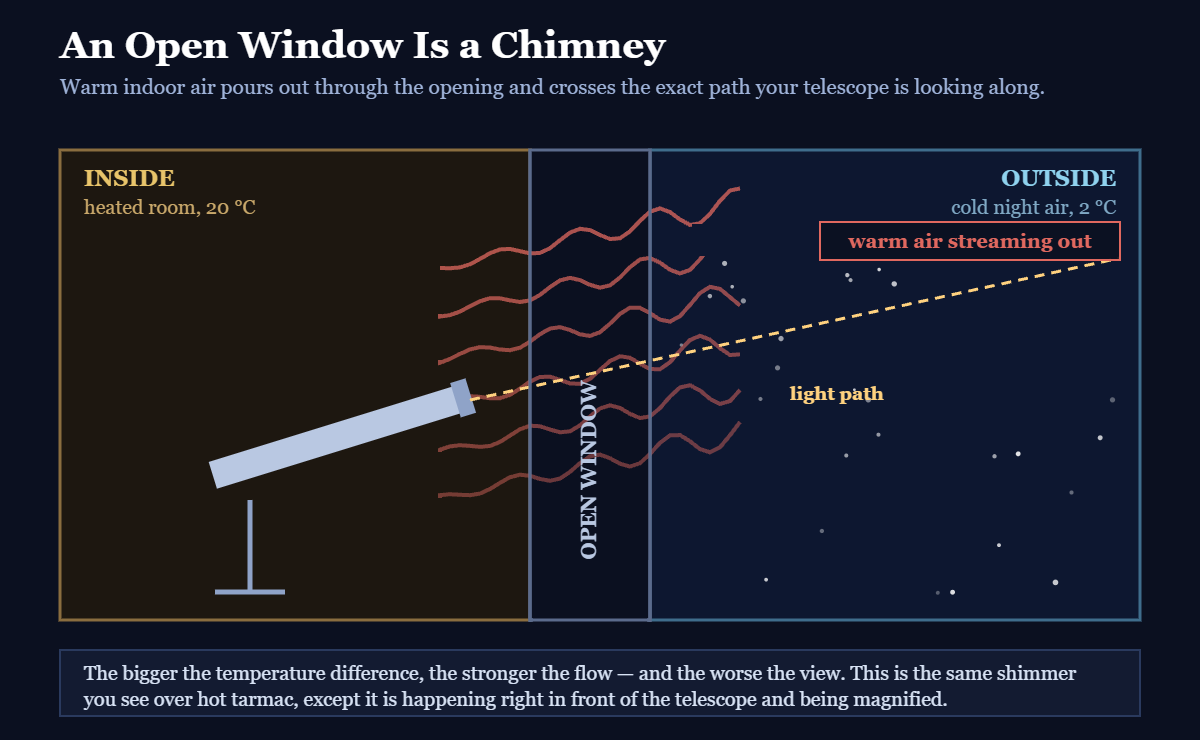
Moving air of varying density bends light, which is why distant objects shimmer above hot tarmac on a summer afternoon. The same effect is happening a few inches in front of your telescope, and the telescope magnifies it along with everything else. The view does not just soften — it boils, continuously, and no focus adjustment touches it.
The severity scales with the temperature difference. A 20 °C room looking out at a 2 °C night is a violent case. The same window in mild autumn weather, with the heating off, is much gentler.
Why opening the window usually makes it worse
Here is the part that surprises people. Experienced observers widely report that if you are stuck observing from indoors, leaving the window closed gives a better image than opening it — because a closed window at least stops the air from flowing. You trade turbulence for imperfect glass, and imperfect glass is the lesser evil.
Worth being straight about the status of that claim: it is consistent, long-standing observer consensus rather than something we measured, and how it lands for you depends on your glazing and the temperature difference on the night. It is a strong prior, not a law.
The logic is easy to follow, though. Bad glass degrades the image in a fixed, static way — it is always the same amount of blur, and your eye partly adapts to it. Turbulence is dynamic, and a constantly moving distortion is far more destructive to perceived detail than a constant one.
If you do want to open the window, the fix is to remove the temperature difference rather than the glass. Turn the heating off in that room, open the window wide, turn out the lights, and leave it for an hour or more before observing. Once the room is close to outdoor temperature there is very little flow, and an open window becomes a genuinely usable option.
Problem 3: double glazing means more than one surface
Almost nothing written about telescopes and windows accounts for what modern glazing actually is. A double-glazed unit is not one sheet of glass — it is two panes with a sealed gas gap between them, which means four air-to-glass surfaces rather than two.
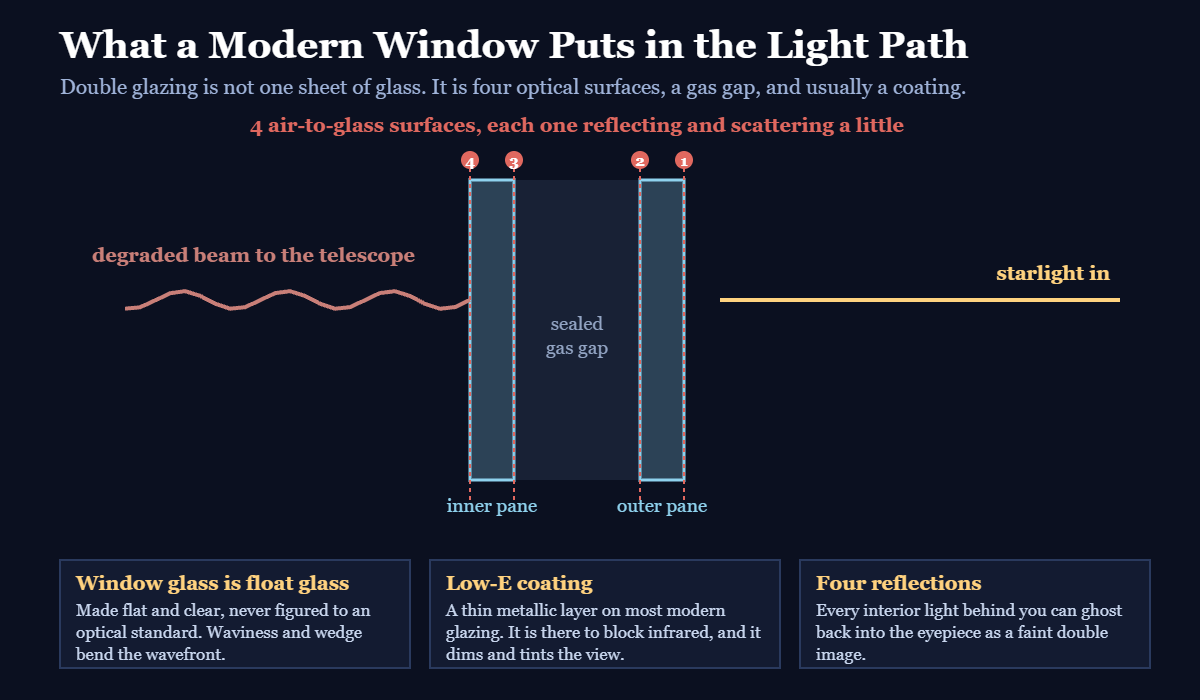
Each surface reflects and scatters a little light. Each pane contributes its own waviness, and there is no reason the two would cancel — they are as likely to compound. Worse, the two panes are separated by a gap, so any wedge in one is amplified rather than corrected by the other.
Most modern glazing also carries a low-emissivity coating, a microscopically thin metallic layer designed to reflect infrared and keep heat indoors. It does its job, and in the process it dims and slightly tints everything you look at through it. Triple glazing multiplies all of this again.
Problem 4: reflections from inside the room
A window is a partial mirror, and at night, with a lit room behind you, it is a fairly effective one. Every lamp, screen, standby LED, and light-coloured wall behind the telescope can reflect off those glass surfaces and back into the light path as ghost images and a general veiling haze that flattens contrast.
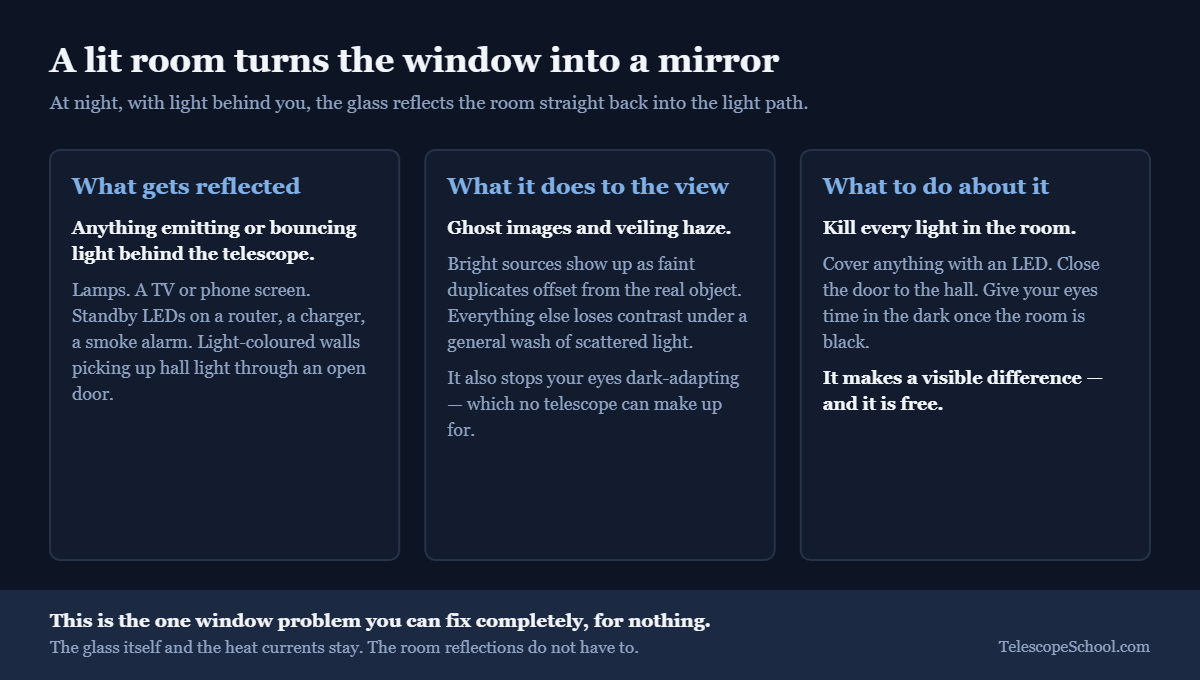
If you are going to observe through glass, kill every light in the room, cover anything with an LED, and close the door to the hall. It makes a visible difference. It also lets your eyes dark-adapt, which they will not do in a lit room no matter how good the telescope is.
The one time it is defensible: the Moon
The Moon is the exception that makes the rule bearable. It is overwhelmingly bright, its interesting detail is high-contrast shadow relief along the terminator, and it does not depend on faint light or subtle tonal gradations. Lunar observing through glass is compromised but genuinely worthwhile — you will still see craters, mountain ranges, and the great dark maria.
Jupiter and Saturn are marginal. You will see that Saturn has rings and that Jupiter has moons, which is a real and memorable thing to show a child on a night nobody wants to go outside. You will not see cloud belts in any detail or the Cassini Division. Everything fainter than that — nebulae, galaxies, star clusters, double stars — is not realistically on the table. Our guide to the best craters and features on the Moon is the right place to start if a window is what you have.
What to do instead
The window is the bottom rung, but it is a ladder, and most people can climb at least one step.
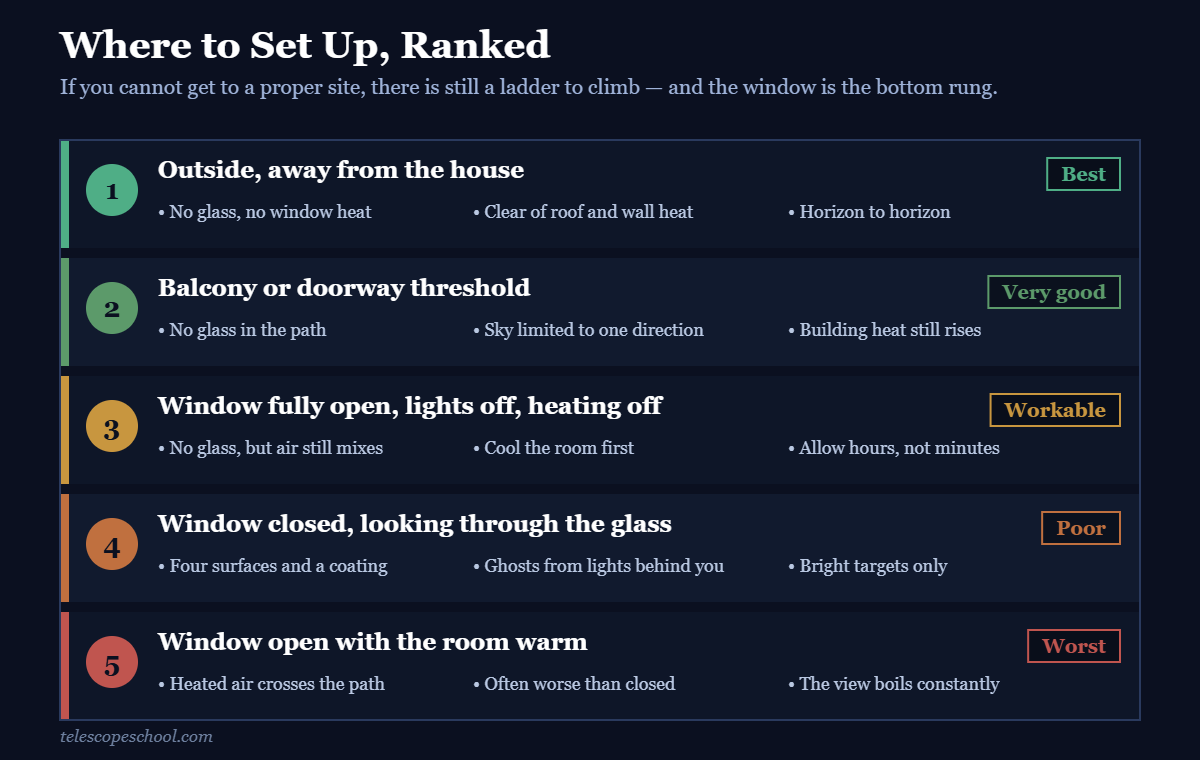
A balcony or a doorway threshold. This is the single biggest upgrade available to most indoor observers, and it removes the glass entirely. You lose most of the sky to one direction, but what you can see, you see properly. Our guide to apartment and balcony astronomy covers how to work within a restricted horizon, and the best telescopes for small spaces covers the gear side.
Something you can carry. The real reason people observe through windows is usually that the telescope is too much trouble to move. A grab-and-go instrument you can carry out in one trip changes that completely. A pair of 10×50 binoculars is the lightest version of this, works beautifully on star fields and the Moon, and can be outside in ten seconds. The Celestron UpClose G2 is the cheap, durable end of that; it is also worth comparing other 10×50s if you want better coatings or a lighter body. If you want an actual telescope that still moves in one trip, a tabletop Dobsonian is the answer — something like the Sky-Watcher Heritage 130mm, which sits on a step or a garden table and carries out under one arm. There are other tabletop Dobsonians worth comparing if you want more aperture.
Let the telescope cool wherever it ends up. A telescope brought straight from a warm house has its own internal air currents, which will soften the view even outdoors. Set it out half an hour before you plan to use it.
Somewhere genuinely dark, occasionally. Even a short drive to a darker site does more for the view than any accessory. Our guide to the Bortle scale explains how to judge what you are working with.
I have not tried it myself, knowing a clear image will not prevail — window glass distorts the light. It is not made to the optical precision a telescope needs, so it can blur and warp the image. Even with the window open, warm indoor air mixing with colder outdoor air can make the view shimmer badly.
Frequently asked questions
Can I use a telescope through a window at all?
Yes, and it will work poorly. Expect a usable view of the Moon, a recognisable view of Jupiter and Saturn, and very little else. The two limits are the optical quality of the glass and the turbulent air moving between the warm room and the cold night. Neither can be focused out.
Should I open the window or leave it closed?
If the room is warm, leaving it closed is usually the better of two poor options, because an open window lets heated air stream across the light path. If you can turn the heating off and let the room equalise with the outside temperature over an hour or more, then opening it is better — you remove the glass without creating the airflow.
Does a screen or insect mesh matter?
Yes, and it should always come out. A mesh in front of the aperture diffracts light and produces a soft cross-shaped flare around every bright object. It is one of the few window problems that is completely free to fix.
Is it worse through double or triple glazing?
Worse, yes. Each additional pane adds two more air-to-glass surfaces and its own imperfections, and modern units usually carry a low-emissivity coating that dims and tints the view. Old single glazing is optically the least bad — though it is still bad.
Can I photograph through a window?
Lunar photography through glass can produce a recognisable image, particularly with short exposures and stacking, which averages out some of the turbulence. Anything requiring long exposure is not realistic — the reflections and the moving air will dominate. Our beginner astrophotography guide assumes an unobstructed sky for good reason.
The short version
Three things to take away. The glass is not neutral — it was manufactured to be clear, not flat, and modern double glazing puts four imperfect surfaces and a metallic coating in your light path. The air is the bigger problem, and an open window into a heated room is the worst case of all rather than the fix. And the Moon is the one target bright enough to survive the whole arrangement.
If a window is what you have tonight, point it at the Moon, turn off every light in the room, and take out the insect screen. Then start looking for a doorway, a balcony, or a patch of grass for next time — that step is worth more than anything you could spend money on. More on making the most of a limited sky here at Telescope School.
I hold an engineering degree, and window glass is simply the wrong optical surface — no technique makes an uncontrolled pane behave like an instrument.
These May Help Too...
Telescope will not come to focus? The cause is almost always spacing, not optics. Work out whether you ran out racking in or out, then fix that end.
Everything looking dim through your telescope? Exit pupil is the number that explains it. Here is the arithmetic, the 2-5mm target, and what to change.