

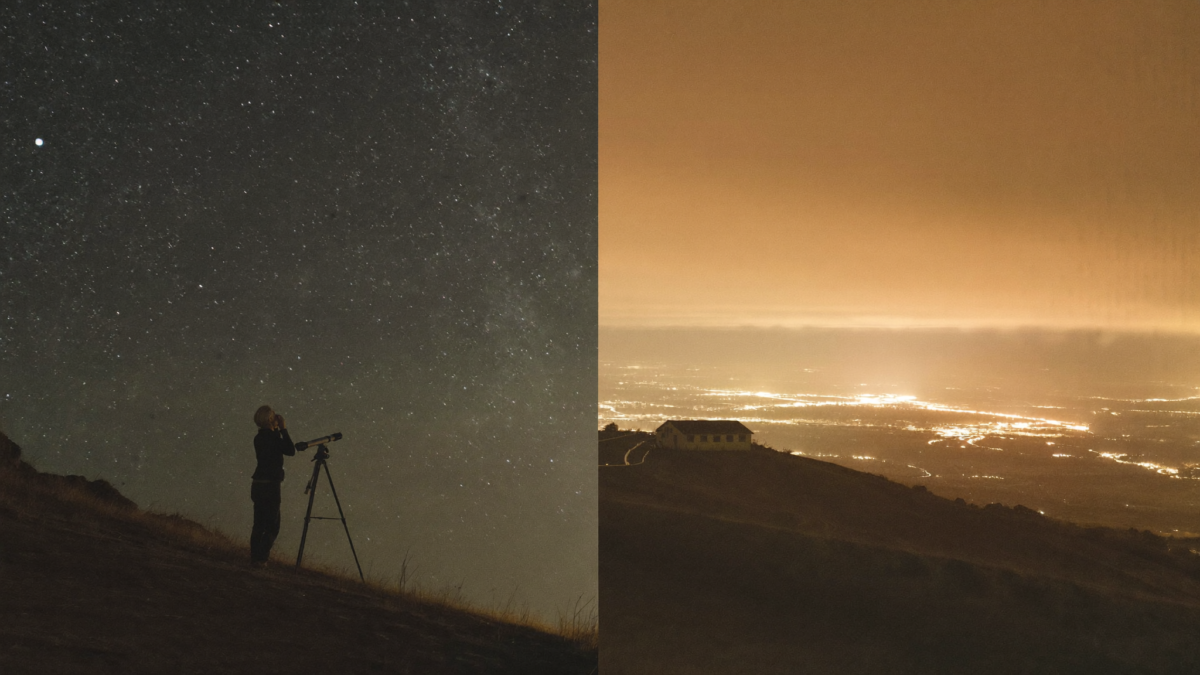
Quick Answer: The Bortle scale is a nine-point description of how dark your night sky is, running from Class 1 (a truly dark site where the Milky Way casts shadows) to Class 9 (an inner-city sky where the Pleiades is the only Messier object you’ll see). It was invented by amateur astronomer John E. Bortle for Sky & Telescope in February 2001, and the most important thing to understand about it is that it describes what you can see on a given night — not a fixed property of your address.
That distinction gets lost constantly, and it is the source of nearly every argument about the scale online. I’m an engineer by background, and I have a low tolerance for measurements that get used outside the conditions they were designed for. This is one of those. Let me give you the actual scale, show you how to determine your own class properly, and then be honest about where the scale breaks down.
What is the Bortle scale?
Bortle created the scale because he thought the existing yardstick was inadequate. In his own words, naked-eye limiting magnitude “is a poor criterion. It depends too much on a person’s visual acuity… One person’s ‘5.5-magnitude sky’ is another’s ‘6.3-magnitude sky.'” More importantly, he pointed out that deep-sky observers need to assess both stellar and nonstellar objects — and that “a modest amount of light pollution degrades diffuse objects such as comets, nebulae, and galaxies far more than stars.”
So rather than a single number, he wrote nine paragraphs of description, each anchored to specific things you either can or cannot see: the Milky Way’s structure, the zodiacal light, airglow, M33, M31, and how well you can see your own telescope in the dark.
Here is the fact that almost no article states plainly: Bortle’s original article contains no SQM values at all. Every “Bortle class equals X mag/arcsec²” table you have ever seen is a third-party retrofit added years later. Bortle gave naked-eye limiting magnitude and the limiting magnitude of a 32cm telescope. That’s it. Keep that in mind when you read the table below.
The nine Bortle classes
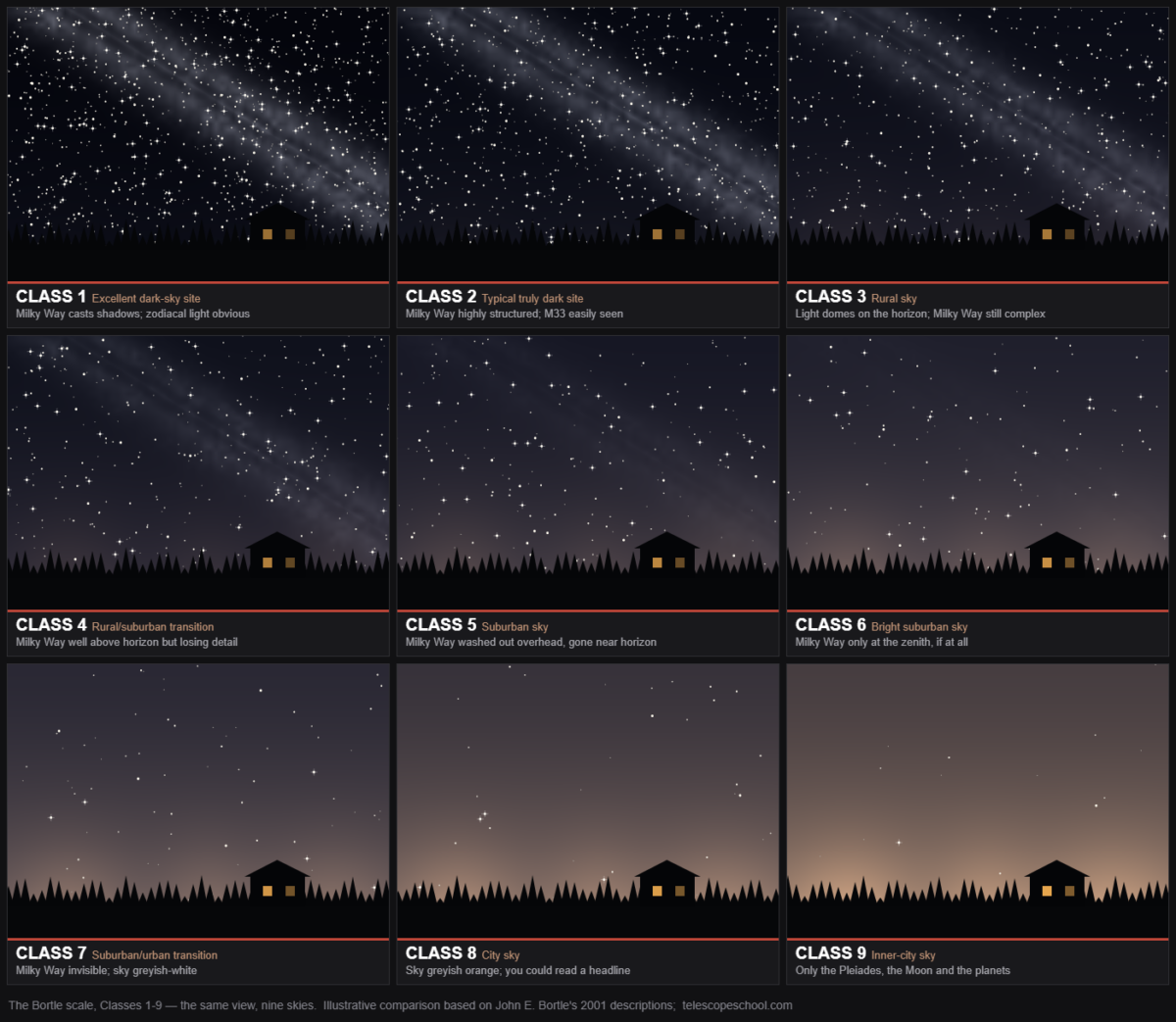
The NELM and telescope figures below are Bortle’s own. The SQM column is the widely circulated approximation — useful, but not canonical and not his.
| Class | Bortle’s title | NELM | 32cm scope limit | Approx. SQM (3rd party) |
|---|---|---|---|---|
| 1 | Excellent Dark-Sky Site | 7.6–8.0 | 17.5 | 21.76–22.00 |
| 2 | Typical Truly Dark Site | 7.1–7.5 | 16–17 | 21.60–21.75 |
| 3 | Rural Sky | 6.6–7.0 | 16 | 21.30–21.59 |
| 4 | Rural/Suburban Transition | 6.1–6.5 | 15.5 | 20.40–21.29 |
| 5 | Suburban Sky | 5.6–6.0 | 14.5–15 | 19.10–20.39 |
| 6 | Bright Suburban Sky | ~5.5 | 14.0–14.5 | 18.50–19.09 |
| 7 | Suburban/Urban Transition | 5.0 “if you really try” | barely 14 | 18.00–18.49 |
| 8 | City Sky | 4.5 at best | ~13 | <18.00 |
| 9 | Inner-City Sky | ≤4.0 | — | <18.00 |
A warning about Wikipedia’s version: it relabels Class 4 as “Brighter rural” with a narrower NELM range, and inserts a “Class 4.5” that Bortle never wrote. If you want the real scale, read Bortle’s original article — Sky & Telescope has it free on their site.
What you can see, class by class
The descriptions are what make the scale useful. Here are the load-bearing indicators, in Bortle’s own framing:
- The Milky Way. Class 1: the Scorpius and Sagittarius regions cast obvious diffuse shadows on the ground. Class 2: highly structured, like veined marble in binoculars. Class 4: impressive, but lacking all but the most obvious structure. Class 5: washed out overhead, invisible near the horizon. Class 6: apparent only toward the zenith. Class 7 and up: gone.
- The zodiacal light. Class 1: striking, with the gegenschein and a zodiacal band spanning the whole sky. Class 3: striking in spring and autumn, extending 60° up. Class 4: clearly evident but doesn’t reach halfway to the zenith. Class 5: hints only, on the best nights. Class 6 and beyond: no trace, ever. This is one of the sharpest dividing lines in the scale.
- M33, the Triangulum Galaxy — Bortle’s key test. Class 1: naked-eye with direct vision. Class 2: fairly easy with direct vision. Class 3: easy with averted vision. Class 4: a difficult averted-vision object, and only when it’s above 50° altitude. Class 6: impossible without binoculars. Sky & Telescope’s own shorthand — if a fully dark-adapted observer can spot M33 naked-eye, the sky is Class 4 or better.
- M31, Andromeda. Class 6: only modestly apparent to the unaided eye. Class 7: glimpsed, very indistinct. Class 8: barely glimpsed by an experienced observer on a good night.
- Airglow. Readily apparent at Class 1, weakly apparent along the horizon at Class 2, and swamped from Class 3 onward.
Bortle also included some wonderfully human markers. At Class 1, “your telescope, companions, and vehicle are almost totally invisible. This is an observer’s Nirvana!” At Class 3, your telescope is vaguely apparent at 20 or 30 feet. At Class 6, you have no trouble seeing eyepieces on an observing table. At Class 8, “you can read newspaper headlines without difficulty.”
How to find your own Bortle class
There are two approaches, and I want to be clear about which one Bortle intended.
Method 1: the light pollution map (fast, and not what Bortle meant)
Type your address into lightpollutionmap.info or David Lorenz’s Light Pollution Atlas and read off a number. The Clear Outside app does the same thing from your phone’s GPS alongside a weather forecast.
This is genuinely useful for trip planning. But it is modeled zenith brightness, not a Bortle class, and Lorenz — who builds one of these maps — refuses to label his with Bortle numbers for exactly that reason. More on why in a moment.
Method 2: count stars in Ursa Minor (slower, and correct)
This is the method I actually use, and it is the closest thing to what Bortle had in mind. Ursa Minor works year-round from northern mid-latitudes and stays conveniently high.
Dark-adapt for 20 to 30 minutes on a moonless, cloudless night after astronomical twilight has ended. Then count inward from Polaris and find the faintest star you can hold steadily:
| Faintest star you can see | Magnitude | Your Bortle class |
|---|---|---|
| Polaris (α UMi) only | 1.95 | 9 |
| Kochab (β UMi) | 2.05 | 9 |
| Pherkad (γ UMi) | 3.00 | 9 |
| ε UMi | 4.20 | 8 |
| Yildun (δ UMi) | 4.35 | 8 |
| η UMi | 4.96 | 7 |
| θ UMi | 5.00 | 7 |
| 11 UMi | 5.02 | 6 |
| 19 UMi | 5.45 | 6 |
| 24 UMi | 5.75 | 5 |
| λ UMi | 6.30 | 4 |
| 3 UMi | 6.40 | 4 |
| π¹ UMi | 6.55 | 3 |
| HIP 74818 | 6.65 | 3 |
| 14 UMi | 7.35 | 2 |
The quick shorthand: only at Bortle 7 or darker will you see all seven main stars of the Little Dipper. At Bortle 8 you lose η UMi. At Bortle 9 you get Polaris, Kochab and Pherkad, and nothing else.
One technical caveat that trips people up: stay above about 40° altitude when doing this. Atmospheric extinction is brutal near the horizon. At the zenith you’re looking through one air mass; at 30° altitude, two; at 10° altitude, 5.6; at the horizon, 40. A star 5° above the horizon is dimmed by roughly 3.5 magnitudes compared to the same star overhead. At 40° up, extinction is only about 0.2 magnitudes — negligible.
If you’d rather work from a different constellation, the Great Square of Pegasus works in autumn, and there’s a good city-friendly ladder using Draco’s head: Vega counts 0, Deneb 1, γ Dra 2, β Dra 3, ξ Dra 4, ν Dra 5.
From experience: for my own backyard the maps are about right. With every light off it is, if anything, a little better than the map suggests on a genuinely clear night — though better does not always mean there is much up there to work with.
Where the Bortle scale breaks down
This is the section most articles skip, and it’s the most useful one.
The SQM-to-Bortle mapping doesn’t hold up
David Lorenz tested the popular map-color-to-Bortle correspondence against National Park Service Night Sky Team data — hundreds of sites, 397 nights, each with both a measured all-sky brightness and a visual Bortle call. His findings:
- The yellow map zone is usually taken to mean Bortle 4. It is more often Bortle 5.
- The orange zone is usually taken to mean Bortle 5. It is more often Bortle 6.
- Bortle 5, 6 and 7 sites skew toward dark zeniths — bright light domes near the horizon with dark sky overhead. A zenith-only measurement cannot see that.
- Some Bortle 1–3 sites have relatively bright zenith readings, because excellent transparency makes the faint indicators visible anyway.
His conclusion, verbatim: “The Bortle Scale is subjective and about the entire sky. Zenith Brightness is objective and just about zenith… any map data should be reported as zenith brightness not the Bortle Scale.”
The practical implication: if a map told you you’re Bortle 4, you’re probably Bortle 5. Most people’s real sky is one class worse than the map suggests.
What experienced observers say
The Cloudy Nights thread “Bortle scale, so wrong!” ran to 137 replies, and the most cited contributor there put it well: the scale “the way John Bortle formulated it for its intended use is not wrong; what’s wrong is the way it’s being used today.” The complaint isn’t the scale — it’s that people quote a number from a website instead of going outside and looking.
Another regular framed the original intent clearly: it was meant “to describe what an observer was seeing at a specific time — not as a descriptor of the darkness at a location. The expectation was the ‘Scale’ number would change as conditions changed. Actually, two people looking from their backyard would likely see two different ‘Bortle’ levels.”
And a fair defense worth keeping in mind: “The Bortle Scale is not a scientific measuring and recording system, it is a system of descriptors that form a common language.” That is exactly right, and it’s why the scale survives despite its flaws.
Everything the scale doesn’t account for
| Variable | Effect |
|---|---|
| Humidity | Observers in humid climates can lose an entire 1 to 2 Bortle classes on a muggy night. |
| Snow cover | Snow is up to 90% reflective vs. under 20% for grass or asphalt — more than four times as much light bounces back into the sky. |
| Thin high cloud | The worst condition of all: reflects distant light pollution down while absorbing starlight. |
| Moonlight | Invalidates the assessment entirely. A full Moon at a dark site produces something like a Class 7 sky. |
| Twilight | Observing before full astronomical darkness costs around 2 magnitudes. |
| Direction | Skies are rarely uniform. A single number can’t describe a bright dome to the south and a dark north. |
| Your eyes | One observer reported reaching magnitude 6.3 at age 35 and only 5.8 at 72 after cataract surgery, under the same sky. |
| Time of night | Municipal dimming after midnight and businesses closing genuinely change the sky. |
There’s also peer-reviewed criticism. Crumey’s 2014 paper in Monthly Notices of the Royal Astronomical Society found that diffuse sources are harder to see than point sources of equal magnitude, and that Bortle’s “M33 naked-eye” benchmark is atypical — a NELM above 7.1 represents “a substantial raising of achievement and expectation.” A NELM of 6.0 to 6.5 is much more commonly achievable.
How bad is light pollution, really?
The definitive numbers come from Falchi et al.’s 2016 Science Advances paper, “The new world atlas of artificial night sky brightness”:
- More than 80% of the world’s population — and more than 99% of the US and European populations — live under light-polluted skies.
- The Milky Way is hidden from more than one-third of humanity, including 60% of Europeans and nearly 80% of North Americans.
- 23% of the world’s land surface, 88% of Europe, and almost half of the United States experience light-polluted nights.
Note the distinction, because articles conflate these constantly: the 80% and 99% figures are people living under light-polluted skies. The “can’t see the Milky Way” figure is the one-third number. They’re different claims.
Frequently asked questions
What Bortle class is my backyard?
Almost certainly worse than the map says. If you’re in a US suburb, you’re most likely Bortle 5 to 7. My own York, Pennsylvania backyard sits around Bortle 5 to 6 depending on humidity. The only way to know is to go outside on a clear moonless night, dark-adapt for half an hour, and count stars in Ursa Minor using the table above.
What’s the difference between Bortle class and SQM?
SQM is an objective instrument measurement of sky brightness at the zenith, in magnitudes per square arcsecond. Bortle is a subjective description of the whole sky based on what an observer can see. They correlate loosely but not reliably, and the conversion tables you find online were not part of Bortle’s original work.
Can you do astronomy from a Bortle 8 sky?
Absolutely — you just have to choose targets that suit it. The Moon, the planets, double stars, bright open clusters and the brightest planetary nebulae are all essentially unaffected by light pollution. Galaxies and large faint nebulae are what you lose. See our guide to the best objects to observe from light-polluted skies.
Does a light pollution filter improve my Bortle class?
No — and this is worth being blunt about. Filters help emission nebulae and planetary nebulae by blocking wavelengths where skyglow lives while passing the nebula’s emission lines. They do nothing for galaxies, star clusters, reflection nebulae or stars, and they actually dim those targets slightly. Broadband “light pollution reduction” filters have also lost much of their value as sodium and mercury streetlights have been replaced by full-spectrum white LEDs.
Is Bortle 1 sky actually achievable?
Yes, but you have to travel. Class 1 sites in the continental United States are largely confined to parts of the desert Southwest, the northern Great Basin and remote stretches of the Mountain West. For most readers, a Class 3 or 4 site within a two-hour drive is a far more realistic goal — and honestly, the jump from Bortle 6 to Bortle 4 is more dramatic than the jump from 4 to 1.
Why does my sky look different from one night to the next?
Because Bortle class is a description of conditions, not a property of your address. Humidity, high thin cloud, snow on the ground, aerosols from wildfires, the Moon’s phase, and how long you’ve been dark-adapted all move the number. Bortle intended it to change night to night — that’s a feature, not a bug.
How to use the scale well
Treat the Bortle number as a common language, not a measurement. Use a light pollution map to plan a trip, then subtract a class from what it tells you. Determine your actual class by going outside and counting stars, on a good night and again on a bad one, so you know your range. And when you’re deciding what to observe tonight, use your observed class rather than your address’s rating.
The most freeing thing I can tell you is that the scale tends to understate what’s achievable from a bright sky. One long-time suburban observer put it perfectly: his Bortle 7 backyard continually surprises him with what can be seen. Mine does too. Knowing your class isn’t about learning what you can’t have — it’s about choosing targets that will actually reward the night you’ve got.
For a practical starting point, TelescopeSchool’s guides to telescopes for urban and suburban skies and deep-sky objects by season both assume a realistic suburban sky rather than an idealized one. And if you want a gentler introduction to the same subject, see our earlier piece on how dark the sky above your telescope really is.
Learning that my own sky is Bortle 5-6 changed what I expect from a night out. Measuring it is the cheapest upgrade in astronomy.
These May Help Too...
Can You Use a Telescope Through a Window? (And Why You Should Not)
Using a telescope through a window ruins the view: bad glass, heat currents and reflections. Here is what actually happens, and what to do instead.
Telescope will not come to focus? The cause is almost always spacing, not optics. Work out whether you ran out racking in or out, then fix that end.