

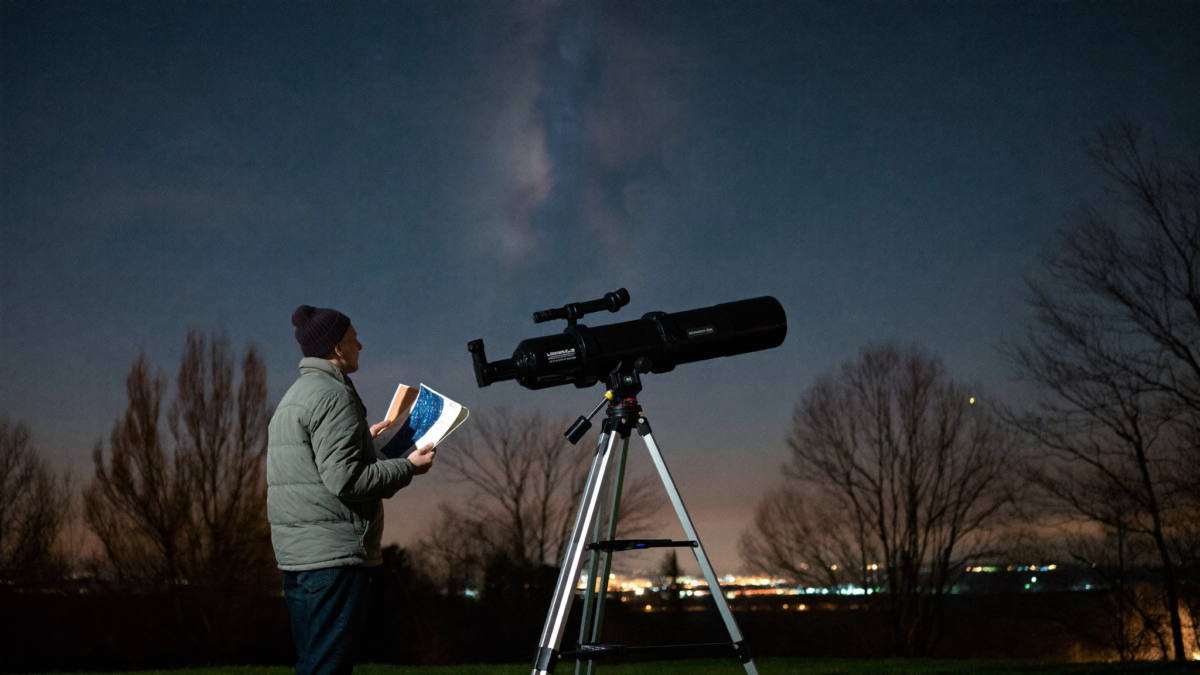
Quick Answer: The Messier catalog is a list of 110 deep-sky objects — galaxies, star clusters and nebulae — assembled by an 18th-century French comet hunter who was trying to remember which fuzzy patches were not comets. If you want the single best place to start, begin with M45 (the Pleiades) and M42 (the Orion Nebula): they are the two brightest objects on the list, they are both winter targets, and they are the only two that reliably look impressive from an ordinary suburban backyard with modest equipment.
I came back to amateur astronomy at 50 after a career built on an engineering degree from Penn State, and the Messier list is what gave my observing sessions a spine. Before that I was wandering around the sky with no plan. What follows is the version of this guide I wish I’d had — not just the 110 names and coordinates, which you can get anywhere, but an honest answer to the question every beginner actually asks: which of these can I really see, from my yard, with the telescope I own?
What is the Messier catalog?
The Messier catalog is a numbered list of 110 permanent deep-sky objects, designated M1 through M110, compiled between 1764 and 1781 by the French astronomer Charles Messier (1730–1817) with substantial help from his colleague Pierre Méchain. Every entry is a galaxy, star cluster, nebula, or — in three amusing cases we’ll get to — something that turned out not to be a deep-sky object at all.
Two things make it the default beginner’s list, roughly 250 years later. First, everything on it was found with the equipment of the 1770s, which means it is all bright enough to be within reach of a modern beginner’s telescope. Second, it covers a genuine variety: you get open clusters, globular clusters, emission nebulae, planetary nebulae, a supernova remnant and forty-odd galaxies, so working the list teaches you what each class of object actually looks like through an eyepiece.
The type breakdown
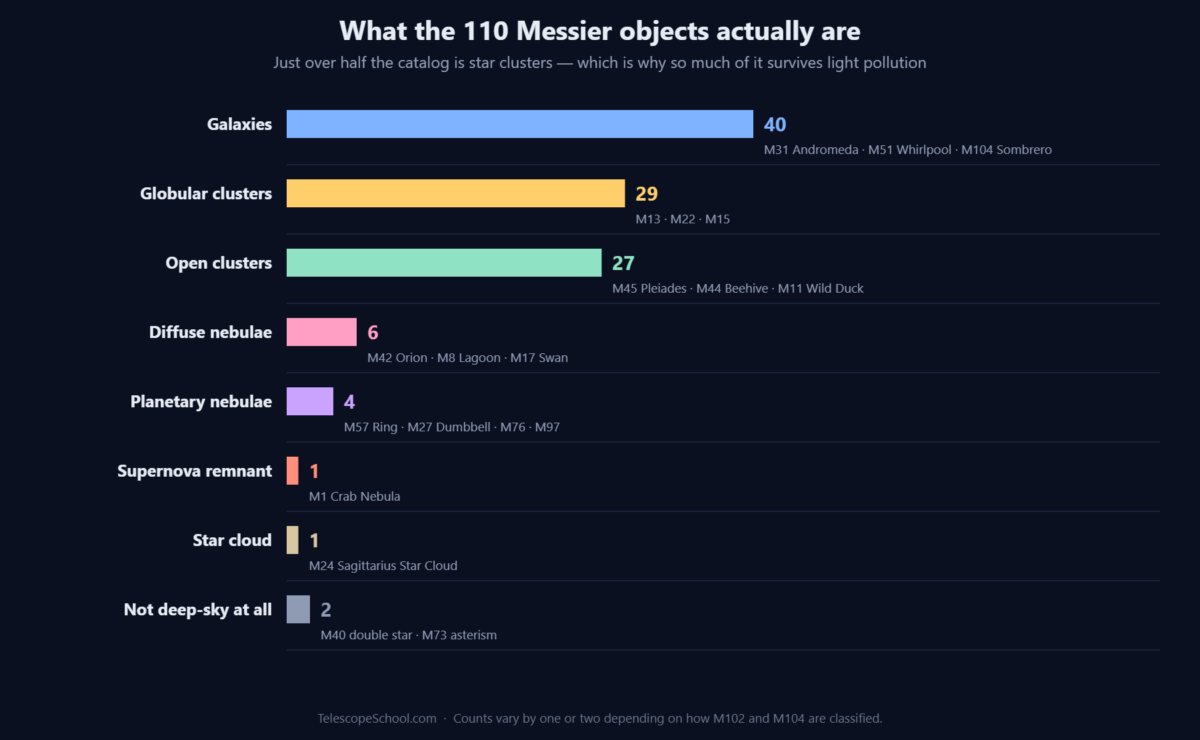
| Object type | Count | Examples |
|---|---|---|
| Galaxies | ~40 | M31 Andromeda, M51 Whirlpool, M104 Sombrero |
| Globular clusters | 29 | M13, M22, M15 |
| Open clusters | ~27 | M45 Pleiades, M44 Beehive, M11 Wild Duck |
| Diffuse (emission/reflection) nebulae | 6 | M42 Orion, M8 Lagoon, M17 Swan |
| Planetary nebulae | 4 | M57 Ring, M27 Dumbbell, M76, M97 |
| Supernova remnant | 1 | M1 Crab Nebula |
| Star cloud | 1 | M24 Sagittarius Star Cloud |
| Not actually deep-sky objects | 2 | M40 (double star), M73 (asterism) |
You will find slightly different counts on different websites, and the disagreement is not sloppiness — it comes from how each source classifies M102 (a probable duplicate) and whether M104’s galaxy type is counted separately. Treat the numbers above as approximate to within one or two in each row.
Why a comet hunter made the most famous list in astronomy
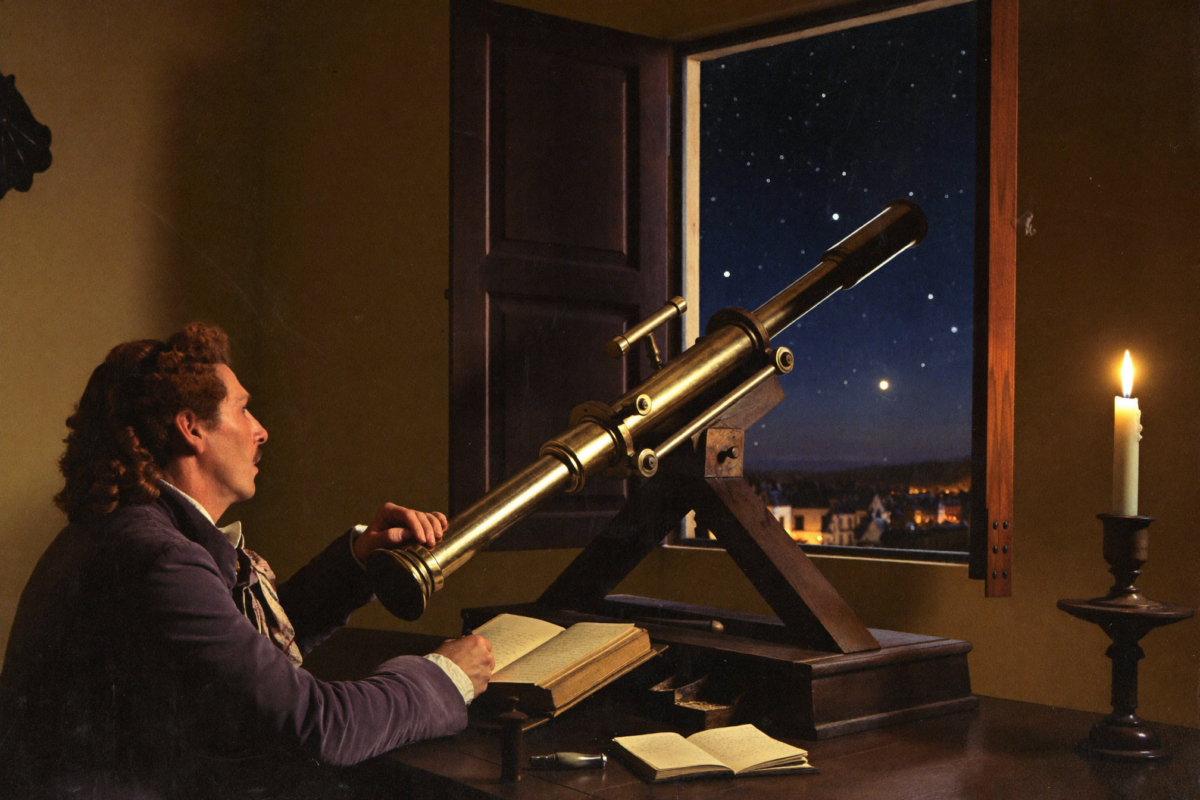
Charles Messier hunted comets for a living, and he was good at it — he is credited with around 13 discoveries. The problem with comet hunting through an 18th-century refractor is that a distant comet looks like a small grey smudge, and the sky is full of small grey smudges that never move. Messier kept re-finding the same permanent fuzzy objects, getting briefly excited, and then watching them sit still night after night.
So around May 1764 he started keeping a record of the false alarms. The catalog was never intended as a tour of the sky’s greatest hits. It is, quite literally, a list of things to ignore — which is one of the better ironies in science, because it became the most-used observing list ever compiled.
How the list grew from 45 objects to 110
Messier published his work in three stages:
- 1774 — a preliminary catalog of 45 objects (M1–M45), of which he had discovered 18 himself.
- 1780 — an expanded edition of roughly 70 objects. Sources disagree on whether the exact figure is 68 or 70; I have not been able to settle it against the original Connaissance des Temps scan, so I’m leaving it hedged rather than picking one and pretending.
- 1781 — the final version Messier himself published, containing 103 objects.
That last number is the one worth remembering, because it explains a question that trips up a lot of beginners: if Messier published 103, why does everyone say 110? The remaining seven were added in the 20th century by later astronomers who found notes in Messier’s and Méchain’s own manuscripts describing objects they had observed but never formally listed:
| Object | Added by | Year |
|---|---|---|
| M104 (Sombrero Galaxy) | Camille Flammarion | 1921 |
| M105, M106, M107 | Helen Sawyer Hogg | 1947 |
| M108, M109 | Owen Gingerich | 1960 |
| M110 | Kenneth Glyn Jones | 1967 |
So the catalog you’ll use tonight is a collaboration across two centuries. Messier wrote 103 of it; four other astronomers finished it.
The three entries that aren’t deep-sky objects
Three catalog numbers are famous mistakes, and knowing them makes you look like you’ve done your homework at a star party.
- M40 is a double star in Ursa Major, also known as Winnecke 4, around magnitude 8.4. Messier went looking for a nebula another observer had reported, found only two close stars, and catalogued them anyway.
- M73 is an asterism in Aquarius — four unrelated stars around magnitude 9 that happen to line up from our viewpoint. There is no cluster there.
- M102 is a probable duplicate. Méchain reported it, then later concluded he had re-observed M101. Most observers today accept the galaxy NGC 5866 in Draco as M102, largely so the catalog totals a satisfying 110.
Don’t skip them. They’re quick, they’re part of the history, and M40 in particular is a nice reminder that the people who built modern astronomy were working at the edge of what their equipment could resolve.
Why there are no far-southern Messier objects
Messier observed from central Paris, at about 49° north latitude, which means large parts of the southern sky simply never rose for him. The catalog therefore covers the sky from the north celestial pole down to roughly declination −35°, and no further. The southernmost entry is M7, Ptolemy’s Cluster, at about −34°49′ in Scorpius.
This is why the Messier list contains none of the southern showpieces — no Large or Small Magellanic Cloud, no Omega Centauri, no 47 Tucanae. It is a northern-hemisphere list by accident of geography. If you observe from the northern US as I do, that’s convenient: almost everything on the list is reachable. M7 is the exception and it is genuinely hard from my latitude in Pennsylvania, sitting low in the summer murk. From about 45°N and above it barely clears the horizon at all.
What equipment do you actually need?
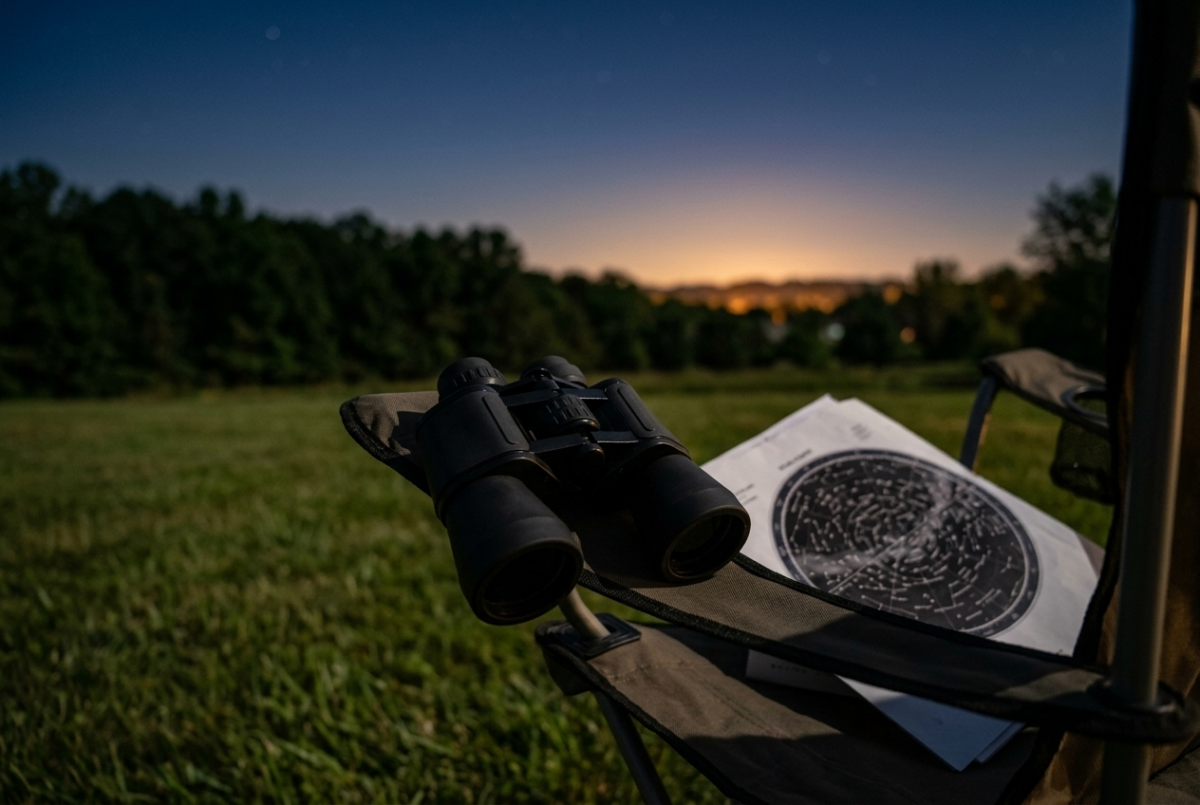
Here is the fact that reframes this whole question: Messier found these objects with a refractor of about 100mm aperture — a 4-inch telescope — from the middle of Paris. Not a dark site. A city, with the light pollution a city produced in the 1770s, which was admittedly a lot gentler than mine.
The engineering read on that is straightforward. A 4-inch telescope can reach every object in the catalog. What larger aperture buys you is not access, it’s detail and contrast — the difference between confirming a grey smudge is there and actually seeing structure in it. That distinction matters because a lot of beginners are told they need an 8-inch scope to “do Messier objects,” get discouraged by the price, and quit. You don’t. You need patience, a dark-adapted eye, and a chart.
Roughly, here’s what each tier of equipment gets you:
| Equipment | Messier objects realistically reachable | What it’s good for |
|---|---|---|
| Naked eye, dark site | About 5–8 | M45, M31, M44, M42, M7, M8 |
| 10×50 binoculars | 50+ | Open clusters, the brighter globulars, big nebulae |
| 60–80mm refractor | 60–80 | Clusters and planetary nebulae; galaxies stay faint |
| 4–6 inch reflector | All 110, with effort (from a dark site) | The whole catalog becomes possible |
| 8 inch+ Dobsonian | All 110, comfortably (from a dark site) | Structure in galaxies, resolved globulars |
The binocular row is not marketing optimism. The Astronomical League’s Binocular Messier Program rates 42 objects as “easy” in binoculars as small as 20–50mm, and every one of the 76 objects in their small-binocular appendix was logged with a $19 pair of 7×35 Tasco binoculars bought at Wal-Mart. A decent pair of 10×50 binoculars is the highest-value first purchase in this hobby, and it isn’t close. If you already own a telescope, see our guide to the top 10 things to see with binoculars before you spend anything else.
If you’re ready to step up, an 8-inch Dobsonian is the classic Messier machine — cheap per inch of aperture, no electronics to fail, and enough light grasp that galaxies start showing shape. I’ve written a full review of the Sky-Watcher 8-inch Dobsonian and a broader Dobsonian buying guide, and there’s an aperture explainer if you want the underlying math. For a general starting point, the Apertura AD8 8-inch Dobsonian covers the entire catalog for life.
Magnitude versus surface brightness — the thing that decides what you’ll see
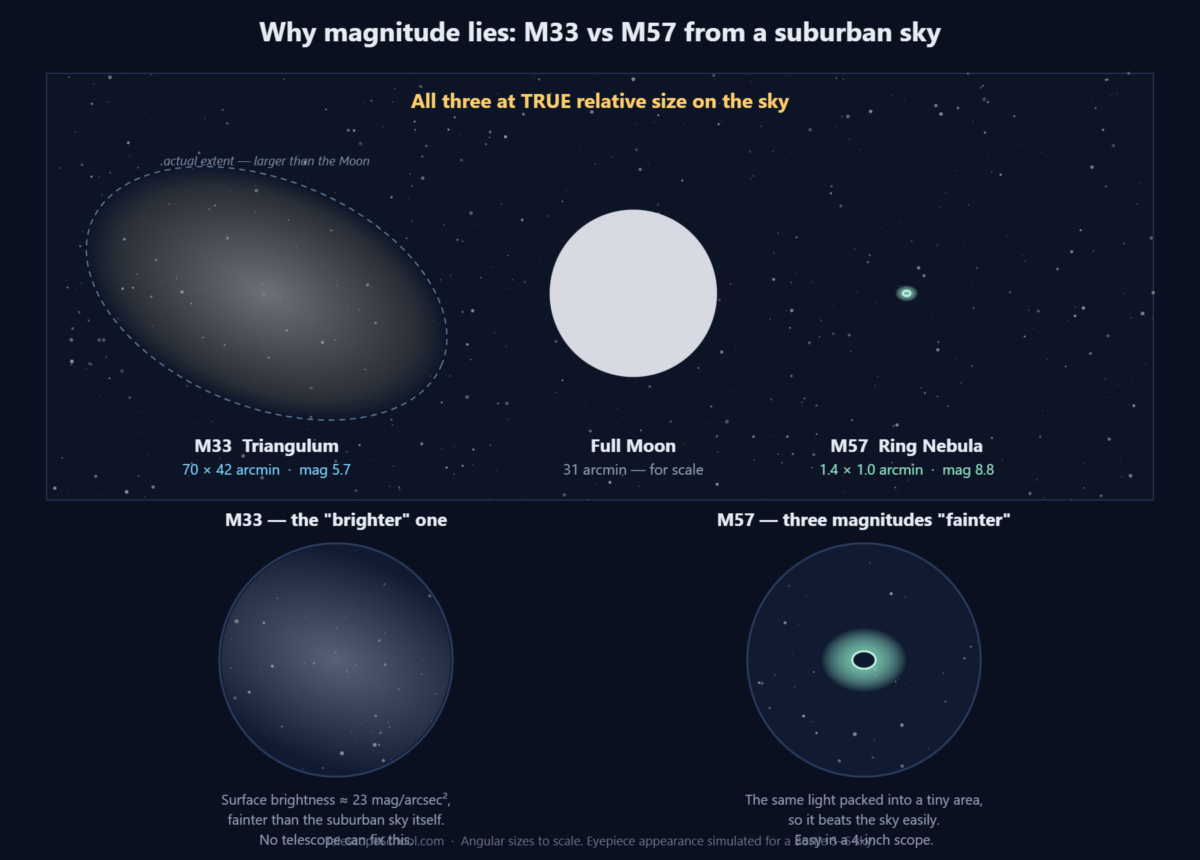
This is the section most beginner Messier guides skip, and skipping it is why people give up. Nearly every list you’ll find prints a magnitude next to each object, and beginners reasonably assume that a lower number means an easier target. For deep-sky objects, that assumption is wrong often enough to ruin your first few nights.
Magnitude for an extended object is integrated magnitude — it’s all the light from the object added together and expressed as if it were squeezed into a single point like a star. But the object isn’t a point. It’s spread across some area of sky, and what your eye actually detects is surface brightness: light per unit area, usually written in magnitudes per square arcsecond.
The textbook example is M33, the Triangulum Galaxy. Integrated magnitude about 5.7, which on paper is naked-eye. In practice it is spread across roughly 70 × 42 arcminutes — more than four times the apparent area of the full Moon — giving a surface brightness around 23 magnitudes per square arcsecond. That is fainter than the background glow of a suburban sky. You cannot see an object that is dimmer than the sky it sits on, no matter how large your telescope is, because contrast is what the eye detects, not brightness.
Meanwhile M57, the Ring Nebula, is a full three magnitudes “fainter” at 8.8 — but it’s tiny, so all that light is concentrated. M57 shows up easily in a 4-inch scope from my Bortle 5–6 backyard in York, Pennsylvania, and it takes high magnification well. M33, ten times brighter on paper, has never once been convincing from the same spot.
The practical rule: for each object, look at the magnitude and the angular size together. Small and bright is easy. Large and bright is easy. Large and faint — big galaxies, most notably — is where beginners get crushed. When you can’t find something, the honest question is usually not “is my telescope good enough” but “does this object have enough surface brightness to beat my sky?”
The 12 Messier objects to start with
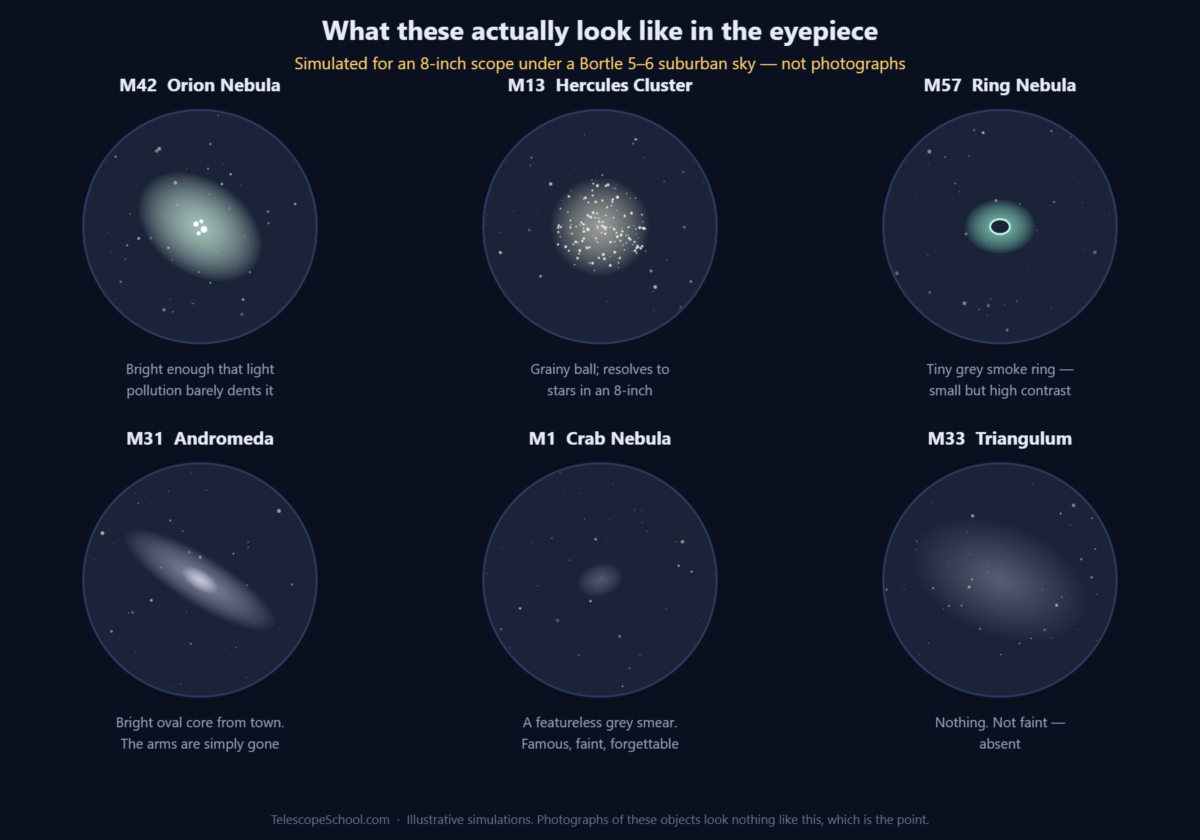
If you observe these twelve in roughly this order over the course of a year, you’ll have learned every object type in the catalog and built the star-hopping skills to find the rest. Magnitudes are approximate and seasons assume mid-evening viewing from mid-northern latitudes.
| Object | Type | Mag | Best season | Smallest gear that works | What you actually see |
|---|---|---|---|---|---|
| M45 Pleiades | Open cluster | ~1.6 | Nov–Feb | Naked eye | Six or seven blue-white stars; dozens in binoculars. Too big for most telescopes. |
| M42 Orion Nebula | Emission nebula | ~4.0 | Dec–Mar | Binoculars | Grey-green wings of gas with the four-star Trapezium at the core. The best object on this list. |
| M31 Andromeda | Spiral galaxy | ~3.4 | Sep–Dec | Naked eye (dark sky) | An elongated glow. Spiral arms need a dark site; from town it’s a bright oval core. |
| M44 Beehive | Open cluster | ~3.7 | Feb–Apr | Binoculars | Loose scatter of 30+ stars. Use your lowest power — a telescope can’t fit it. |
| M13 Hercules Cluster | Globular cluster | ~5.8 | May–Aug | Binoculars | Fuzzy ball at low power; grainy in a 6-inch; resolves to individual stars at 8 inches. |
| M57 Ring Nebula | Planetary nebula | ~8.8 | Jul–Sep | 4-inch scope | A tiny grey smoke ring. Small but high contrast — push the magnification. |
| M27 Dumbbell | Planetary nebula | ~7.4 | Jul–Sep | 4-inch scope | A soft rectangular or apple-core patch about 8 arcminutes across. |
| M11 Wild Duck | Open cluster | ~6.3 | Jul–Sep | Binoculars | The densest open cluster in the catalog — looks almost globular at low power. |
| M81 / M82 | Galaxy pair | ~6.9 / 8.4 | Feb–May | 4-inch scope | Two galaxies in one low-power field, 31 arcminutes apart. M81 oval, M82 a thin streak. |
| M104 Sombrero | Spiral galaxy | ~8.0 | Mar–May | 6-inch scope | The easiest galaxy to see structure in — the dust lane shows at 6–8 inches. |
| M51 Whirlpool | Spiral galaxy | ~8.4 | Mar–Jun | 6-inch, dark sky | Two cores from the suburbs; spiral arms only from genuinely dark sky. |
| M7 Ptolemy’s Cluster | Open cluster | ~4.1 | Jun–Aug | Binoculars | Big, bright, low. Needs an unobstructed southern horizon — hard above ~45°N. |
A seasonal warning that saves a lot of frustration: those seasons assume you’re outside between about 10pm and midnight. If you observe at 3 or 4 in the morning, shift everything forward roughly one season — the summer objects are already up in spring pre-dawn. Our seasonal deep-sky guide breaks the year down month by month.
Which Messier objects actually work from suburban skies
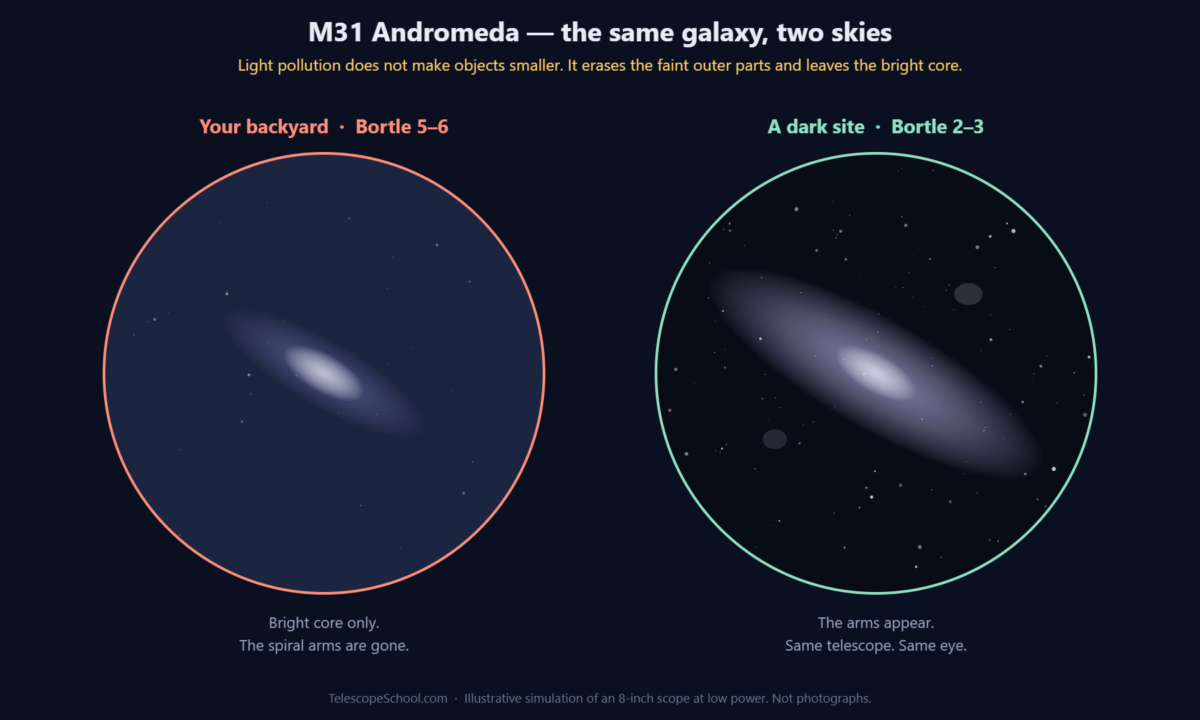
I observe from York, Pennsylvania, which sits at roughly Bortle class 5 to 6 depending on which direction I’m looking and how much haze is holding the town’s lights up. That’s the sky most American readers of TelescopeSchool have. Here’s the honest sort.
Reliable from Bortle 5–6
All the open clusters — M45, M44, M11, M35, M36, M37, M38, M6, M7 if it clears your trees. Clusters are made of stars, and stars punch through light pollution far better than diffuse glow does. All the bright globulars: M13, M22, M15, M5, M92. The compact planetary nebulae M57 and M27. And M42, which is bright enough that light pollution barely dents it.
That’s already 20-odd objects that look genuinely good from a suburban backyard, which is more than enough to fill a first year.
Possible but underwhelming
The brighter galaxies — M31, M81, M82, M104, M51, M64, M65/M66. You will find them. They will be faint grey ovals without much structure. This is not a failure of your telescope; it’s the sky. The core of M31 is easy from town, but the arms that make the photographs are gone.
Effectively out of reach without a dark site
M33, M74, M101, M98, M99, M109 — the large, low-surface-brightness face-on galaxies. Also the sprawling nebulae M8, M17 and M20 lose most of their extent, though a narrowband filter helps these specifically. Don’t measure yourself against these from a suburban yard.
If you want the full treatment of what light pollution does and doesn’t cost you, I’ve written a dedicated guide to the Bortle scale and a companion piece on the best objects to observe from light-polluted skies.
The Messier objects that will disappoint you first
Nobody warns beginners about this and they should. Some catalog entries are historically important and visually dull, and hitting three of them in a row on your second night is how people conclude they’re bad at this.
- M1, the Crab Nebula. It’s a supernova remnant, it’s the first object in the catalog, and from the suburbs it is a featureless grey smear. Famous, faint, forgettable in the eyepiece.
- M33, the Triangulum Galaxy. Covered above — the magnitude number lies.
- M74 and M101. Both beautiful face-on spirals in photographs, both notorious as two of the hardest visual objects in the entire catalog.
- M40. Two stars. That’s it. Enjoy the history.
- M73. Four stars in a Y shape. Same deal.
Save these for when you’ve got some confidence and a dark night. There’s no rule that says you have to work the list in numerical order, and M1 being first is an accident of Messier’s comet-hunting schedule, not a recommendation.
I should be straight with you about my own progress here. I am somewhere around 50 to 60 percent of the way through the list, and that has taken years — not because the objects are beyond the equipment, but because of where I live. From my backyard in York, Pennsylvania, one or two genuinely usable nights a week is a good average once cloud, summer haze and the Moon have taken their cut. Star-hopping from a suburban sky, five new objects in a session is a decent night, not a slow one. Do that arithmetic and a year gets you a long way into the catalog — but it does not get you to 110, and no amount of patience from this backyard will.
What is left splits into two piles, and they need two different things. The first pile is the faint, spread-out galaxies I sorted into the out-of-reach group above. Those are not beaten by aperture or by effort — they are beaten by the light dome, and the only real fix is to drive away from it.
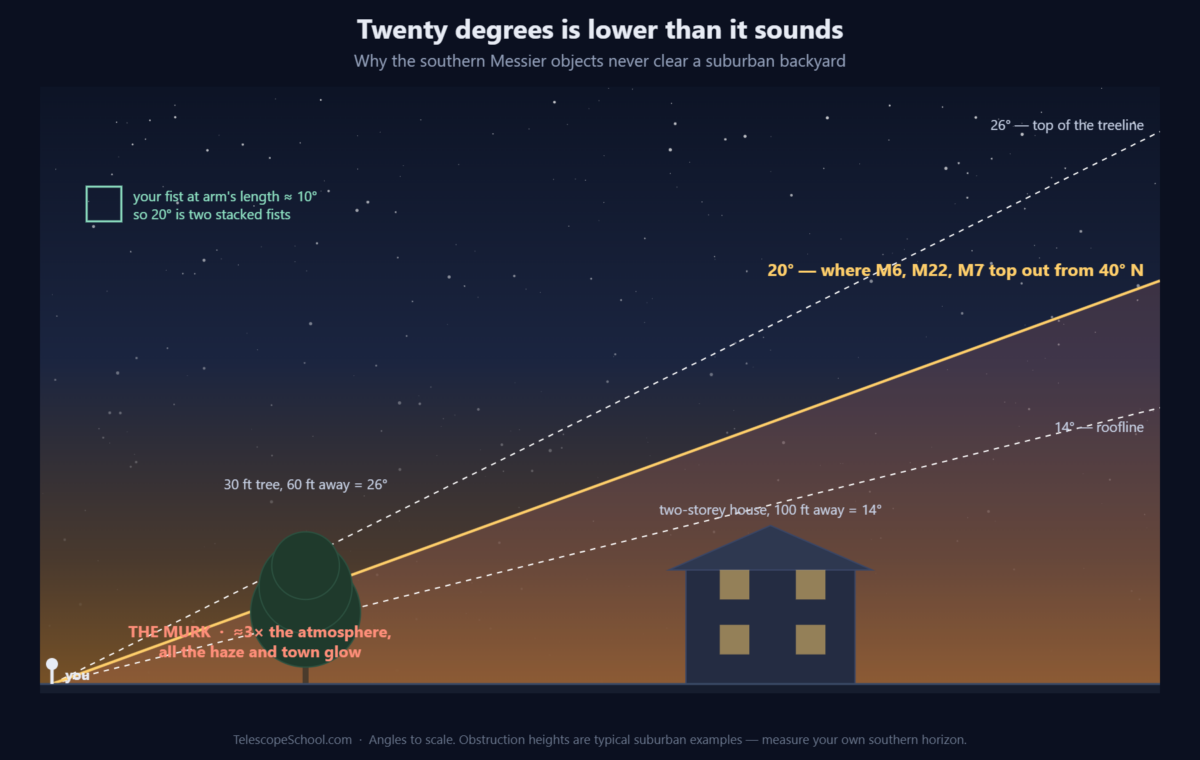
The rest are a problem with my horizon, not with the objects. Anything that far south — M7, M69, M70, M55, M83 — never climbs more than about 20° above my horizon, and 20° at my house is a treeline, a neighbour’s roofline, and a streetlight throwing glare across everything underneath it. Twenty degrees is not as high as it sounds: hold your fist out at arm’s length and it covers about 10°, so we are talking two stacked fists above flat ground. Even with a perfectly clear sightline I would be looking through roughly three times as much atmosphere as something overhead, and that low, thick air is exactly where the humidity and the town glow live. Realistically those objects come off the list on a trip — a dark-sky vacation, or a week somewhere further south with an open horizon — not on a Tuesday at home.
Your site is not my site. Before you blame the telescope, go out and look at what your southern horizon actually gives you: a two-storey house 100 feet away blocks about 14°, and a 30-foot tree 60 feet away blocks about 26°. Plenty of northern observers have never seen M6 or M22 and quietly assume they must be faint. M22 is brighter on paper than M13, and it would be one of the famous ones if it sat higher in the sky. It is not faint. It is behind their neighbour’s garage.
One more thing about the nights that do cooperate. When a clear, moonless evening finally lands, the thing eating the session is not looking — it is finding. Fifteen minutes of star-hopping per object is fifteen minutes you are not spending at the eyepiece, and across a three-hour window that is most of your night gone to hunting. A GoTo mount flips that ratio, but only once it is set up correctly: a rushed or sloppy alignment will point you at empty sky and cost you more time than it ever saves, while a careful one takes about ten minutes at the start of the night and then drops object after object into the field in seconds. On a sky like mine, where good nights are the scarce resource, that trade is worth taking seriously — we work through whether it is worth the money in are computerized GoTo telescopes worth the price.
How to work through the whole catalog
First, the math nobody shows you
Every guide that tells you to “work through the catalog” quietly assumes you live somewhere with dark skies and a lot of clear nights. Most of us do not, so run the numbers on your own sky before you commit to the whole list.
Run the pace I described above against your own sky and it comes out at something like 40 dark, clear, actually-available nights a year — a couple of hundred observations, which on paper makes 110 look easy.
Most of the list is genuinely within reach — it is the tail that gets you. Spread those nights across all four seasons and a year of steady observing takes a real bite out of the catalog, because you cannot bank Sagittarius objects in January no matter how clear it is. But somewhere past the two-thirds mark the pace stops being about nights and starts being about sky: what is left is either too faint for a light-polluted backyard or too low in the south to clear the haze, and neither of those yields to another year of trying.
The geometry makes it worse in one specific place. The densest concentration of Messier objects anywhere in the catalog sits in Sagittarius and Scorpius, and from 40° north none of that region climbs much above 20° above the horizon. You are looking through the thickest slice of atmosphere available, low in the south, in July and August, when humidity turns that part of the sky into a lit wall of haze. The richest part of the list is the part our summer hides. A darker site fixes this; nothing you do from the backyard will.
Where GoTo actually helps — and where it does not
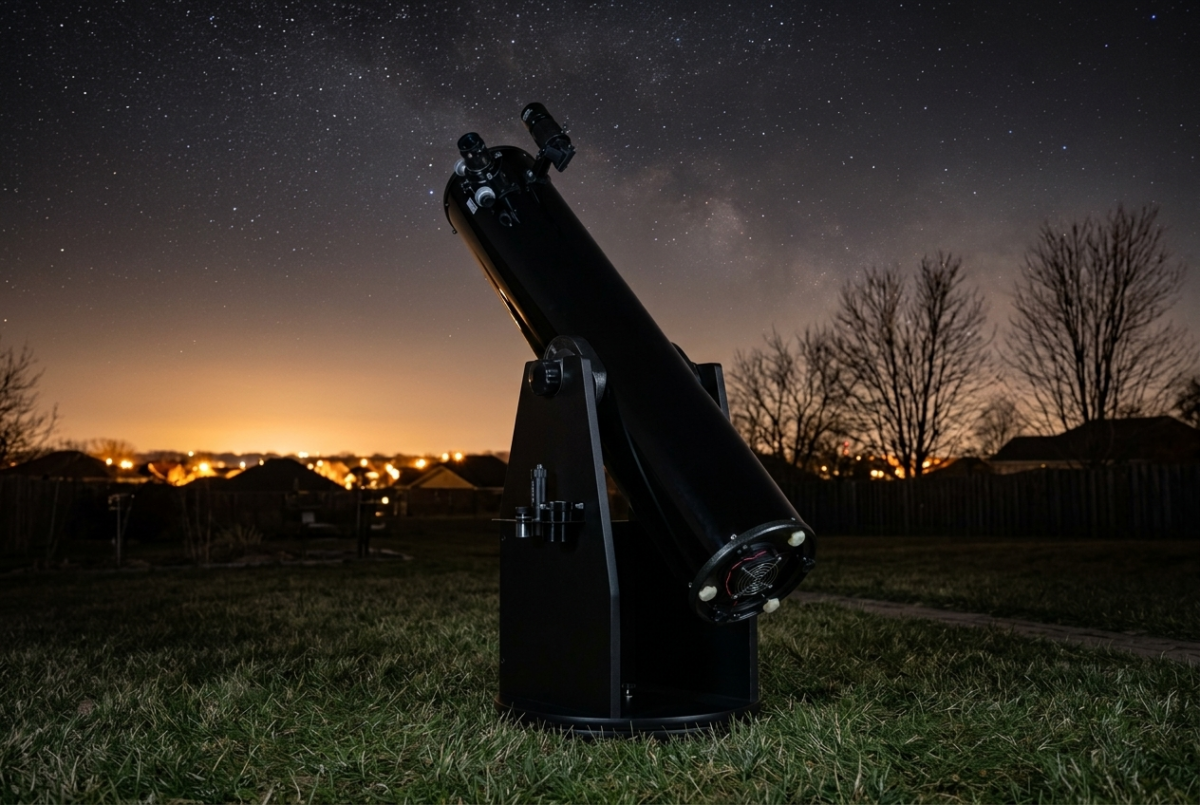
This is the honest case for a computerized mount, and it has nothing to do with laziness. Star-hopping depends on seeing the 4th- and 5th-magnitude guide stars you are hopping between. From a light-polluted backyard, half of them simply are not there — you are not failing at the technique, you are missing the map. A GoTo mount can turn a fifteen-minute hunt into a ninety-second slew, and on a night with three usable hours before dew or cloud wins, that is the difference between five objects and twenty. We go through the trade-offs in are computerized GoTo telescopes worth the price, and the cheaper middle road — phone-guided push-to — in our StarSense Explorer review.
But be clear about what it buys you. GoTo raises how many objects you can reach in a night. It does not raise the ceiling. It will not make M74 appear in a suburban eyepiece, and it will not lift Sagittarius higher in the sky. It is an accelerator, not a cure — and there is one more catch worth knowing before you buy: the Astronomical League’s standard Messier certificate requires you to find the objects without GoTo assistance. If the certificate is the goal, the slow way is the only way. If simply seeing as much as possible is the goal, GoTo is the biggest single accelerator available to you.
None of which means don’t chase the list. It means chase it with the right expectation: you will finish the objects your sky allows, and the rest will take a trip somewhere darker rather than another year of patience.
The three approaches
With the expectations set, here are three ways to actually work the list, in increasing order of ambition.
1. Season by season (recommended)
Pick the objects that are well-placed this month, learn the constellation they sit in, and star-hop to them. Over a couple of years this walks you through everything your sky is willing to give you, and — more importantly — you’ll actually know the sky at the end of it rather than having pushed a GoTo button 110 times. Our star-hopping guide covers the technique, and a red flashlight is essential kit for reading charts without wrecking your dark adaptation.
2. The Astronomical League observing programs
If you like having a target, the Astronomical League issues a certificate for observing 70 of the 110 without GoTo assistance, and an honorary award for all 110. There’s a separate Binocular Messier Program with a certificate at 50 objects. It’s free structure, and the requirement to log what you saw makes you a better observer — writing down “faint oval, no structure, averted vision only” forces you to look properly.
3. The Messier Marathon
Once a year it is possible to observe all 110 objects between dusk and dawn in a single night. This works because of a quirk in how the objects are distributed: there is a wide gap in right ascension — roughly 21h40m to 23h20m — containing no Messier objects at all. In late March the Sun sits in that empty stretch, so nothing is lost to daylight. You also need a moonless night, and the geometry works best from around 25°N latitude.
The first confirmed sweep of all 110 in one night was by Gerry Rattley from Dugas, Arizona, on the night of 23–24 March 1985. For 2027, the primary marathon weekend falls around April 3, with a secondary window near March 6. Check a current marathon planner against your own latitude before committing to a night — these dates shift with the lunar cycle each year.
Frequently asked questions
How many Messier objects are there?
There are 110 Messier objects, numbered M1 through M110. Charles Messier himself published 103 in the final 1781 edition of his catalog; the remaining seven were added between 1921 and 1967 by later astronomers working from notes in Messier’s and Méchain’s original manuscripts.
Can you see Messier objects with binoculars?
Yes — around 50 of the 110 are within reach of ordinary 10×50 binoculars from a reasonably dark site, and the Astronomical League rates 42 as “easy” in binoculars as small as 20–50mm. Open clusters and the brighter globular clusters work best; small planetary nebulae like M57 need a telescope.
What is the easiest Messier object to find?
M45, the Pleiades, at about magnitude 1.6 — it’s the brightest object in the catalog and visible to the naked eye from almost anywhere. For the most rewarding first telescope target, M42 (the Orion Nebula) is the better answer: it’s bright, it’s easy to locate below Orion’s belt, and it’s the one object on the list that shows real structure in a small scope.
Do I need a telescope to observe the Messier catalog?
Not for all of it. About five to eight objects are naked-eye from a dark site, and roughly 50 are binocular targets. For the remaining objects — most of the galaxies and the smaller planetary nebulae — you need a telescope. A 4-inch aperture can technically reach all 110, since that’s roughly what Messier used from Paris; a 6- to 8-inch makes them look like something rather than a smudge.
What is the hardest Messier object to see?
M74 and M101 are widely considered the toughest — both are large, face-on spiral galaxies with very low surface brightness, meaning their light is spread so thin it barely rises above the background sky. M33 and M98/M99 are close behind. All of them require genuinely dark skies rather than a bigger telescope.
Which Messier objects can I see from a light-polluted backyard?
From Bortle 5–6 suburban skies, expect reliable views of the open clusters (M45, M44, M11, M35–M38), the bright globulars (M13, M22, M15, M5, M92), the compact planetary nebulae M57 and M27, and M42. Bright galaxies like M31, M81 and M104 are findable but will look like featureless grey ovals. Large diffuse galaxies such as M33 and M101 are effectively out of reach without traveling to a darker site.
Where to go from here
The Messier catalog’s real value isn’t the 110 objects. It’s that it turns “go outside and look at space” into a finite, ordered task with a finish line — which is exactly what a new observer needs when the sky is overwhelming and every faint smudge looks the same. Start with M45 and M42 this winter, add M13 and M57 next summer, and let the list teach you the sky.
When you’re ready for the next step, TelescopeSchool has guides on choosing eyepieces, how much magnification your telescope can actually deliver, and — once you’ve had your fill of faint fuzzies — observing Jupiter and its moons, which rewards exactly the opposite conditions.
Prices, availability and event dates referenced here are approximate and current as of August 2026. Astronomical dates should be checked against a current ephemeris for your own location before you plan a night around them.
From a Bortle 5-6 backyard only part of this catalogue is realistically within reach. Knowing which part saves a lot of frustrating nights.
These May Help Too...
Can You Use a Telescope Through a Window? (And Why You Should Not)
Using a telescope through a window ruins the view: bad glass, heat currents and reflections. Here is what actually happens, and what to do instead.
Telescope will not come to focus? The cause is almost always spacing, not optics. Work out whether you ran out racking in or out, then fix that end.