

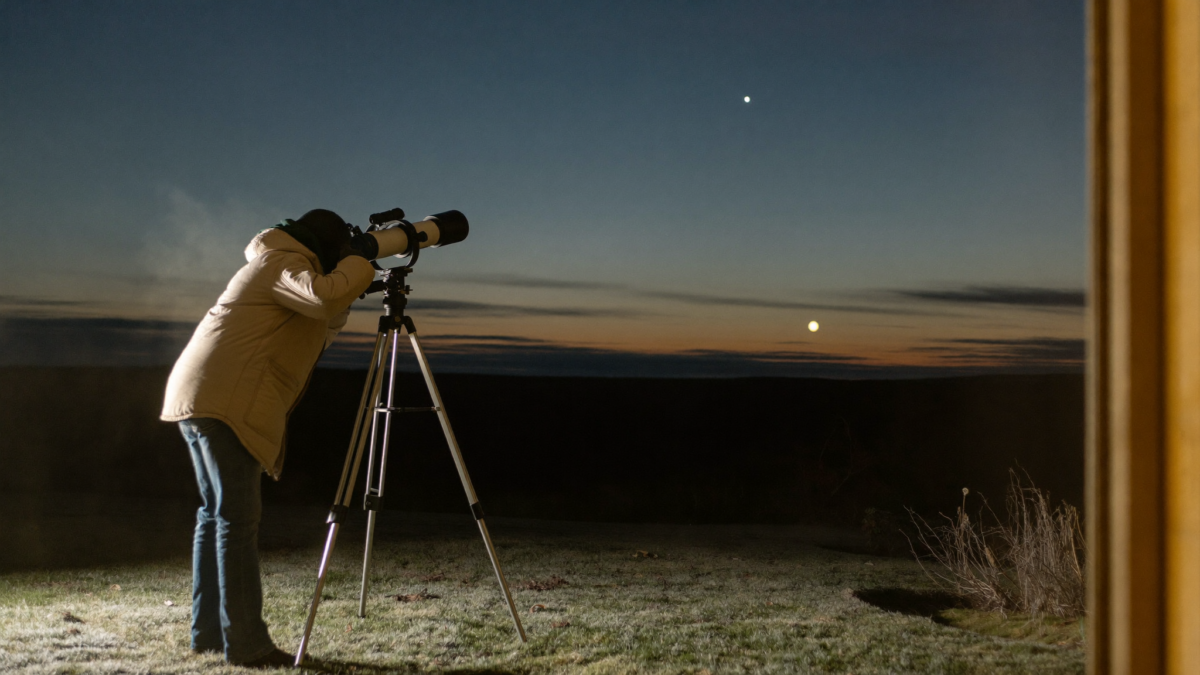
Quick Answer: Point any telescope at Jupiter and you will see two dark equatorial belts and up to four Galilean moons strung out in a line — the belts snap into view around 75x in a 60 to 80mm scope, and the moons are visible in ordinary 10×50 binoculars. The catch as of August 2026 is timing: Jupiter is a pre-dawn object right now, and it does not return to convenient evening viewing until mid-December.
I mention that up front because nearly every guide to observing Jupiter you will find online was written for a different year and quietly tells you to look after dinner. Let’s start with where the planet actually is, then get into what to do once you find it.
Where is Jupiter right now? (August–December 2026)
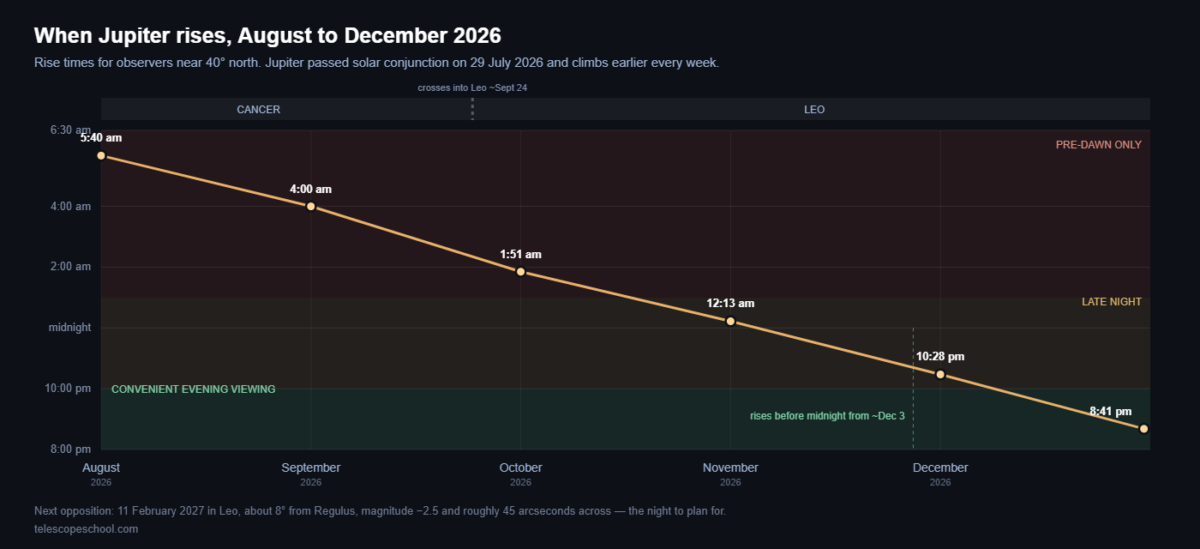
Jupiter passed solar conjunction on July 29, 2026 and is climbing back into the morning sky. Here is the honest schedule for observers around 40° north:
| Month | When to look | Rise time | Constellation |
|---|---|---|---|
| August 2026 | Just emerging, very low ENE in bright twilight | ~5:40 am | Cancer |
| September 2026 | Pre-dawn, low; workable in the last hour before sunrise | ~4 am | Cancer → Leo (~Sept 24) |
| October 2026 | Morning only — decent altitude by 4 am | 1:51 am | Leo |
| November 2026 | Late night into morning | 12:13 am | Leo |
| December 2026 | Rises before midnight from ~Dec 3; a real evening target by late month | 10:28 pm → 8:41 pm | Leo |
Jupiter’s next opposition is February 11, 2027, in Leo about 8 degrees from Regulus, at magnitude −2.5 and roughly 45 arcseconds across. That is the night to plan for. Between now and then Jupiter brightens steadily from about −1.9 and 33 arcseconds in October to −2.4 and 43 arcseconds by New Year’s Eve.
You will not need a star chart to identify it. Jupiter is the brightest thing in that part of the sky by a wide margin, it does not twinkle the way stars do, and once Leo is up it sits unmistakably near Regulus. Our star-hopping guide covers the technique if you want it, but Jupiter genuinely does not require it.
What equipment do you need to see Jupiter’s moons?
Less than you think. This is the great gateway object of amateur astronomy — Galileo found the moons in 1610 with an instrument worse than a modern toy telescope.
- Naked eye: Jupiter itself, as a brilliant non-twinkling “star.” No moons.
- Binoculars, 7×50 minimum: two to four moons as tiny points. 10×50 has a clear advantage over 7×50 because the extra magnification separates the moons from Jupiter’s glare. Bracing matters more than aperture — lean against a doorframe or fence, or the moons will dance out of view.
- 60–80mm telescope at ~75x: the two main equatorial belts, all four moons, and shadow transits as sharp black dots.
- 6-inch (150mm): temperate belts, easy shadow transits, moon transits become feasible.
- 8-inch (203mm) and up: festoons, white ovals, subtle color differences between the moons themselves.
A quick word on magnification, because this is where beginners go wrong. There is no magic “50x for the belts” threshold, despite how often you’ll read it. What is true: the belts become obvious somewhere in the 50x to 100x range, full detail and the Great Red Spot want around 150x, and pushing past about 200x is usually pointless from a typical backyard because atmospheric seeing — not your optics — is the limit. Sky & Telescope’s own guidance is that you will rarely use more than 40x per inch of aperture. See our magnification guide for the full picture.
The four Galilean moons, in order
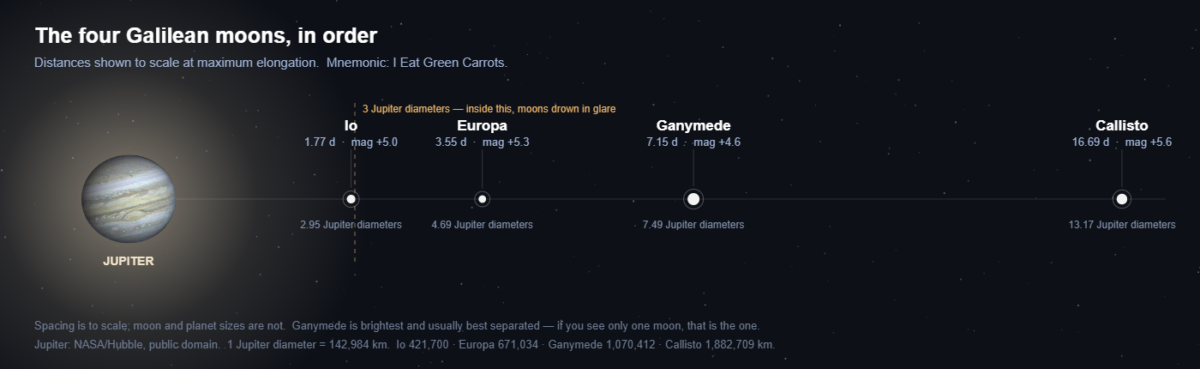
Working outward from Jupiter: Io, Europa, Ganymede, Callisto. A useful mnemonic is “I Eat Green Carrots.”
| Moon | Orbital period | Magnitude | Apparent disk | Notes |
|---|---|---|---|---|
| Io | 1.77 days | +5.0 | 1.2″ | Fastest — visibly moves in a single evening. Hardest in binoculars. |
| Europa | 3.55 days | +5.3 | 1.0″ | Smallest of the four. Casts a pinprick shadow. |
| Ganymede | 7.15 days | +4.6 (brightest) | 1.7″ | Largest moon in the solar system. Shadow looks like a bullet hole. |
| Callisto | 16.69 days | +5.6 (faintest) | 1.5″ | Ranges furthest out; often the lone moon far from the pack. |
Here is the counterintuitive bit nobody explains: brightest does not mean easiest. Io is the second-brightest moon but the hardest to spot in binoculars, because it never strays more than about three Jupiter-diameters from the planet and gets lost in the glare. Ganymede is the easiest of the four — bright and usually well separated. If you can only see one moon, that’s the one you’re looking at.
Io, Europa and Ganymede are locked in a 4:2:1 orbital resonance — for every four Io orbits, Europa completes two and Ganymede one. That is why the configuration you see tonight will look genuinely different tomorrow.
How to tell which moon is which tonight
The moons all look identical — four white dots. Identifying them requires a chart, and the standard free tool is Sky & Telescope’s Jupiter’s Moons utility, which covers 1900 to 2100 and shows the configuration for any date and time. Stellarium (desktop or the free web version) does the same thing.
The step beginners get wrong is the orientation setting, and it matters enormously — pick the wrong one and your chart is a mirror image of what you’re seeing. The tool offers three modes:
- Direct (north up, east left) — matches star atlases and naked-eye/binocular views.
- Inverted (south up, west left) — matches a Newtonian reflector, including any Dobsonian.
- Mirror reversed (north up, west left) — matches an SCT, Maksutov or refractor used with a star diagonal.
Set that correctly first, and the identification becomes trivial. If your view still doesn’t match, our explainer on why telescope images are upside down or reversed will sort you out.
From experience: what surprised me was how obvious the moons are, and how alive the whole system feels. They are little points strung out in a line beside the planet — and if you catch a transit, that tiny pitch-black shadow genuinely moves across Jupiter while you sit there watching it.
Shadow transits: the best show Jupiter puts on
When a moon passes between Jupiter and the Sun, it casts a shadow onto the cloud tops — a perfectly round, jet-black dot crawling across the disk. These happen at least once a week, and double shadow transits once or twice a month. They are the most rewarding Jupiter event available to a small telescope, and far easier than seeing the moons themselves against the disk.
Shadow transit nights worth setting an alarm for — December 2026
All times Eastern. Knock off an hour for each time zone west of you. Two nights are marked east-coast-only — not because the event does not happen, but because Jupiter has not cleared the horizon yet further west, and no amount of arithmetic fixes that.
| Night | Be outside by | What you get |
|---|---|---|
| Dec 1 | 1:30 am | One shadow — Io’s — for a bit over two hours. |
| Dec 8 | 1:15 am | Europa’s shadow first. Io’s joins around 3:30 am — two shadows at once until about 4. |
| Dec 9 | 10:00 pm | One shadow — Io’s — until just after midnight. The only civilised hour all month. East coast only. |
| Dec 16 | 11:45 pm | One shadow — Io’s — past midnight. Not from the Pacific coast. |
| Dec 24 | midnight | The best night of the month. Ganymede’s shadow — the big one — from about midnight. Io’s joins around 1:45 am for two shadows at once until nearly 4. |
| Dec 31 | 4:00 am | Two shadows, Io’s and Ganymede’s, but you are racing dawn. |
Do not treat the start times as a countdown. A shadow takes a few minutes to creep onto the disk and the whole event runs for two to four hours, so being half an hour late costs you nothing. Get set up, get focused, and look for a small perfectly round black dot that was not there twenty minutes ago.
Times computed from the Guide 9.1 Jovian event tables published by Project Pluto and converted from Universal Time. Those tables are global — an event listed there may be below your horizon or in daylight where you live, which is exactly why the December 11 triple transit mentioned below does not work from North America at all.
The aperture ladder:
- 2-inch: Ganymede’s shadow — the biggest.
- 3-inch: the other three shadows.
- 60–80mm: all shadows as sharp black dots.
- 6-inch and up: easy, and the moons themselves become visible on the disk (much harder — a moon in transit is a pale grey smudge against pale cloud, not a dark dot).
- 150x+: the moons start showing actual disks rather than points.
Bob King put the size difference memorably: Ganymede’s shadow looks like a bullet hole, while little Europa’s more resembles a pinprick.
One geometry detail worth knowing: before opposition a moon trails its shadow; after opposition it precedes it. And Callisto’s orbit is tilted about 3 degrees, so it usually misses the disk entirely — except near Jovian equinox, which is happening right now. The 2026–27 season includes a run of mutual events where the moons eclipse and occult each other, and Callisto transits become possible. This is a genuinely unusual observing window.
Two dates worth flagging for late 2026: a waning crescent Moon occults Jupiter on October 6, 2026 (greatest around 10:16 UTC, so pre-dawn from eastern North America) with the Galilean moons disappearing one at a time behind the lunar limb; and on December 11, 2026 there is a rare triple satellite transit — Io, Europa and Callisto simultaneously on the disk for about 18 minutes around 22:35 UTC. Triple transits are genuinely rare — a handful per decade. One catch, and it is a big one: that window falls at 5:33 to 5:53 pm Eastern, and Jupiter is still below the horizon from North America at that hour. Europe and Africa get this one. From Pennsylvania you will be reading other people’s reports, so plan around the October 6 lunar occultation instead.
Finding the Great Red Spot
Sky & Telescope is blunt about this and they are right: for something so famous, the Great Red Spot can be surprisingly difficult to see. Three reasons.
First, it has shrunk. In the 1800s it spanned roughly 41,000 km. Voyager measured about 23,300 km in 1979. Hubble’s recent measurements put it near 16,500 km — the smallest ever recorded, still shrinking around 930 km per year. The old line about it being “three Earths wide” is decades out of date. It is now roughly one Earth wide. A 2024 Hubble study also found it oscillates in size and shape on a roughly 90-day cycle, which the researchers described as jiggling like a bowl of gelatin. Nobody has explained why yet.
Second, it is only on the visible side twice a day. Jupiter rotates in about 9 hours 55 minutes (System II, which is the rotation rate that applies to the Great Red Spot’s latitude). Your observing window is roughly 50 minutes either side of the moment the spot crosses the central meridian. Sky & Telescope publishes a free Great Red Spot transit-time calculator — check it before you set up, or you will spend an hour looking at the wrong hemisphere.
Third, contrast matters more than aperture. The spot’s visibility depends on the South Equatorial Belt beneath it. When the SEB is dark, the spot hides against it; when the SEB fades, the spot darkens and becomes obvious. This varies year to year.
Practically: glimpse it at 50x to 75x in good conditions, see it properly at 100x to 150x. A light blue filter helps. The underlying rule for planetary filters is to choose a color opposite to the feature you want — reddish features like the Great Red Spot and the belts pop under blue. A Wratten 82A (light blue) is the gentle choice for small apertures, 80A (medium blue) for larger ones. Our 80A vs 82A filter comparison covers exactly this choice, and our filter guide covers the rest.
Recommended gear for Jupiter
- 10×50 astronomy binoculars — the cheapest way to see the Galilean moons tonight
- Wratten 82A light blue filter, 1.25″ — for Great Red Spot contrast in small scopes
- 6mm planetary eyepiece — gets most beginner scopes into the 150x range
Watching Jupiter rotate in real time
Here is the observing project I recommend to anyone who thinks planets are a five-minute look. Jupiter’s 9-hour-55-minute rotation is fast enough that features visibly move while you watch. Sketch the disk, wait 20 minutes, sketch it again — the drift is unmistakable. In fact, if you are sketching, finish in under 12 to 20 minutes or rotation will have invalidated your drawing.
Over a single long night you can observe the entire circumference of the planet. That is not true of any other world you can see from your backyard, and it’s the sort of thing that turns a casual look into an actual hobby.
A practical setup note: give your telescope 30 to 90 minutes to reach ambient temperature before expecting sharp planetary views, and avoid looking over rooftops, driveways or air-conditioning units. Thermal currents will ruin the seeing far more effectively than light pollution ever will. If your view is mushy, our blurry telescope troubleshooting guide works through the usual suspects.
Frequently asked questions
Can you see Jupiter’s moons with binoculars?
Yes. 7×50 binoculars are the practical minimum, and 10×50 is noticeably better because the extra magnification pulls the moons clear of Jupiter’s glare. Even a 6×30 finderscope will show them. The critical factor is steadiness — brace the binoculars against something solid or the moons will be lost to shake.
How many of Jupiter’s moons can I see?
Four — Io, Europa, Ganymede and Callisto. Jupiter has 95 confirmed moons, but the rest are far too faint for amateur equipment. On any given night you may see fewer than four, because a moon can be in front of Jupiter, behind it, or in its shadow.
Why do Jupiter’s moons look different every night?
Because they orbit quickly. Io completes an orbit in under two days, so its position changes visibly within a single evening. Ganymede takes a week, Callisto over two. The result is a configuration that never repeats in the same way twice, which is a large part of the appeal.
What magnification do I need to see Jupiter’s bands?
The two main equatorial belts show up somewhere between 50x and 100x in a 60 to 80mm telescope. For belt structure, festoons and the Great Red Spot, aim for around 150x. Beyond about 200x you are usually fighting atmospheric turbulence rather than gaining detail.
Why can’t I see the Great Red Spot?
Most likely it is on the far side of the planet — it is only facing Earth for about 100 minutes at a time, roughly twice per Earth day. Check a Great Red Spot transit-time calculator before observing. It is also genuinely smaller and lower-contrast than photographs suggest, and its visibility depends on how dark the South Equatorial Belt is that year.
Can I see Jupiter from a light-polluted city?
Yes, easily. Jupiter and its moons are essentially unaffected by light pollution — they are bright point and disk sources, and skyglow does not compete with them the way it does with faint galaxies. City observers should make planets their primary targets. See our guide to what to observe from light-polluted skies.
Your first Jupiter session, step by step
- Check when Jupiter is up. Right now that means before dawn; from mid-December, after dinner.
- Put the scope outside 30 to 90 minutes early to cool down.
- Look up the moon configuration and set the chart orientation to match your telescope type.
- Start at low power — 30x to 50x — to center Jupiter and take in the moons.
- Step up to 100–150x for belt detail. Let your eye settle; detail emerges over 30 seconds of steady looking, not instantly.
- Check the Great Red Spot transit times and come back when it’s on the meridian.
- Sketch it. You will see more in ten minutes of drawing than an hour of glancing.
Jupiter is the object that convinced me to come back to this hobby at 50, and it is still the one I point new observers at first. It is bright, it is easy, it changes every night, and it works from a suburban backyard. Everything TelescopeSchool recommends for beginners starts here.
Dates and figures were compiled in August 2026. Rise times are calculated for approximately 40° north and will shift with your latitude and time zone.
Jupiter and its moons were among the first things I ever photographed, with no stacking and no experience. It is a genuinely easy win.
These May Help Too...
Can You Use a Telescope Through a Window? (And Why You Should Not)
Using a telescope through a window ruins the view: bad glass, heat currents and reflections. Here is what actually happens, and what to do instead.
Telescope will not come to focus? The cause is almost always spacing, not optics. Work out whether you ran out racking in or out, then fix that end.