

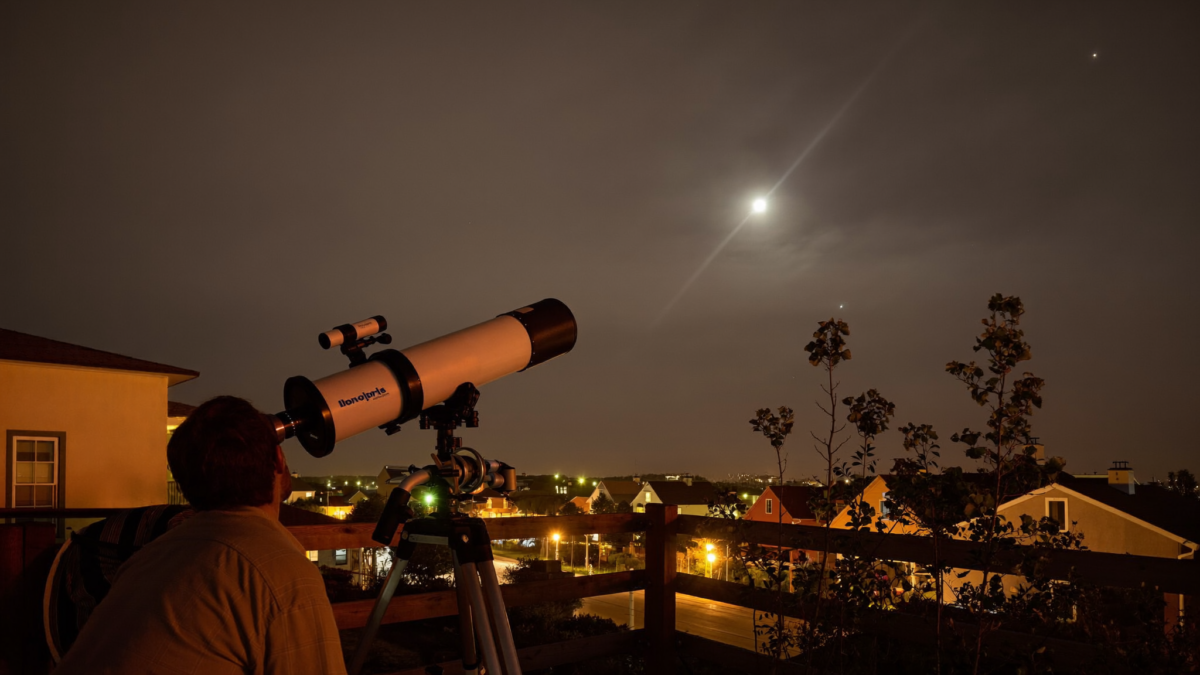
Quick Answer: From a light-polluted backyard, the objects that still deliver are the Moon, the planets, double stars, bright open clusters, globular clusters, and — the sleeper category nobody talks about — small planetary nebulae like the Ring, the Dumbbell and the Cat’s Eye. What you lose is galaxies, large faint nebulae and the Milky Way itself. Choose from the first list and a Bortle 7 sky is a genuinely good hobby; chase the second list and you will conclude astronomy isn’t for you.
I observe from York, Pennsylvania under a Bortle 5 to 6 sky, and I came back to this hobby at 50 after assuming light pollution had made it pointless. It hadn’t. It had just changed which targets are worth my time. Here’s the logic, then the list.
The one principle that explains everything
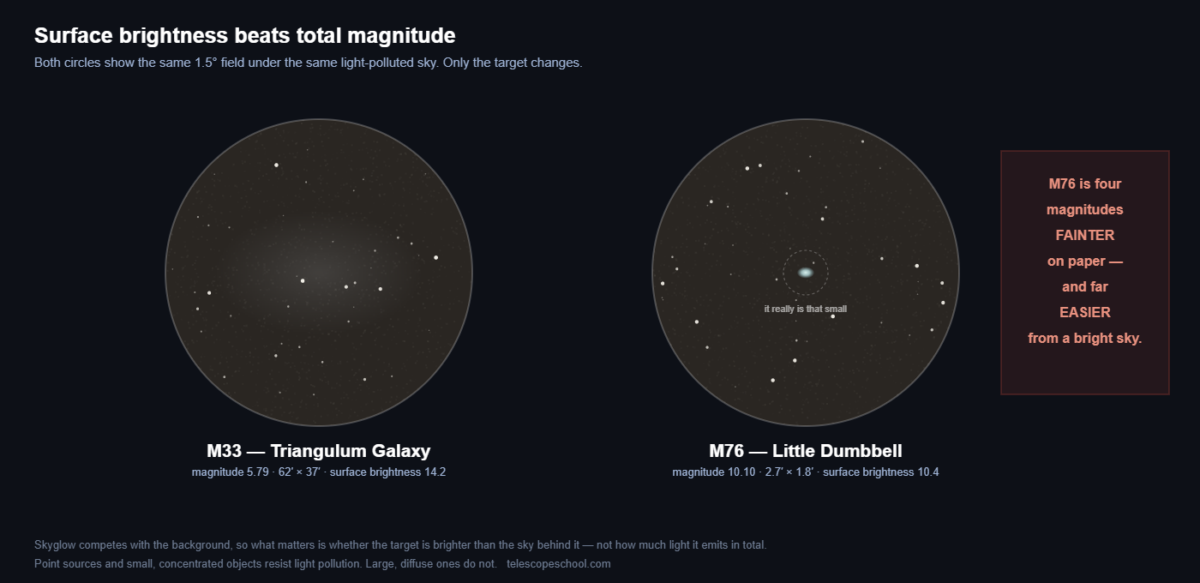
Surface brightness beats total magnitude. This is the single most useful concept in urban astronomy and almost nobody leads with it.
An object’s catalog magnitude tells you how much total light it emits. Surface brightness tells you how concentrated that light is. Skyglow competes with the background, so what matters is whether your target is brighter than the sky behind it — not how much light it puts out in total.
The clean example: M33, the Triangulum Galaxy, is magnitude 5.79 — bright, on paper. But it’s spread across 62 by 37 arcminutes, giving it a surface brightness around 14.2 mag/arcsec². M76, the Little Dumbbell, is magnitude 10.10 — four magnitudes fainter — but it’s crammed into 2.7 by 1.8 arcminutes, for a surface brightness of 10.4. The “fainter” object is dramatically easier from a bright sky.
The practical rule that falls out of this: point sources and small, concentrated objects resist light pollution. Large, diffuse objects don’t. That’s why stars, planets and tight clusters survive in the city while sprawling nebulae and face-on spirals vanish.
A useful corollary most guides get backwards: use more magnification, not less. Higher power spreads the background skyglow over a larger apparent area, darkening it, while a small object’s surface brightness holds up better. On a compact planetary nebula from a city, 150x will show you more than 50x.
What works at every Bortle class
The Moon — arguably better from the city
The Moon is so bright that skyglow is irrelevant, and in a light-polluted sky the contrast between the Moon and its surroundings is actually less punishing on your eyes. Available year-round, immune to everything except cloud. Any telescope, any sky.
Planets — completely unaffected
Jupiter’s belts and moons, Saturn’s rings, Venus’s phases, Mars at opposition — all of these are just as good from a city center as from a dark site. What limits planetary observing is atmospheric seeing (steadiness) and your optics, not skyglow. High-resolution planetary imaging is routinely done from downtown apartments. Even Uranus and Neptune show as discs from suburbia with a 200mm scope.
If you are stuck in a Bortle 7 or 8 sky, planets should be your primary target. Our planetary telescope guide and 2026 planet observing calendar will get you started.
Double stars — the underrated urban specialty
Point sources, so light pollution is nearly irrelevant. What limits you is aperture, magnification and seeing. Albireo and the Double-Double in Lyra are comfortably within reach of a 150 to 200mm telescope from fairly bright skies.
- Albireo (β Cygni) — gold and blue, the showpiece. Summer/autumn. Colors wash out slightly under heavy light pollution but survive.
- ε Lyrae, the Double-Double — two pairs in one field. A genuine test of optics and seeing. Summer.
- Mizar and Alcor — naked-eye pair in the Big Dipper’s handle, with Mizar itself splitting in a telescope. Spring.
- Almach (γ Andromedae) — gold and blue, rivals Albireo. Autumn.
- Castor — a tight, bright white pair. Winter.
Variable stars — a real project
Algol (β Persei) eclipses every 2.87 days, dropping over a magnitude, and the whole cycle is visible naked-eye or with binoculars from moderate light pollution. Your observations can be submitted to the AAVSO. This is one of the few ways a city observer can contribute actual science, and it requires no telescope at all.
Carbon stars — genuinely differentiated urban targets
Deep red giants with dramatic color, and because they’re point sources, light pollution barely touches them. Y Canum Venaticorum (La Superba), TX Piscium, U Hydrae and VY Ursae Majoris are all reachable. R Leporis (Hind’s Crimson Star) is the famous one, but it varies from magnitude 5.5 to 11.7 over a 427-day cycle — catch it near maximum or it disappears into the skyglow.
Deep-sky objects that survive light pollution
Open clusters — the best DSO class for city observers
Collections of individually bright stars. Because each star is a point source, skyglow barely dents them. If you observe from Bortle 6 or worse, this is where you should spend most of your time.
| Object | Magnitude | Season | Notes |
|---|---|---|---|
| Hyades | 0.5 | Winter | Naked-eye; needs binoculars or a very wide field |
| M45 Pleiades | 1.5 | Winter | Works from anywhere, even Bortle 9 |
| M44 Beehive | 3.1 | Winter/Spring | Superb in binoculars |
| Coathanger (Cr 399) | 3.6 | Summer | Genuinely looks like a coathanger |
| M6 Butterfly | 4.2 | Summer | Low for northern observers |
| M7 Ptolemy’s Cluster | 3.3 | Summer | Very low from mid-northern latitudes |
| Double Cluster (NGC 869/884) | 5.3 | Autumn/Winter | Two clusters in one low-power field |
| M35 | ~5.3 | Winter | Large and rich |
| M37 | 5.6 | Winter | The richest of the Auriga trio |
| M11 Wild Duck | 5.8 | Summer | Best surface brightness on this list (9.0) — nearly globular-like |
| M36, M38 | 6.0, 6.4 | Winter | Auriga companions to M37 |
| NGC 457 Owl/E.T. Cluster | 6.4 | Autumn/Winter | Two bright “eyes” — a crowd-pleaser |
Globular clusters — mostly hold up
Dense, concentrated, decent surface brightness. From Bortle 6 they look like fuzzy balls; from Bortle 5 with a 6-inch or larger, the outer stars start resolving.
| Object | Magnitude | Season |
|---|---|---|
| M22 | 5.1 | Summer (low) |
| M5 | 5.7 | Spring/Summer |
| M13 Hercules | 5.8 | Summer |
| M15 | ~6.2 | Autumn |
| M92 | 6.4 | Summer |
| M28 | 6.8 | Summer |
| M56, M71 | 8.3 | Summer (loose, harder) |
Planetary nebulae — the sleeper category
This is the section that should change how you observe from the city, and no competing guide emphasizes it. Planetary nebulae are small and concentrated, which gives them far higher surface brightness than anything else on this page.
| Object | Magnitude | Surface brightness | Season |
|---|---|---|---|
| NGC 6543 Cat’s Eye | 8.1 | 5.0 | Summer |
| NGC 6826 Blinking Planetary | 8.9 | 6.9 | Summer |
| M57 Ring Nebula | 8.8 | 9.3 | Summer |
| M27 Dumbbell | 7.1 | 11.2 | Summer |
| M42 Orion Nebula | 4.0 | 11.0 | Winter |
The Cat’s Eye at surface brightness 5.0 is essentially light-pollution-proof. Push the magnification up — 150x or more — and it holds its brightness while the background darkens. These are also the exact objects that respond best to an OIII filter, which I’ll come to.
The galaxies that just barely work
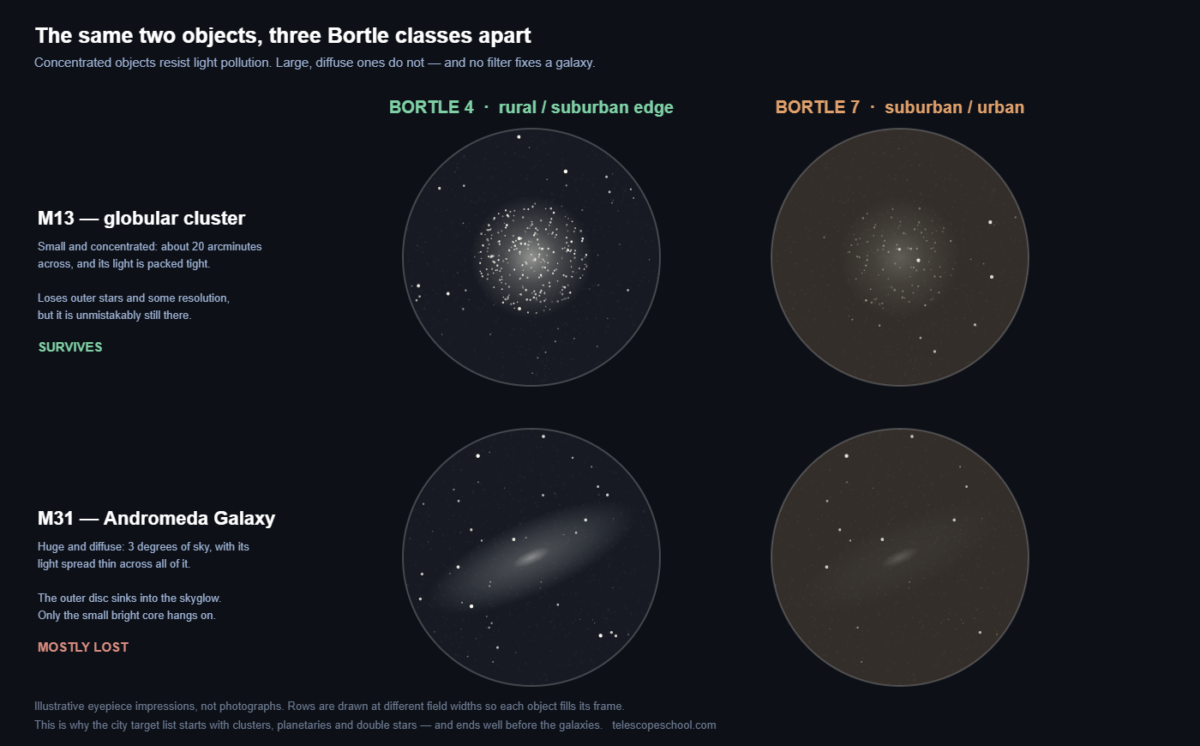
Three exceptions worth attempting: M31 Andromeda (mag 3.3 — you’ll get the bright core only, not the arms), M81 (6.8) and M82 (8.0). M82 is worth special mention: it’s edge-on, giving it a surface brightness of 12.5, so it is actually easier from a bright sky than the brighter, face-on M81 sitting next to it. That’s the surface brightness principle in one field of view.
From experience: the best thing I have seen from my Bortle 5 to 6 backyard is the Orion Nebula. Even under suburban light it has real structure — a glowing cloud around the Trapezium, uneven wisps running outward, and more detail the longer you keep looking. The biggest disappointment was Andromeda. You hear “galaxy” and expect a spiral; what you actually get is a bright fuzzy core fading into the background. Impressive once you understand what you are looking at, but nothing like the photographs a beginner has in mind.
What does NOT work — the honest section
Every other guide on this topic is relentlessly encouraging. Here is what will waste your nights:
- The Milky Way. Gone from Bortle 7 upward. Visible only near the zenith at Bortle 6.
- Most galaxies. The best evidence I’ve seen is a direct comparison of M31 through the same 8-inch scope at different sites: at Bortle 8 it’s “just a small, slightly grayish fuzzy patch”; at Bortle 6 it becomes a much larger oval with a bright core; only at Bortle 4 do the dust lanes, spiral hints and companions M32 and M110 appear. Same telescope. The only variable is the sky.
- M33. Impossible without binoculars by Bortle 6, and borderline even at Bortle 4.
- Face-on low-surface-brightness spirals — M101, M51, M74. The surface brightness math says these are hopeless in Bortle 7 to 8, and my experience agrees.
- Large faint emission nebulae — North America, Veil, California, Rosette, Heart and Soul. Too big and too diffuse.
- Reflection nebulae — no emission lines means no filter can help them. Ever.
- Dark nebulae — they require a bright Milky Way background for contrast, and that’s the first thing light pollution takes.
- Most comets — surface-brightness-limited, same as galaxies.
Knowing this list is not defeatism. It’s what lets you stop blaming your telescope. If you’ve been staring at an empty eyepiece wondering what’s wrong, our guide to why you can’t see anything through your telescope covers the other causes.
Do light pollution filters actually help?
Partly. The honest summary, and it’s more nuanced than either the “buy a filter” crowd or the “filters are useless” crowd will tell you.
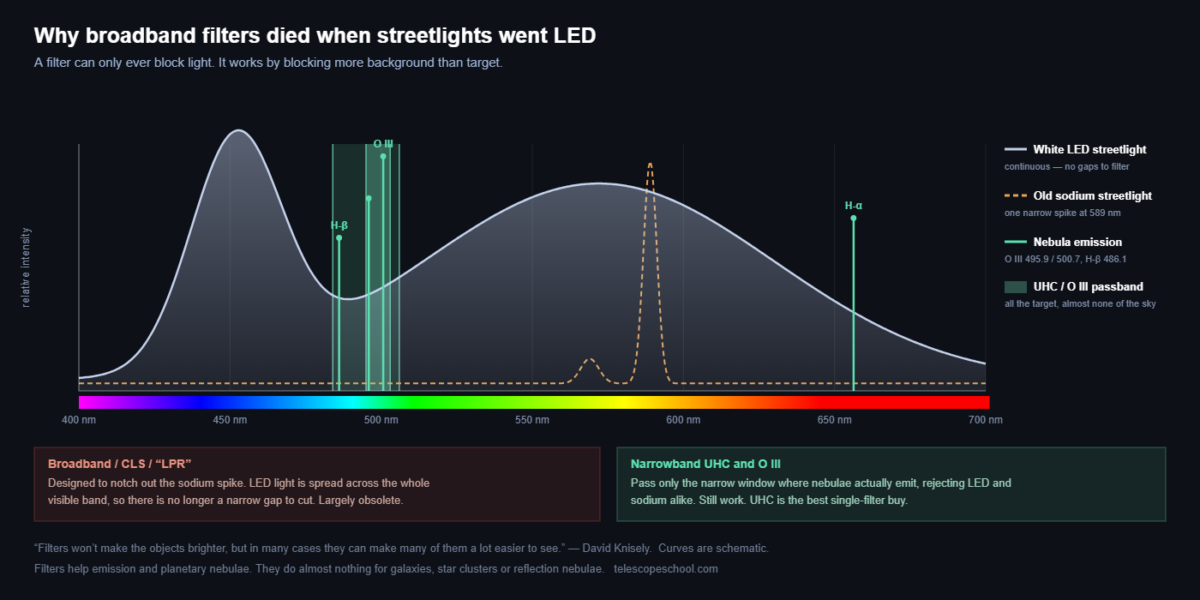
The foundational principle, from David Knisely’s long-standing reference work on the subject: “Filters won’t make the objects brighter, but in many cases, they can make many of them a lot easier to see.” A filter can only ever block light. It works by blocking more background than target.
| Filter type | What it does | Helps | Doesn’t help |
|---|---|---|---|
| Broadband / CLS / “LPR” | Blocks sodium and mercury vapor emission lines | Modest boost on emission nebulae | Galaxies (mild at best), star clusters (almost nothing). Largely obsolete against white LED streetlights. |
| Narrowband / UHC | Passes OIII and H-beta, blocks the rest | Emission nebulae — significant improvement. The best single-filter buy. | Slightly dims star clusters, reflection nebulae and galaxies |
| OIII line filter | Passes only the OIII lines | Planetary nebulae — transformative. Also the Veil and Helix. | Dims clusters and galaxies even more than UHC. Hurts H-beta targets. |
| H-beta | Passes only H-beta | Horsehead, California, Cocoon | Nearly wipes out most planetary nebulae. Niche — skip it. |
The big 2026 update: broadband “light pollution reduction” filters have lost most of their value. They were designed to notch out the narrow emission lines of sodium and mercury vapor streetlights. As municipalities have switched to white LEDs — which emit across the full visible spectrum — there’s no longer a narrow band to block. They never blocked metal halide lighting either. If someone is selling you a CLS filter as a cure for modern light pollution, be skeptical.
Narrowband and OIII filters still work, because they don’t care what’s polluting your sky — they pass only the wavelengths the nebula emits and block everything else, LED included.
A neat trick the OIII filter enables: the blinking technique. Hold the filter between your eye and the eyepiece and move it in and out. Stars dim; the planetary nebula doesn’t. A faint planetary you couldn’t identify will pop right out.
Buying advice: if you buy one filter, make it a true narrowband UHC. If you buy two, add an OIII. Be aware that a few products labeled “UHC” — Astronomik UHC-E, Baader UHC-S, Celestron UHC-LPR — are actually broadband filters wearing the name. Our telescope filter guide covers the full range.
- Astronomik UHC narrowband filter, 1.25″ — the standard first nebula filter
- OIII line filter, 1.25″ — for planetary nebulae and the Veil
Free techniques that beat any filter
Before you spend a hundred dollars on glass, do these — they cost nothing and several are more effective:
- Observe near the zenith. Least air mass, least skyglow, biggest single improvement available.
- Observe after midnight. Municipal dimming kicks in, businesses close, and the sky genuinely darkens.
- Moonless nights only for deep-sky. A full Moon turns a dark site into Bortle 7.
- Block direct glare. Put a fence, tree or building between you and every visible light source. Use a long dew shield.
- Dark-adapt properly — 20 to 30 minutes, red light only, and consider an eyepatch or observing hood. See our red flashlight guide.
- Never observe through an open window or over a rooftop. Thermal currents will destroy your image far more effectively than skyglow.
- Use higher magnification on small objects to darken the background.
- Flock your tube. Poor internal baffling scatters stray light and makes skyglow look worse than it is — especially on open-tube Dobsonians.
- Use decent eyepieces. Cheap glass scatters light and reduces contrast exactly where you can least afford it.
Frequently asked questions
What can I see with a telescope in the city?
The Moon in full detail, all the planets, hundreds of double stars, most bright open clusters, the brighter globular clusters, and small planetary nebulae like the Ring and the Dumbbell. From a Bortle 8 city center, an 8-inch telescope will still reach around magnitude 11 — that covers a great deal of the Messier catalog‘s brighter half.
Are light pollution filters worth buying?
A true narrowband UHC filter is worth it if you want to observe emission nebulae, and an OIII is worth it for planetary nebulae. Broadband “CLS” or “light pollution reduction” filters are largely obsolete now that white LED streetlights have replaced sodium and mercury vapor. No filter helps galaxies, star clusters or reflection nebulae — and they slightly dim them.
Can I see the Andromeda Galaxy from a light-polluted sky?
You can see its core from Bortle 6 or 7 as a small oval smudge — but not the spiral structure, the dust lanes, or its full extent. M31 is enormous, over 3 degrees across, and light pollution erases everything but the bright center. Interestingly, its neighbor M82 often shows better because it’s edge-on and more concentrated.
What’s the best telescope for light-polluted skies?
Aperture still helps — it doesn’t beat light pollution, but it collects more light from your target while the sky background stays the same. That said, a portable scope you actually carry to a darker site once a month will outperform a huge one you never move. See our urban and suburban telescope picks.
Does it help to observe after rain?
This one is genuinely disputed. Rain washes aerosols out of the air, which should reduce scattering — but the residual humidity scatters light too, and humid nights can cost you a full Bortle class or more. In my experience in Pennsylvania, the night after a front passes through, once the air has dried out, is far better than the night immediately after rain.
Should I just buy a smart telescope instead?
It’s a legitimate option. Smart telescopes stack many short exposures, which pulls faint detail out of a bright sky in a way visual observing simply cannot match — they will show you galaxies from a Bortle 7 backyard. What they won’t give you is the experience of looking through an eyepiece. Our smart vs. traditional comparison lays out the trade-off honestly.
Where to start tonight
If you’re in a Bortle 6 to 8 sky and you have one clear evening, do this: start on whatever planet is up, spend twenty minutes on it at high power, then find one bright open cluster and one double star. That’s a complete, satisfying session that a city sky supports perfectly — and it’s a far better introduction to the hobby than an hour spent failing to find a galaxy.
The thing that surprised me most about coming back to astronomy under a suburban sky is how consistently the Bortle scale understates what’s achievable. Experienced observers say the same thing constantly. TelescopeSchool’s position on this is simple: pick targets that match your sky, and light pollution stops being a reason not to observe.
For a fuller picture of what your own sky can support, see our Bortle scale explainer, and for seasonal target planning, our deep-sky objects by season guide.
Everything I observe comes from suburban York, Pennsylvania, under Bortle 5-6 skies. Light pollution shortens the list, but it does not end it.
These May Help Too...
Can You Use a Telescope Through a Window? (And Why You Should Not)
Using a telescope through a window ruins the view: bad glass, heat currents and reflections. Here is what actually happens, and what to do instead.
Telescope will not come to focus? The cause is almost always spacing, not optics. Work out whether you ran out racking in or out, then fix that end.