

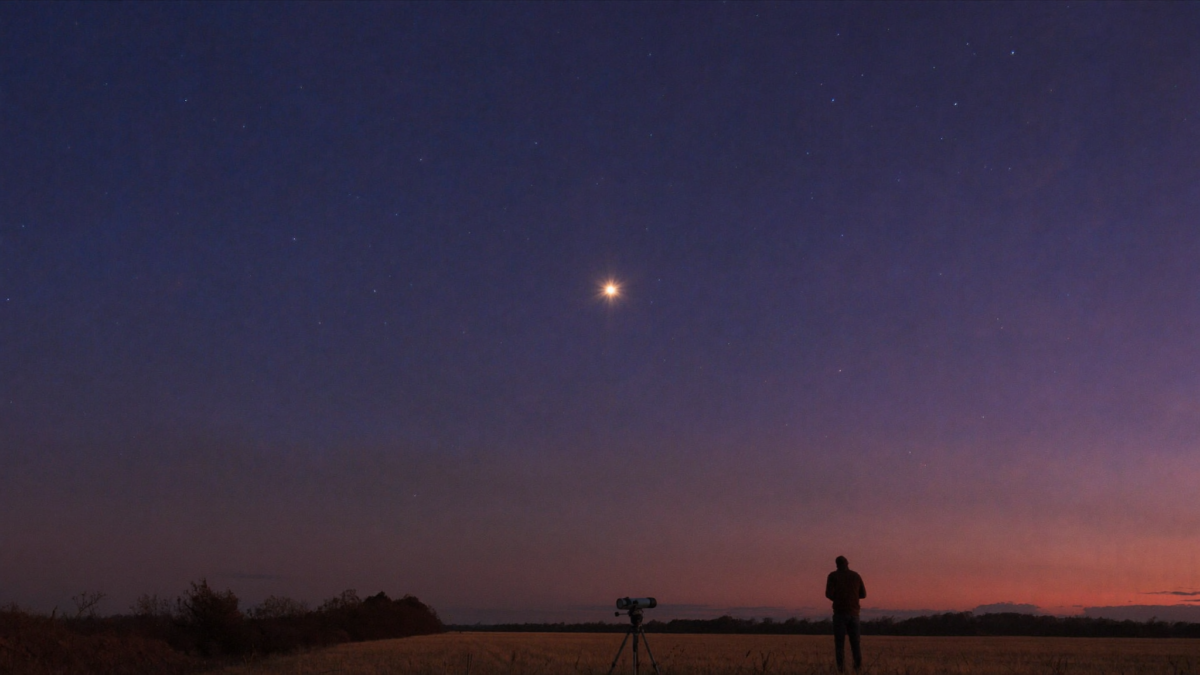
Quick Answer: If you want one planet night in what remains of 2026, make it Saturn in early October — opposition falls on October 4, the rings are open about 7 degrees again after the 2025 edge-on disappearing act, and it rides high all evening. Jupiter is a pre-dawn object until December, and Mars has no opposition in 2026 at all; it is a naked-eye orange dot until the very end of the year.
I am writing this in August 2026, which means a good chunk of the year is already behind us. Rather than pretend otherwise, this guide is organized around what you can still catch — plus the early-2027 events worth putting on a calendar now. I observe from York, Pennsylvania at about 40° north under a Bortle 5 to 6 sky, and everything below assumes a similar northern mid-latitude vantage point.
The 2026 planet table at a glance
Opposition is when a planet sits opposite the Sun from our point of view — closest, brightest, and up all night. It is the single most useful date to know.
| Planet | 2026 opposition | Magnitude | Apparent size | Constellation | Verdict for 2026 |
|---|---|---|---|---|---|
| Saturn | October 4, 2026 | +0.3 | 19.7″ globe | Cetus | The year’s best planet. Rings open ~7°. |
| Jupiter | January 10, 2026 (passed) | −2.7 | ~46″ | Gemini | Morning object until mid-December. |
| Mars | None in 2026 | — | — | — | Skip it until December. Next opposition Feb 19, 2027. |
| Venus | Greatest elongation east, Aug 15, 2026 | −4.4 | — | — | Poor evening apparition despite the wide 46° angle. |
| Mercury | Greatest elongation east, Oct 12, 2026 | 0.0 | — | Libra | Best evening Mercury window of the autumn. |
Saturn: October 4, 2026 is the night to circle
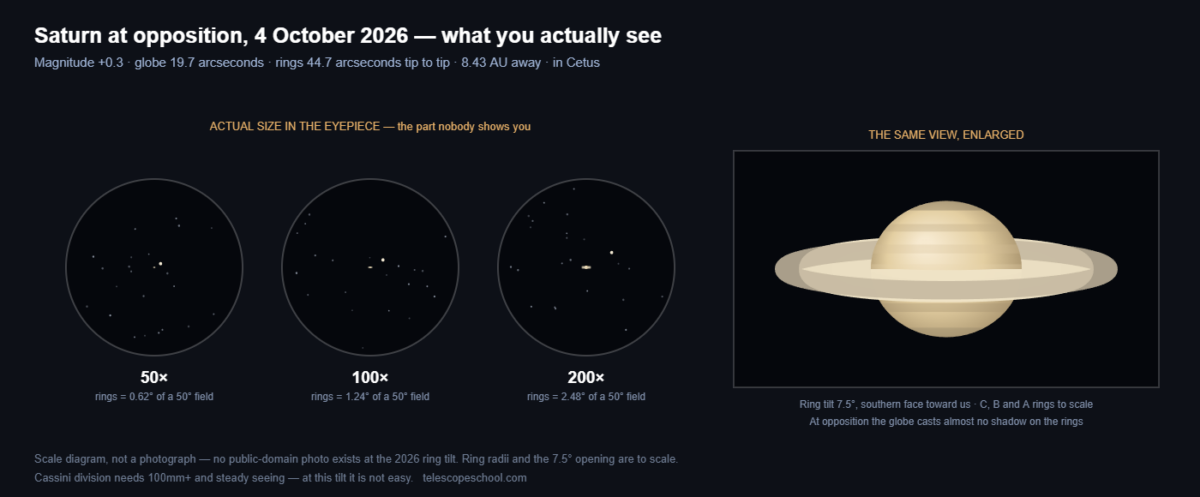
Saturn reaches opposition on October 4, 2026 at about 12h UTC, shining at magnitude +0.3 with a 19.7-arcsecond globe, 8.43 AU away. At opposition it sits in Cetus — not Pisces, where you will find it in August as it drifts eastward. If you are writing the date on a calendar, note that Saturn is well placed from late August right through the winter; the opposition date is the peak, not a deadline.
The ring story is the real headline. Saturn’s rings went edge-on and effectively vanished in March 2025, which frustrated a lot of new observers who bought a telescope specifically to see them. They are back. Through 2026 the tilt runs between about 5 and 9 degrees, sitting near 7.5 degrees at opposition with the southern face toward us. That is enough to show an unmistakable open ellipse in any small telescope. It is not enough to make the Cassini division easy — expect to need at least a 100mm aperture, steady seeing, and 150x or more to have a shot at it.
A note on sources: at least one telescope site is currently publishing an 11 to 13 degree ring tilt for 2026. That figure is wrong. Both the major ephemeris sources and a direct calculation put it near 7.5 degrees at opposition.
How to observe it. The rings resolve as a distinct ellipse from about 40x to 50x. The sweet spot is 100x to 150x, where you can also start hunting Titan (an easy 8th-magnitude “star” nearby) and the shadow of the globe on the rings. Saturn retrogrades from July 26 to December 10, 2026, so it will appear to slide backwards against the stars all autumn. Our guide to seeing Saturn’s rings through a telescope covers eyepiece choice in more detail.
Rise times at 40° north: around 9:09 pm on August 15, 6:59 pm on September 15, and essentially at sunset by October 1. From October onward it is up as soon as the sky is dark — the easiest planet in the sky to catch on a weeknight.
Jupiter: a morning object, not an evening one
This is the correction I most want to make, because nearly every “Jupiter in 2026” article still tells readers to look after dinner. For most of autumn 2026, Jupiter is only visible before dawn.
Jupiter’s 2026 opposition was on January 10, at magnitude −2.7 and about 46 arcseconds across, in Gemini. It reached solar conjunction on July 29, 2026 and has been climbing out of the dawn twilight since mid-August. Here is the practical schedule:
| Period | Where to look | Rise time (40°N) | Magnitude / size |
|---|---|---|---|
| Late Aug 2026 | Very low ENE before dawn | ~5:40 am | ~−1.9 / ~31″ |
| September 2026 | Pre-dawn, still low | ~4 am | ~−1.9 / ~32″ |
| October 2026 | Morning only | 1:51 am (Oct 1) | −1.9 / 33″ |
| November 2026 | Late night into morning | 12:13 am (Nov 1) | −2.0 / 36″ |
| December 2026 | Becomes a late-evening target | 10:28 pm (Dec 1) | −2.2 / 39″ |
| Late Dec 2026 | Convenient evening object | 8:41 pm (Dec 28) | −2.4 / 43″ |
Jupiter crosses from Cancer into Leo in early October 2026 and stays there. It begins retrograde motion on December 12, and reaches its next opposition on February 11, 2027 in Leo, about 8 degrees from Regulus, at magnitude −2.5. For US observers that is the night of February 10–11.
The practical upshot: if you want Jupiter’s belts and Galilean moons this year without setting a 4 am alarm, wait until mid-December. If you are willing to get up, October and November mornings are perfectly good — Jupiter is bright enough that low altitude hurts less than it would for a fainter target. Our Jupiter and Galilean moons guide walks through what to look for.
Mars: skip it until December
There is no Mars opposition in 2026. Mars oppositions come roughly every 26 months, and the sequence runs January 16, 2025 → February 19, 2027. The whole of 2026 falls in the gap. Mars passed solar conjunction on January 9, 2026, and has been slowly climbing out of the glare ever since.
Here is what Mars actually looks like through the rest of the year:
| Date | Magnitude | Disk size | Elongation | Worth pointing a telescope at? |
|---|---|---|---|---|
| Aug 11, 2026 | +1.3 | 4.8″ | 49° | No — featureless orange dot |
| Oct 1, 2026 | +1.1 | 5.6″ | 66° | Not really |
| Nov 1, 2026 | +0.9 | 6.5″ | 80° | Marginal |
| Dec 1, 2026 | +0.5 | 8.0″ | 97° | Yes — a dark marking becomes possible |
| Dec 31, 2026 | −0.1 | 10.2″ | 119° | Yes — polar cap and albedo features in a 6-inch |
Below about 6 arcseconds there is nothing to see but an orange disc, no matter how good your telescope is. Mars only becomes a genuine target in December 2026, and the payoff runs from then through March 2027.
One expectation to manage now: the February 19, 2027 opposition is an aphelic one. Mars will be 0.678 AU away — its most distant opposition of the current series, with a 13.8-arcsecond disk, the smallest since 2012, at magnitude −1.2. It is still worth observing, but it will not be the spectacular 2018 or 2020 Mars. Plan for a 150x to 250x view of a small, bright, detail-rich disc rather than a big one. Mars is the one planet that genuinely rewards pushing magnification past the usual comfort zone.
Venus and Mercury: the remaining 2026 windows
Venus reached greatest eastern elongation on August 15, 2026 at 45.9 degrees, magnitude −4.4. Despite that wide angle, this is a poor evening apparition for northern observers — the autumn evening ecliptic sits at a shallow angle to the horizon, so Venus sets barely half an hour after the Sun through the autumn. It reaches inferior conjunction on October 24 and returns as a morning object, hitting greatest western elongation (47.0°, magnitude −4.6) on January 3, 2027. That January window will be far better than anything Venus offers this autumn.
Mercury has two windows left in 2026:
- October 12, 2026 — greatest eastern elongation, 25 degrees, magnitude 0.0, in Libra. Evening sky, and the widest Mercury elongation of the year. This is your best shot.
- November 20, 2026 — greatest western elongation, 19.6 degrees, magnitude −0.5. Morning sky, tighter but brighter.
Mercury is a naked-eye and binocular target more than a telescope one; a small gibbous phase is about all a modest scope will show. Find a clear horizon and look during the half hour after sunset (October) or before sunrise (November).
What to expect at the eyepiece: I have not logged Saturn right at opposition from the York backyard myself, so this is drawn from 8-inch Dobsonian owners around Pennsylvania rather than from my own notebook. At 130× to 170× Saturn is a small cream-yellow globe with the rings unmistakably separated from it — a crisp little oval when they are well tilted, and startlingly thin, almost a sharp line through the planet, when they are near edge-on as they were in 2025. A steady night will take an 8-inch toward 200×, but around 150× is the most consistently useful view from a Pennsylvania backyard.
What a beginner actually sees
Aperture and magnification expectations, so nobody is disappointed:
| Planet | Useful magnification | What you’ll see |
|---|---|---|
| Saturn | 100–150x | Rings as an open ellipse, globe shadow, Titan. Cassini division needs 100mm+, steady air, 150x+. |
| Jupiter | 30–50x for belts and moons; 100–180x for detail | Two equatorial belts and four Galilean moons in almost any telescope. Great Red Spot at higher power. |
| Mars | 150–250x (Feb 2027) | Nothing below 8″. At opposition, a polar cap and dark albedo markings. |
| Venus | 50–100x | Phase only. No surface detail ever — it’s cloud. |
| Mercury | 75–150x | A small phase, low in murky air. |
The practical ceiling on any telescope is roughly 50x per inch of aperture, and atmospheric seeing usually caps you near 200x from a typical backyard regardless of what you own. Our 50x rule explainer covers why. For scope selection, see the best telescopes for planetary observing.
One genuine advantage of planetary observing: light pollution barely matters. The planets are bright enough that a Bortle 8 city sky is very nearly as good as a dark site. Seeing — atmospheric steadiness — is what limits you, and that has nothing to do with streetlights. If you are stuck under city skies, planets are where TelescopeSchool tells you to start.
Frequently asked questions
When is the best time to see Saturn in 2026?
October 4, 2026 is opposition, when Saturn is closest, brightest and visible all night. In practice anywhere from late August through December works well, since Saturn stays high in the evening sky all autumn. The rings are tilted about 7 degrees, so they are clearly open again after the March 2025 edge-on event.
Why can’t I see Jupiter in the evening in 2026?
Because Jupiter passed behind the Sun on July 29, 2026. Through October and November it only rises after midnight, so it is a morning object. It returns to convenient evening viewing in mid-to-late December 2026, and reaches opposition again on February 11, 2027.
Is there a Mars opposition in 2026?
No. Mars oppositions occur about every 26 months, and 2026 falls between the January 2025 and February 2027 events. Mars is small and featureless through most of 2026 and only becomes a worthwhile telescope target in December.
What magnification do I need to see Saturn’s rings?
The rings become an obvious ellipse at around 40x to 50x — well within reach of any beginner telescope. For the Cassini division, plan on 150x or more, an aperture of at least 100mm, and a night of steady seeing. Note that at the current shallow ring tilt, Cassini is harder than it was a few years ago.
Can I see the planets from a city?
Yes. Planets are the least light-pollution-sensitive objects in the sky. A Bortle 8 city center will show you Jupiter’s belts and Saturn’s rings essentially as well as a dark rural site would. What matters is atmospheric steadiness, plus avoiding looking over hot rooftops or air conditioning units. See our guide to the best telescopes for urban and suburban observers.
What is opposition and why does it matter?
Opposition is the moment when Earth passes between a planet and the Sun, putting the planet directly opposite the Sun in our sky. At opposition the planet is at its closest to us, at its brightest, and — usefully — it rises at sunset and sets at sunrise, so it is observable all night. For outer planets it is the peak of the observing season.
Your 2026 planet plan, in one paragraph
Between now and New Year: put Saturn on October 4 in your calendar and treat every clear evening from September through December as a Saturn night. Catch Mercury around October 12 low in the west just after sunset. If you are a morning person, Jupiter from October onward before dawn is excellent; if you are not, wait for mid-December when it becomes an evening object. Leave Mars alone until December, then follow it into a February 2027 opposition. And skip the Venus evening apparition entirely — January 2027 mornings will be far better.
Dates and figures in this guide were compiled in August 2026 from ephemeris sources and cross-checked; opposition instants can vary by a few minutes between sources depending on how opposition is defined, and local dates may shift by one day depending on your time zone. For a broader seasonal target list beyond the planets, see our deep-sky objects by season guide.
Planning around opposition rather than convenience is the change that improved my planetary observing most. Timing beats equipment.
These May Help Too...
Can You Use a Telescope Through a Window? (And Why You Should Not)
Using a telescope through a window ruins the view: bad glass, heat currents and reflections. Here is what actually happens, and what to do instead.
Telescope will not come to focus? The cause is almost always spacing, not optics. Work out whether you ran out racking in or out, then fix that end.