

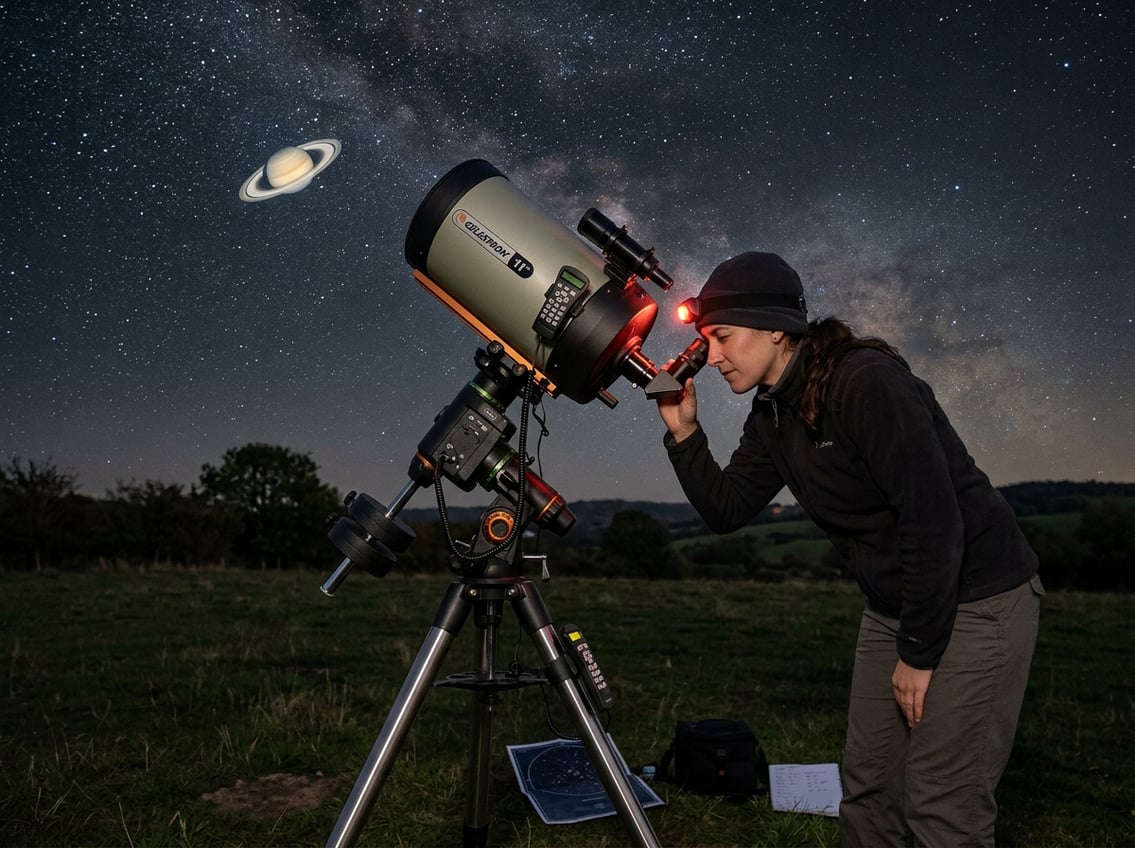
Seeing Saturn through a telescope ranks among astronomy’s most memorable experiences. The ringed planet appears as a golden dot to the naked eye, but even a small telescope reveals its famous rings as a distinct structure surrounding the planet. A telescope with at least 60mm aperture can show Saturn’s rings, though a 100mm or larger instrument will reveal better detail like the dark gap known as the Cassini Division.
Current viewing conditions make planning important. In 2026, Saturn’s rings appear nearly edge-on, which limits how much detail observers can see compared to years when the rings tilt more openly toward Earth. This temporary viewing challenge doesn’t mean the planet loses its appeal, but it does require realistic expectations about what different telescope sizes will show.
Finding Saturn, selecting appropriate equipment, and understanding atmospheric conditions all contribute to successful observation sessions. Amateur astronomers can spot the ringed planet from backyards and urban locations without needing expensive gear or advanced skills. The following guide covers everything needed to locate Saturn in the night sky and view its rings through a telescope.
Last Updated: May 2026 | Will Montgomery is an amateur astronomer who has spent many nights at the eyepiece observing Saturn and knows exactly how to coax the rings into sharp view.
Understanding Saturn’s Ring System
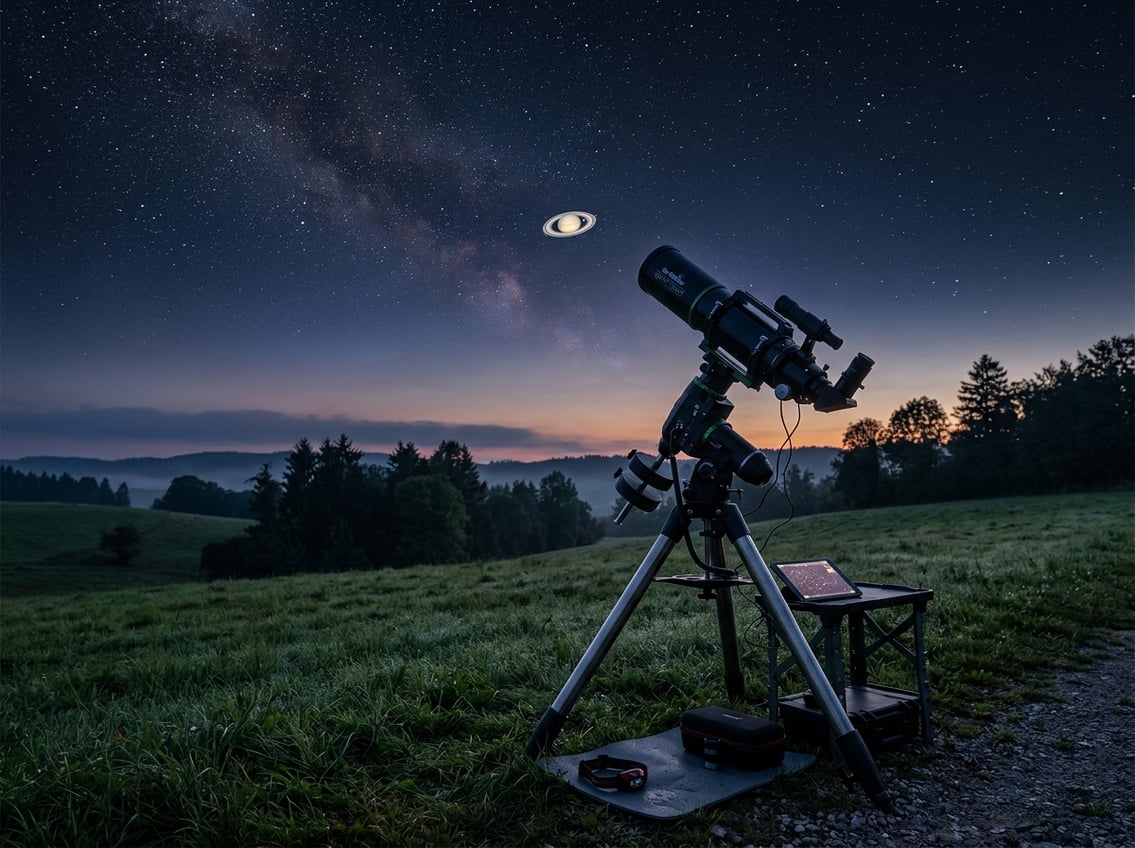
Saturn’s rings consist of billions of ice and rock particles organized into distinct bands, with major divisions separating the main ring groups. The rings appear different from Earth depending on their tilt, which changes throughout Saturn’s 29-year orbit around the sun.
Ring Structure and Divisions
The ringed planet features several main ring groups labeled alphabetically in order of discovery. The B ring stands out as the brightest and widest section, followed by the A ring on the outside. The C ring sits closest to Saturn and appears much darker than its neighbors.
Ring A measures roughly 14,600 kilometers wide. Ring B spans about 25,500 kilometers and contains the densest concentration of particles. The C ring extends 17,500 kilometers but remains faint and difficult to spot through amateur telescopes.
These ring groupings visible in a backyard scope show clear boundaries between them. The particles within each ring range from dust-sized grains to house-sized chunks of ice and rock.
Famous Features: Cassini and Encke Divisions
The Cassini Division represents the most prominent gap in Saturn’s rings. This 4,800-kilometer-wide dark band separates Ring A from Ring B. The division appears as a black line between the two brightest rings when viewing conditions align properly.
French astronomer Jean Cassini discovered this gap in 1675. Observers need steady atmospheric conditions and good telescope optics to see the Cassini Division clearly. A telescope with at least 100mm aperture provides the best chance of resolving this feature.
The Encke Division cuts through Ring A as a much narrower gap. This 325-kilometer-wide division requires larger telescopes and excellent seeing conditions to detect.
Ring Visibility Cycles
Saturn’s rings tilt toward or away from Earth as the planet orbits the sun. In March 2025, the rings appeared edge-on and nearly invisible from Earth. The south side of the rings now faces Earth and will gradually open wider.
The rings currently sit at a narrow angle as of May 2026. They will reach their maximum tilt of 27 degrees by May 2032. The thin ring angle around September 2025 offered better views of both hemispheres of Saturn despite the narrow presentation.
When the rings appear edge-on roughly every 15 years, they become extremely difficult or impossible to see through telescopes. The rings measure only about 10 meters thick despite spanning over 280,000 kilometers in diameter.
When and Where to View Saturn
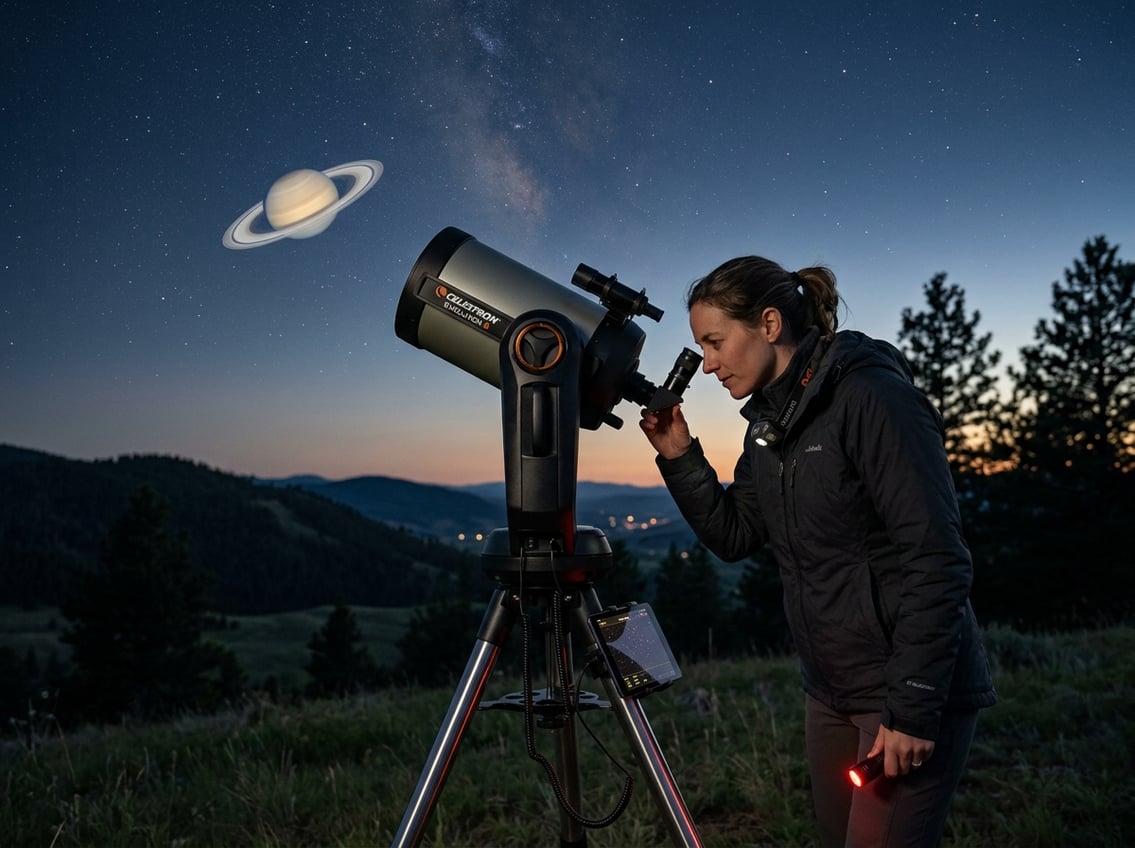
Saturn’s visibility changes throughout the year based on its position relative to Earth and the Sun. The planet reaches its best viewing position during opposition, when it appears brightest and stays visible all night long.
Optimal Times for Observing
Saturn reaches opposition on October 4, 2026, marking the ideal time for viewing the ringed planet. During opposition, Saturn rises at sunset, climbs highest around midnight, and sets at dawn.
The planet is well-placed for evening observation from June through November 2026. Starting in July, it rises before midnight, making it accessible for observers who prefer not to stay up late. August through October provides the best evening viewing window when Saturn appears high in the southern sky.
2026 Saturn Visibility:
- January–April: Morning sky, poor visibility
- May–July: Rising in eastern sky before dawn
- August–October: Best evening viewing period
- October 4: Opposition (closest approach)
- November–December: Still visible, setting earlier each night
The planet shines at magnitude +0.4 to +0.8, appearing as a steady, pale yellow point of light that doesn’t twinkle like stars do.
Locating Saturn in the Night Sky
Saturn appears in the constellation Aquarius during 2026. Using a planetarium app like Stellarium or SkySafari provides the most reliable method for finding the planet’s exact position each night.
To the naked eye, Saturn looks like a bright, non-twinkling yellowish star in the southern or southeastern evening sky from July through October. The planet’s steady light distinguishes it from actual stars, which appear to twinkle due to atmospheric turbulence.
Once located, observers should start with their lowest-power eyepiece to center Saturn in the telescope’s field of view. At low magnification, the planet appears as a slightly elongated shape rather than a round point of light. After centering, switching to higher magnification (100-150×) reveals the ring system clearly.
Ring Tilt and Yearly Changes
Saturn’s rings passed through edge-on orientation in March 2025, when they appeared as a thin line even through large telescopes. This event occurs every 15 years due to Saturn’s 27-degree axial tilt.
In 2026, the rings tilt approximately 11-13 degrees from edge-on. This angle increases each month as Saturn’s rings return to their most favorable viewing tilt. By 2032, the rings will reach their maximum tilt of 27 degrees, providing the most spectacular views possible.
Every year from 2026 through 2032 offers progressively better ring views as the tilt increases. Observers watching Saturn over multiple years will notice the rings appearing wider and more prominent each season.
Choosing the Right Telescope and Accessories
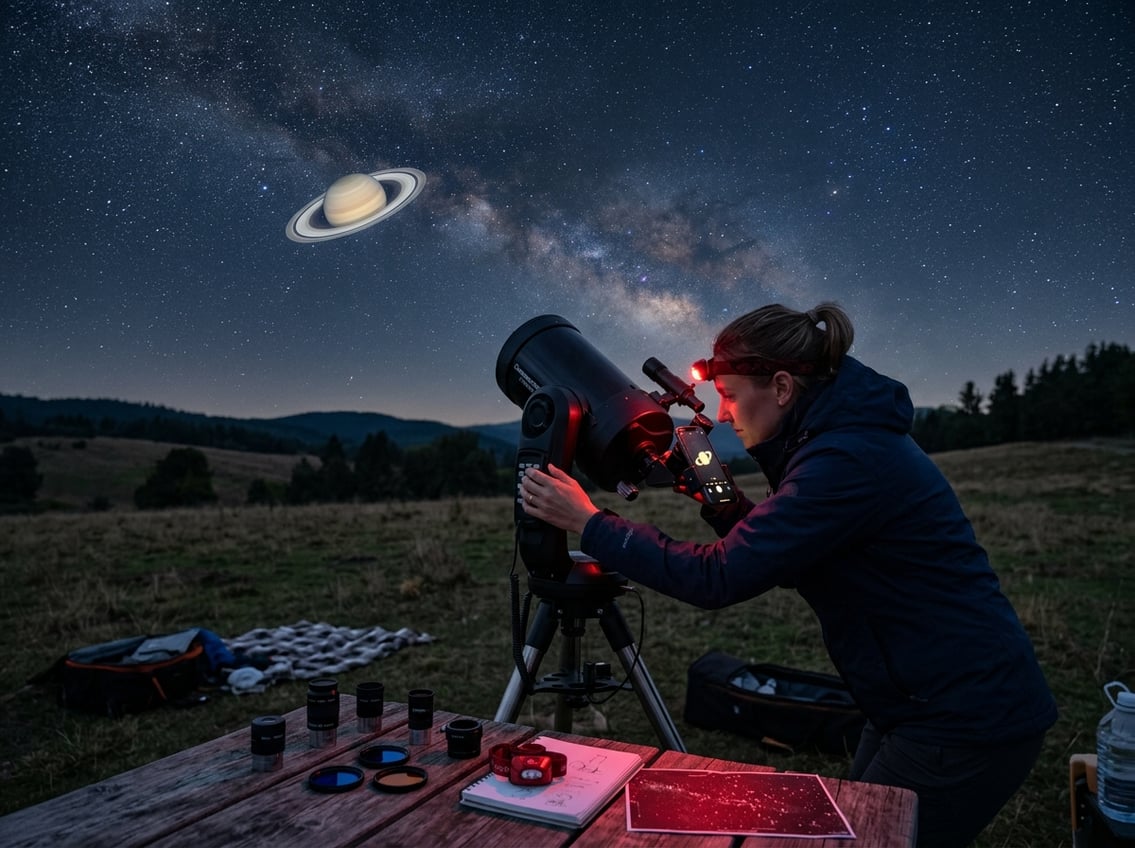
Different telescope designs excel at planetary viewing, but all require sufficient aperture and magnification to reveal Saturn’s rings. A 60mm telescope shows the rings as a distinct shape, while larger apertures reveal divisions and cloud bands.
Telescope Types for Saturn Viewing
Refractor telescopes produce sharp, high-contrast views ideal for planetary observing. Their sealed tubes require no maintenance and deliver crisp images of Saturn’s rings without the internal obstructions found in other designs. Achromatic refractors work well at f/10 or longer focal ratios to minimize color fringing around bright Saturn.
Schmidt-Cassegrain telescopes (SCTs) combine portability with long focal lengths. An 8-inch SCT at f/10 provides excellent magnification in a compact tube, making it popular for viewing Saturn’s rings. The folded optical path delivers high power without requiring a massive tube length.
Newtonian reflectors on Dobsonian mounts offer the most aperture per dollar. An 8-inch Dobsonian reveals Saturn’s Cassini Division and multiple moons at 200× magnification. These scopes excel at gathering light but require occasional mirror alignment for optimal planetary performance.
Maksutov-Cassegrain telescopes deliver exceptional planetary detail in smaller apertures. A 127mm Maksutov at f/12 produces views rivaling larger scopes due to its high contrast and minimal optical aberrations when viewing bright objects like Saturn.
Minimum Requirements for Seeing the Rings
A 60mm refractor telescope represents the absolute minimum for seeing Saturn’s rings as a distinct shape. At 50× magnification, the rings appear as an elongated oval extending from the planet’s disc. This aperture shows the rings exist but reveals limited detail.
80-100mm aperture marks the point where Saturn viewing becomes rewarding. The Cassini Division appears as a thin dark line separating the rings on nights of steady atmosphere. Saturn’s equatorial belt becomes visible as a faint band across the disc.
150mm and larger apertures transform the view. Multiple cloud belts stripe the planet’s surface. The shadow of the rings falls visibly on Saturn’s globe. Four to six moons appear as tiny points of light surrounding the planet.
Magnification matters as much as aperture. Start at 75-100× to locate and center Saturn through the telescope. Increase to 150-200× for detailed ring observation. Pushing beyond 250× requires excellent atmospheric conditions and precise focusing.
Enhancing Detail with Accessories
A Barlow lens doubles or triples magnification without requiring multiple eyepieces. A 2× Barlow transforms a 10mm eyepiece into 5mm, instantly doubling the magnification on Saturn. Quality Barlow lenses maintain sharp focus and contrast essential for planetary detail.
Planetary eyepieces with 4-8mm focal lengths provide the high magnification needed for Saturn. Designs like Plössl or orthoscopic eyepieces deliver sharp views with minimal distortion. Wide-field eyepieces work better for locating Saturn initially.
Color filters enhance specific features when viewing Saturn through a telescope. A yellow filter (#12) increases contrast on Saturn’s cloud belts. A light blue filter (#82A) helps reveal the Cassini Division more clearly. Green filters (#56) work well for observing the planet’s polar regions.
A motorized tracking mount keeps Saturn centered in the eyepiece at high magnification. Manual tracking becomes difficult above 150× as Saturn drifts quickly through the field of view.
Step-by-Step Guide to Observing Saturn’s Rings
From experience: My first look at Saturn’s rings was actually by accident — I stumbled past the astronomy lab after a late class and they had it perfectly dialed in. They let me look, then swung over to a globular cluster for their study. That one unplanned moment hooked me completely.
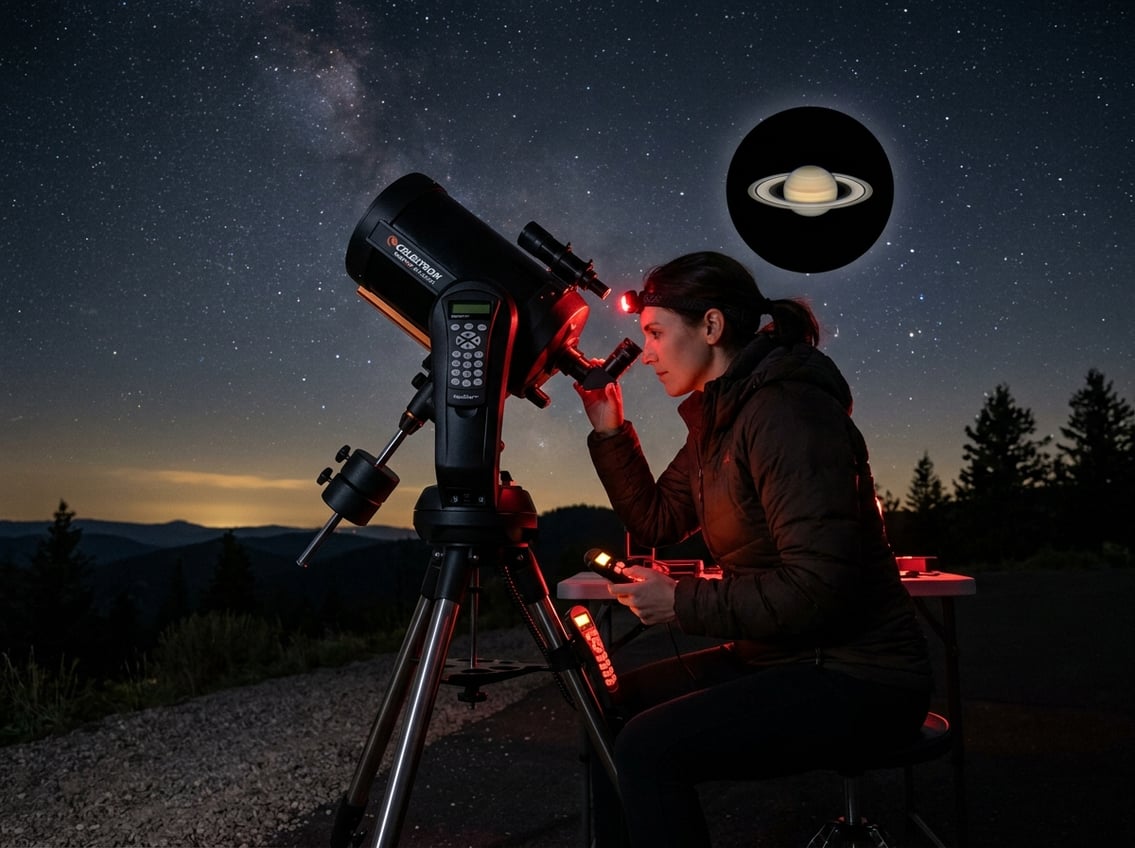
Setting up properly and using the right magnification makes the difference between a blurry blob and a clear view of Saturn’s iconic ring system. Starting with low power to locate the planet, then gradually increasing magnification, helps observers get the sharpest possible views.
How to Set Up for Ring Observation
The observer should start by setting up the telescope at least 30 minutes before observing to allow the optics to reach ambient temperature. Temperature differences create air currents inside the tube that blur the image.
Initial Setup Steps:
- Place the telescope on stable ground away from heat sources like air conditioning vents or warm pavement
- Insert the lowest-power eyepiece first (typically 25mm or 32mm)
- Point the telescope toward Saturn using a planetarium app or star chart
- Center Saturn in the finder scope, then look through the main eyepiece
- Focus carefully using the focuser knob until Saturn appears as a sharp point
At low power, Saturn looks like a small elongated object rather than a round star. The rings create this distinctive shape even at 30× to 50× magnification. Once centered, the observer can increase power to see more detail.
A red LED flashlight preserves night vision while adjusting equipment. White lights force the eyes to readjust to darkness, wasting valuable observing time.
Magnification and Power Tips
Observers should start at 75× to 100× to locate and center Saturn, then increase to 150× to 200× for optimal ring detail. The formula for magnification is telescope focal length divided by eyepiece focal length.
Useful Magnification Ranges:
| Purpose | Magnification | What’s Visible |
|---|---|---|
| Finding Saturn | 30-50× | Elongated shape, rings barely visible |
| General viewing | 75-100× | Rings clearly separated from planet |
| Detailed observation | 150-200× | Cassini Division, ring shadow |
| Maximum detail | 200-300× | Multiple ring divisions (requires good conditions) |
Atmospheric steadiness limits how much magnification works on any given night. If the image becomes fuzzy or washed out when increasing power, the observer should back down to lower magnification. Pushing past what the atmosphere can support ruins the view.
Using a Barlow lens doubles or triples magnification without buying multiple eyepieces. A 2× Barlow turns a 10mm eyepiece into effective 5mm magnification.
Observing Saturn as a Beginner
New observers should pick nights when Saturn appears high in the sky, at least 30 degrees above the horizon. Looking through less atmosphere produces sharper, steadier images.
The best time to observe Saturn is within a few months of opposition, when the planet rises in the east at sunset and stays visible most of the night. In 2026, opposition occurs on October 4.
What to Look For:
- The gap between the rings and the planet’s disc becomes visible at 80× to 100×
- The Cassini Division appears as a dark line in the rings at 150× or higher
- Saturn’s equatorial belt shows as a darker band across the middle
- Titan, the largest moon, looks like a bright star near Saturn
Observers should take breaks every 10 to 15 minutes to rest their eyes. Looking away, blinking, and relaxing helps maintain focus for longer viewing sessions. Patience matters because atmospheric turbulence comes in waves, with moments of sharp clarity between periods of blurriness.
Using Astronomy Apps and Tools
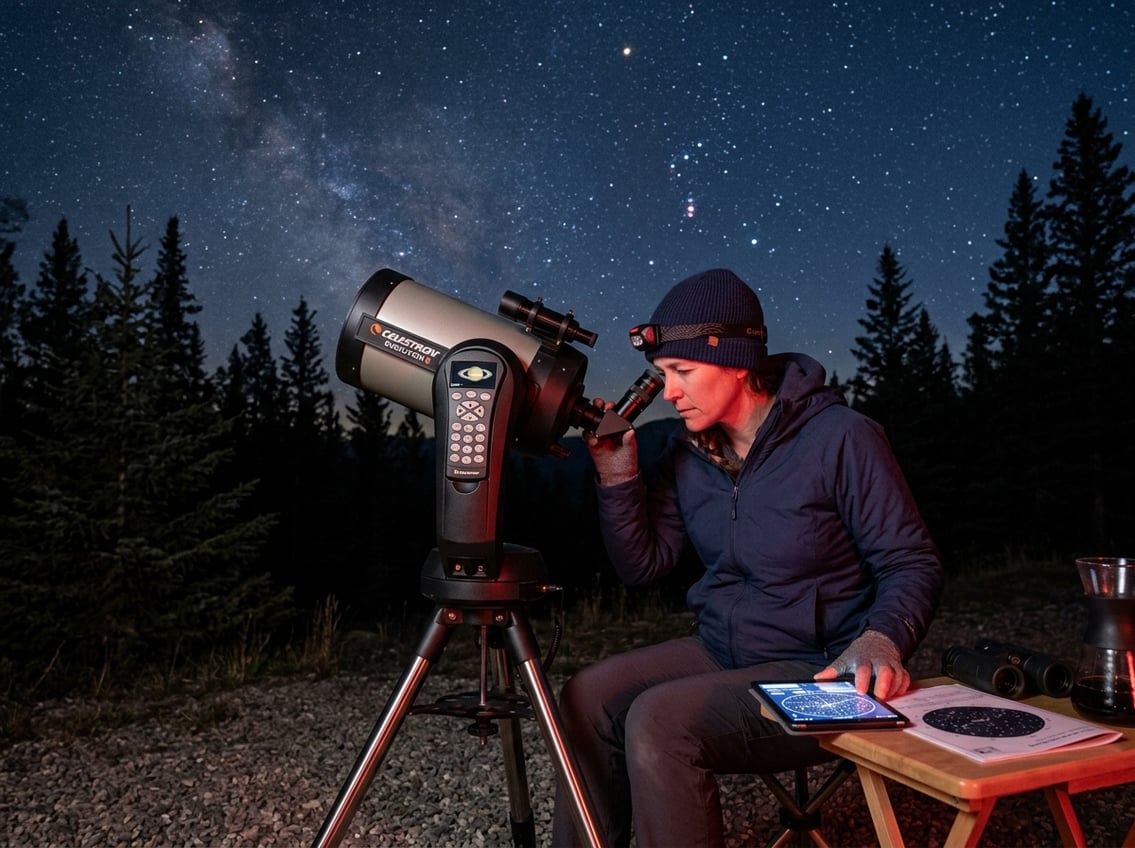
Modern astronomy apps eliminate guesswork when tracking Saturn’s position in the night sky. These free and paid apps provide real-time sky maps, orbital data, and notifications that make finding Saturn straightforward even for beginners.
Locating Saturn with Stellarium
Stellarium offers a free planetarium experience on computers and mobile devices. Users can search for Saturn by name, and the app displays its exact position against the current sky view from their location.
The app shows Saturn’s magnitude, rise and set times, and current constellation location. Users can fast-forward time to see where Saturn will appear later in the evening or in upcoming months. This helps plan observing sessions around weather and personal schedules.
Stellarium’s telescope control feature connects directly to computerized mounts. The red-light night mode preserves dark adaptation while checking the app at the telescope. The ground landscape display helps users orient themselves by showing recognizable landmarks and horizon features.
SkySafari: Features and Benefits
SkySafari provides detailed information about Saturn’s physical appearance, including current ring tilt angle and which moons are visible. The app calculates optimal viewing times based on altitude and atmospheric conditions.
The app’s Tonight’s Best feature ranks celestial objects by visibility quality. Users can filter results to show only planets, making Saturn easy to locate among thousands of database objects. SkySafari’s telescope control works with most popular mount brands.
The Plus and Pro versions include thousands of deep-sky objects alongside planetary data. Users can simulate telescope views at different magnifications to preview what Saturn will look like through their specific equipment before heading outside.
Star Walk 2 for Sky Mapping
Star Walk 2 uses augmented reality to overlay celestial objects directly onto the phone’s camera view. Users point their device at the sky, and the app identifies Saturn’s location in real time.
The app sends notifications when Saturn reaches optimal viewing altitude. Time machine functionality shows Saturn’s position for any date, helping users plan observing sessions during opposition or when ring tilt is most favorable.
Star Walk 2’s What’s Up Tonight section highlights visible planets with quick-access buttons. The app displays Saturn’s current distance from Earth, brightness, and constellation location without requiring manual searches through menus.
Recognizing Saturn’s Moons and Other Details
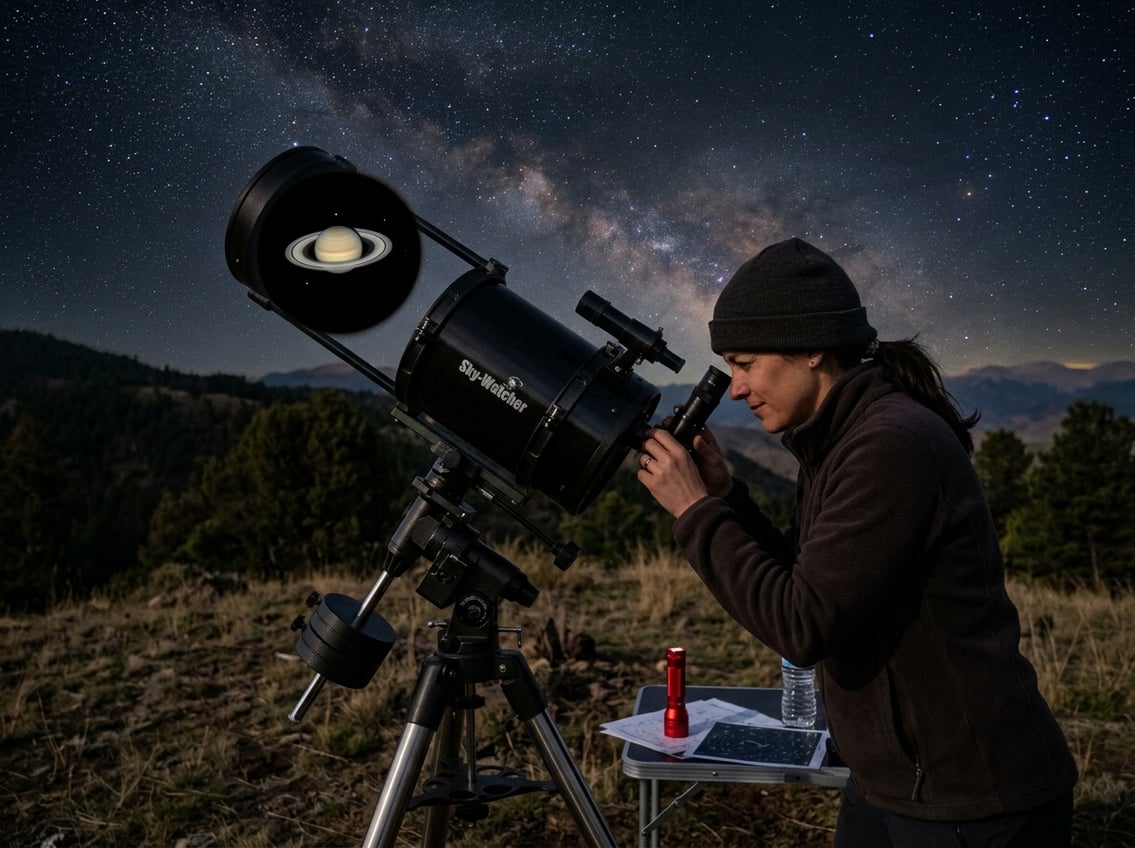
Beyond the rings themselves, Saturn offers observers a chance to spot several bright moons and subtle planetary features. Saturn has 146 known moons, though only a handful are visible through amateur telescopes.
Spotting Titan and Other Major Moons
Titan stands out as the easiest moon to observe due to its massive 5,150km diameter, making it larger than Mercury. A 2-inch telescope can reveal Titan as a star-like point near Saturn. Six moons are accessible to amateur observers: Titan, Rhea, Dione, Tethys, Enceladus, and Mimas.
A 4-inch telescope shows Titan clearly and may reveal Rhea and Dione under good conditions. The challenge increases with the fainter moons. Observers typically need magnifications between 110x and 170x to separate these moons from Saturn’s bright glare.
Iapetus presents a unique observing challenge. This moon varies dramatically in brightness depending on which hemisphere faces Earth. At its brightest, it becomes visible in moderate telescopes, but it can fade beyond detection when its dark side rotates into view.
The moons appear as tiny dots of light positioned at various distances from the planet. They shift positions noticeably from night to night as they orbit Saturn.
Moons’ Effects on Ring Viewing
Saturn’s moons don’t directly impact ring visibility, but they add context to the viewing experience. When multiple moons align near the rings, they can create momentary confusion about what features belong to the ring system versus independent satellites.
The planet’s shadow on the rings becomes more apparent when observers understand the three-dimensional arrangement of moons orbiting in the same plane. Titan’s orbital period of 16 days means it completes a visible circuit around Saturn relatively quickly. Closer moons like Enceladus orbit in just 33 hours, creating rapid positional changes between observing sessions.
Maximizing Success: Tips for Clear Views
Atmospheric steadiness limits what observers can see more than telescope size does, and proper equipment setup directly affects image sharpness. Allowing the telescope to reach outdoor temperature and checking alignment prevents blurred views that waste Saturn’s best viewing windows.
Importance of Seeing Conditions
Atmospheric turbulence determines how much detail appears in Saturn’s rings and atmosphere. On nights with poor seeing, the planet appears to shimmer and wobble, making fine details like the Cassini Division impossible to observe even with large telescopes.
The best seeing occurs when air is stable and calm. Observers should avoid viewing Saturn when it sits low on the horizon, where they look through more atmosphere. Viewing 30 degrees or higher above the horizon provides clearer images.
Nights after a cold front passes often deliver excellent seeing conditions. High-altitude jet streams and local heat rising from buildings or pavement degrade image quality. Observing Saturn through a telescope works best when the air feels still and temperatures have stabilized after sunset.
Patience matters when seeing conditions vary throughout the night. Moments of steady air reveal details that disappear seconds later during turbulent periods.
Collimation and Cooling
Telescopes must reach the same temperature as the outdoor air to deliver sharp images. Warm air currents rising from a telescope that hasn’t cooled create internal turbulence that blurs Saturn’s rings.
Reflector telescopes need at least 30 minutes to cool down in mild weather. Larger apertures require longer cooling times, sometimes 60-90 minutes on warm evenings. Opening tube vents or removing dust caps early speeds this process.
Collimation keeps mirrors or lenses properly aligned. Misaligned optics scatter light and reduce contrast, making Saturn’s ring divisions harder to detect. Schmidt-Cassegrain telescopes hold collimation well but should be checked monthly. Newtonian reflectors require more frequent adjustments.
A collimation tool costs less than most eyepieces and takes five minutes to use. Observers who check collimation before each session consistently report sharper planetary views.
Recording and Sketching Observations
Drawing Saturn helps observers notice details they would otherwise miss. The act of sketching forces careful examination of ring divisions, cloud bands, and moon positions.
Simple pencil sketches capture what the eye sees better than rushed photographs. Observers should draw the basic shape first, then add details during moments of steady seeing. Recording the date, time, aperture, magnification, and seeing conditions makes each sketch a useful reference.
Digital records complement sketches. Phone cameras held up to the eyepiece can capture Saturn’s appearance, though the image won’t match visual quality. These snapshots document ring tilt changes over months and track moon positions.
Keeping an observing log builds experience. Comparing sketches from different nights reveals which atmospheric conditions, magnifications, and eyepieces produce the best results for a specific telescope setup.
Seeing Saturn’s rings from my own backyard is still a thrill, so I tell you exactly what aperture and magnification it really takes.
These May Help Too...
Can You Use a Telescope Through a Window? (And Why You Should Not)
Using a telescope through a window ruins the view: bad glass, heat currents and reflections. Here is what actually happens, and what to do instead.
Telescope will not come to focus? The cause is almost always spacing, not optics. Work out whether you ran out racking in or out, then fix that end.