
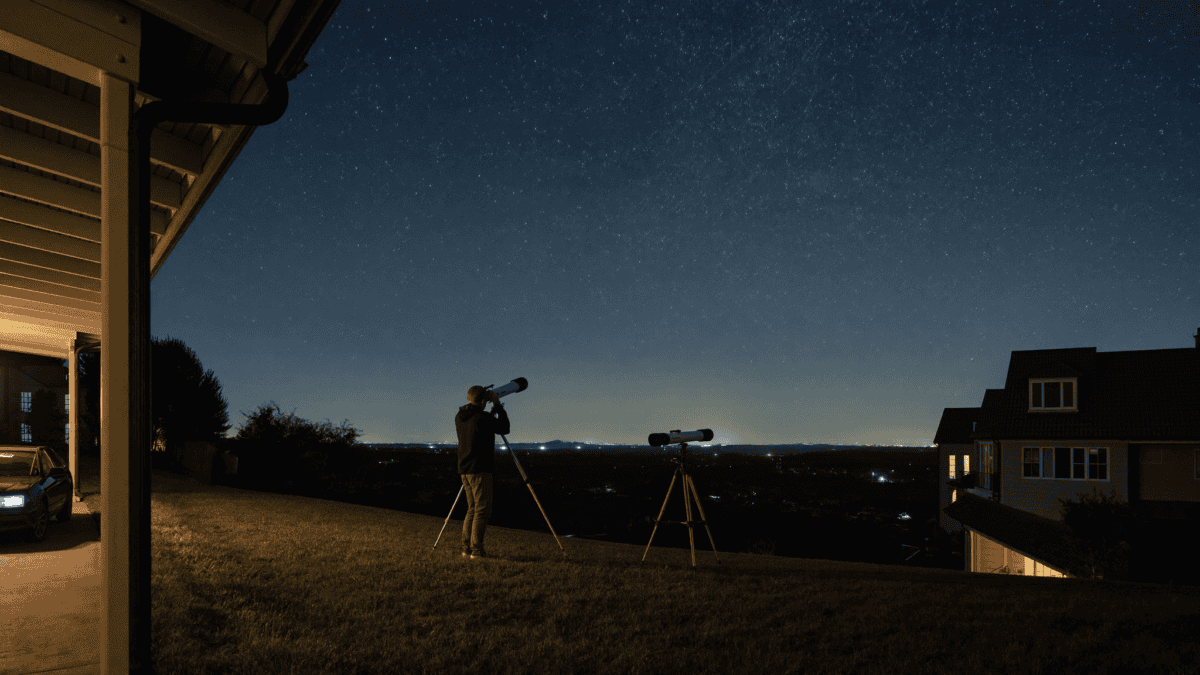
The best telescope for urban and suburban stargazers is the Celestron StarSense Explorer DX 130AZ — it pairs enough aperture for the Moon and planets with a phone app that finds targets for you, which matters far more in the city where you can barely see the stars you’d normally hop between. If your real goal is deep-sky photos through the light dome, skip visual entirely and get the ZWO Seestar S50 Pro smart telescope. I’ve spent the last several years observing from my own backyard here in York, PA, under Bortle 5–6 suburban skies, and the honest truth is this: most of what a beginner wants to see does not care about light pollution at all. This TelescopeSchool guide ranks the scopes that actually deliver under city and suburban lights, and tells you which ones will just frustrate you.
Quick Answer: The best telescope for urban and suburban skies is the Celestron StarSense Explorer DX 130AZ (~$400): enough aperture for the Moon and planets, plus a phone app that finds targets when light pollution hides the stars. For deep-sky from the city, the ZWO Seestar S50 smart telescope beats light pollution; for maximum aperture, an 8-inch Dobsonian.
Model update — September 2026
The Seestar S50 named here has been discontinued. Its replacement is the Seestar S50 Pro — same 50mm aperture, upgraded sensor and autofocus — at an introductory $899. It is newly released: High Point Scientific is taking orders, B&H lists it as coming soon. We will update here once it is confirmed in stock. If you want a smart telescope you can buy today, the Seestar S30 Pro at $699 is in stock now.
Best telescopes for urban and suburban stargazers at a glance
For city and suburban observers, the right telescope depends on whether you want to find things easily, photograph the deep sky, or pull maximum detail out of the Moon and planets. Here are the picks, with the job each one does best.
| Telescope | Type | Aperture | Best for (in the city) | Approx. price |
|---|---|---|---|---|
| Celestron StarSense Explorer DX 130AZ | Reflector + phone push-to | 130mm | Best overall — finds targets when few stars are visible | ~$400 |
| ZWO Seestar S50 Pro | Smart telescope | 50mm | Deep-sky photos through light pollution | ~$899 (updated Sept 2026) |
| Apertura AD8 / Sky-Watcher 8" Dobsonian | Dobsonian reflector | 203mm (8") | Max aperture — best planets & brighter deep-sky | ~$480 |
| Sky-Watcher Skymax 102 Maksutov | Maksutov-Cassegrain | 102mm | Sharp Moon & planets from a small balcony | ~$220 |
| Sky-Watcher Heritage 130P | Tabletop Dobsonian | 130mm | Grab-and-go from a balcony or patio | ~$220 |
| Celestron 70mm Travel Scope | Refractor | 70mm | Budget starter / kids on a patio | ~$100 |
You don’t need dark skies for the Moon and planets
You do not need to escape the city to enjoy a telescope — the Moon, Saturn, Jupiter, Venus, and Mars punch straight through light pollution. This is the single most important thing a discouraged city beginner needs to hear. Light pollution washes out faint, spread-out objects like galaxies and nebulae, because their dim light has to compete with the glow of the sky. But the Moon and planets are bright, compact, and high-contrast. From my Bortle 5–6 backyard, Saturn’s rings and Jupiter’s cloud belts look essentially the same as they do from a dark site — the sky background around them is a little brighter, and that’s it.
So the first question isn’t “how do I beat the light pollution?” It’s “what do I actually want to look at?” If it’s the Solar System, almost any decent telescope on this list will thrill you tonight. If it’s deep-sky, you need a different strategy — and that’s where a smart telescope or a drive to darker skies comes in.
Best overall for the city: Celestron StarSense Explorer DX 130AZ (~$400)
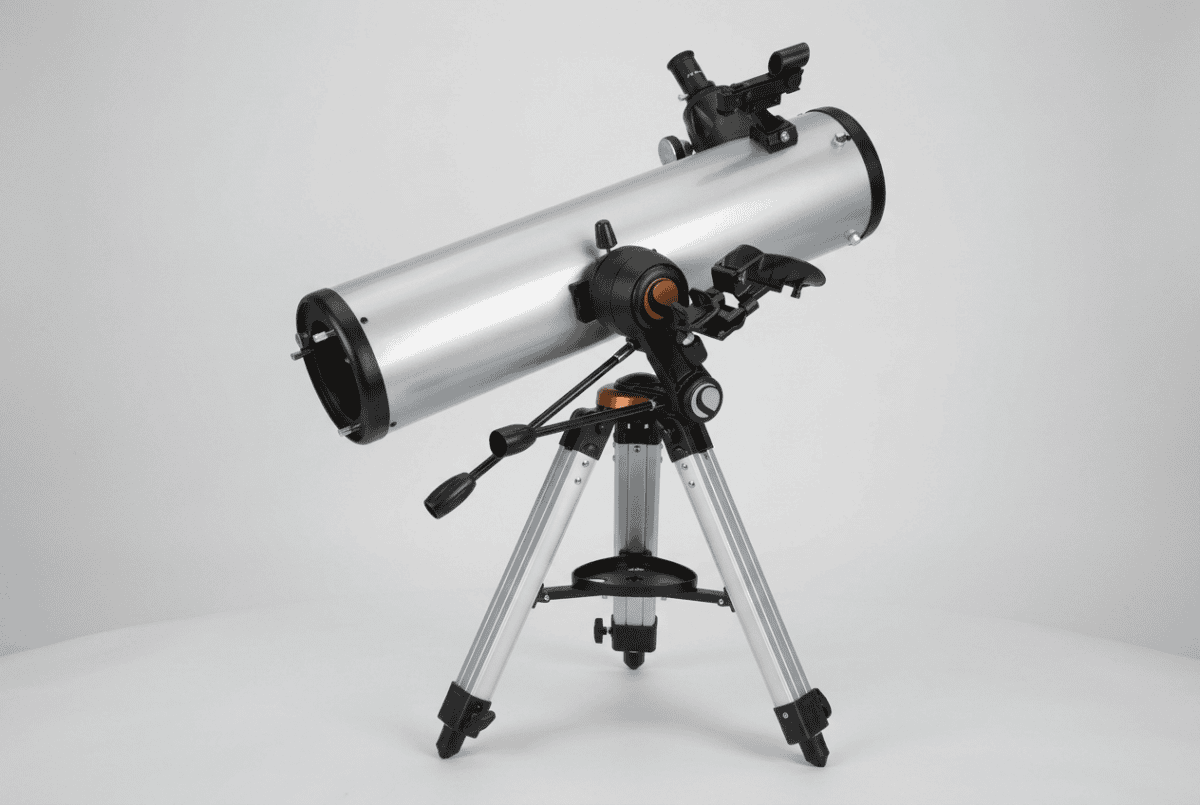
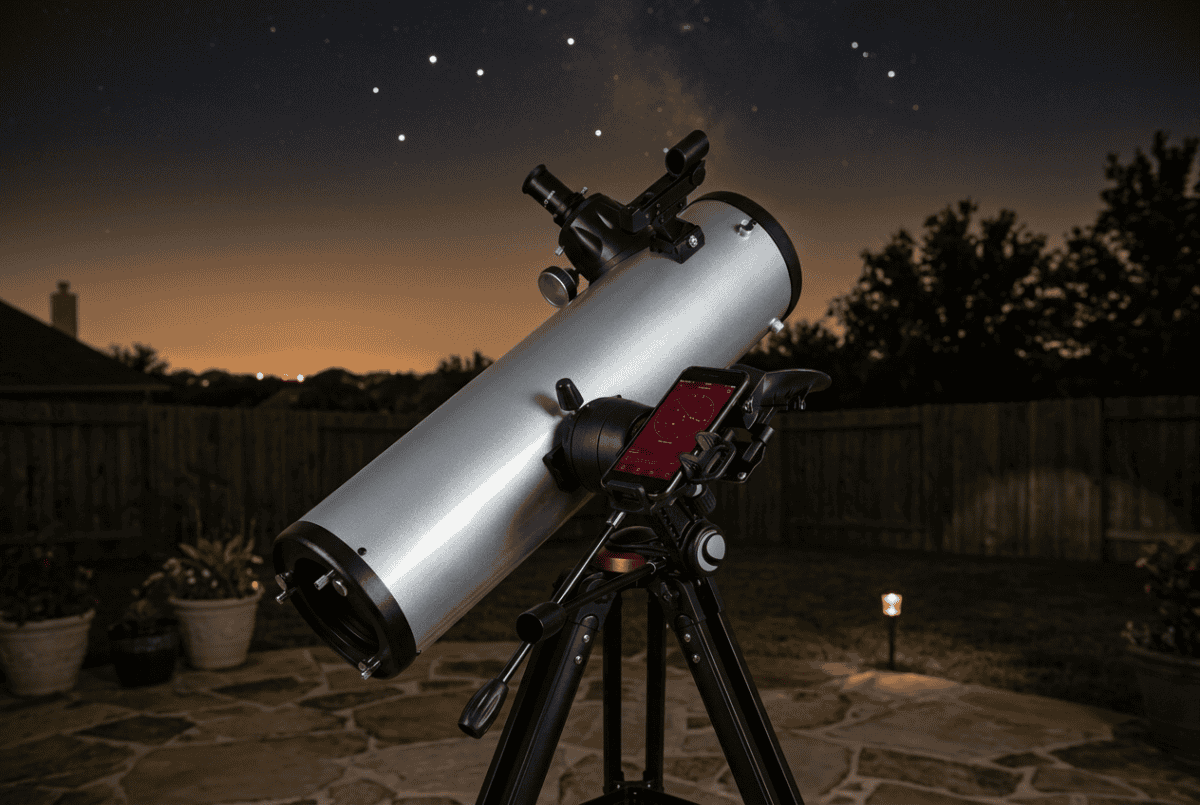
The StarSense Explorer DX 130AZ is the best all-around telescope for urban and suburban beginners because it solves the city’s real problem: you can’t star-hop when the sky is washed out. Its 130mm reflector gathers enough light for crisp views of the Moon, planets, and the brighter deep-sky objects, and the StarSense phone dock does the finding for you. You drop your phone in the cradle, the app reads the star field (even a thin one), and arrows guide you to nudge the scope onto the target. In a suburb where you might only see a dozen stars with the naked eye, that plate-solving is worth its weight in gold.
Be clear on what it is: StarSense is manual push-to, not a motorized GoTo. You move the telescope by hand while the app tells you which way to go — no motors, no batteries to die, no frustrating alignment routine. For a city beginner that’s a feature, not a limitation. It gets you observing in minutes and quietly teaches you the sky.
- Pros: App finds objects with almost no visible stars; real 130mm aperture; no power or alignment headaches; teaches you the sky.
- Cons: You still nudge it by hand; phone must fit the dock; the included eyepieces are just okay (an upgrade helps).
Best for deep-sky from the city: ZWO Seestar S50 (~$899 (updated Sept 2026))
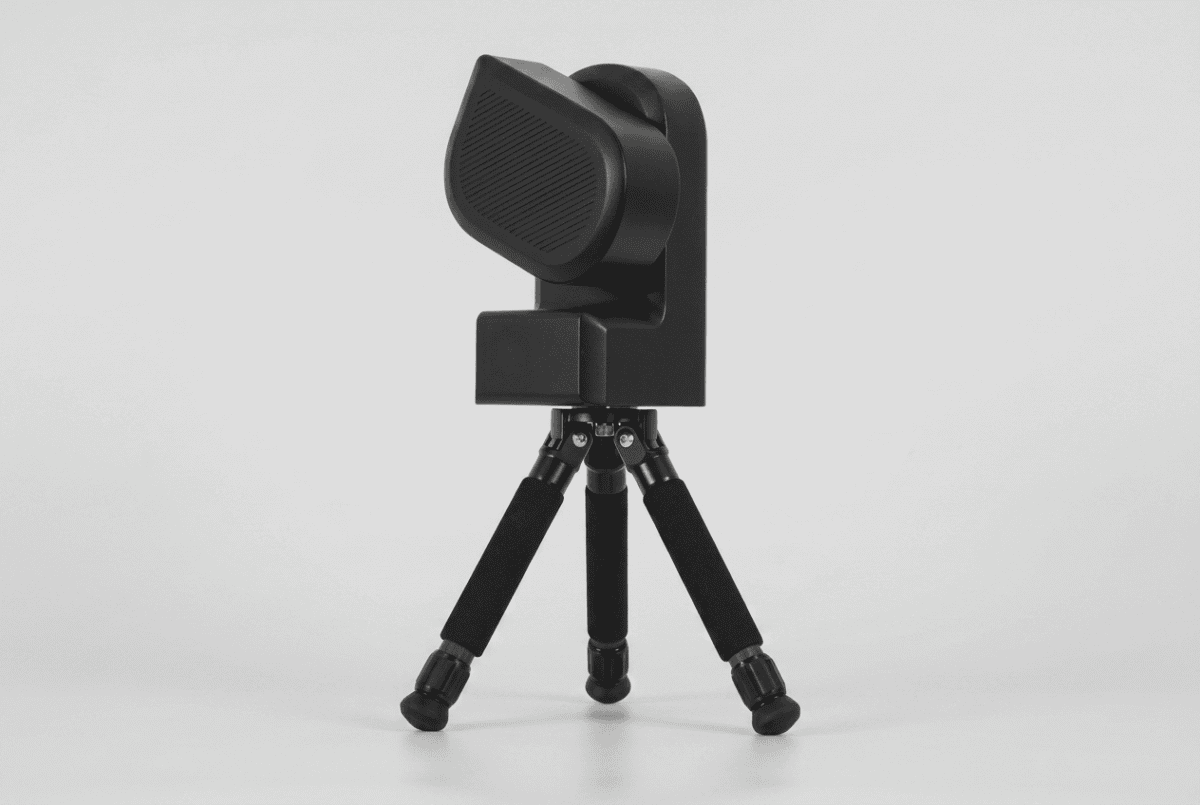
If you want to actually capture nebulae and galaxies from a light-polluted backyard, the ZWO Seestar S50 is the answer, because it stacks many short exposures on your phone to pull faint detail out of a bright sky. This is the one telescope on the list that genuinely defeats light pollution for deep-sky targets — not by magic, but by math. Each frame is noisy and washed out, but stack a few hundred of them and the Orion Nebula or the Andromeda Galaxy emerges in color, right on your screen, from a Bortle 6 driveway.
The trade-off is that this is astrophotography, not eyepiece viewing. There’s no eyepiece to look through; you watch the image build on your phone. The 50mm aperture and wide field mean planets stay small, and framing is fixed. But for a city dweller who’s been told “you’ll never see galaxies from here,” the Seestar is a revelation. For the full breakdown, see my ZWO Seestar S50 review and how it stacks up in best smart telescopes of 2026.
- Pros: Beats light pollution for deep-sky via stacking; fully automated; works from a tiny balcony; app-based, beginner-friendly.
- Cons: Imaging, not visual; weak on planets; fixed framing; you’re looking at a screen, not through glass.
Best aperture value: Apertura AD8 or Sky-Watcher 8-inch Dobsonian (~$480)
If you have somewhere to store it, an 8-inch Dobsonian gives you the most telescope for the money and the best planetary views on this list, because aperture is king — and even in the suburbs, more light means more detail. An 8" (203mm) mirror shows the Cassini Division in Saturn’s rings, festoons in Jupiter’s belts, and turns the brighter globular clusters like M13 into a sparkling ball of stars. From my Bortle 5–6 yard it still pulls in the Ring Nebula and the brighter galaxies; they’re faint smudges rather than photographs, but they’re there.
The honest catch for city and apartment folks is size. A full-size 8" Dob is a two-piece armful and needs floor space to store. It’s manual, so you’ll learn to find things yourself (a red-dot or a StarSense-style app helps). And it does no photography. But dollar-for-dollar of what your eye sees, nothing here beats it. If storage or stairs are a problem, drop down to the tabletop 130P below.
- Pros: Most aperture per dollar; best visual planets and deep-sky; simple, no electronics.
- Cons: Bulky to store and carry; manual finding; no astrophotography.
Best for a small balcony: Sky-Watcher Skymax 102 Maksutov (~$220)
For a cramped balcony or a small patio where you mostly want the Moon and planets, a 102mm Maksutov-Cassegrain like the Sky-Watcher Skymax 102 is the sharpest, most compact choice, because its long focal length is built for high-magnification Solar System views and it shrugs off light pollution completely. The tube is short and light, it cools quickly, and the optics deliver tight, high-contrast images of lunar craters, Saturn’s rings, and Jupiter’s moons — exactly the targets that don’t care how bright your sky is.
A Mak’s narrow field of view makes it poor for large, faint deep-sky objects, so this isn’t the scope for someone chasing nebulae. But for an urban observer whose realistic menu is the Moon and planets from a balcony, it’s a precision instrument in a coat-pocket-sized package. Put it on a small alt-az mount or tripod and you’re set up in under a minute.
- Pros: Very compact; superb Moon/planet detail; immune to light pollution for its best targets; fast to set up.
- Cons: Narrow field — weak on big deep-sky objects; needs a steady mount for high power.
Best grab-and-go: Sky-Watcher Heritage 130P (~$220)
The Sky-Watcher Heritage 130P is the best grab-and-go telescope for renters and balcony observers, because it packs 130mm of aperture into a collapsible tabletop Dobsonian you can carry with one hand. It gives you real light-gathering for the Moon, planets, and brighter deep-sky, then collapses down and stores in a closet. For someone in an apartment with no backyard, that portability is the whole game.
The honest caveats: it’s a tabletop scope, so it must sit on a solid table, stool, or crate at the right height — it has no tripod. The helical focuser is basic, and the open tube means stray light and dust reach the mirror, so a light shroud helps in the city. But as a first telescope you can actually use from a small space, it’s hard to beat. I go deeper in my Sky-Watcher Heritage 130P review.
- Pros: 130mm aperture that’s genuinely portable; collapses for storage; affordable; ideal for balconies and patios.
- Cons: Needs a table/surface to sit on; basic focuser; open tube catches stray city light.
Best budget starter: Celestron 70mm Travel Scope (~$100)
If you’re testing the waters or buying for a child, the Celestron 70mm Travel Scope is a sensible, honest budget pick because it sets realistic expectations: the Moon in crisp detail, the phases of Venus, and Jupiter’s four bright moons, all from a patio or balcony. It’s small, light, and forgiving. It will not show you galaxies, and it’s a refractor of modest quality, so don’t expect miracles — but it’s a real telescope, not a toy, and it can spark the hobby without a big outlay.
- Pros: Cheap; light and portable; genuinely shows the Moon and bright planets; great for kids.
- Cons: Small aperture; wobbly included tripod; not for deep-sky.
What can you actually see with a telescope in the city or suburbs?
From experience: even from my light-polluted suburban backyard, the Orion Nebula is the one I keep coming back to. It is no NASA photo, but it is an easy grab on almost any clear night.
From a light-polluted backyard you can see a surprising amount: the Moon in stunning, crater-by-crater detail; Saturn’s rings; Jupiter’s cloud belts and four Galilean moons; the phases of Venus; Mars as a small orange disk near opposition; double stars; and the brightest deep-sky objects — the Orion Nebula (M42), the Pleiades (M45), and the globular cluster M13. What light pollution steals is the faint stuff: most galaxies, dim nebulae, and the Milky Way’s structure fade into the sky glow. From my own Bortle 5–6 skies, galaxies show up as faint grey smudges, not the swirls you see in photos — that’s normal, and it’s why smart telescopes and dark-sky road trips exist.
One 2026 note worth planning around: this is a great year for Saturn, which reaches opposition on October 4 and rides high and bright — a perfect light-pollution-proof target. Jupiter’s best window was early in the year (opposition was January 10). Mars is quiet in 2026 with no opposition until February 2027, so temper expectations there.
How to beat light pollution (without moving)
You beat light pollution mostly by choosing the right targets and, when you want deep-sky, the right tools. The four moves that actually work, in order of payoff:
- Observe the Moon and planets. They’re immune to light pollution. Build your hobby around them and you’ll never be disappointed by your city sky.
- Use a smart telescope for deep-sky. Live stacking (like the Seestar) is the only thing that reliably pulls nebulae and galaxies out of a bright sky.
- Add the right filter. A broadband light-pollution filter can lift contrast on emission nebulae, and a simple Moon or color filter sharpens planetary detail. See my guide to telescope filters and which ones to use where. (Filters can’t rescue galaxies — those need dark skies or stacking.)
- Take the occasional dark-sky trip. Even a 30–45 minute drive to a Bortle 4 site transforms deep-sky observing. Check your Bortle class first — my guide on how dark the sky is above your telescope shows you how.
Telescopes to avoid for city stargazing
Avoid any telescope that markets a giant “magnification” number — that’s the clearest sign of a hobby-killer. Boxes screaming “450x!” on a tiny 60–70mm tube are selling empty magnification the optics can’t support; you’ll get a dim, blurry blob and give up. Steer clear of the Celestron PowerSeeker 127EQ (a “Bird-Jones” design with a fussy corrector and a terrible focuser), and the generic Amazon-marketplace brands (Gskyer, SOLOMARK, and similar) sold on flimsy, shaky equatorial mounts. In the city especially, a wobbly mount and bad optics turn an already-challenging sky into a frustrating one. Spend the same money on aperture and stability instead — everything on this list is a better use of your cash.
How to choose a telescope for urban or suburban skies
Choose based on what you want to see and how much space you have, in that order. Start with aperture for light-gathering, then pick a mount you’ll actually set up, then decide how you’ll find objects. Here’s the quick decision path:
- Mostly Moon and planets? Aperture and sharp optics win — a Dobsonian or a Maksutov. Light pollution barely matters.
- Want deep-sky from home? Get a smart telescope and let stacking do the work.
- Can’t see many stars to navigate by? A StarSense phone-finder scope removes the biggest city frustration.
- Tight on space (apartment, balcony)? Go tabletop (Heritage 130P) or compact Mak (Skymax 102).
One formula worth knowing: magnification equals the telescope’s focal length divided by the eyepiece focal length, and useful maximum magnification is roughly two times the aperture in millimeters (so about 260x on a 130mm scope) — on a night of steady air. Ignore any “675x” marketing.
Frequently asked questions
What is the best telescope for the city?
The Celestron StarSense Explorer DX 130AZ is the best all-around telescope for city and suburban observers, because it has enough aperture for the Moon and planets and a phone app that finds targets even when few stars are visible. For deep-sky photos through light pollution, the ZWO Seestar S50 smart telescope is the better choice.
Can you use a telescope in a light-polluted area?
Yes. The Moon, Saturn, Jupiter, Venus, and Mars cut right through light pollution and look great from any backyard. Only faint deep-sky objects like galaxies and dim nebulae are washed out — and a smart telescope with live stacking can recover many of those from the city.
Do light pollution filters really work?
Broadband light-pollution filters help modestly on emission nebulae by boosting contrast against the sky glow, but they do nothing for galaxies or star clusters, whose light spans all wavelengths. They’re a useful add-on, not a cure. For real deep-sky in the city, stacking with a smart scope works far better.
Is a smart telescope better than a regular telescope for city use?
For photographing deep-sky objects from a light-polluted area, yes — a smart telescope like the Seestar S50 stacks images to overcome sky glow, which no eyepiece can do. For actually looking at the Moon and planets with your own eye, a traditional Dobsonian or Maksutov gives a more detailed, satisfying view.
What can you see with a telescope from a backyard in the suburbs?
From typical suburban (Bortle 5–6) skies you can see the Moon in fine detail, Saturn’s rings, Jupiter’s belts and moons, Venus’s phases, double stars, and bright objects like the Orion Nebula and the Pleiades. Fainter galaxies appear as dim grey smudges rather than the colorful photos you may have seen.
Do I need a GoTo telescope for the city?
No. Under city skies a phone-based push-to system (like StarSense) is usually the better call — it finds objects without motors, batteries, or a fussy alignment routine, and it works even when you can barely see the stars. Motorized GoTo also works but costs more and eats aperture at this budget.
The bottom line
Living under city or suburban lights is not the barrier most people think it is. Build your hobby around the Moon and planets and you’ll have a lifetime of stunning nights from your own backyard — that’s the under-$500 reality I’ve lived under Bortle 5–6 skies for years. For most urban beginners, the Celestron StarSense Explorer DX 130AZ is the smartest first telescope: real aperture, and a phone that finds targets when the stars won’t help you. Want to actually capture galaxies from your driveway? Add a ZWO Seestar S50 and let the software beat the light pollution for you. Three takeaways: aperture and sharp optics matter more than a dark sky for the Moon and planets; a smart scope is your deep-sky shortcut in the city; and you can always sharpen the view with the right filter or an occasional drive to darker skies. Explore more beginner guides here at TelescopeSchool and get outside tonight.
I’m Will Montgomery, an engineer who returned to astronomy at 50 and observes from Bortle 5-6 suburban skies near York, Pennsylvania. I test scopes under the exact light-polluted conditions most city stargazers actually face.
These May Help Too...
Can You Use a Telescope Through a Window? (And Why You Should Not)
Using a telescope through a window ruins the view: bad glass, heat currents and reflections. Here is what actually happens, and what to do instead.
Telescope will not come to focus? The cause is almost always spacing, not optics. Work out whether you ran out racking in or out, then fix that end.