

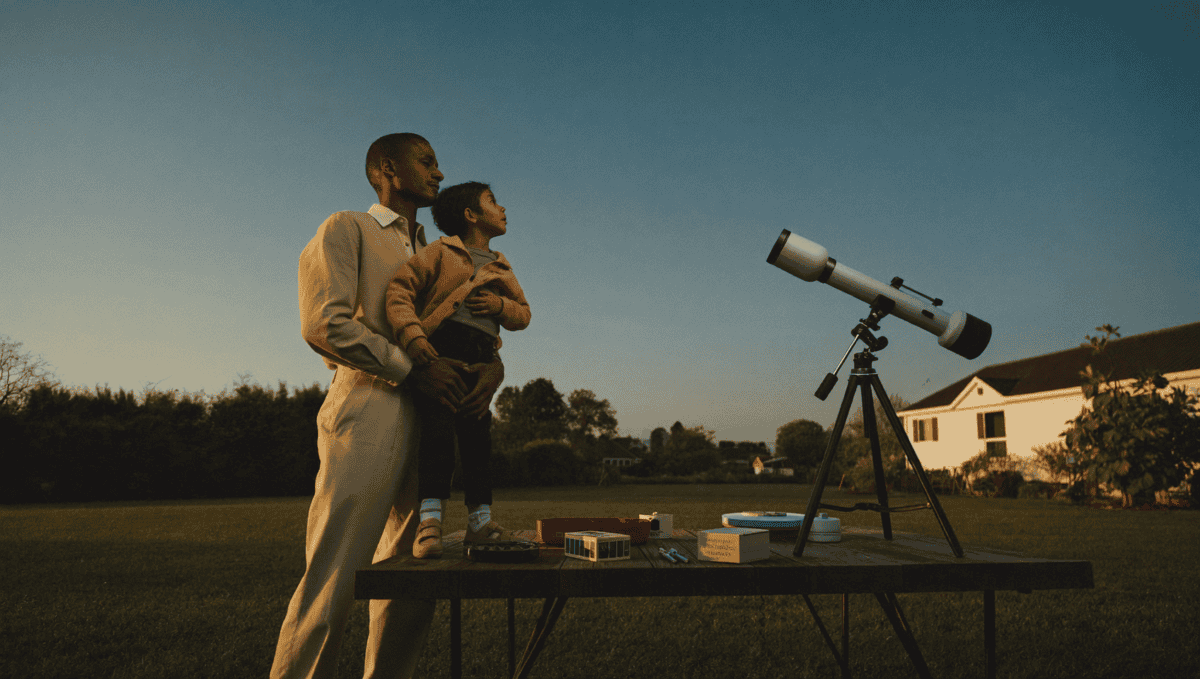
➤ Check today’s price: Sky-Watcher Heritage 130P on Amazon
On a budget? The Heritage 130P also features in our best telescopes under $500 roundup — and if you’d rather go digital, see our ZWO Seestar S50 review.
From experience: This 130 is a lot like my Astronomers Without Borders tabletop — dead simple. You point it and you view; there’s no alignment routine or learning curve between you and the sky. That’s exactly why a scope like this gets used on spur-of-the-moment clear nights when a bigger rig would just stay in the closet.
Quick answer: The Sky-Watcher Heritage 130P is one of the best-value beginner telescopes you can buy, and my pick for the best tabletop Dobsonian under about $350. It shows real detail on the Moon, planets, and the brighter deep-sky objects, but you need to go in knowing two things: the focuser is crude, and it needs a table or stand to work at all.
I came back to astronomy at 50 after a 25-year break, and I spend most of my clear nights under Bortle 5-6 suburban skies here in York, Pennsylvania. That matters, because the Heritage 130P is exactly the kind of scope a returning beginner or a first-timer actually reaches for. It is small, it is honest, and it punches above its price. Below is my engineer’s-eye teardown of what it does well, where it frustrates people, and who should buy one.
What the Sky-Watcher Heritage 130P actually is
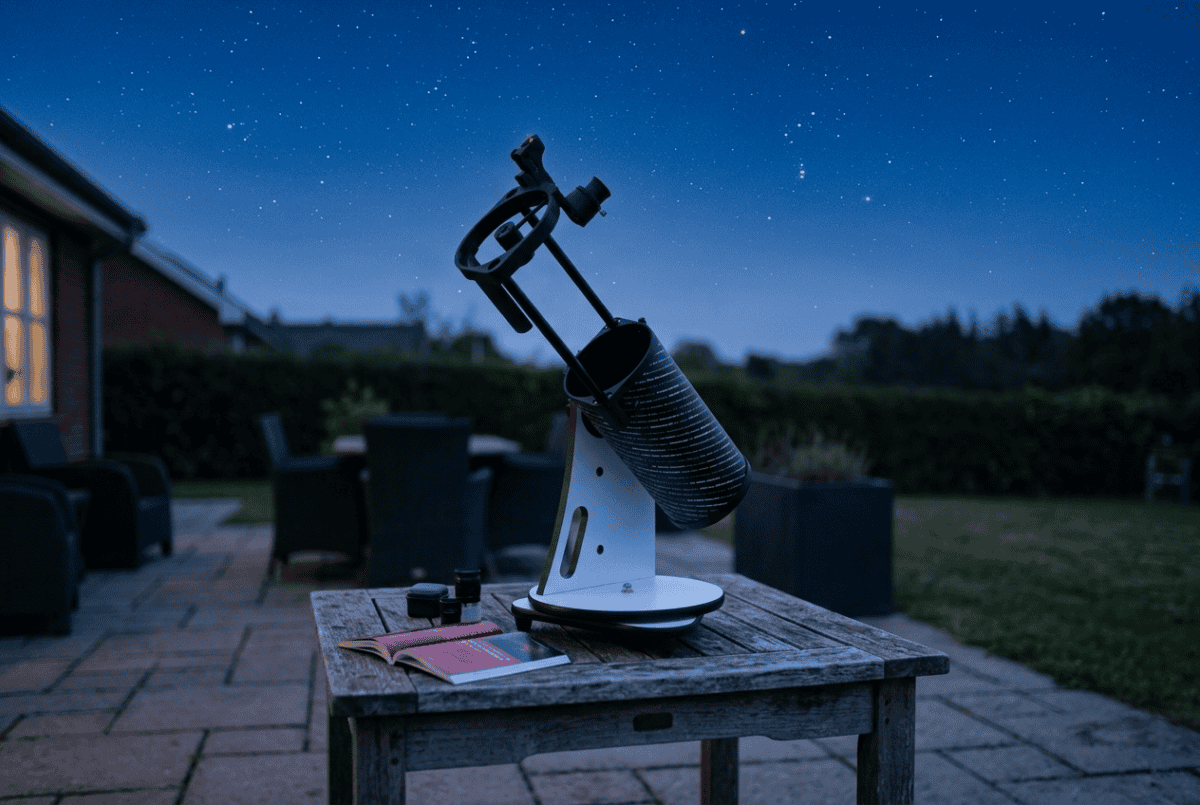
The Heritage 130P is a 130mm (5.1-inch) collapsible tabletop Dobsonian reflector. In plain terms: it is a 5-inch mirror telescope on a simple swiveling base that sits on a table instead of a tripod. The tube is a Newtonian reflector with a focal length of roughly 650mm, which works out to about f/5 — a fast, wide, forgiving optical system that is easy for beginners to point and use.
The signature feature is the collapsible (Sky-Watcher calls it “FlexTube”) design. The upper half of the tube telescopes down over the lower half, so a scope that is a couple of feet long in use shrinks to something you can tuck in a cabinet or a backpack. The optical tube weighs only around 6.5 pounds, and the whole rig runs no batteries, no motors, and no software. You set it on a picnic table, nudge it by hand, and look. For grab-and-go observing — hauling it into the backyard for twenty minutes, or throwing it in the car for a darker site — it is genuinely one of the easiest real telescopes to live with.
Verify before you buy: aperture is 130mm at f/5 (roughly 650mm focal length), and it ships with two eyepieces and a red-dot finder. Street price has generally run in the $250-$350 range depending on the retailer and any bundle.
What you can actually see with it
You can see far more than most beginners expect, as long as you keep expectations honest. A 130mm mirror gathers enough light to make the night sky genuinely rewarding from a suburban backyard.
Here is what has held up in real sessions from my Bortle 5-6 yard:
- The Moon: Spectacular. Craters, mountain ranges, and the shadow line (the terminator) are razor sharp. This alone sells people on the hobby.
- Jupiter: The disk shows its two main cloud belts, and the four Galilean moons line up like beads on a string, shifting position night to night.
- Saturn: The rings are clearly separated from the planet — the “oh wow” moment that makes a first-timer gasp. Do not expect Hubble; do expect a real, tiny, ringed Saturn.
- Deep-sky: The Orion Nebula (M42) shows structure and its trapezium of stars, and open clusters like the Pleiades and the Double Cluster are beautiful in the wide field. Brighter globular clusters and galaxies show up as faint smudges from the suburbs and improve a lot under darker skies.
What it will not do: it will not show color in faint galaxies, it will not turn Mars into a postcard, and light pollution will wash out the dimmest targets. That is physics and geography, not a flaw in the scope. Under my suburban glow the planets and the Moon are the stars of the show, and a short drive to darker skies opens up the deep-sky list.
The focuser and the tabletop reality: the honest weak points
Let me be blunt, because this is where returns and complaints come from. The Heritage 130P has two quirks that catch buyers off guard, and I would rather you hear them from me than discover them at 10 p.m. in the cold.
The helical focuser is the weak point
The 130P uses a 1.25-inch helical focuser — you twist the whole eyepiece barrel in and out to focus rather than turning a smooth rack-and-pinion knob. It works, but it is imprecise. Reaching exact focus at high magnification takes patience, the image can shift slightly as you twist, and heavier eyepieces are not ideal for it. This is the single most common criticism of the scope, and it is fair. The good news: for the Moon and planets you find focus and mostly leave it, and the focuser is upgradeable if it starts to bug you (more on that in the FAQ).
It must sit on a table or stand — there is no tripod
This surprises more first-time buyers than anything else. The Heritage 130P is a tabletop Dobsonian. It has no legs. Out of the box it needs a sturdy surface at roughly seated eye height — a patio table, a sturdy stool, a workbench, or a purpose-made observing stand. Set it on the ground and you will be lying in the grass; set it on a wobbly TV tray and every touch shakes the view. Plan for a solid, stable surface before your first night. Budget for a stand if you do not already have a suitable table.
Stray light and collimation
Two smaller engineering notes. Because the collapsible tube is open along the gap when extended, stray light from a porch bulb or streetlight can sneak in and lower contrast; a simple light shroud (a fabric sleeve around the open section, DIY or store-bought) noticeably cleans up the view. And because the tube collapses, the optics can drift out of collimation (mirror alignment) over time or from transport. That is normal for this design and quick to correct — see setup below.
Setup and collimation
Setup is about as simple as real telescopes get: extend the tube, drop it on its base, seat an eyepiece, and align the red-dot finder to the main tube during the day so pointing is easy after dark. You can be observing in a couple of minutes.
Collimation — aligning the mirrors so stars focus to crisp points — is the one maintenance skill worth learning. Because the tube collapses, expect to check it now and then, especially after travel. You can do a rough job by eye, but an inexpensive collimation cap or a cheap laser collimator makes it a two-minute task. Do not let the word scare you; I put off learning it for weeks and then felt silly, because it is genuinely easy once you have done it once. This is exactly the kind of thing we walk through step-by-step at Telescope School, because a well-collimated 130mm will out-perform a neglected larger scope every time.
Astrophotography and phone photos: set expectations
The honest answer: the Heritage 130P is a visual telescope, not an astrophotography rig. It is a Dobsonian on a manual base with no motor to track the sky, so long-exposure deep-sky imaging is off the table. Do not buy it to photograph galaxies.
What you can do is afocal phone photography of bright targets. With a smartphone adapter clamped to the eyepiece, you can capture surprisingly good shots of the Moon — the craters photograph beautifully — and grab a recognizable Jupiter-with-moons or a tiny ringed Saturn. It takes patience because the target drifts across the field and you are nudging the scope by hand, but Moon shots in particular are a real crowd-pleaser and cost you nothing but a cheap phone bracket. Treat any planetary photo as a fun souvenir, not a serious image.
Pros and cons
Here is the balance sheet after real time behind the eyepiece:
Pros:
- 130mm of aperture at a beginner price — genuinely excellent light-gathering for the money
- Collapsible, lightweight (~6.5 lb tube) and truly grab-and-go
- Fast f/5 optics give wide, bright, forgiving views
- Dead-simple to use: no batteries, no motors, no software
- Real detail on the Moon, Jupiter’s belts and moons, Saturn’s rings, and brighter deep-sky objects
- Focuser and eyepieces are upgradeable as you grow
Cons:
- The 1.25-inch helical focuser is imprecise — the scope’s biggest weakness
- Needs a table or stand; there is no tripod, and this surprises buyers
- The open collapsible tube lets in stray light, so a shroud helps
- Can lose collimation from the collapsible design and from transport
- Not a tracking mount, so no serious astrophotography
- No dedicated solar option — never point it at the Sun without proper certified solar filtering
Who the Heritage 130P is for
Buy it if you are a first-time buyer, a returning beginner like I was, or a parent buying for a curious kid, and you want the most aperture and the least hassle for the money. It is ideal for someone who values portability and simplicity, already has a sturdy table or is happy to add a stand, and wants to actually see the Moon, planets, and bright deep-sky objects without a learning curve or a battery to charge.
Skip it if you specifically want astrophotography (get a tracking mount instead), if you cannot provide a stable elevated surface, or if a fiddly focuser would sour the experience for you. For most beginners, though, none of that is a dealbreaker — and that is why this scope earns a strong recommendation with eyes open.
Ready to buy? the Sky-Watcher Heritage 130P on Amazon
Frequently asked questions
Is the Sky-Watcher Heritage 130P worth it?
Yes. For roughly $250-$350 you get 130mm of aperture, a portable collapsible design, and views of the Moon, Jupiter, Saturn, and brighter deep-sky objects that easily justify the price. It is one of the best-value beginner telescopes and my top pick among tabletop Dobsonians, as long as you accept its crude focuser and its need for a table.
Does the Heritage 130P need a table or stand?
Yes — it is a tabletop Dobsonian with no tripod, so it must sit on a stable, elevated surface. A sturdy patio table, a solid stool, a workbench, or a purpose-built observing stand at roughly seated eye height all work. Setting it on the ground or a wobbly surface ruins the experience, so plan your surface before your first night.
Can you upgrade the focuser?
Yes, and many owners eventually do. The stock 1.25-inch helical focuser is the scope’s weakest part, and it can be replaced with an aftermarket rack-and-pinion or Crayford-style focuser for smoother, more precise focusing, sometimes with light modification. It is not required — plenty of people use the scope happily as-is — but it is the single most worthwhile upgrade if the twist-focus starts to frustrate you.
Can you attach a phone to take photos?
Yes, with an inexpensive smartphone adapter that clamps your phone over the eyepiece. You can get genuinely nice photos of the Moon and recognizable shots of Jupiter and Saturn. But because the manual Dobsonian base does not track the sky, long-exposure deep-sky astrophotography is not possible — treat phone photos as fun bright-target snapshots, not serious imaging.
Is the Heritage 130P good for beginners?
It is one of the best beginner telescopes available. It is simple to set up, needs no batteries or software, is light enough to carry with one hand, and delivers real, satisfying views. The only beginner gotchas are remembering it needs a table and learning basic collimation — both of which are easy once someone shows you how.
The bottom line
Three takeaways to leave you with:
- It is a lot of telescope for the money. 130mm of aperture, truly portable, dead simple — the Heritage 130P remains one of the best-value beginner scopes and my favorite tabletop Dobsonian.
- Buy with your eyes open. The helical focuser is crude and it needs a table or stand — know that going in and you will not be disappointed.
- It rewards a little learning. A light shroud, basic collimation, and realistic expectations turn a good scope into a great one.
If you are still comparing options, we go deeper in our Telescope School guides to the best telescopes under $300, the best Dobsonian telescopes, and the best telescopes for beginners. Clear skies.
A tabletop Dobsonian was on my own shortlist, so I give the Sky-Watcher Heritage 130P an honest, hands-on-minded engineer’s review.
These May Help Too...
Can You Use a Telescope Through a Window? (And Why You Should Not)
Using a telescope through a window ruins the view: bad glass, heat currents and reflections. Here is what actually happens, and what to do instead.
Telescope will not come to focus? The cause is almost always spacing, not optics. Work out whether you ran out racking in or out, then fix that end.