

➤ Check today’s price: ZWO Seestar S50 Pro at High Point Scientific
Weighing your options? See how it ranks in our best smart telescopes of 2026 guide, or compare smart scopes against traditional optics in the best telescopes under $500.
Quick answer: The ZWO Seestar S50 is a roughly $499 all-in-one “smart telescope” that automatically finds, tracks, and stacks images of the Moon, the Sun, and wide-field deep-sky objects using your phone. For beginners, gift buyers, and anyone stuck under city light pollution, it is the best entry-level smart telescope you can buy right now — as long as you understand it is a wide-field astro-camera, not an eyepiece scope, and it is genuinely weak on planets.
I came back to astronomy at 50, after a 25-year break, and I do most of my observing from my backyard in York, Pennsylvania under a Bortle 5–6 suburban sky. That matters for this review, because light pollution is exactly where a scope like the Seestar earns its keep — and where a traditional telescope frustrates a beginner into quitting. I have spent enough nights under that orange glow to tell you honestly where this thing shines and where it falls flat.
How we tested this: The hands-on impressions below come from my friend John, a fellow observer who owns a Seestar S50 and has run it across many nights under real suburban skies. I’ve paired his first-hand feedback with my own research and the wider testing record, so what you read here is honest about both what the Seestar nails and where it falls short. Where a judgment is John’s from the field, I say so.
Model update — September 2026
This review covers the original Seestar S50, which ZWO has now discontinued. Everything below still describes how it performs, and the review remains useful if you are buying used or comparing generations. If you are shopping new, the replacement is the Seestar S50 Pro — same 50mm aperture, upgraded sensor and autofocus — at an introductory $899 (list $999). It is newly released: High Point Scientific is taking orders and B&H lists it as coming soon. We will update this page as soon as it is confirmed in stock — check back if you are waiting on one.
What the ZWO Seestar S50 is
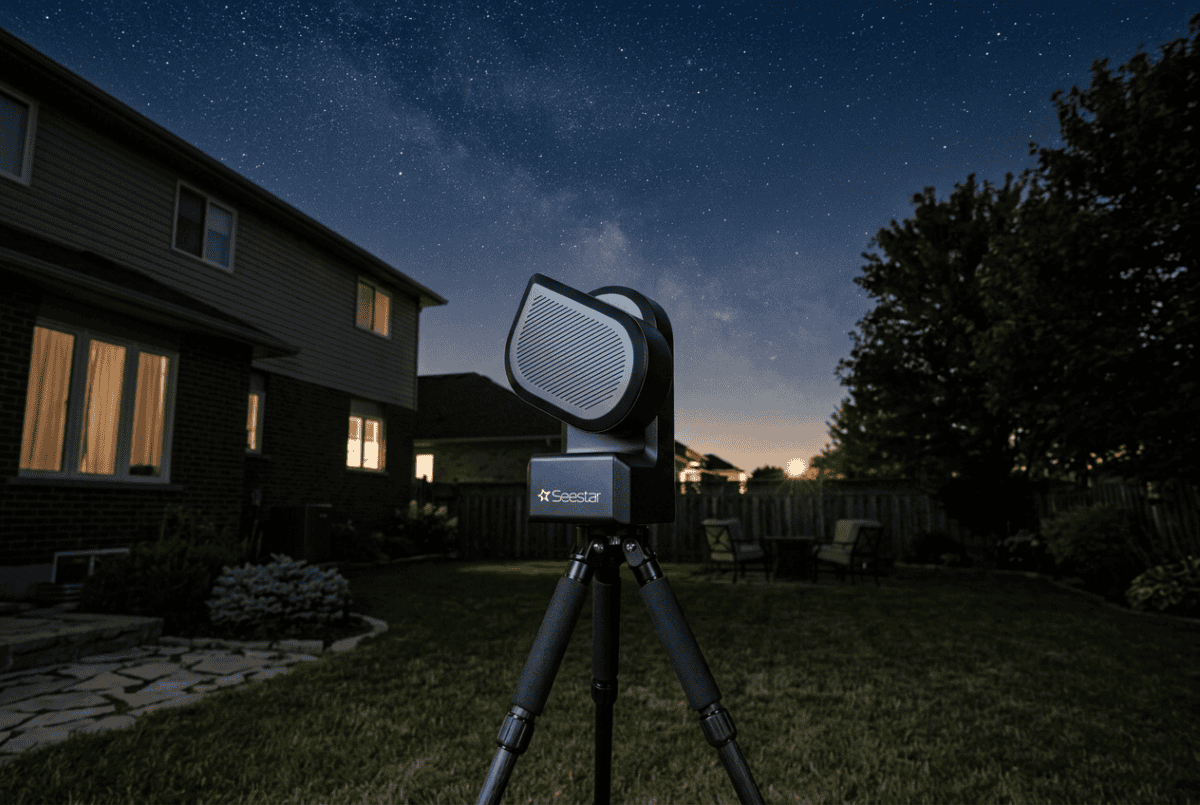
The Seestar S50 is a self-contained smart telescope that does everything through an app on your phone. Instead of a tube with an eyepiece you look through, it is a small optical system with a camera sensor and a motorized alt-azimuth mount packed into one 2.5-kg body that sits on the included tripod. You point the app at a target, the scope aligns itself against the star field, and it begins taking and stacking short exposures in real time so an image builds up on your screen.
The core specs are modest on paper: roughly a 50mm aperture, about a 250mm focal length, an f/5 optical system, and a Sony IMX462 sensor of around 2 megapixels. It is alt-az mounted, has a built-in dual-band light-pollution filter, and ships with a tripod and a solar filter for daytime use on the Sun. That is a small aperture by traditional-telescope standards. The trick is that the Seestar is not trying to deliver a bright eyepiece view — it is a live-stacking camera, and stacking is what lets a 50mm lens pull a galaxy out of a washed-out sky.
How the Seestar S50 works
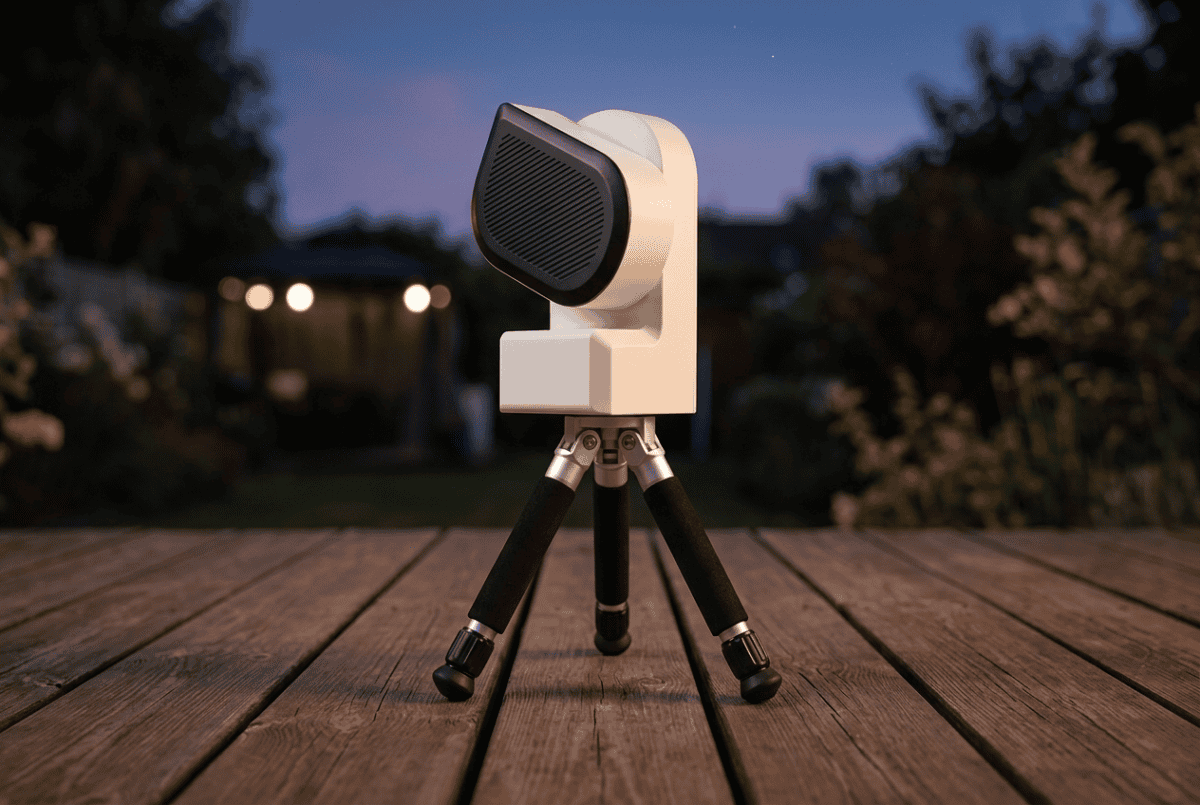
The Seestar works by combining plate-solving, motorized tracking, and live image stacking, all driven from the free app. When you pick a target, the scope takes a reference frame, figures out exactly where it is pointing by matching stars, slews to the object, and starts capturing a stream of short sub-exposures (typically 10 seconds each). The app aligns and stacks those frames on the fly, so noise falls away and faint detail climbs out of the background the longer you leave it running.
In practice you go from a folded-up scope in a bag to a live image of the Orion Nebula in a couple of minutes, with no polar alignment, no finder scope, and no star charts. As an engineer, I appreciate how much genuinely hard astrophotography workflow ZWO automated here. The auto-focus, auto-align, and auto-stack pipeline is the whole product, and it works reliably. The main friction is battery: expect only a few hours of runtime per charge, so on a long session you will want a USB power bank plugged in.
What you can actually see with the Seestar S50
The Seestar S50 is built for three things: the Moon, the Sun, and wide-field deep-sky objects — and it is honestly weak on planets. The Moon is excellent; you get crisp, detailed lunar images almost instantly. With the included solar filter fitted, you can safely image sunspots during the day, which is a genuinely fun feature most beginner scopes never offer.
Where it really surprises people is deep sky. Large, bright nebulae and galaxies — Orion, the Lagoon, Andromeda, the North America Nebula, star clusters — come through with real color and structure after a few minutes of stacking. That is the payoff for a light-polluted observer, and I will come back to it.
Now the honest part: the Seestar S50 is a poor choice if your dream is seeing planets. Because it is a short-focal-length wide-field imager, Jupiter, Saturn, and Mars show up as tiny dots. You will make out Saturn’s rings as a shape and maybe a couple of Jupiter’s cloud bands, but nothing like the detailed planetary views a longer-focal-length telescope delivers. If planets are the goal, this is the wrong tool — buy a traditional scope instead.
Image quality: the 2MP and portrait reality
Image quality is genuinely impressive for the price, but there are two limitations you should know before you buy. First, the sensor is only about 2 megapixels. For phone-screen viewing and social sharing that is plenty, and stacking keeps the images clean, but you are not going to make a large, wall-sized print from a single Seestar frame. It is a small sensor doing clever work, not a full astrophotography rig.
Second, the raw images come out in portrait (vertical) orientation because of how the sensor is mounted. That surprises a lot of first-time buyers who expect a wide, landscape astrophoto and instead get a tall, narrow frame. There are ways to work around it — mosaic modes and post-processing — but out of the box, portrait framing is what you get. Neither of these is a dealbreaker; they are just the honest ceiling on a device at this price, and you should walk in knowing where that ceiling sits.
Using the Seestar S50 in light pollution
This is where the Seestar S50 makes the most sense, and it is the reason I recommend it to my suburban neighbors. Under my Bortle 5–6 sky in York, a traditional 50mm telescope would show almost nothing but the brightest handful of objects — the deep-sky targets are simply drowned out by skyglow. The Seestar’s built-in dual-band light-pollution filter, combined with live stacking, cuts through a huge amount of that glow because it lets through the specific wavelengths nebulae emit while rejecting the broadband orange haze from streetlights.
The result is that I can pull a genuinely colorful nebula out of a sky where my eyes see gray. It does not turn your backyard into a dark-sky site — John still drives out to darker locations when he wants the best results — but for someone who can only observe from a city or suburb, the Seestar delivers deep-sky images that a conventional beginner scope simply cannot from the same spot. If you have been told astronomy is impossible from the city, this is the device that proves otherwise. That is exactly the kind of hard-won lesson we try to pass along at Telescope School.
Pros and cons of the ZWO Seestar S50
Here is the balanced picture after real use.
Pros:
- Near-zero setup — auto-align, auto-focus, and auto-stacking do the hard work for you
- All-in-one design with the tripod and a solar filter included in the box
- Excellent results on the Moon, the Sun, and bright deep-sky objects
- Built-in dual-band filter makes it genuinely effective under city and suburban light pollution
- Compact and portable at about 2.5 kg — easy to grab and go
- Strong value for money at around $499 for what it does
Cons:
- Only about a 2MP sensor — fine for screens, limited for large prints
- Images come out in portrait orientation by default
- Short battery life — roughly a few hours; plan on a power bank
- Weak on planets — they appear as tiny dots, not detailed disks
- No eyepiece and no true live visual observing — it is a camera, not a look-through scope
- The app’s list of recommended targets is somewhat limited
Who should buy the Seestar S50 (and who shouldn’t)
Buy the Seestar S50 if you are a beginner who wants deep-sky images with zero fuss, a gift buyer looking for something that will not overwhelm the recipient, or a city or suburban observer who is tired of seeing nothing through a conventional scope. For all three, this is close to an ideal first instrument — it removes almost every point where beginners normally give up.
Do not buy the Seestar S50 if you want to see planets in sharp detail, or if the whole appeal of astronomy for you is putting your eye to an eyepiece and looking at the real photons. This device does neither. If that is you, a traditional Dobsonian or a longer-focal-length telescope will make you far happier, and we cover those options in other Telescope School guides.
Seestar S50 vs S30: a quick note
The short version: the S50 has more aperture and reach, while the smaller S30 is cheaper, lighter, and offers a wider field of view. The S50’s roughly 50mm aperture and 250mm focal length give it a tighter, more magnified frame that suits galaxies and smaller nebulae, plus a bit more light-gathering. The S30 steps down to a smaller aperture and shorter focal length, so it frames very large targets and the Milky Way more comfortably and costs less — but it pulls in less light on faint objects.
For most beginners I lean toward the S50 as the better all-rounder, especially if deep-sky reach matters to you. If budget is tight or you are drawn to sweeping wide-field views, the S30 is a legitimate, less expensive choice. Neither one will show you planets well — that limitation is shared across the whole smart-scope family.
Frequently asked questions
Is the Seestar S50 worth it?
Yes, for the right buyer the Seestar S50 was worth it at around $499, and the S50 Pro continues the line at $899. It delivers real deep-sky and lunar images with almost no setup or learning curve, which is exceptional value for a beginner or gift. It is not worth it if you specifically want detailed planetary views or a look-through-the-eyepiece experience, because it does neither.
What can you see with the Seestar S50?
With the Seestar S50 you can image the Moon in crisp detail, the Sun and its sunspots using the included solar filter, and a wide range of bright deep-sky objects such as nebulae, galaxies, and star clusters. It performs best on large, wide-field targets. Planets are visible but appear only as tiny dots rather than detailed disks.
Does the Seestar S50 work in light pollution?
Yes. The Seestar S50 works well in light pollution thanks to its built-in dual-band filter and live image stacking, which together suppress skyglow and reveal nebulae that are invisible to the eye from a city or suburb. From my own Bortle 5–6 backyard it pulls colorful deep-sky detail out of a sky that looks gray to the naked eye, though truly dark skies still produce the best results.
Seestar S50 vs S30 — which should I buy?
Buy the Seestar S50 if you want more aperture, more reach on faint deep-sky objects, and a stronger all-round performer. Buy the smaller S30 if you want a cheaper, lighter scope with a wider field of view for very large targets and the Milky Way. Most beginners are happiest with the S50, but both are capable and neither shows planets well.
Can the Seestar S50 see planets?
The Seestar S50 can technically capture planets, but not in satisfying detail. Because it is a short-focal-length wide-field imager, Jupiter, Saturn, and Mars appear as very small dots — you may glimpse Saturn’s ring shape or a Jupiter cloud band, but nothing close to a detailed planetary view. If planets are your priority, choose a traditional telescope with a longer focal length instead.
The bottom line
Three takeaways to leave you with. First, the ZWO Seestar S50 is the best entry-level smart telescope for the money — roughly $500 bought you a genuinely automated path to deep-sky and lunar imaging. Second, it is a wide-field camera, not an eyepiece scope, so set your expectations accordingly and do not buy it for planets. Third, if you observe from the city or suburbs, its light-pollution performance is the strongest reason to pick it over a traditional beginner telescope.
If you want to take the next step, it is worth pinning down whether a smart scope is even right for you before you spend the money. Have a look at our related Telescope School guides on whether smart telescopes are worth it, the best smart telescopes for 2026, and the best telescopes for urban stargazers — they will help you decide with clear eyes.
Ready to buy? the Seestar S50 Pro at High Point Scientific
I put smart scopes through an engineer’s honest assessment, so here’s my real take on whether the ZWO Seestar S50 delivers for beginners.
These May Help Too...
Can You Use a Telescope Through a Window? (And Why You Should Not)
Using a telescope through a window ruins the view: bad glass, heat currents and reflections. Here is what actually happens, and what to do instead.
Telescope will not come to focus? The cause is almost always spacing, not optics. Work out whether you ran out racking in or out, then fix that end.