

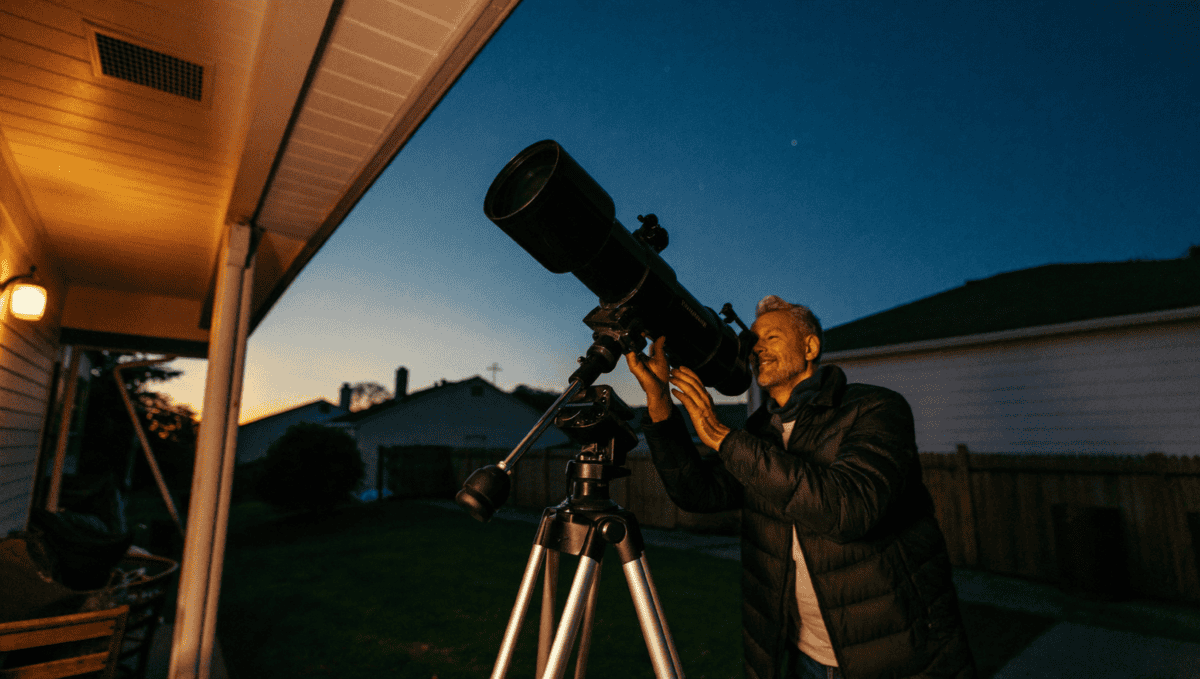
Quick Answer: If you want the most telescope your $500 can buy, get an 8-inch Dobsonian reflector (the Apertura AD8 or a Sky-Watcher 8″ Classic) — nothing else in this price range gathers as much light or shows you as much detail per dollar. If you’d rather have the scope find things for you, the Celestron StarSense Explorer DX 130AZ or the Sky-Watcher Virtuoso GTi 150P are the two picks I steer beginners toward instead.
I came back to amateur astronomy at 50, after a 25-year gap, and the first thing that hit me was how much the buying landscape had changed — and how much of it was still noise. I’m an engineer by training (B.S. Engineering, Penn State) and I’ve spent a career in manufacturing pulling specs apart, so when I say most “best telescope” lists read like padded affiliate copy, I mean it as a technical complaint. Below is how I’d actually spend $500 today, evaluated the way I’d evaluate a machine on the plant floor: what does it do, what does it cost, and where does it fall down.
Comparison: Best Telescopes Under $500 at a Glance
| Telescope | Type | Aperture | Best for | Price (checked Sep 2026) |
|---|---|---|---|---|
| Sky-Watcher Heritage 150 | Tabletop Dobsonian | 150mm (6″) | Best overall value — most aperture per dollar | ~$355 |
| Celestron StarSense Explorer DX 130AZ | Reflector (app push-to) | 130mm (5.1″) | Finding objects without GoTo | ~$415 |
| Celestron StarSense Explorer DX 102AZ | Refractor (app push-to) | 102mm (4″) | Zero maintenance, sharp Moon and planets | ~$440 |
| Sky-Watcher Virtuoso GTi 150P | Tabletop Dobsonian (GoTo) | 150mm (6″) | Hands-off tracking, still 6 inches | ~$469 |
| Celestron StarSense Explorer 150mm Tabletop | Tabletop Dobsonian (app push-to) | 150mm (6″) | Watch for a sale | ~$510 (just over) |
| Sky-Watcher Classic 150 | Dobsonian, solid tube | 150mm (6″) | Floor-standing, no table needed | ~$515 (just over) |
| Apertura AD8 / Sky-Watcher 200P | Dobsonian, solid tube | 203mm (8″) | Most aperture, if you can stretch | ~$700–$725 (stretch) |
Every price above was checked on the retailer’s own page in September 2026. Telescope prices move a lot month to month — treat these as a snapshot, not a promise, and click through for the live number.
1. Sky-Watcher Heritage 150 — Best Overall Value
➤ Check today’s price: Sky-Watcher Heritage 150 on Amazon
From experience: This grab-and-go tabletop class is what I actually use most. My Astronomers Without Borders desktop is basically point-and-view — no alignment ritual, no long setup — and that simplicity is why it gets used on far more nights than any bigger scope I’ve had my hands on.
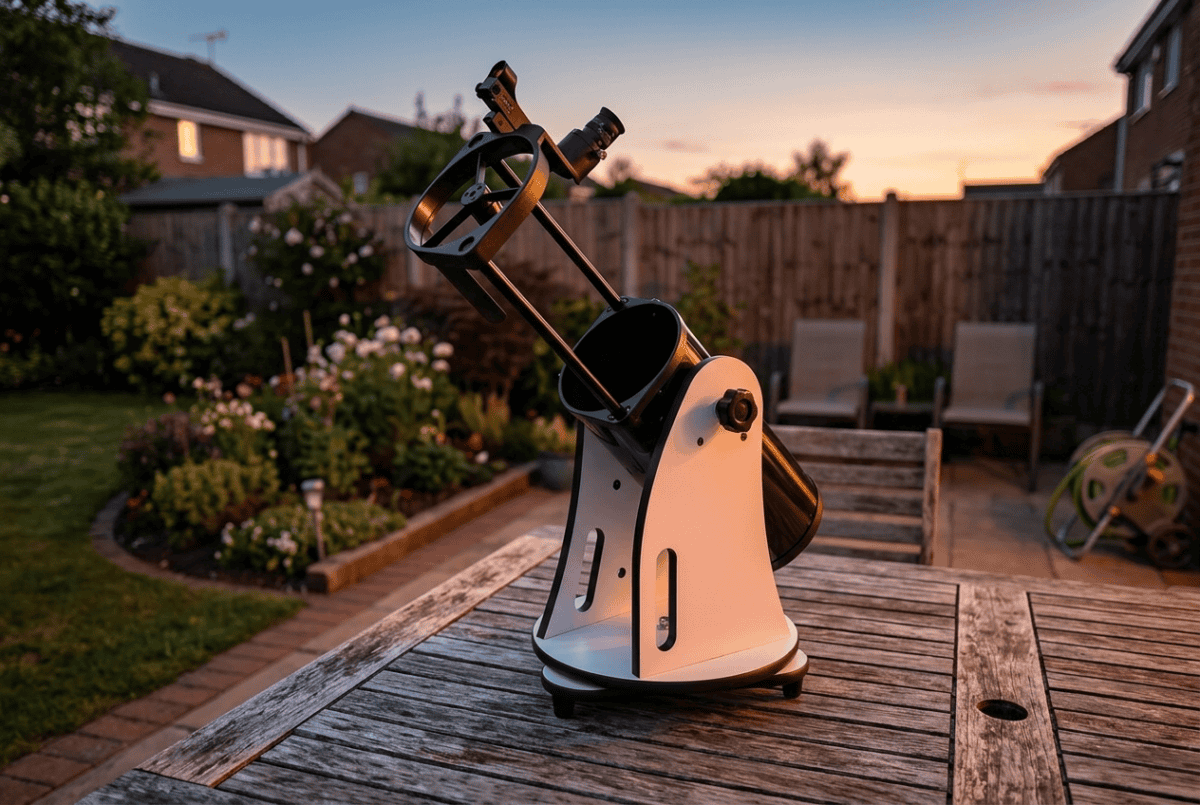
Verdict: The tabletop dob you’ll actually use on a weeknight because it takes ten seconds to carry outside. The single biggest predictor of whether a beginner sticks with astronomy isn’t optics — it’s friction. A scope that lives in the garage because it’s a pain to set up shows you nothing. The collapsible Heritage 150 (150mm) and its smaller sibling the Heritage 130P (130mm) solve that by being light enough to grab with one hand and set on a picnic table or a sturdy stool.
I keep a small tabletop dob by the back door precisely because on a marginal night I’ll still go out for twenty minutes when the big scope would’ve stayed inside.
Pros:
- Genuinely portable — the tube collapses down, and the whole rig weighs under 15 lbs.
- 150mm still shows real deep-sky detail, well beyond what a department-store scope manages.
- Cheap enough to leave real budget for good eyepieces or a road trip to darker skies.
Cons:
- Needs a table or platform — there’s no tripod, so factor in a steady surface at the right height.
- The open collapsible tube lets in stray light and dew; a simple shroud helps a lot.
- Less aperture than the 8″ dob, so faint galaxies stay dim from light-polluted skies.
Who it’s for: Apartment dwellers, travelers, parents who want something a kid can help carry, and anyone whose honest answer to “will you set this up on a Tuesday?” is “only if it’s easy.”
2. Celestron StarSense Explorer DX 130AZ — Best for Finding Things
➤ Check today’s price: Celestron StarSense Explorer DX 130AZ on Amazon
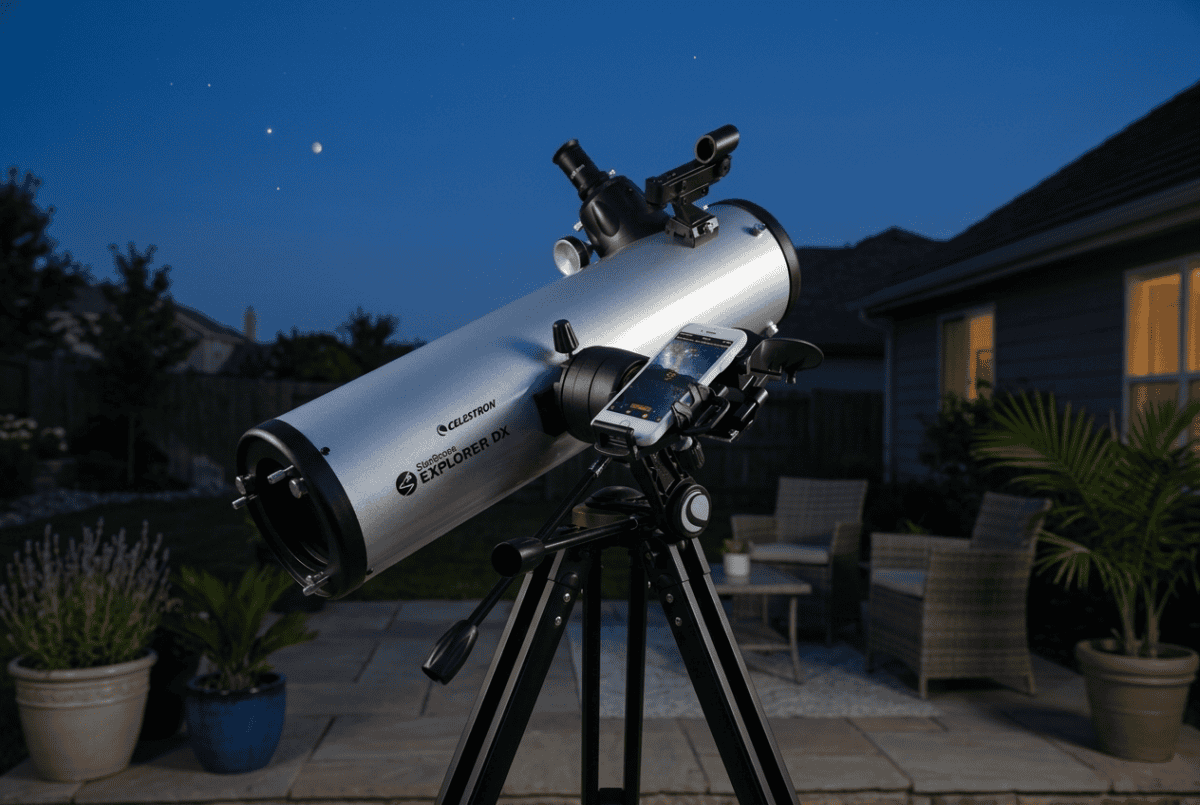
Verdict: The smartest way to point a manual scope — your phone does the star-hopping so you don’t have to memorize the sky yet. This 130mm reflector clips your smartphone into a cradle, and Celestron’s StarSense app reads the star field through your camera and gives you real-time arrows: nudge left, nudge up, you’re on target. It’s not motorized GoTo — you still move the scope by hand — but it removes the single most frustrating part of the beginning, which is not being able to find anything.
When I came back to the hobby after 25 years away, the humbling part wasn’t the optics — it was rediscovering that finding a faint fuzzy in a suburban sky is genuinely hard. This is the tool I wish I’d had.
Pros:
- The StarSense app works — it reliably lands targets in the eyepiece, and it teaches you the sky as you go.
- 130mm of aperture is a real step up from the 70–90mm scopes most beginners get talked into.
- No motors or alignment routine to fumble in the dark; you’re observing in a few minutes.
Cons:
- The included eyepieces are just okay — budget for one better mid-range eyepiece down the line.
- The AZ mount and tripod are a little light; it can shimmy at high magnification until it settles.
- It relies on your phone and its battery. Cold nights drain phones fast, so bring a warm pocket.
Who it’s for: The beginner who wants to see planets and bright deep-sky objects tonight, doesn’t want to learn a GoTo alignment procedure, but is tired of aimlessly sweeping and finding nothing.
3. Celestron StarSense Explorer DX 102AZ — Best Refractor
➤ Check today’s price: Celestron StarSense Explorer DX 102AZ on Amazon
Every other pick on this list is a mirror. This one is a lens, and that changes what owning it feels like. A refractor has nothing to collimate, nothing to cool for forty minutes, and no spider vanes to spike bright stars. You carry it out, you look, you carry it in. For anyone who suspects they will not fiddle with a telescope — and most beginners will not — that matters more than the spec sheet suggests.
The trade is aperture. Four inches gathers noticeably less light than the six-inch Dobsonians above it, so faint galaxies stay faint. What it does give you is a clean, high-contrast image on the Moon, on Jupiter and on Saturn, with none of the diffraction artefacts a Newtonian produces. On double stars it is genuinely lovely.
It carries the same StarSense phone dock as the 130AZ: the app watches the sky through your camera, works out where the telescope is pointing, and walks you onto the target with arrows. Nothing is motorised — you push it yourself — but you stop hunting.
Buy it if you want the least possible maintenance, you mostly care about the Moon and planets, or you are buying for someone who will be put off by a scope that needs adjusting. Skip it if deep-sky is the goal — put the same money into the Heritage 150 and take the extra aperture.
4. Sky-Watcher Virtuoso GTi 150P — Best Hands-Off GoTo
➤ Check today’s price: Sky-Watcher Virtuoso GTi 150P on Amazon
This is the only way to get motorised tracking and a real six-inch mirror while staying under $500. You align it from your phone, tap a target, and the mount drives to it and then keeps it centred while you look. At high magnification on a planet that is the difference between observing and constantly re-aiming.
It is a collapsible tabletop Dobsonian, so it needs a table, a stool or a crate at roughly chair height — plan for that before it arrives. Collapsed it is genuinely small. The same 150mm f/5 optics as the manual Heritage sit underneath, so the view is the same; you are paying about $115 for the motors and the app.
Buy it if you want to spend the night looking rather than searching, or you are showing objects to other people and cannot afford to lose the target between turns. Skip it if you would rather put every dollar into glass — the manual Heritage 150 shows you exactly the same sky for $114 less.
5. Just Over the Line: Two Six-Inch Scopes Worth a Sale Alert
These two miss the $500 cap by ten and fifteen dollars. That is close enough that a single sale, a coupon or a bundle change puts them inside it, and both give you the same six-inch aperture as the Heritage at the top of this list — just in a different shape. If you are shopping without a hard deadline, set a price alert on both.
➤ Check today’s price: Celestron StarSense Explorer 150mm Tabletop at B&H
Celestron StarSense Explorer 150mm Tabletop — about $510. A six-inch tabletop Dobsonian with the StarSense phone dock built in. It is the Heritage 150’s aperture plus the DX 130AZ’s find-it-for-me app, in one box. If both of those appeal and you can find it discounted, this is the one to wait for.
➤ Check today’s price: Sky-Watcher Classic 150 at High Point Scientific
Sky-Watcher Classic 150 — about $515. The solid-tube, floor-standing version of the same six inches. No table, no stool, no crate — it stands on the ground at eyepiece height on its own base. If the tabletop requirement is what is putting you off the Heritage, this solves it, and it is the sturdiest mount in this whole guide.
6. If You Can Stretch to $700: the 8-Inch Dobsonian
➤ Check today’s price: Apertura AD8 at High Point Scientific
From experience: Full disclosure — I don’t own an 8-inch Dob. A buddy lent me his, and even on a night I already knew was going to be good, it still proved to be a little too much to deal with. Living in PA, the weather rarely lets you commit to a session days ahead, so when a clear night does show up I want something quick. More often than not that means a 4-inch or my Astronomers Without Borders tabletop — not wrestling the big Dob out the door.
Before you buy: A quality 8-inch Dob like the Apertura AD8 now runs about $700 — just over our $500 cap — and it’s a genuine two-hands, one-trip-per-piece load. It earns its spot as the best pure aperture-per-dollar in this guide and is worth stretching for if you have a fixed spot to observe from. But if you mostly catch clear nights on short notice, skip down to the Heritage 150P or the smart scopes, which all come in under budget.
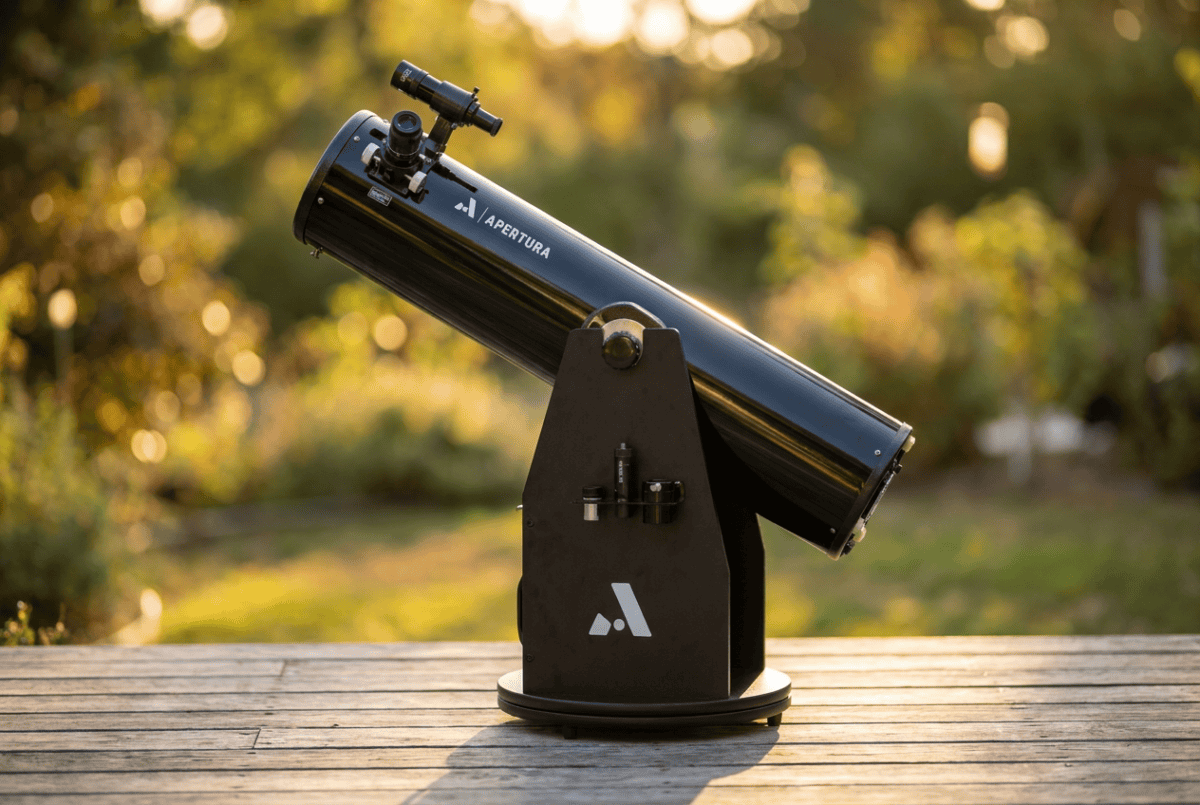
Verdict: If you only remember one thing from this page, it’s this — an 8-inch Dobsonian is the most telescope you can buy for the money, full stop. An 8″ mirror gathers roughly 840 times the light your naked eye does. That is the number that actually matters, because in this hobby aperture is everything: more light means you see fainter galaxies, more detail on Jupiter’s cloud bands, and structure inside nebulae instead of a gray smudge. From my Bortle 5–6 backyard in York, PA, an 8″ dob is the difference between “yeah, that’s the Orion Nebula” and actually seeing the wings and the trapezium stars pop.
The two I’d point you at are the Apertura AD8 and the Sky-Watcher 8″ Classic 200P . The Apertura tends to ship with a genuinely useful accessory bundle — a 2″ Crayford focuser, a decent finder, a cooling fan, and a couple of eyepieces — which is why it’s the one I recommend most often at Telescope School.
Pros:
- Unbeatable aperture-per-dollar — nothing else here comes close on raw light-gathering.
- Dead-simple Dobsonian mount: point, look, nudge. No electronics to fail, no batteries to die on a cold night.
- The AD8 accessory package saves you the $150–$200 in add-ons most other scopes force you to buy later.
Cons:
- It’s big. The tube is roughly 4 feet long and the whole thing runs 40–50 lbs — you carry it in two pieces, and it won’t hide in a closet corner discreetly.
- No GoTo and no tracking. You find objects yourself and nudge the scope to follow them. That’s a feature to me, but it’s a learning curve for some.
- Fully-loaded versions often creep just over $500. If you’re strict about the budget, the Sky-Watcher base model or a 6″ dob keeps you comfortably under.
Who it’s for: Anyone with a car and a bit of storage space who wants to actually see the most. This is the classic best-bang-for-buck beginner-to-lifetime scope, and it’s the one I’d buy again.
A Warning Before You Buy: The 500x Trap
Walk into any big-box store or scroll Amazon’s cheapest listings and you’ll see refractors screaming “500X POWER!” on the box — the Celestron PowerSeeker 127EQ is the poster child. Here’s the engineer’s reality: magnification is the least important number on the box, and it’s usually a lie. A telescope’s useful magnification maxes out at roughly 50x per inch of aperture. Push past that and you just get a bigger, dimmer, blurrier smudge. That “500x” eyepiece is worthless.
Worse, the PowerSeeker 127 is a “Bird-Jones” design that crams a corrective lens into the focuser tube to fake a longer focal length. They’re notoriously hard to collimate and often arrive with mediocre optics. The lesson — and it’s the core of how we teach buying at Telescope School — is simple: judge a scope by its aperture and the quality of its optics and mount, never by advertised magnification.
How to Choose a Telescope Under $500
Aperture beats magnification, every time
Aperture — the diameter of the main lens or mirror — determines how much light the scope collects and how much detail you can resolve. It’s the one spec that genuinely governs what you’ll see. Ignore “power” claims and buy the most aperture you can comfortably store and carry.
Refractor vs. reflector vs. Dobsonian
A refractor uses a lens; small ones are grab-and-go and low-maintenance but expensive per inch of aperture. A reflector uses mirrors and gives you far more aperture per dollar, at the cost of occasional collimation (mirror alignment). A Dobsonian is just a big reflector on a simple, stable rocker mount — and it’s the reason you can get 8 inches of aperture for around $500. For pure visual bang-for-buck, a Dob wins.
GoTo vs. manual
GoTo (motorized computer pointing) is convenient but expensive — on a $500 budget, every dollar spent on motors is a dollar not spent on aperture, which is why the GoTo NexStar 4SE has a much smaller mirror than the manual 8″ dob. Manual scopes, or app-assisted “push-to” systems like StarSense, get you far more optical performance for the same money. I’d only pay the GoTo premium if hands-off tracking genuinely matters more to you than what you’ll see.
Visual vs. smart telescopes
A traditional scope puts photons into your eye — there’s a real, hard-to-describe thrill to seeing Saturn’s rings with your own eye for the first time. A smart telescope shows you a stacked photo on a screen and, importantly, punches through light pollution far better than visual observing can. Neither is “better.” Pick based on whether you want the personal experience of looking, or shareable images from a light-polluted yard.
Frequently Asked Questions
What can you see with a telescope under $500?
Plenty. With an 8″ Dobsonian under $500 you’ll see Saturn’s rings, Jupiter’s cloud bands and its four big moons, craters and mountains on the Moon in sharp relief, the phases of Venus, dozens of star clusters, and brighter galaxies and nebulae like Orion and Andromeda. From darker skies the deep-sky views get dramatically better. What you won’t get is the colorful, detailed look of a NASA photo — visually, deep-sky objects appear as detailed grayscale glows.
Is a 130mm telescope good enough for a beginner?
Yes — 130mm (about 5 inches) is a genuinely good beginner aperture and a big step up from the 60–80mm scopes often sold to newcomers. It’ll show you the planets, the Moon in detail, and many deep-sky objects. An 8″ (203mm) will show noticeably more, but a 130mm scope like the StarSense Explorer DX 130AZ is capable, portable, and won’t leave you feeling limited in your first year or two.
Refractor or reflector — which is better for a beginner?
For most beginners on a budget, a reflector (specifically a Dobsonian) is the better buy because it delivers far more aperture per dollar — and aperture is what lets you see more. Refractors are lower-maintenance and better for grab-and-go or wide-field viewing, but you pay a steep premium for aperture. If your priority is seeing the most for $500, go reflector; if it’s simplicity and portability above all, a small refractor or tabletop dob makes sense.
Do I need a GoTo mount?
No, you don’t need one, and on a $500 budget I usually advise against it. GoTo motors add cost that comes straight out of your aperture budget, and modern app-assisted “push-to” systems like Celestron’s StarSense help you find objects for far less money. A GoTo mount is worth it if hands-off automatic tracking — for showing others or for planetary viewing — matters more to you than raw light-gathering.
Are smart telescopes better than regular telescopes under $500?
They’re different, not strictly better. A smart telescope excels at astrophotography and cuts through light pollution to capture nebulae and galaxies a traditional scope can barely show visually from the suburbs. But it’s a camera — you view images on a screen, not through an eyepiece. If you want the personal experience of seeing the cosmos with your own eye, a traditional scope wins; if you want shareable images from a light-polluted backyard, the smart scope wins.
The Bottom Line
Three things to take with you:
- Buy aperture, not magnification. A six-inch mirror is the most aperture your $500 actually buys in 2026 — the Heritage 150 gets you there for about $355 — ignore any box shouting about “500x power.”
- Match the scope to your real life. Tight on space? The tabletop Heritage 150. Hate hunting for targets? The StarSense DX 130AZ. Want hands-off tracking? The Virtuoso GTi 150P.
- The best telescope is the one you’ll actually use. Portability and ease of setup beat spec-sheet bragging rights every single time.
Want to go deeper before you commit? Explore the related guides here at Telescope School: our best telescopes under $200 and best telescopes under $300 roundups for tighter budgets, our full guide to the best Dobsonian telescopes, and are smart telescopes worth it? if a smart telescope is on your list. Clear skies.
At $500 the trade-offs get interesting, so I weigh aperture, mount, and optics the way I did choosing my own gear.
These May Help Too...
Can You Use a Telescope Through a Window? (And Why You Should Not)
Using a telescope through a window ruins the view: bad glass, heat currents and reflections. Here is what actually happens, and what to do instead.
Telescope will not come to focus? The cause is almost always spacing, not optics. Work out whether you ran out racking in or out, then fix that end.