

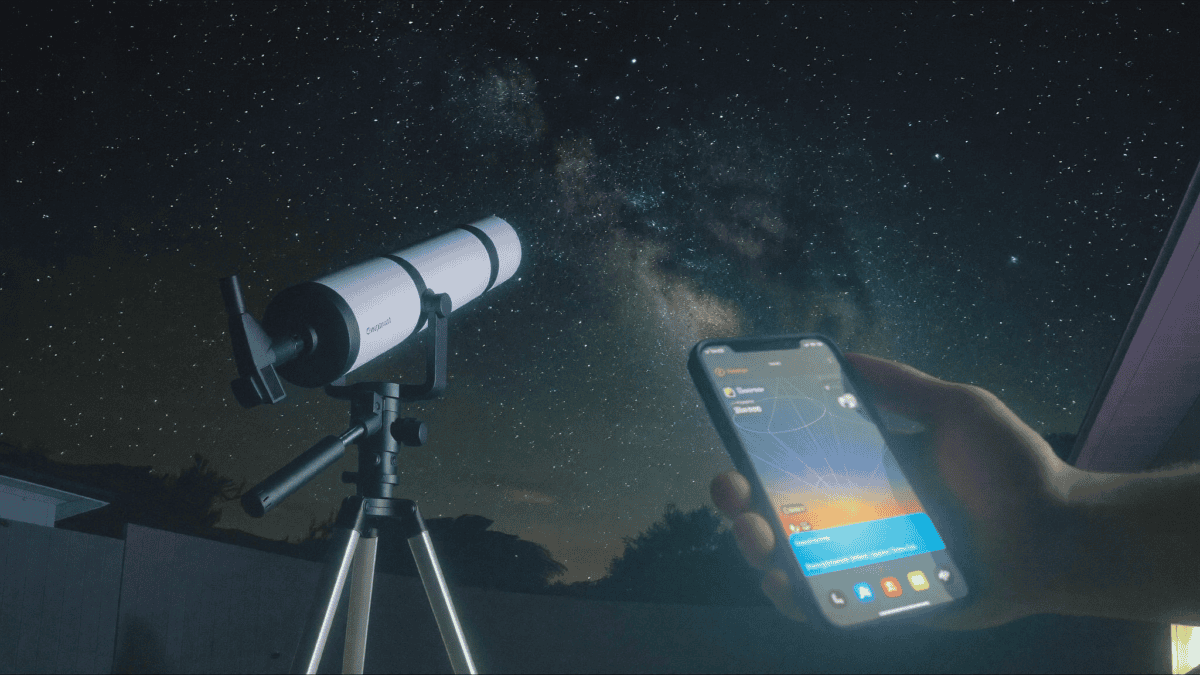
Quick answer: Yes, a smart telescope is worth it for most suburban and city observers in 2026 — if what you actually want is images of galaxies, nebulae, and comets rather than the classic eye-to-eyepiece experience. Live stacking cuts through light pollution in a way a traditional beginner scope simply cannot, and a ZWO Seestar S30 or S50 delivers that for the price of a mid-range visual scope. Skip it if you’re a visual purist, if your budget is under about $250, or if half the joy for you is looking at real photons with your own eye.
Last Updated: July 2026 | Will Montgomery holds a B.S. in Engineering from Penn State and came back to amateur astronomy at 50, observing from suburban York, PA (Bortle 5–6). This assessment reflects real experience shooting the sky from a light-polluted backyard.
The engineer’s version of this question
I spent a manufacturing career asking one question over and over: does this machine actually do what the spec sheet claims, and is it worth what it costs? You develop a nose for marketing that outruns reality. So when a whole category of “smart telescopes” showed up promising the universe from your backyard with one tap, my first instinct was skepticism.
Here’s the context that changed my mind. I came back to astronomy at 50, after a telescope I bought in my twenties sat in a closet for 25 years. I observe from York, Pennsylvania — Bortle 5 to 6, the kind of washed-out suburban sky where the Milky Way is a rumor and half the “faint fuzzies” in the observing guides are invisible through an eyepiece no matter how good your scope is. That’s the reality for most people reading this. And it’s exactly where smart telescopes have a genuine, measurable edge over the traditional gear I grew up on. This isn’t a gadget review written from a dark-sky mountaintop. It’s an assessment of whether these things earn their keep where most of us actually live.
What “smart telescope” actually means
A smart telescope is an all-in-one, app-controlled robot that finds objects for you and builds an image on your phone instead of showing you a view through an eyepiece. There is no eyepiece on most of them. You point the app at a target — say, the Orion Nebula — it slews itself to the right patch of sky using plate-solving (matching the star field it sees against an internal catalog), locks on, and then starts stacking.
That stacking part is the whole ballgame, so it’s worth understanding. The camera takes many short exposures — 10 or 20 seconds each — and the software adds them together in real time, or “live stacks” them. Each frame is faint and noisy. But signal adds up faster than random noise does, so after five minutes you’re looking at something a single exposure could never show, and after 30 minutes to an hour it starts to look like the astrophotos that got you interested in the first place. The scope tracks the sky as it turns, corrects its own aim, and throws out bad frames automatically.
Compare that to a traditional telescope, where light from a dim galaxy hits your eye for a fraction of a second and your retina cannot accumulate it. Your eye has no “shutter.” That’s the fundamental reason a $500 smart scope can show you the Whirlpool Galaxy’s spiral arms from a parking lot while a $500 visual scope shows you a gray smudge. Two different tools solving two different problems.
Automated go-to vs. live-stacking astrophotography
Two features get bundled under “smart,” and it’s worth separating them. Automated go-to means the mount finds and tracks objects on its own — great, but plenty of traditional computerized scopes have done that for 20 years. Live stacking is the new thing: the electronic image sensor plus real-time software that builds a photograph. When people say a smart telescope changed what they can see from the city, they’re really talking about the second feature. Celestron’s StarSense scopes, which I’ll get to, offer a clever version of the first without the second — and that distinction is the key to choosing.
The 2026 smart telescopes worth comparing
See the current price of the ZWO Seestar S50 Pro at High Point Scientific →
The category matured fast. Here are the models I’d actually put money on this year, from budget to premium. Prices are what I saw at major U.S. retailers in mid-2026.
| Smart telescope | Aperture / type | Best for | Price band |
|---|---|---|---|
| ZWO Seestar S30 | 30mm apo refractor | Cheapest true entry into live-stacking astrophotography; wide-field targets, ultra-portable | ~$350–$400 |
| ZWO Seestar S50 | 50mm apo refractor | The default recommendation; more aperture, better on smaller galaxies and the Moon/Sun | ~$500–$550 |
| DwarfLab Dwarf 3 | ~35mm dual-lens (apo) | Versatile shooter — astro plus daytime wildlife/landscape; strong EQ mode | ~$550 |
| Unistellar Odyssey | 85mm reflector | Premium build, larger aperture, polished experience; deeper reach on galaxies | ~$2,600 (Pro ~$4,600) |
| Celestron StarSense Explorer (e.g. DX 130AZ, 8″ Dob) | 114–203mm optical, visual | App-guided visual observing — real eyepiece views, no stacking | ~$180–$800+ |
Prices change constantly with sales, bundles, and new model releases — treat these as ballpark bands from mid-2026, not quotes. Always confirm the current price on the retailer’s page before you buy.
Who a smart telescope is actually for
A smart telescope is for the person who wants results more than ritual. If you’ve ever looked at Hubble-style deep-sky photos and thought “I want to make something like that, but I don’t want to spend two years learning polar alignment, guiding, and PixInsight,” this category was built for you. It’s also the best answer I know of for a few specific people.
- Suburban and city dwellers whose skies kill visual deep-sky observing. This is the biggest group and the strongest case — more on it below.
- Busy people who can be set up and imaging in five minutes on a weeknight, then packed away just as fast. No cool-down, no star-hopping, no collimation.
- Families and total beginners who bounced off a traditional scope because they couldn’t find anything. Tap a target, see a picture. My honest starting point for most newcomers is still my best telescope for beginners guide, but a Seestar has quietly become a legitimate first “telescope” for a lot of households.
- Travelers and grab-and-go observers. A Seestar S30 weighs about three pounds and fits in a backpack. That matters more than any spec, because the best telescope is the one you actually take outside.
If you’ve been frustrated staring into an eyepiece seeing nothing, read my piece on why you can’t see anything through your telescope before you conclude the hobby isn’t for you — sometimes the problem is technique, and sometimes the honest answer is that a smart scope is a better fit for your sky.
Smart telescopes and light pollution: the real edge
From experience: From my Bortle 5–6 backyard, the Seestar’s edge is absolutely noticeable for deep-sky objects — especially emission nebulae. It won’t make suburban skies equal to a dark site, but it turns a yard where you’d visually see almost nothing into one where recognizable nebulae and galaxies build up on the screen within minutes.
Under light-polluted skies, live stacking does something a traditional telescope physically cannot: it separates faint object signal from the bright background over time. This is the single most important thing I can tell a suburban observer, and it’s why I stopped being a skeptic.
Here’s the engineering of it. Light pollution is a roughly constant glow added to every exposure. The faint galaxy you’re after is a tiny signal buried in that glow. When you stack many frames, the software can model and subtract that background, and the object’s signal keeps climbing frame after frame while the noise grows much more slowly. Your eye can’t do any of that — it sees the glow and the object summed together in one instant, and the glow wins. That’s why a gorgeous 8-inch Dob that would show the Andromeda Galaxy beautifully from a dark site shows me a faint oval from my driveway.
From my Bortle 5–6 backyard, my Seestar pulls in the Ring Nebula, the Dumbbell, several Messier galaxies, the North America Nebula (with a light-pollution filter engaged), and the Orion Nebula in stunning detail — targets that are either invisible or deeply unimpressive visually from the same spot. It is not magic; a dark sky still beats a bright one, and a smart scope under Bortle 3 will run circles around the same scope under Bortle 6. But for the tens of millions of us who will never routinely observe from anything darker than suburbia, this is the closest thing to a cheat code the hobby has produced. If your whole barrier has been “I can’t see anything from my yard,” a smart telescope is very likely worth it for you specifically.
The honest trade-offs
The biggest trade-off is the one no spec sheet lists: you are looking at a screen, not through an eyepiece. For some people that erases the entire point of owning a telescope. There’s a real, hard-to-describe difference between knowing that ancient photons from a galaxy are physically landing on your retina versus watching a beautiful image assemble on your phone. I feel it too. A smart telescope is astrophotography-as-observing; it is not the same experience as visual astronomy, and anyone who tells you it perfectly replaces the eyepiece is selling something.
A few more that I want you to hear before you spend money:
- You’re tied to an app and a battery. The experience lives entirely in a phone or tablet. Firmware updates matter, the company staying in business matters, and a dead phone ends the night.
- Small aperture is still small aperture. A 30–50mm lens gathers a modest amount of light. Stacking is powerful, but it can’t fully substitute for glass. Big, close targets (large nebulae, the Moon, the Sun with the right filter) look great; small, faint galaxies are where you feel the aperture limit.
- Planets are underwhelming. These scopes are built for wide, faint deep-sky objects, not high-magnification planetary detail. Don’t buy one expecting crisp Saturn’s rings — a traditional scope does that better. This is also a good moment to understand why magnification isn’t the spec that matters; see my explainer on the 50x rule and real magnification limits.
- You don’t learn the sky the same way. Star-hopping to find a target teaches you the constellations in your bones. Tapping a menu doesn’t. That’s a feature for beginners and a genuine loss for people who value the craft.
- Editing is optional but tempting. The live image is good; getting a great final image often means exporting the raw frames and processing them on a computer, which pulls you back toward the learning curve you were trying to skip.
Who should skip a smart telescope
Some people should keep their money, and I’d rather tell you that than sell you a box you’ll resent. Skip a smart telescope if any of these is you.
- You’re a visual purist. If the magic for you is your own eye on real light — the reason many of us fell for this hobby — a screen will feel hollow no matter how sharp the picture. Buy a good Dobsonian instead.
- Your budget is tight. Under about $250 there is no smart telescope worth owning; the cheap ones are toys. Your money goes much further in glass. A solid manual scope in that range will out-observe any bargain-bin “smart” gadget — start with my best telescope under $200 picks.
- You mainly want the Moon and planets. A 4- to 8-inch traditional scope shows lunar craters and planetary detail that these small smart scopes can’t match.
- You want to learn the night sky by hand. If star-hopping and knowing your way around the constellations is the goal, automation robs you of the exact skill you’re trying to build.
The cheaper middle ground: Celestron StarSense
See the current price of the Celestron StarSense Explorer DX 130AZ on Amazon →
Celestron’s StarSense Explorer line is the smartest way to get “smart” help without paying for a camera you might not want. These are ordinary visual telescopes — you look through a real eyepiece — but a dock holds your phone, and the StarSense app uses your phone’s camera to plate-solve the sky and draw arrows telling you exactly which way to nudge the scope until the target is centered. You get the find-it-fast convenience of go-to at a fraction of the price, and you keep the eyepiece experience.
StarSense scopes run from around $180 for a small tabletop model up past $800 for the big Dobsonians, and they solve a different problem than the Seestar or Dwarf. They won’t beat light pollution the way live stacking does — you’re still limited by your eye and your sky. But for someone who wants real visual observing with the frustration of finding things removed, they’re an excellent, honest value and a legitimate middle path between a fully manual scope and a full smart-imaging rig.
So — are they worth it, in one paragraph
For a suburban or city observer who wants to actually see galaxies and nebulae and doesn’t mind a screen, a smart telescope is one of the best values in the hobby right now, and the ZWO Seestar S50 is where I’d point most people first — with the S30 as the budget option and the Dwarf 3 for anyone who also wants a daytime camera. Step up to a Unistellar Odyssey only if you want more aperture and a more premium, polished experience and the price doesn’t scare you. Choose a Celestron StarSense if you want the eyepiece kept and just want help finding things. And walk away entirely if you’re a visual purist on a budget who wants the Moon and planets — a plain Dobsonian will make you happier for less. Worth it isn’t a yes-or-no; it’s a match between what the tool does well and what you actually want out of a night under the stars.
Frequently asked questions
Are smart telescopes good for beginners?
Yes, they’re among the easiest ways for a beginner to see real deep-sky objects, because the scope finds and tracks targets automatically and builds an image without any technical skill. The main catch is that you won’t learn to navigate the sky by hand, and you’re viewing on a screen rather than through an eyepiece. For a first “telescope” that produces satisfying results fast, a Seestar S30 or S50 is hard to beat.
Can you actually look through a smart telescope?
Most smart telescopes have no eyepiece at all — you view a live, stacking image on your phone or tablet instead of putting your eye to the scope. That’s a fundamental design choice, not a flaw, and it’s what lets them beat light pollution. If looking through a real eyepiece matters to you, choose a Celestron StarSense Explorer, which keeps the eyepiece and only adds app-based finding help.
Do smart telescopes work in light-polluted cities?
Yes, and this is their strongest advantage. Live stacking lets the software separate faint object signal from the constant glow of light pollution over many exposures, revealing nebulae and galaxies that are invisible through a traditional eyepiece from the same backyard. A dark sky is still better, but a smart telescope narrows the gap dramatically for suburban and city observers.
Are smart telescopes good for viewing planets?
Not really — they’re optimized for wide, faint deep-sky objects, not high-magnification planetary detail. Their small apertures and short focal lengths give underwhelming views of Saturn and Jupiter compared with a traditional 4- to 8-inch telescope. If planets are your priority, buy a conventional scope instead of a smart one.
Is the ZWO Seestar S50 worth it over the cheaper S30?
The S50 has a larger 50mm aperture that gathers more light and performs better on smaller galaxies and detailed lunar and solar imaging, which makes it the better all-rounder for most buyers. The S30 is lighter, cheaper, and excellent on wide targets, so it’s the smarter pick if portability and price matter most. Both use the same app and live-stacking approach, so you can’t really go wrong — it’s a trade between reach and budget.
I assessed smart telescopes with an engineer’s skepticism, so I give you an honest read on whether they’re worth the money.
These May Help Too...
Can You Use a Telescope Through a Window? (And Why You Should Not)
Using a telescope through a window ruins the view: bad glass, heat currents and reflections. Here is what actually happens, and what to do instead.
Telescope will not come to focus? The cause is almost always spacing, not optics. Work out whether you ran out racking in or out, then fix that end.