

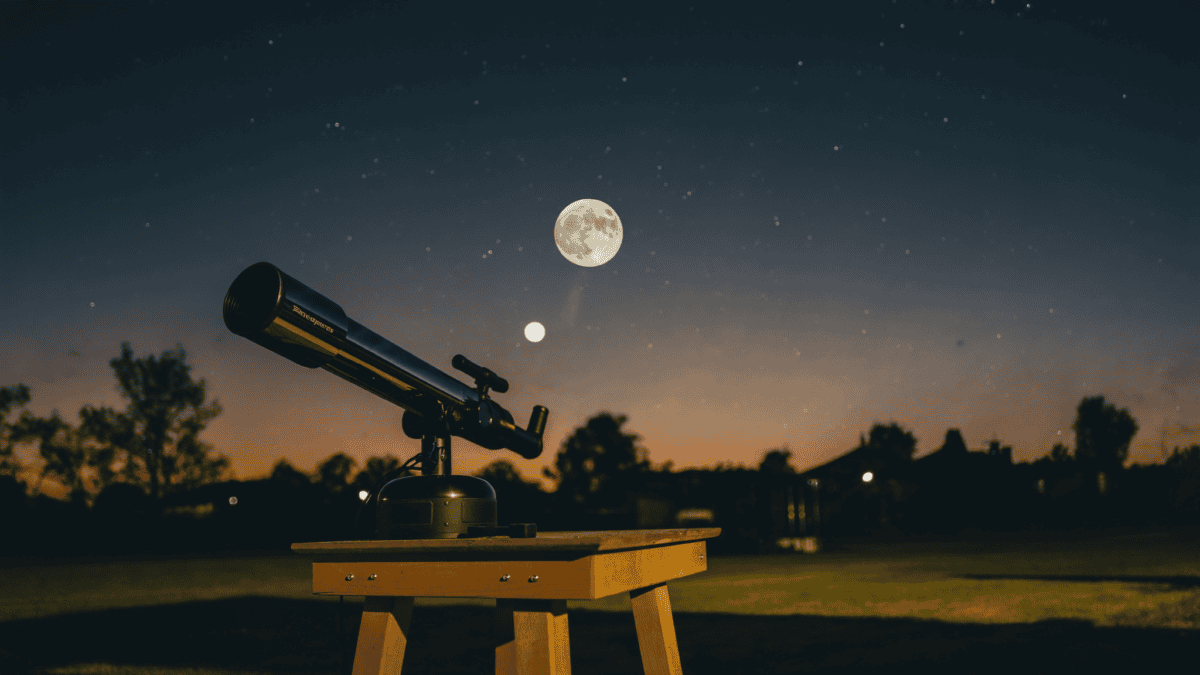
Quick answer: The best telescope under $200 for most beginners in 2026 is the Sky-Watcher Heritage 130P — its 130mm mirror gathers far more light than any refractor in this price range, and the collapsible tabletop design means you’ll actually use it. If you struggle to find things in the sky, the Celestron StarSense Explorer LT 80AZ uses your phone to point you to targets. If you want the cheapest scope that still shows the Moon and Saturn clearly, the Celestron AstroMaster 70AZ is the honest floor. Everything below that is a toy.
I’m Will Montgomery. I have an engineering degree from Penn State, I spent my career in manufacturing evaluating whether machines actually do what the spec sheet claims, and I came back to astronomy at 50 after my first telescope sat in a closet for 25 years. I observe from my backyard in York, Pennsylvania — a light-polluted Bortle 5–6 suburb, not some pristine dark-sky park. So when I tell you what a $200 telescope will and won’t show you, it’s from a driveway that looks a lot like yours.
The under-$200 bracket is where most people start, and it’s also where most people get burned. The stores are full of scopes screaming “800x MAGNIFICATION!” on the box — a number that’s almost a guarantee the telescope is junk. This guide is my honest engineer’s take on what’s actually worth your money in 2026, what each scope really does under a suburban sky, and the popular models I’d tell you to walk away from.
Last Updated: July 2026 | Will Montgomery holds a B.S. in Engineering from Penn State and came back to amateur astronomy at 50, observing from suburban York, PA (Bortle 5–6). These picks reflect what actually holds up under a real backyard sky.
The best telescopes under $200 at a glance
Here’s the short version before we get into detail. Prices drift, so treat these as bands and check the current number before you buy.
| Telescope | Type | Aperture | Price band | Best for |
|---|---|---|---|---|
| Sky-Watcher Heritage 130P | Tabletop reflector | 130mm | ~$200 | Most light per dollar |
| Celestron StarSense Explorer LT 80AZ | Refractor + phone app | 80mm | ~$180 | People who can’t find anything |
| Celestron AstroMaster 70AZ | Refractor | 70mm | ~$130 | Cheapest honest starter |
| Sky-Watcher Heritage 100P | Tabletop reflector | 100mm | ~$150 | Grab-and-go simplicity |
| Gskyer 70mm AZ | Refractor | 70mm | ~$100 | A first scope for a kid or gift |
Prices accurate at time of publication. Check current pricing before buying — good beginner scopes go on sale often, and a patient shopper can sometimes grab a bigger scope in this list during a holiday dip.
What $200 actually buys you (and what it doesn’t)
Check the current price of the Gskyer 70mm AZ on Amazon →
Here’s the single most useful thing an engineer can tell a new buyer: in a telescope, aperture is everything. Aperture is the diameter of the main lens or mirror, and it decides how much light the scope collects and how much fine detail you can resolve. Magnification is almost a distraction by comparison — and the useful ceiling on magnification is tied directly to aperture, not to whatever number is printed on the box.
A rough rule I lean on is the 50x-per-inch limit: you can push a telescope to roughly 50x of magnification for every inch of aperture before the image turns into a dim, mushy blob. A 70mm (2.75″) refractor tops out near 140x on a steady night. That “675x” number on the box is a marketing fantasy. If you want the full reasoning, I broke it down in my guide to the 50x rule and real magnification limits.
So under $200, the real decision is a trade-off between three things: how much aperture you can get, how easy the scope is to point and carry, and how much you’re willing to fiddle. A big mirror shows you more but needs occasional alignment. A small refractor shows you less but works the second you set it down. There’s no single right answer — there’s the right answer for how you’ll actually use it.
Sky-Watcher Heritage 130P — the most telescope for the money
Check the current price of the Sky-Watcher Heritage 130P on Amazon →
If you want to see the most with $200, buy the Heritage 130P. Its 130mm mirror collects roughly three-and-a-half times more light than a 70mm refractor, and that’s the difference between “I think that’s a smudge” and “I can see the bands on Jupiter and the whole sweep of the Orion Nebula.”
It’s a tabletop Dobsonian: a short reflector on a simple rotating base you set on a table, a stool, or an overturned bucket. The tube collapses down for storage and transport, which sounds like a gimmick until you realize the scope you can grab in ten seconds is the scope you’ll actually use on a Tuesday night. Mine comes out far more than my bigger, heavier equipment for exactly that reason.
The honest cons: as a reflector it will occasionally need collimation — a five-minute mirror alignment that intimidates beginners but is genuinely simple once you’ve done it once. It also needs a stable surface at the right height, so factor in something to set it on. Neither of these is a dealbreaker; they’re just the price of that big, hungry mirror.
Celestron StarSense Explorer LT 80AZ — the scope that finds things for you
Check the current price of the Celestron StarSense Explorer LT 80AZ on Amazon →
If your biggest fear is pointing an expensive tube at the sky and finding absolutely nothing, this is your scope. The number one reason beginners quit isn’t optics — it’s frustration. You can’t find anything, so the scope goes in the closet. I know, because that’s exactly what happened to me the first time around; I wrote about that whole miserable experience in why you can’t see anything through your telescope.
The StarSense Explorer LT 80AZ solves that with a phone dock and a free app. You place your smartphone in the cradle, the app reads the star field through your camera, and it gives you real-time arrows: nudge left, nudge up, stop — the target is in your eyepiece. It turns “hunting blindly” into “following directions,” and for a lot of people that’s the difference between a hobby and a returned box.
The honest cons: at 80mm of aperture, you’re paying part of your budget for the technology rather than the glass, so it shows less raw detail than the 130P. And it’s a refractor on a lightweight mount, so keep expectations modest on deep-sky objects. But for a true beginner who values getting to the target over squeezing out every last photon, it’s worth it — and it still works as a normal manual telescope once you’ve learned the sky.
Celestron AstroMaster 70AZ — the honest budget floor
Check the current price of the Celestron AstroMaster 70AZ on Amazon →
The AstroMaster 70AZ is the cheapest telescope I’ll recommend without an asterisk. It’s a 70mm refractor on a simple alt-azimuth mount, and it does the beginner basics genuinely well: sharp views of the Moon’s craters, Saturn as a tiny ringed disc, Jupiter with its four bright moons strung out like beads, and the brighter star clusters.
Refractors have a real advantage for beginners — sealed tube, no mirror to align, point-and-look simplicity. For a Moon-and-planets starter that a total novice can operate on night one, this is a solid, unpretentious choice from a reputable brand.
The honest cons: the included tripod is on the flimsy side and can shake, which is annoying at higher magnification — a common gripe I’ll confirm from experience. The bundled eyepieces are just okay. But it works, it’s cheap, and it won’t lie to you the way the toy scopes do.
Sky-Watcher Heritage 100P — grab-and-go simplicity
A note for our UK and EU readers: the Heritage 100P is easy to find on your side of the Atlantic — you can find it on Amazon UK here. (It isn’t currently stocked by US retailers, so US buyers should look at the other picks above.)
The Heritage 100P is the middle path: real reflector aperture in the smallest, simplest package. Think of it as the 130P’s little sibling — a 100mm tabletop reflector that’s lighter, cheaper, and even easier to store. You lose some light-gathering versus the 130, but you gain ultimate grab-and-go convenience, and 100mm is still a meaningful step up from any 70mm refractor.
The honest cons: same tabletop story — you need a surface to set it on, and it may need the occasional collimation. If your budget can stretch to the 130P, get the 130P for the extra aperture. If you want the absolute least-fuss reflector that still shows real detail, the 100P is a smart pick.
Gskyer 70mm AZ — the “first scope for a kid” pick
The Gskyer 70mm is the best of the sub-$100 Amazon crowd, and I recommend it with clear eyes about what it is. It’s an inexpensive 70mm refractor that will show a child the Moon’s craters and the rings of Saturn — and for a young kid or a low-stakes gift, that spark is the whole point.
The honest cons: the mount is lightweight, the accessories are basic, and the phone adapter is more novelty than tool. Don’t expect it to compete with the AstroMaster, let alone the reflectors. But as a first taste of the sky for someone who might not stick with it, it’s honest value — and far better than the “400x space junk” it sits next to on the shelf.
Telescopes to AVOID under $200
Save your money and skip these. This is the section the big affiliate sites won’t write, because these scopes sell well. Here’s the engineer’s warning:
- Any scope advertising huge magnification (525x, 800x, “up to 1000x”). As covered above, a small scope physically cannot deliver usable views at those powers. That number is a red flag that the maker is selling to people who don’t know better.
- Celestron PowerSeeker 127EQ. It looks like a lot of aperture for the money, but it uses a “Bird-Jones” design with a corrector lens jammed in the focuser tube. It’s notoriously hard to collimate, ships poorly aligned, and frustrates more beginners than almost any scope I know. A 100mm Heritage will outperform it and outlast the headache.
- No-name “ToyerBee / HEXEUM / 400x” refractors on flimsy tripods. The tripods shake so badly that finding and holding a target becomes an exercise in patience most beginners don’t have. If the brand exists only on one marketplace, be skeptical.
How to choose the right one for you
Match the scope to how you’ll actually behave, not to the spec sheet. Three quick questions settle most decisions:
Do you want the most to see, or the least to fuss with? Most-to-see means a reflector (Heritage 130P or 100P) and accepting occasional collimation. Least-to-fuss means a refractor (AstroMaster 70AZ) that works instantly but shows less. There’s no wrong answer — only the honest one about your patience.
Can you find things in the sky? If star-hopping sounds fun, any of these work. If the thought of hunting blindly makes you want to quit before you start, the StarSense LT 80AZ’s app is worth the aperture trade-off. If you want to learn the manual way, my complete beginner telescope buying guide walks through the whole decision.
Where will you observe? This one’s personal for me. From my Bortle 5–6 backyard in York, light pollution washes out faint galaxies no matter what I do — so aperture spent chasing dim fuzzies is partly wasted, while the Moon, planets, double stars, and bright clusters cut right through the glow beautifully. If you’re stuck under suburban skies like most of us, buy for the Moon and planets first; that’s where a $200 scope genuinely delivers.
What you’ll really see under a suburban sky
From experience: The scope I actually put in a beginner’s hands is a small tabletop Dobsonian — usually a Zhumell Z100 or Z114. They’re always surprised they can pick out Saturn’s rings and Jupiter’s moons, but it’s the Moon that hooks them hardest — that brightness and crater detail up close is what they remember.
Let me set honest expectations, because the disappointment I see most often comes from Hubble photos in people’s heads. Through any scope in this guide, from a light-polluted suburb, on a decent night, you can expect: the Moon in stunning, crater-by-crater detail (it never gets old); Saturn as a small but unmistakable ringed disc; Jupiter as a striped ball with its four Galilean moons; Venus going through phases like a tiny moon; and the brighter star clusters as glittering fields. What you generally won’t see is colorful, sprawling nebulae — those need darker skies and are dim and gray even then. Buy for the reliable wins, and the faint stuff becomes a bonus on your dark-sky road trips.
Frequently asked questions
What is the best telescope under $200 for a beginner?
For most beginners in 2026, the Sky-Watcher Heritage 130P is the best telescope under $200, because its 130mm mirror gathers more light than any refractor at this price and its collapsible tabletop design makes it easy to actually use. If finding objects is your worry, the Celestron StarSense Explorer LT 80AZ uses your phone to guide you to targets instead.
Can you see Saturn’s rings with a $200 telescope?
Yes. Every telescope recommended in this guide can show Saturn’s rings as a distinct ringed disc, even from a light-polluted backyard. The rings look small but unmistakable at around 100–150x magnification on a steady night. Planetary detail is exactly where budget telescopes shine.
Is a refractor or a reflector better for beginners?
Neither is universally better — it’s a trade-off. Refractors like the AstroMaster 70AZ are simpler and need no maintenance, but cost more per inch of aperture. Reflectors like the Heritage 130P give you far more light for the money but need occasional mirror alignment. Choose refractor for simplicity, reflector for maximum views per dollar.
Why should I avoid telescopes that advertise 500x or higher?
Because a small telescope physically cannot produce a usable image at those magnifications. Useful magnification is limited by aperture to roughly 50x per inch, so a 70mm scope tops out near 140x. Boxes advertising 500x or more are a reliable warning sign of a low-quality “toy” telescope.
Do I need any accessories with my first telescope?
Not to start — every scope here comes ready to use. Over time, a better eyepiece or two and a red-dot finder make the biggest difference, and a stable surface matters for the tabletop reflectors. Skip the expensive filters and gadgets until you know the hobby has stuck.
The bottom line
Under $200 in 2026, the honest hierarchy is simple. Buy the Sky-Watcher Heritage 130P if you want to see the most. Buy the StarSense Explorer LT 80AZ if you’re afraid you won’t find anything. Buy the AstroMaster 70AZ if you want the cheapest scope that still delivers real views. Any of the three will show you the Moon, Saturn, and Jupiter from your own backyard — and that first clear look is what turned a closet telescope into a lifelong hobby for me.
Whichever you choose, spend more time under the sky than reading about it. For the full picture across every budget, start with my beginner telescope buying guide, and clear skies from York, PA.
These are the picks I’d stand behind on a $200 budget — chosen as an engineer who came back to the hobby at 50 and knows what a beginner really needs.
These May Help Too...
Can You Use a Telescope Through a Window? (And Why You Should Not)
Using a telescope through a window ruins the view: bad glass, heat currents and reflections. Here is what actually happens, and what to do instead.
Telescope will not come to focus? The cause is almost always spacing, not optics. Work out whether you ran out racking in or out, then fix that end.