

The best beginner eyepiece setup is three eyepieces plus a Barlow: a ~32mm for wide views and finding objects, a ~15mm all-rounder, and a ~9mm for planets, with a 2x Barlow to double all three. That’s it — you do not need the drawer full of eyepieces the marketing wants you to buy. Good Celestron Omni Plössls or the popular SVBONY “goldline” eyepieces cover this for well under $150 total. I’ve observed from Bortle 5–6 suburban skies for years, and I’ve watched beginners waste real money over-buying glass they never use. This TelescopeSchool guide gives you the specific eyepieces to buy first and why. For the deeper theory — exit pupil math, optical designs, eye relief — see my complete guide to telescope eyepieces; this article is purely “which ones do I buy.”
Quick Answer: Most beginners only need three eyepieces plus a Barlow: a ~32mm for wide views and finding objects, a ~15mm all-rounder, and a ~9mm for planets, with a 2x Barlow to double each. A budget Celestron Omni or SVBONY set covers this for under $150 total, and you do not need the drawer full of glass the marketing pushes.
Best beginner eyepieces 2026 at a glance
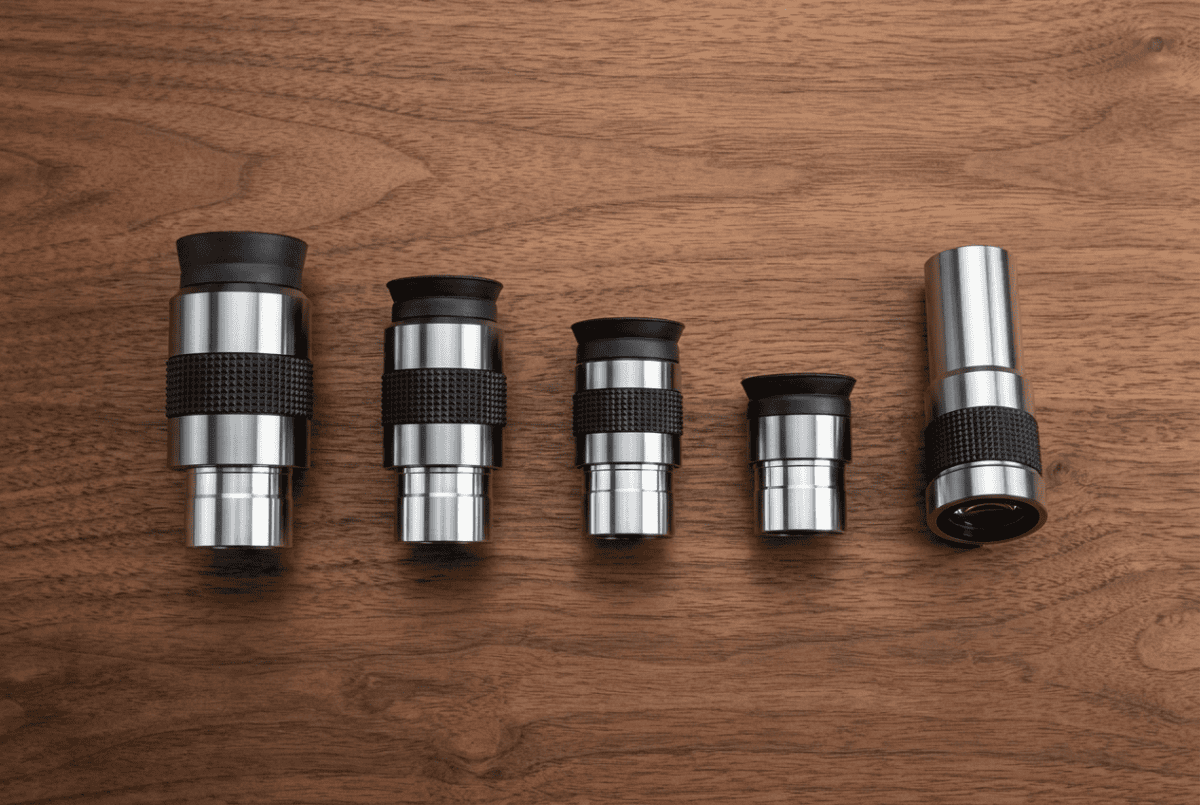
Here’s the short list, each pick chosen for the job a beginner actually needs it to do. Match the exact millimeter to your telescope’s focal length — these are the categories that matter.
| Eyepiece | Focal length | Best for | Approx. price |
|---|---|---|---|
| Celestron Omni 32mm Plössl | 32mm | Low power — wide views, finding objects | ~$40 |
| SVBONY 15mm “goldline” (68°) | 15mm | Medium all-rounder | ~$30 |
| Agena StarGuider 8mm Dual ED | 8mm | High power — planets & Moon, good eye relief | ~$60 |
| Celestron Omni 2x Barlow | — | Doubles every eyepiece above | ~$45 |
| Celestron X-Cel LX (glasses-friendly) | various | Comfort + 16mm eye relief for eyeglass wearers | ~$110 |
How to read an eyepiece spec in 60 seconds
You only need four numbers to shop confidently. Focal length (in mm) sets magnification — and remember, smaller mm means more zoom. Magnification is just your telescope’s focal length divided by the eyepiece’s, so a 1000mm scope with a 10mm eyepiece gives 100x. Apparent field of view (AFOV) is how wide the view feels: a Plössl is about 50°, a “goldline” about 66–68°, premium wide-fields 82°+. Eye relief is how far your eye can sit back and still see everything — 15–20mm if you wear glasses. And nearly every beginner eyepiece is a 1.25-inch barrel, the universal standard. That’s enough to buy smart; the eyepiece pillar has the rest.
The only three eyepieces (plus a Barlow) most beginners need
A low, medium, and high-power eyepiece plus a 2x Barlow gives you six useful magnifications from four purchases — everything a beginner does for years. Here’s the logic behind each one:
- Low power (~30–32mm): your starting eyepiece every session — the widest true field, easiest for locating objects and framing big star clusters.
- Medium power (~15mm): the workhorse for the Moon, brighter deep-sky, and general viewing.
- High power (~8–9mm): for planets and lunar detail on steady nights — prioritize eye relief here so it’s comfortable.
- 2x Barlow: doubles each of the above (your 32 becomes a 16, your 15 a 7.5, your 9 a 4.5), so you skip buying three more eyepieces.
This is the anti-overbuying setup. Resist the urge to buy a 7-piece kit; you’ll reach for these four 95% of the time.
Best budget Plössl set: Celestron Omni or SVBONY (~$30–40 each)
For the best value in a first eyepiece, a quality Plössl is the beginner’s champion, and the Celestron Omni Plössl line is the most-recommended for good reason: sharp, well-built, and cheap. Buy the 32mm for wide views and a 9mm for planets, add a 15mm for the middle, and you’ve got the core trio for around $100. If you’d rather have a wider, more immersive view for a similar price, the SVBONY “goldline” eyepieces (6, 9, 15, 20mm, ~66° field) are a beloved budget upgrade — a noticeably bigger window than a Plössl for around $30 each.
Best step-up: Agena StarGuider Dual ED (~$60 each)
When you’re ready to spend a little more for comfort and a wider view, the Agena StarGuider Dual ED eyepieces are the sweet-spot upgrade. They offer a 60° field and a generous ~16mm of eye relief across the range (3.2 to 25mm), which makes the high-power eyepieces far more pleasant to use than a tight little Plössl — especially the 8mm for planets. If you only upgrade one eyepiece from the kit glass, make it your high-power one, and make it a StarGuider.
Best for glasses-wearers: Celestron X-Cel LX (~$110)
If you wear glasses at the eyepiece, eye relief is everything, and the Celestron X-Cel LX is the beginner-friendly answer with a comfortable 16mm of eye relief and a 60° field across the whole line. You can keep your glasses on and still see the full view — something cheap short Plössls make nearly impossible. It costs more than a budget Plössl, but for eyeglass wearers it’s the difference between straining and actually enjoying the view.
Best wide-field upgrade: Explore Scientific 62° (~$100)
When a 50° Plössl view starts to feel like looking through a straw, a wide-field eyepiece is the upgrade that changes how observing feels. The Explore Scientific 62° series (5.5, 9, 20, 26mm, around $100 each) opens the window noticeably — more sky, more immersion, easier to keep an object in view. It’s a luxury, not a necessity, so buy it after you’ve got aperture and the basic trio covered — but it’s the first “wow” upgrade most observers make.
Best Barlow: Celestron Omni 2x (~$45)
A Barlow is the single most cost-effective eyepiece accessory, and the Celestron Omni 2x Barlow is the consensus budget pick. Drop it in front of any eyepiece and the magnification doubles — so two eyepieces become four powers, and three become six, for about $45. The only rule is to buy a decent one, because a cheap Barlow smears the image. I break down the how and the trade-offs in what a Barlow lens does and round up options in the best Barlow lenses.
What you get at $30, $100, and $300
Your eyepiece budget maps cleanly onto three tiers, and knowing them keeps you from over- or under-spending. At ~$30–40 you get a single quality Plössl or goldline — a real upgrade over the kit glass and a great place to start. At ~$100 you can build the full beginner trio (low, medium, high) or buy one excellent wide-field. At ~$300 you have the trio plus a Barlow plus a wide-field upgrade — genuinely everything a beginner needs for years. Beyond that you’re into premium territory (Tele Vue Nagler, Ethos), which is wonderful glass but firmly a later-in-the-hobby purchase. Spend on aperture first; my best telescope for beginners guide covers that side.
Common beginner eyepiece mistakes
From experience: my first truly worth-it upgrade was an Explore Scientific 12mm 92°, and it still amazes me every time out — one day I want to try a 100° field. The worst was the tiny 4-6mm eyepiece bundled with my first scope: so poor I could barely see anything but the Moon through it.
Most eyepiece regret comes from three predictable mistakes. First, over-buying — a 7-piece kit sounds like value, but you’ll use three of them; buy fewer, better eyepieces. Second, chasing maximum magnification — that 4mm eyepiece giving 250x on a small scope just shows you a dim, blurry blob, because aperture caps useful power at about 2x the aperture in mm. Third, ignoring eye relief — if you wear glasses and buy a cheap 6mm Plössl, you’ll hate it. Avoid those three and your eyepiece money goes a long way.
Frequently asked questions
What eyepiece should a beginner buy first?
Start with a low-power ~32mm Plössl for finding objects and wide views, then add a ~9mm for planets and a 2x Barlow to fill the range in between. That trio-plus-Barlow covers almost everything a beginner does.
How do I calculate an eyepiece’s magnification?
Divide your telescope’s focal length by the eyepiece’s focal length. For example, a 1000mm telescope with a 10mm eyepiece gives 100x magnification.
What’s the highest magnification I can use?
About 50x per inch of aperture, or roughly 2x the aperture in millimeters — so a 100mm telescope tops out near 200x, and pushing beyond that gives a dim, blurry image.
Are expensive eyepieces like Tele Vue worth it for beginners?
Not at first. An affordable Celestron Omni Plössl or SVBONY goldline delivers most of the experience for a fraction of the cost, so save premium glass for once you know what you observe most.
What does a Barlow lens do and do I need one?
A Barlow multiplies an eyepiece’s magnification, usually by 2x, effectively doubling your eyepiece collection for around $45 — making it the best-value first accessory you can buy.
What’s the difference between 1.25-inch and 2-inch eyepieces?
The 1.25-inch barrel is the standard size that fits nearly every telescope and is all a beginner needs, while larger 2-inch eyepieces are for wide-field low-power views you’ll likely want later.
The bottom line
You can build a beginner eyepiece kit that lasts for years with just three eyepieces and a Barlow, for around $150 total. Buy a ~32mm for finding and wide views, a ~15mm all-rounder, and a ~8–9mm for planets — Celestron Omni Plössls or SVBONY goldlines are perfect — then add a Celestron Omni 2x Barlow to double them all. Mind your eye relief if you wear glasses, don’t chase magnification numbers, and don’t over-buy. For the full theory behind these choices, read my complete guide to telescope eyepieces. Explore more beginner guides here at TelescopeSchool, and clear skies.
I’m Will Montgomery, an engineer who returned to astronomy at 50 and observes from Bortle 5-6 suburban skies near York, Pennsylvania. I’ve watched beginners waste money over-buying eyepieces, so these are the few that actually earn a place in the case.
These May Help Too...
Can You Use a Telescope Through a Window? (And Why You Should Not)
Using a telescope through a window ruins the view: bad glass, heat currents and reflections. Here is what actually happens, and what to do instead.
Telescope will not come to focus? The cause is almost always spacing, not optics. Work out whether you ran out racking in or out, then fix that end.