

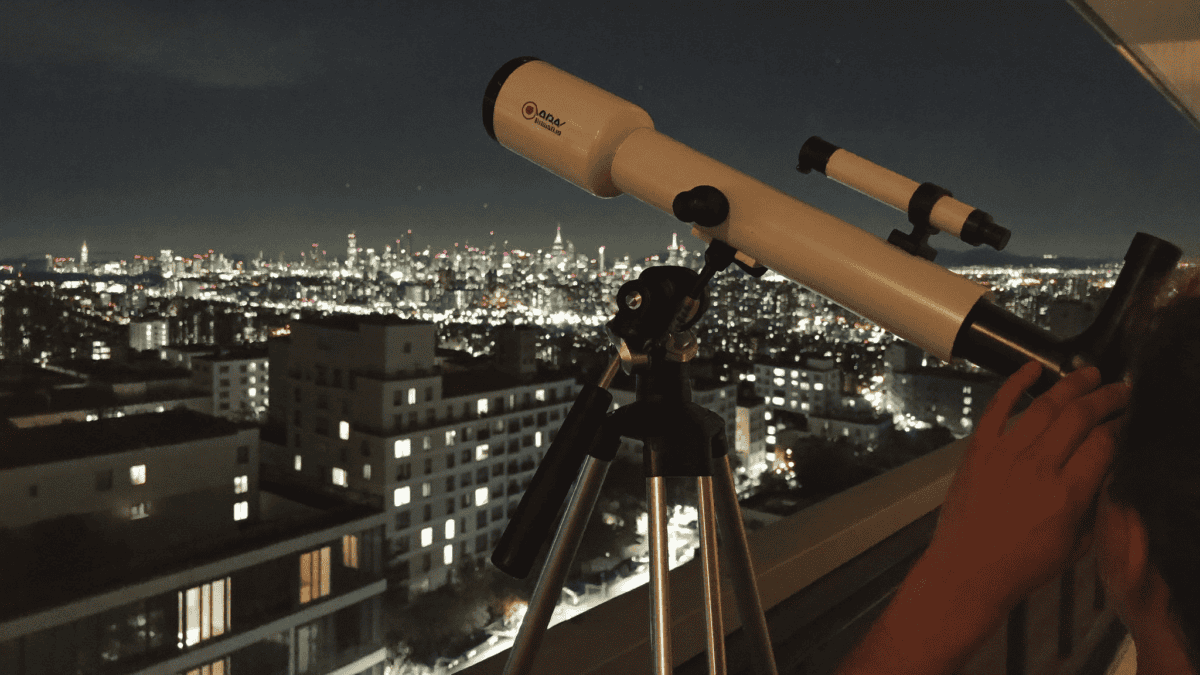
Yes, you can absolutely do real astronomy from an apartment or balcony — the Moon, planets, double stars, and bright clusters look great from a fourth-floor railing, and a smart telescope can even pull galaxies out of a city sky. What changes when you observe from a balcony isn’t whether it works, but how you work: you’re dealing with a narrow slot of sky, a hard floor that transmits vibration, light pollution, and no room to store a big scope. I’ve spent years observing from Bortle 5–6 suburban skies, often in exactly these cramped, light-washed conditions, and this TelescopeSchool guide is the honest playbook I wish existed — including the one factor that decides more than any telescope you buy: which direction your balcony faces.
Quick Answer: Yes, you can do real astronomy from an apartment balcony. The Moon, planets, and bright double stars are easy targets, and the main limits are your balcony direction and railing height, not your ZIP code. A tabletop Dobsonian like the Sky-Watcher Heritage 130P or a ZWO Seestar S50 smart telescope is the best first buy.
Model update — September 2026
The Seestar S50 named here has been discontinued. Its replacement is the Seestar S50 Pro — same 50mm aperture, upgraded sensor and autofocus — at an introductory $899. It is newly released: High Point Scientific is taking orders, B&H lists it as coming soon. We will update here once it is confirmed in stock. If you want a smart telescope you can buy today, the Seestar S30 Pro at $699 is in stock now.
Can you really do astronomy from an apartment or balcony?
You can, and plenty of dedicated amateur astronomers do it every clear night. A balcony gives you the Moon in all its phases, Jupiter’s four bright moons, Saturn’s rings, the phases of Venus, colorful double stars, and bright star clusters — all of which shrug off light pollution. What a balcony can’t easily give you is faint galaxies and nebulae by eye, and a full view of the whole sky. The trick is to match your gear and your targets to your specific balcony, and to lean on a smart telescope when you want the deep-sky objects the city normally hides. Everything below shows you how.
The four real constraints of balcony astronomy
Balcony observing is defined by four limitations, and understanding them upfront saves you money and frustration. First is the sky slot: a balcony only shows you the wedge of sky its railing and the building don’t block, so timing matters — you wait for a target to drift into your slot. Second is light pollution: city skyglow washes out faint objects, though it barely touches the Moon and planets. Third is vibration: hard concrete or composite decks transmit every footstep and bump straight into the eyepiece, turning high magnification into a shaky mess. Fourth is storage: apartments have no room for a big Dobsonian, so the scope has to live in a closet and set up in minutes. Nearly every choice on a balcony traces back to one of these four.
Which direction does your balcony face? (This decides everything)
The single most important factor in balcony astronomy is the compass direction your balcony faces, because it determines which objects ever cross your slice of sky. The Moon and planets travel along the ecliptic, which arcs across the southern sky for Northern Hemisphere observers — so a south-facing balcony is the jackpot. Here’s what each direction unlocks:
| Balcony faces | What you can observe |
|---|---|
| South / Southeast / Southwest | The best case — the Moon, all the planets, and the richest constellations ride through the southern sky. If you get to choose, this is it. |
| East | Rising objects and pre-dawn views — catch planets and constellations as they come up, and morning apparitions of Venus and Jupiter. |
| West | Evening and setting objects — great for a planet low in the western sky after sunset and early-evening sessions before bed. |
| North | The toughest — mostly circumpolar stars like the Big Dipper and Cassiopeia, plus Polaris. You’ll miss the Moon and planets, so a smart scope for star clusters and doubles helps most here. |
Before you buy anything, spend a few nights just noting what passes through your slot and when. That free reconnaissance tells you more than any spec sheet.
What you can actually see from a balcony (and what you can’t)
From experience: the real limit on a balcony is how much sky you actually get — it is a small window, and which direction the balcony faces decides what you can see. If your building has roof access, it is worth asking for it.
From a typical city or suburban balcony you can see a genuinely satisfying menu, as long as your expectations are honest. Easy wins, immune to light pollution: the Moon in crater-by-crater detail, Saturn’s rings, Jupiter’s cloud belts and Galilean moons, Venus’s phases, Mars near opposition, and bright double stars like Albireo and Mizar. Still doable: bright star clusters such as the Pleiades (M45), the Beehive (M44), and the globular M13 as a soft glow. Hard or impossible by eye: most galaxies and faint nebulae, which the city’s skyglow simply erases. From my own Bortle 5–6 skies, galaxies show up as faint grey smudges at best — that’s normal, and it’s exactly the problem a smart telescope solves. To gauge your own sky, check my guide on how dark the sky is above your telescope.
Smart telescopes: the light-pollution cheat code
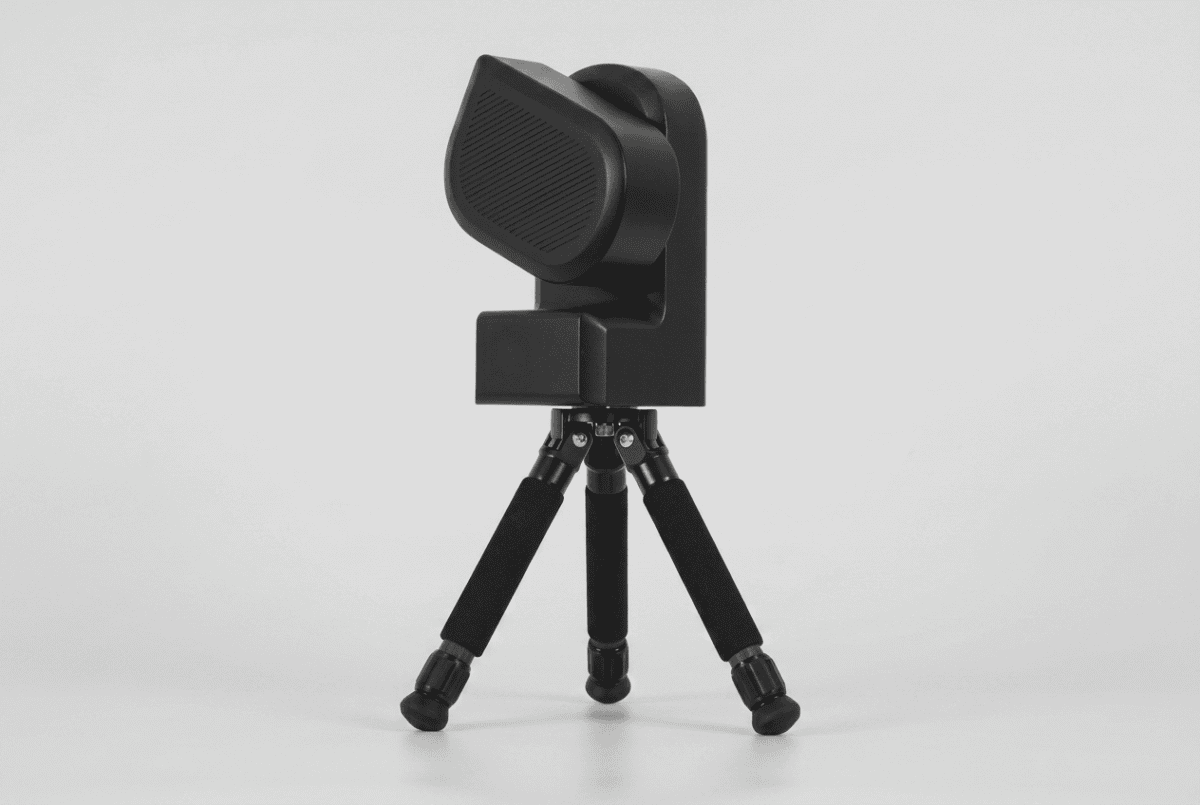
If you want galaxies and nebulae from a light-polluted balcony, a smart telescope is the answer, because it stacks many short exposures to pull faint detail out of a bright sky. A device like the ZWO Seestar S50 sets up in under a minute, finds the target itself, and builds a color image on your phone — overcoming skyglow that no eyepiece can beat. For a cramped balcony with a poor direction or heavy light pollution, this is often the highest-payoff purchase you can make, because it turns a limited sky into a productive one. See how the options compare in my best smart telescopes of 2026 guide. The trade-off is that you’re doing astrophotography on a screen rather than looking through an eyepiece — but from a balcony, that’s frequently the better path to the deep sky.
Choosing the right telescope for a small space
The best telescope for an apartment balances aperture against the harsh realities of a small, hard-floored space, which rules out the big scopes and rewards compact, fast-cooling designs. You want something you can carry with one hand, set up in a minute, and store in a closet. Here’s how the practical options compare:
| Type | Why it works on a balcony | Watch out for |
|---|---|---|
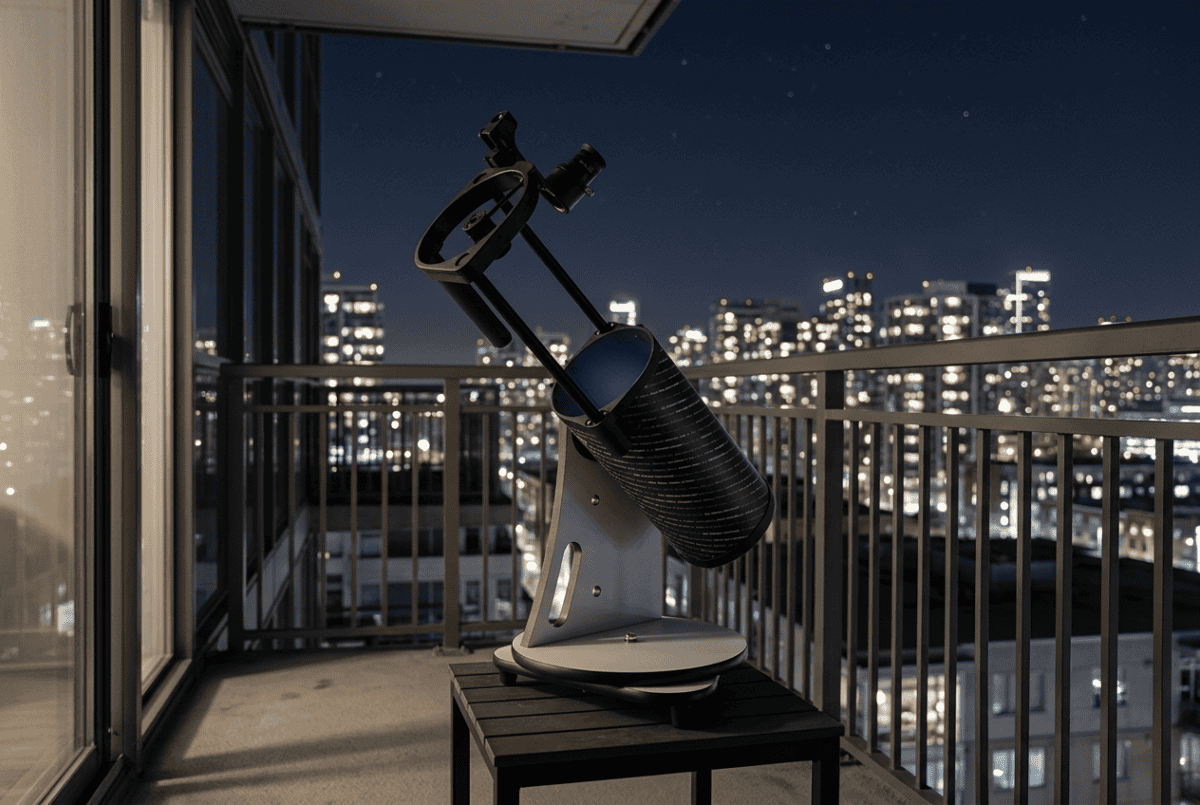
| Tabletop Dobsonian | Most aperture per dollar; sits on a stool or rail; no shaky tripod | Needs a solid surface at the right height |
| Compact Maksutov | Tiny, superb on Moon/planets/doubles; immune to light pollution for its targets | Narrow field — weak on large faint objects |
| Small refractor (grab-and-go) | Fast-cooling, low-maintenance, no collimation | Modest aperture; avoid cheap wobbly tripods |
| Smart telescope | Near-zero setup; beats light pollution for deep-sky | Imaging, not eyepiece viewing; weak on planets |
Our top telescope picks for apartments and balconies
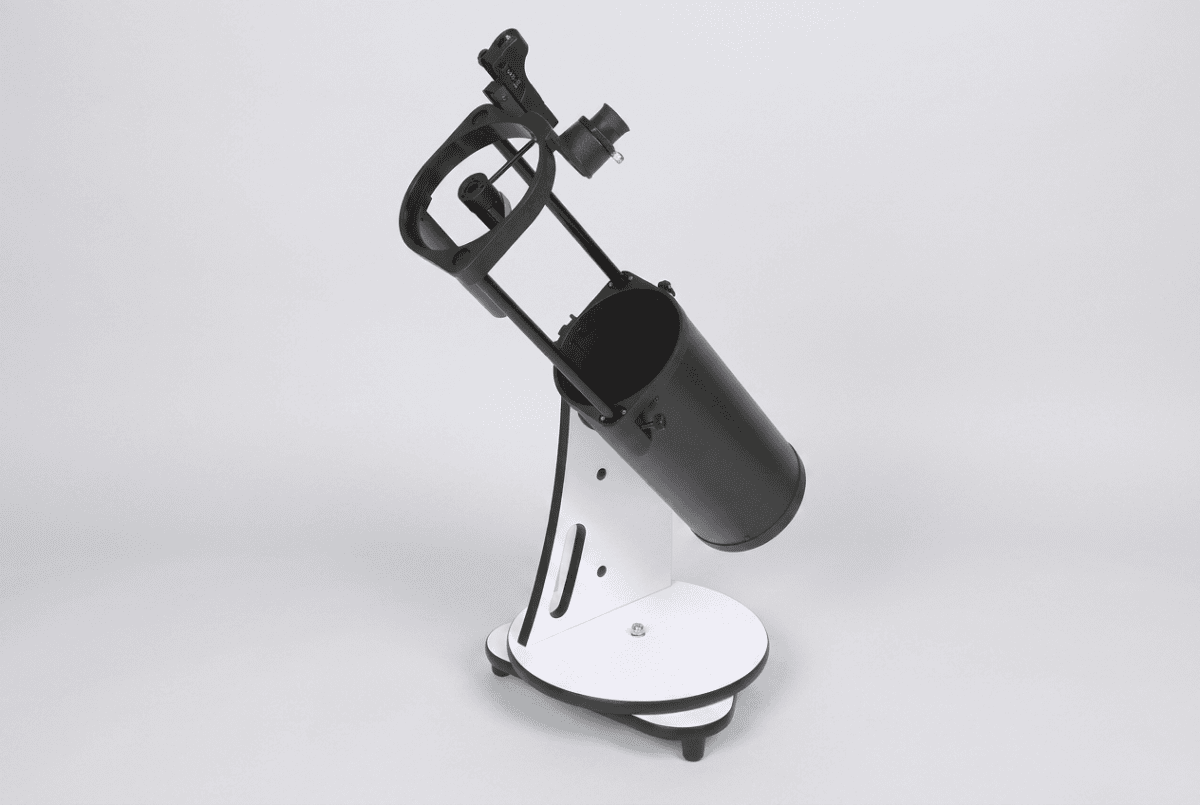
For most balcony observers, a tabletop Dobsonian or a smart telescope is the right first buy. Here are my specific recommendations by goal:
- Best all-round grab-and-go — Sky-Watcher Heritage 130P (~$230): a collapsible 130mm tabletop Dob that gives real aperture, sits on a stool or the railing, and stores in a closet. My favorite first telescope for small spaces — full Heritage 130P review here. The Heritage 100P (~$160) is the budget step-down for a tiny balcony.
- Best for Moon and planets — Sky-Watcher Skymax 102 Maksutov (~$280): compact, sharp, and light-pollution-proof for the Solar System — ideal if your slot faces the ecliptic.
- Best light-pollution beater — ZWO Seestar S50 Pro (~$899 (updated Sept 2026)): stacks out skyglow to deliver deep-sky objects from a city balcony; the Seestar S30 (~$399) is the smaller, cheaper option.
If you also observe from a yard or drive to darker sites, cross-reference my best telescopes for urban and suburban stargazers guide, which ranks scopes for city skies more broadly.
What to avoid on a balcony
The wrong telescope will sit unused in a corner, so avoid anything big, heavy, or wobbly. Skip large Dobsonians (8-inch and up) — they’re too bulky to store and move, and your narrow sky slot wastes the aperture anyway. Avoid long refractors on flimsy tripods and cheap beginner bundles on shaky equatorial mounts (the department-store “675x!” specials), because on a hard balcony floor their vibration makes high magnification unusable. And steer clear of anything with a huge tripod footprint or a long thermal cool-down — on a balcony, fast and compact always beats big and finicky.
Setting up on a hard floor: beating vibration and going grab-and-go
Vibration is the quiet killer of balcony observing, so control it first. A tabletop scope on a sturdy stool, crate, or the railing itself is inherently steadier than a tall tripod on concrete. If you do use a tripod, add anti-vibration pads under the feet, keep the legs short and wide, and hang a weight from the center to damp the shakes. Move deliberately — every footstep on a composite deck ripples into the eyepiece, so take your step, then let the view settle before observing. The other half of the battle is speed: balcony sessions are often short, squeezed between clouds or a target crossing your slot, so pick gear you can carry out and be observing with in under two minutes. The scope you set up in one minute gets used ten times more than the one that takes twenty.
Neighbors, security lights, HOAs, and renters
Being a considerate, low-profile observer keeps balcony astronomy hassle-free. A neighbor’s motion-sensor security light will wreck your night vision in an instant, so position yourself out of its trigger zone, use a red flashlight to preserve dark adaptation, and give your eyes 20 minutes to recover if you get flashed. Be mindful of optics etiquette — keep the scope aimed up at the sky, never toward windows, so no one wonders what you’re looking at. On the HOA and lease side, a portable tripod telescope you carry out and bring back in is almost always fine, since it’s not a fixture; trouble only arises with anything permanent or bolted down, so keep your setup fully removable. A little discretion and courtesy means you’ll never have a reason to stop.
Storage, accessories, and a simple balcony routine
A small-space setup thrives on a short, repeatable routine and a compact kit. Store the scope collapsed in a closet with a few essentials in a small bag: a couple of eyepieces, a red flashlight, a planisphere or a stargazing app, and a moon filter for those brilliant full-Moon nights. Build a simple rhythm — check what’s crossing your sky slot tonight, carry everything out in one trip, set up on your stool or railing, and start with the Moon or a bright planet while your eyes adjust. Keep a small notebook or phone note of what you see; tracking your own progress is what turns a gadget into a hobby. Done this way, a balcony becomes a genuine little observatory you’ll actually use.
Frequently asked questions
Can you use a telescope on an apartment balcony?
Yes. A balcony is well suited to the Moon, planets, and double stars, and a smart telescope can even capture deep-sky objects. Your main limits are a narrow slice of visible sky and vibration from a hard floor, both of which are manageable.
What can I see if my balcony faces north?
Mostly circumpolar stars and constellations like the Big Dipper, Cassiopeia, and Polaris. You’ll miss the Moon and planets, which ride the southern sky, so a smart telescope for clusters and double stars gets the most out of a north-facing balcony.
What’s the best telescope for a small apartment?
A tabletop Dobsonian like the Sky-Watcher Heritage 130P or a smart telescope like the ZWO Seestar S50 Pro — both store in a closet, set up in about a minute, and deliver real results from a balcony.
Can I see galaxies and nebulae from a light-polluted balcony?
Rarely by eye, because city skyglow washes them out. But a smart telescope that stacks images, like the Seestar, can pull faint galaxies and nebulae out of even heavily light-polluted skies.
How do I stop my telescope from shaking on a hard balcony floor?
Use a tabletop scope on a sturdy stool or the railing, add anti-vibration pads under any tripod, keep tripod legs short and wide, and move slowly so each step’s vibration settles before you look.
Can my HOA or landlord stop me from putting a telescope on my balcony?
A portable tripod telescope you set out and bring back in is almost always fine because it isn’t a fixture. Permanent or bolted-down installations can trigger lease or HOA rules, so keep your setup fully removable.
The bottom line
An apartment or balcony is no barrier to real astronomy — it just asks you to work with your sky slot, your direction, and your space instead of against them. Figure out which way your balcony faces, set honest expectations, control vibration with a compact scope on a steady surface, and lean on a smart telescope when you want the deep sky the city hides. A Sky-Watcher Heritage 130P or a ZWO Seestar S50 will have you observing the Moon, planets, and more from your own railing tonight. Explore more beginner guides here at TelescopeSchool, and clear skies from your balcony.
I’m Will Montgomery, an engineer who returned to astronomy at 50 and observes from Bortle 5-6 skies near York, Pennsylvania, often from tight spots with a blocked horizon, so I know what a balcony can and cannot deliver.
These May Help Too...
Can You Use a Telescope Through a Window? (And Why You Should Not)
Using a telescope through a window ruins the view: bad glass, heat currents and reflections. Here is what actually happens, and what to do instead.
Telescope will not come to focus? The cause is almost always spacing, not optics. Work out whether you ran out racking in or out, then fix that end.