
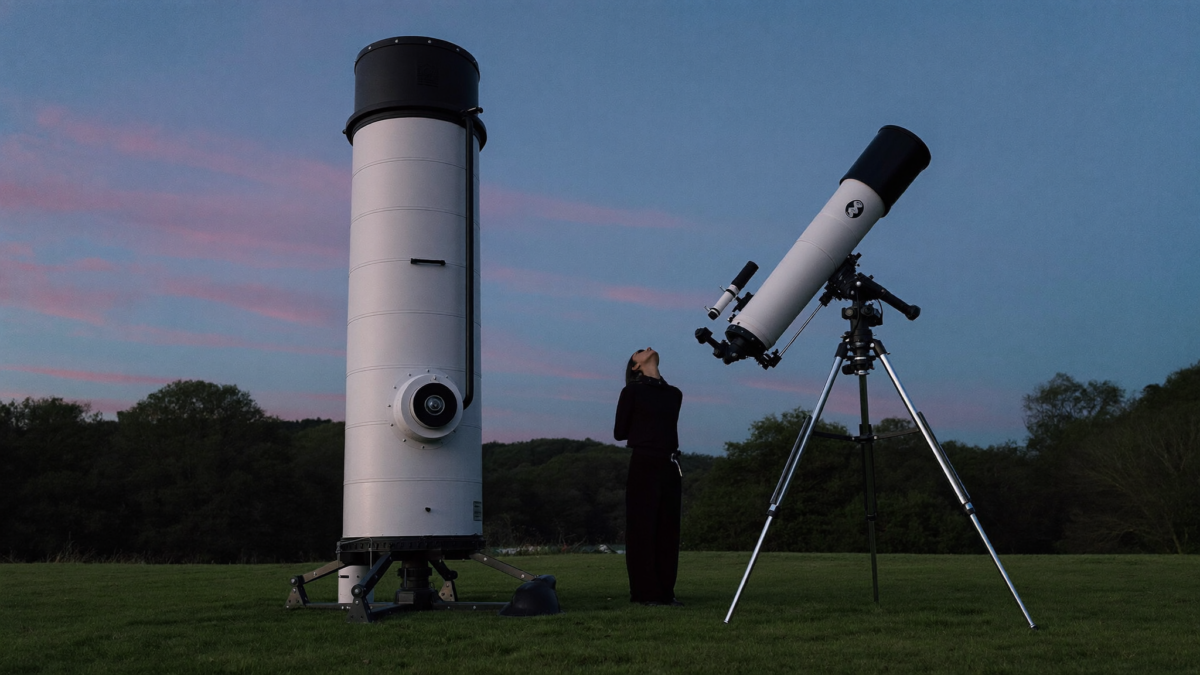
If your first telescope is about learning the sky and looking at planets and the Moon with your own eyes, buy a traditional telescope — an 8-inch Dobsonian is the classic answer. If it is about getting deep-sky images from a light-polluted yard with almost no learning curve, buy a smart telescope like the ZWO Seestar. They are different tools for different goals, and the honest truth is that a lot of people end up owning both.
I am an engineer by training (B.S., Penn State) who came back to this hobby at 50, and I get this question constantly: “Should my first scope be one of those app-controlled smart telescopes, or a regular one” Here is how I actually reason through it, without the marketing spin from either side.
Quick Answer: Buy a traditional 8-inch Dobsonian if your goal is learning the sky and seeing the Moon and planets with your own eyes; buy a smart telescope like the ZWO Seestar S50 if you want easy deep-sky images from a light-polluted yard with almost no learning curve. They solve different problems, and many observers end up owning both.
What is the real difference between a smart and a traditional telescope?
The core difference is the experience: a traditional telescope sends real photons to your eye through an eyepiece, while a smart telescope shows you a live, computer-stacked image on your phone. A traditional scope — a refractor, reflector, or Dobsonian on a manual or motorized mount — is an optical instrument you point and look through. A smart telescope is essentially a small automated camera-and-mount that aligns itself, finds the target, and builds an image electronically (what enthusiasts call EAA, electronically assisted astronomy).
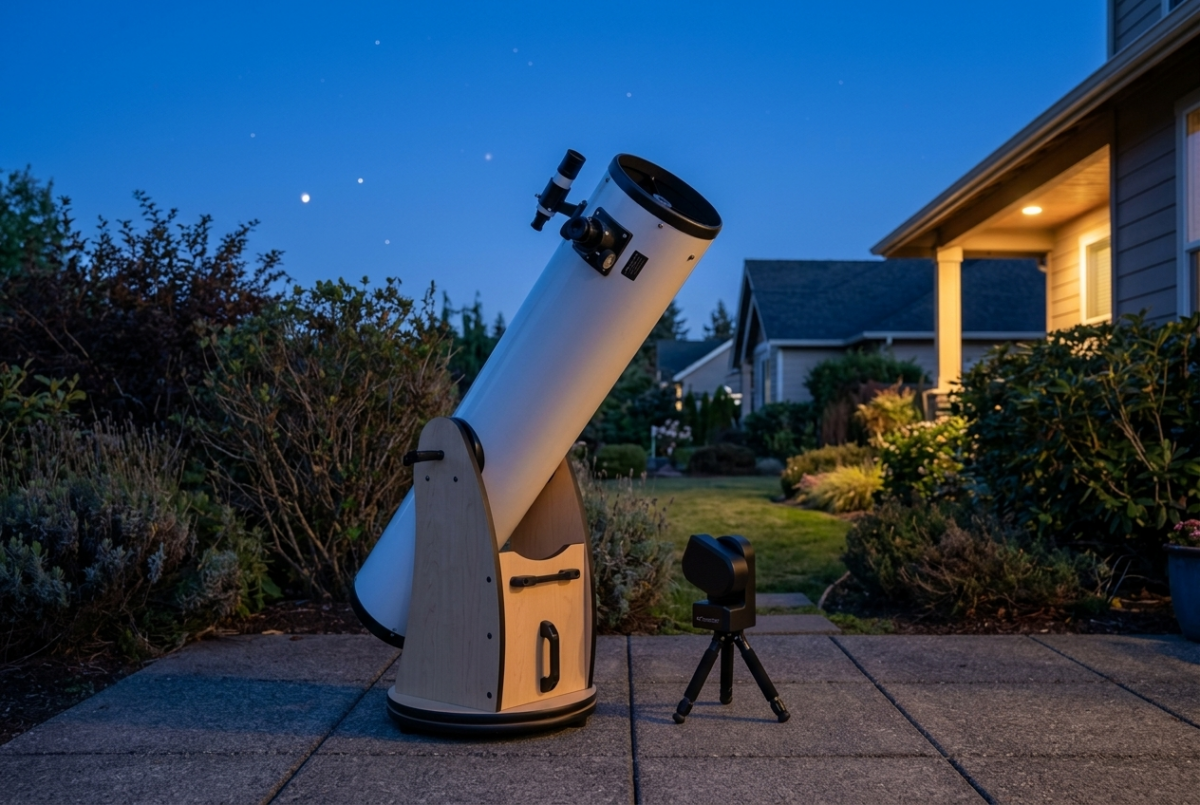
Neither is “better.” They optimize for opposite things. One rewards patience, aperture, and sky knowledge. The other rewards convenience and gives you a shareable picture in minutes.
Smart telescope pros and cons
A smart telescope’s biggest strength is that it removes almost every beginner frustration — and its biggest weakness is that you never actually look through it. Here is the balanced view.
Where smart telescopes win:
- Near-automatic setup: level it, power on, connect the app, tap a target — it aligns, finds, and tracks for you.
- Deep-sky images from the city: live stacking plus built-in light-pollution filters pull nebulae and galaxies out of skies where visual observing would show almost nothing.
- Shareable results: everyone crowded around the phone sees the same image, which makes it fantastic for kids and outreach.
- Portable and low-maintenance: sealed optics, no collimation, plane-friendly.
Where they fall short:
- No eyepiece — you watch a screen, not live photons.
- Weak on planets and high-magnification lunar detail; small apertures render planets small.
- Closed ecosystems with little room to upgrade the hardware.
- You do not learn the sky by hand, and you depend on a battery, phone, and app.
Traditional telescope pros and cons
A traditional telescope gives you the most aperture per dollar and a real through-the-eyepiece experience, at the cost of a learning curve. That trade is the whole story.
Where traditional scopes win:
- Real, immersive views — the “I’m actually seeing Saturn’s rings myself” moment that hooks people.
- Best value for visual observing: a manual Dobsonian buys enormous aperture cheaply.
- Best high-magnification planetary and lunar detail, especially with aperture and long focal length.
- It teaches you the sky (star-hopping) and it is endlessly upgradeable, with a clear path to serious observing or astrophotography.
Where they fall short:
- Finding objects by hand has a learning curve unless you pay for GoTo or a push-to system.
- Light pollution badly hurts visual deep-sky — faint fuzzies look like gray smudges from town.
- The astrophotography path is genuinely complex and gear-hungry.
- Big scopes are bulky and need occasional maintenance like collimation.
Which should you choose? A decision table
Match the tool to your primary goal, and the choice usually gets obvious. This is the table I walk people through.
| Your main goal | Better choice | Why |
|---|---|---|
| Learn the sky & observe visually | Traditional (8″ Dobsonian) | Eyepiece experience, star-hopping, teaches constellations |
| Easy deep-sky imaging | Smart telescope | Live stacking + auto-everything; results fast |
| City / light-polluted living | Smart telescope | Stacking sees through glow; visual deep-sky suffers in town |
| Planets & the Moon in detail | Traditional (aperture) | High magnification rewards aperture and focal length |
| Kids, family, outreach | Smart telescope | No skill needed; everyone sees the screen at once |
| Serious astrophotography path | Traditional modular rig | Full control, upgradeable, higher ceiling |
| Grab-and-go / travel | Smart telescope | Compact, minutes to set up |
| Tightest budget, visual | Traditional (Dobsonian) | Most aperture per dollar |
What about cost?
The two categories now overlap in price, which is exactly why this decision got harder. Budget smart telescopes run roughly $350–$700 (the ZWO Seestar S30 around $349, the S50 around $499, the Dwarf 3 around $549), while premium models from Unistellar and Vaonis climb to $2,300–$5,000. Traditional scopes span an even wider range: capable tabletop and beginner Dobsonians from roughly $150–$400, the benchmark 8-inch Dobsonian around $600–$700, and a real beginner astrophotography rig easily $1,000–$3,000 once you add a tracking mount, camera, and accessories. Treat all of these as approximate and check current prices before you buy.
Dollar for dollar, a Dobsonian buys more aperture; a smart telescope buys more convenience and a working camera. You are not really comparing prices — you are comparing what you want to walk away with.
My honest recommendation
Pick based on the single thing you most want from night one. If you want the hobby — the sky, the eyepiece, the slow skill of finding things — start traditional, ideally a Dobsonian, and read my best telescope for beginners guide. If you live under city lights, want images, or are buying for kids, a smart scope will make you far happier far faster, and my best smart telescopes roundup narrows it down. And if you genuinely cannot decide, my favorite beginner path is a smart telescope plus a membership at a local astronomy club, where you can look through other people’s traditional scopes before you buy one. Whichever way you lean, that is the kind of practical, no-regrets decision we try to help you make at TelescopeSchool.
From experience: On bright targets like the Moon and planets the eyepiece still feels more immediate and alive, but a smart scope’s live stacking pulls out far more color and detail in faint galaxies and nebulae — especially under light-polluted skies, or when your eyes aren’t what they used to be.
Frequently asked questions
Can a smart telescope replace a traditional telescope?
Not entirely. It replaces the deep-sky imaging role very well but cannot give you true eyepiece viewing or strong high-magnification planetary detail, which is why many observers eventually own both.
Is a smart telescope good for beginners?
Yes. Automatic alignment, GoTo, and live stacking remove almost all the friction, so a beginner can get impressive deep-sky images on the first night with no sky knowledge.
Do you look through a smart telescope?
No. There is no eyepiece — you view a live, continuously stacking image on your phone or tablet through an app.
Which is better for planets, smart or traditional?
Traditional. Planets are tiny, high-magnification targets that reward aperture and long focal length, so they look small and underwhelming on most small-aperture smart scopes.
Are smart telescopes worth the money?
For city dwellers, imaging, travel, and convenience, yes — a $350–$700 unit bundles optics, mount, camera, and software. For pure visual observing, you get more aperture per dollar from a Dobsonian.
Can kids use a smart telescope?
Yes. The app-driven, screen-based workflow is genuinely kid-friendly — there is no manual finding, focusing, or eyepiece to fuss with, and everyone can watch the same screen together.
Popular starting points: the smart-telescope route with a ZWO Seestar S50, or the traditional route with an 8-inch Dobsonian telescope.
I own a traditional reflector and still weigh this question honestly. The right answer depends on whether you want to look or to photograph.
These May Help Too...
Can You Use a Telescope Through a Window? (And Why You Should Not)
Using a telescope through a window ruins the view: bad glass, heat currents and reflections. Here is what actually happens, and what to do instead.
Telescope will not come to focus? The cause is almost always spacing, not optics. Work out whether you ran out racking in or out, then fix that end.