

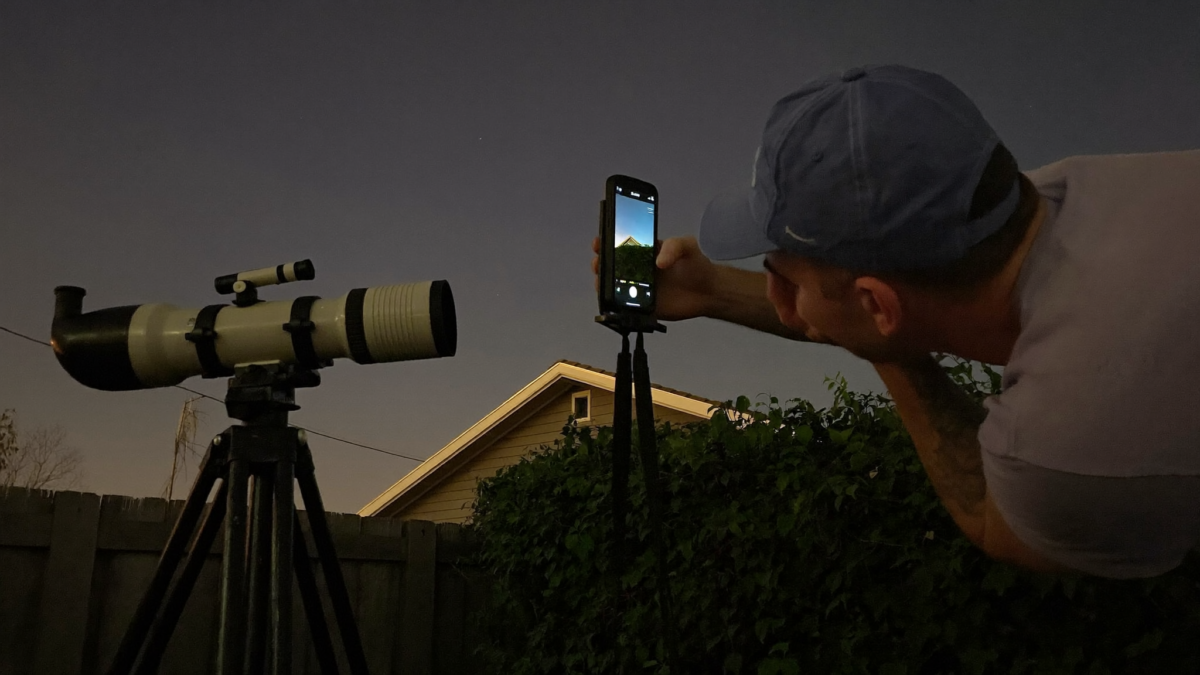
The Celestron StarSense Explorer is the beginner telescope I recommend most often to people who keep giving up because they cannot find anything in the sky — and the DX 130AZ is the model to get for the best mix of aperture and value. It uses your smartphone to figure out exactly where the scope is pointed and then guides you to targets with on-screen arrows. Just understand one thing up front: it is a manual push-to telescope, not a motorized GoTo.
I am an engineer by training (B.S., Penn State) who came back to amateur astronomy at 50, observing from a light-polluted Bortle 5–6 sky in York, Pennsylvania. I have not run the StarSense Explorer under my own skies, so this review leans on two things I do trust: the engineering behind how its plate-solving system actually works, and detailed feedback from owners who use it in exactly the kind of washed-out suburban sky where most beginners struggle. Here is my honest, engineering-eyed take.
Quick Answer: The Celestron StarSense Explorer is the beginner telescope I recommend most for people who keep giving up because they cannot find anything in the sky, and the DX 130AZ is the model to get for the best mix of aperture and value. It uses your smartphone to pinpoint where the scope is aimed and guides you to targets with on-screen arrows. Note that it is a manual push-to scope, not motorized GoTo.
What is the StarSense Explorer and how does it work?
The StarSense Explorer is a telescope that uses plate-solving on your phone to tell you where the scope is aimed and then shows you which way to nudge it by hand. You clamp your phone into a dock whose mirror lets the phone’s camera see the sky. The free StarSense app snaps a photo, analyzes the star pattern to pinpoint the aim (that is plate-solving), then displays a list of what is visible tonight. Pick a target and the screen shows arrows; you push the tube by hand until a bullseye turns green, and the object is sitting in your eyepiece.
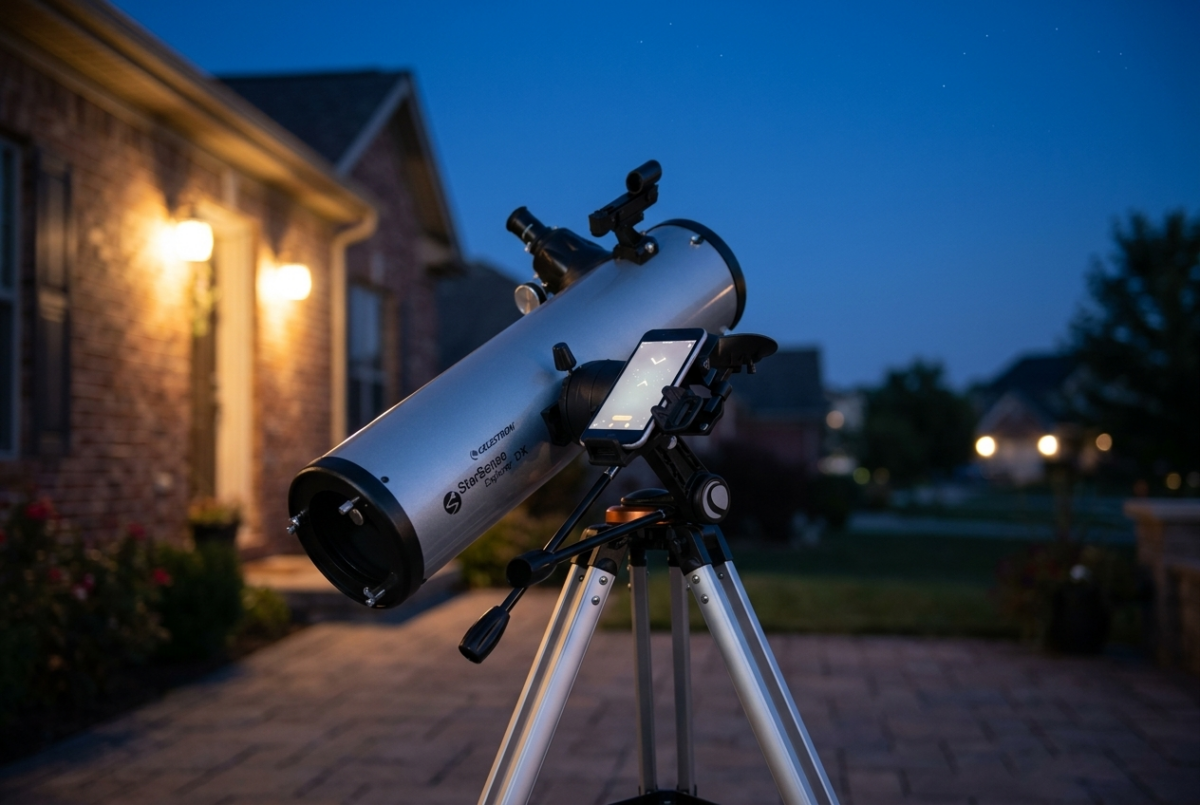
From an engineering standpoint it is a clever, low-cost answer to the beginner’s real problem, which is not the optics — it is aiming. In independent testing, pointing accuracy lands around a quarter of a degree, roughly half a full-moon width, which is plenty to drop a target into a low-power eyepiece.
Push-to, not GoTo: read this before you buy
The single most important thing to understand is that the StarSense Explorer has no motors — you move it yourself. There is no auto-slew that drives the scope to the target, and there is no motorized tracking, so as objects drift with Earth’s rotation you re-nudge them back by hand. The app uses plate-solving on setup and whenever you swing across the sky, and it fills in the fine movements using your phone’s motion sensors.
That design has real advantages: nothing electronic in the scope to drain batteries or fail, no cables, faster setup than a GoTo alignment routine, and it cannot mechanically lose alignment. The trade is obvious — if you were expecting to type in “Saturn” and watch the telescope drive itself there, you will be disappointed. If you want that motorized experience instead, read my take on whether computerized GoTo telescopes are worth the price.
The StarSense Explorer lineup and which to buy
The best all-around value in the lineup is the DX 130AZ, a 5-inch reflector, while the LT 114AZ is the budget entry and the Dobsonian models give you the most aperture. Prices below are approximate and worth re-checking before you buy.
| Model | Type | Aperture | Focal length / ratio | Approx. price |
|---|---|---|---|---|
| LT 80AZ | Refractor | 80mm | 900mm, f/11 | ~$250 |
| LT 114AZ (budget) | Reflector | 114mm | 1000mm, f/8.8 | ~$260 |
| DX 102AZ | Refractor | 102mm | 660mm, f/6.5 | ~$490 |
| DX 130AZ (best value) | Reflector | 130mm | 650mm, f/5 | ~$500 |
| 8″ / 10″ / 12″ Dobsonian | Dobsonian | 203–305mm | ~f/5 | ~$650–$1,500+ |
Quick decoder: LT means the phone dock rides on the tube (a lighter, budget line), DX means a sturdier mount with the dock off to the side, the number is the aperture, and AZ is the alt-azimuth mount. My pick for most buyers is the DX 130AZ — the extra aperture and the sturdier DX mount are worth the step up from the LT line. If you want maximum aperture and have storage space, the StarSense Dobsonians are compelling, and you can compare them against manual options in my best Dobsonian telescopes guide.
What can you see with it?
Because it finds targets you cannot see by eye, the StarSense Explorer is especially good in light-polluted areas for the Moon, planets, double stars, bright star clusters, and the brighter nebulae. On the DX 130AZ I have had crisp lunar craters, Saturn’s rings, Jupiter’s belts and moons, and objects like the Orion Nebula and the Pleiades — things a beginner in the same yard would spend an hour failing to find manually. The app’s object database has grown well beyond its original list to include most of the Messier catalog. Faint galaxies still will not show much detail from a bright suburb, but that is physics and light pollution, not the aiming system; my article on how dark your sky is explains why.
Pros and cons
The StarSense Explorer’s strengths cluster around one thing — it gets beginners actually seeing objects — and its weaknesses are the predictable costs of a phone-dependent, non-motorized design.
Pros:
- Solves the biggest beginner frustration — finding things — so you succeed on night one.
- Works well in light-polluted cities because it locates targets you cannot see with the naked eye.
- No motors, batteries, or cables in the scope to drain or fail; only your phone needs charge.
- Faster, simpler setup than a motorized GoTo alignment.
- The DX models have genuinely good optics for the price and a reasonably sturdy mount.
Cons:
- It is push-to, not GoTo — no auto-slew and no tracking, so you constantly re-nudge.
- The phone-dock alignment can be finicky and may take a couple of tries.
- It requires a reasonably recent smartphone; older phones may be unsupported, so check compatibility.
- The app plus camera use drains your phone battery — plan on a power bank.
- Bundled eyepieces and the diagonal are mediocre, and the LT line uses lighter mounts.
Is the StarSense Explorer worth it?
For a beginner who struggles to find objects, yes — the StarSense Explorer turns a frustrating scavenger hunt into a guided tour, and that is the difference between a telescope that gets used and one that gathers dust in a closet. Experienced observers who already know the sky, or anyone chasing maximum aperture for the money, may be happier with a plain Dobsonian at the same price. But for the specific person this is built for — a newcomer under city or suburban skies who wants to actually see things — it is one of the easiest telescopes to recommend, and it is a regular on my shortlist at TelescopeSchool.
From the field: In the astronomy groups I follow, StarSense owners under Bortle 5–6 skies consistently report getting onto unfamiliar targets — Andromeda, the Orion Nebula, planets, and clusters — in under a minute once the scope is aligned.
Frequently asked questions
Is the StarSense app worth it?
For beginners who struggle to find objects, yes — it turns aiming into a guided tour and gets you observing quickly. Experienced observers who already know the sky may prefer a plain Dobsonian for the same money.
Does StarSense Explorer work in the city with light pollution?
Yes. Because it locates targets by plate-solving rather than by eye, it is especially useful in light-polluted areas for finding the Moon, planets, brighter nebulae, clusters, and double stars. Faint galaxies still will not show much detail from the city.
Does it work with iPhone and Android?
Yes, the free app runs on both, but only on reasonably recent phones; older devices may be unsupported. Check Celestron’s current compatibility list before buying, since requirements have changed over time.
Is StarSense Explorer GoTo or manual?
It is manual (push-to) — there are no motors. The app shows arrows and you move the scope by hand until the bullseye turns green; it does not slew or track automatically.
Which StarSense Explorer is best?
For most buyers the DX 130AZ (5-inch reflector) is the best all-round value. The LT 114AZ is the budget pick, and the 8″, 10″, or 12″ Dobsonians give the most aperture if you have the space.
Can you use it without a phone?
Not for the guided finding — that depends entirely on your phone and the app. You can still use it as an ordinary manual telescope with its red-dot finder, but you would lose the main reason to buy this model.
Recommended models: the best-value Celestron StarSense Explorer DX 130AZ and the budget StarSense Explorer LT 114AZ.
Finding targets is the part that defeats most beginners, so push-to that genuinely works is worth more than a little extra aperture.
These May Help Too...
Can You Use a Telescope Through a Window? (And Why You Should Not)
Using a telescope through a window ruins the view: bad glass, heat currents and reflections. Here is what actually happens, and what to do instead.
Telescope will not come to focus? The cause is almost always spacing, not optics. Work out whether you ran out racking in or out, then fix that end.