
Quick answer
Almost any telescope with at least 60mm of aperture will show you Jupiter’s cloud belts and its four bright moons, Saturn’s rings, and the phases of Venus. What separates a good planet night from a bad one is not the price of your telescope — it is atmospheric steadiness, letting the optics cool, and knowing what the view is honestly supposed to look like.
Planets are the targets that keep beginners in this hobby. They are bright enough to punch through city light, they are visible from a balcony or a driveway, and unlike faint galaxies they show something the very first time you point at them. But they are also the targets that cause the most disappointment, because the pictures everyone has seen were taken by spacecraft that flew there.
This guide covers what each planet actually shows in an eyepiece, how much telescope you need for each one, why magnification stops helping sooner than you expect, and when to look over the next eighteen months. It is the hub page for the planetary section of Telescope School, and it links out to the deeper how-tos for individual planets.
Last Updated: September 2026 | Will Montgomery holds a B.S. in Engineering from Penn State and came back to amateur astronomy at 50, observing from suburban York, PA (Bortle 5-6).
What planets actually look like through a telescope
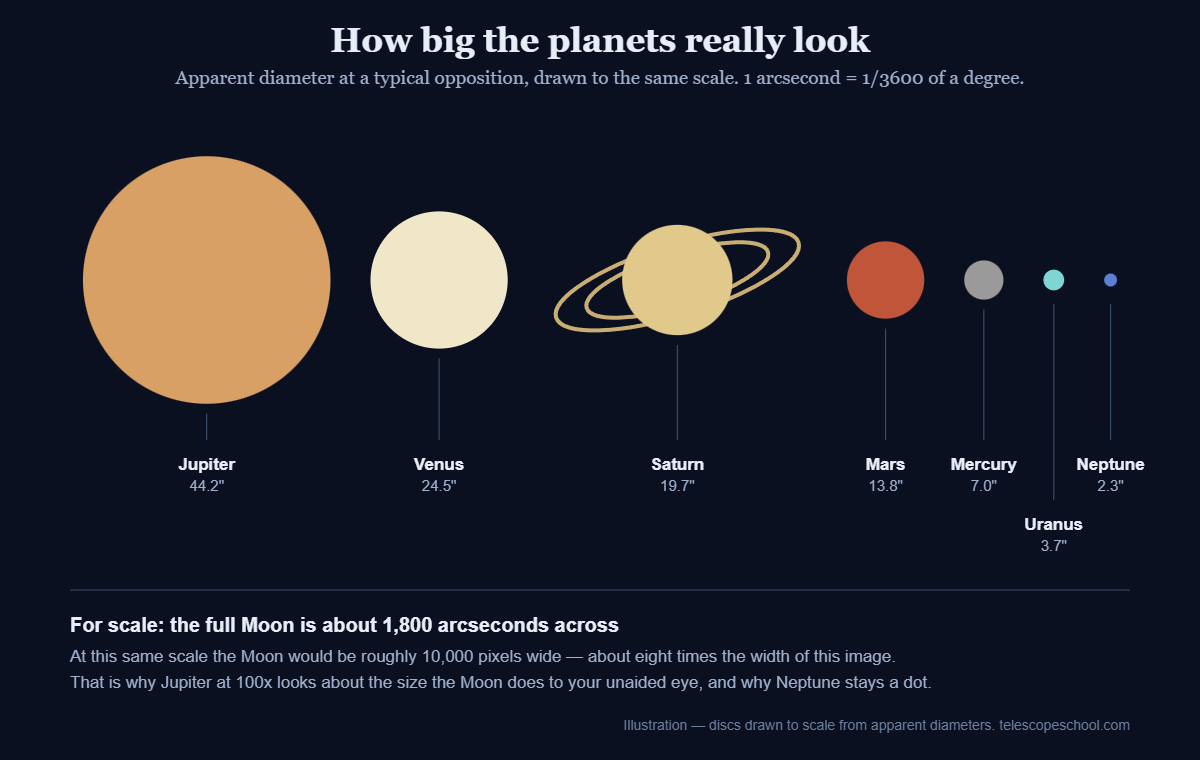
Planets look small, bright, and sharp — not like the poster. The single most useful thing a beginner can learn is that a planet’s apparent size is measured in arcseconds, and there are 3,600 arcseconds in a degree. The full Moon is about 1,800 arcseconds across. Jupiter, the biggest planet in the sky, tops out near 50.
That means at 100x, Jupiter appears roughly the size the Moon does to your naked eye. That is genuinely impressive when you understand it. It is crushing if you were expecting a Hubble portrait.
| Object | Apparent size (arcseconds) | How big it looks at 150x |
|---|---|---|
| Full Moon (for scale) | ~1,800″ | Far wider than the field of view |
| Venus | 9.6″ – 66″ | A distinct crescent or disc |
| Jupiter | 29.8″ – 50.1″ | Noticeably bigger than the naked-eye Moon |
| Saturn (globe) | 14.9″ – 20.8″ | About half the naked-eye Moon, plus rings |
| Mars | 3.5″ – 25.1″ | Small disc; tiny except near opposition |
| Mercury | 4.5″ – 13.0″ | A small, low, shimmering half-disc |
| Uranus | 3.3″ – 4.1″ | A tiny blue-green dot with a hint of disc |
| Neptune | 2.2″ – 2.4″ | Barely more than a coloured star |
What you gain in exchange for the small image scale is detail and colour that no photograph conveys the same way: the ochre of Jupiter’s belts shifting in real time as the seeing steadies, the impossible geometry of Saturn’s rings, the knife-edge terminator on Venus. Live photons, arriving now.
The five minutes of setup that decide the whole night
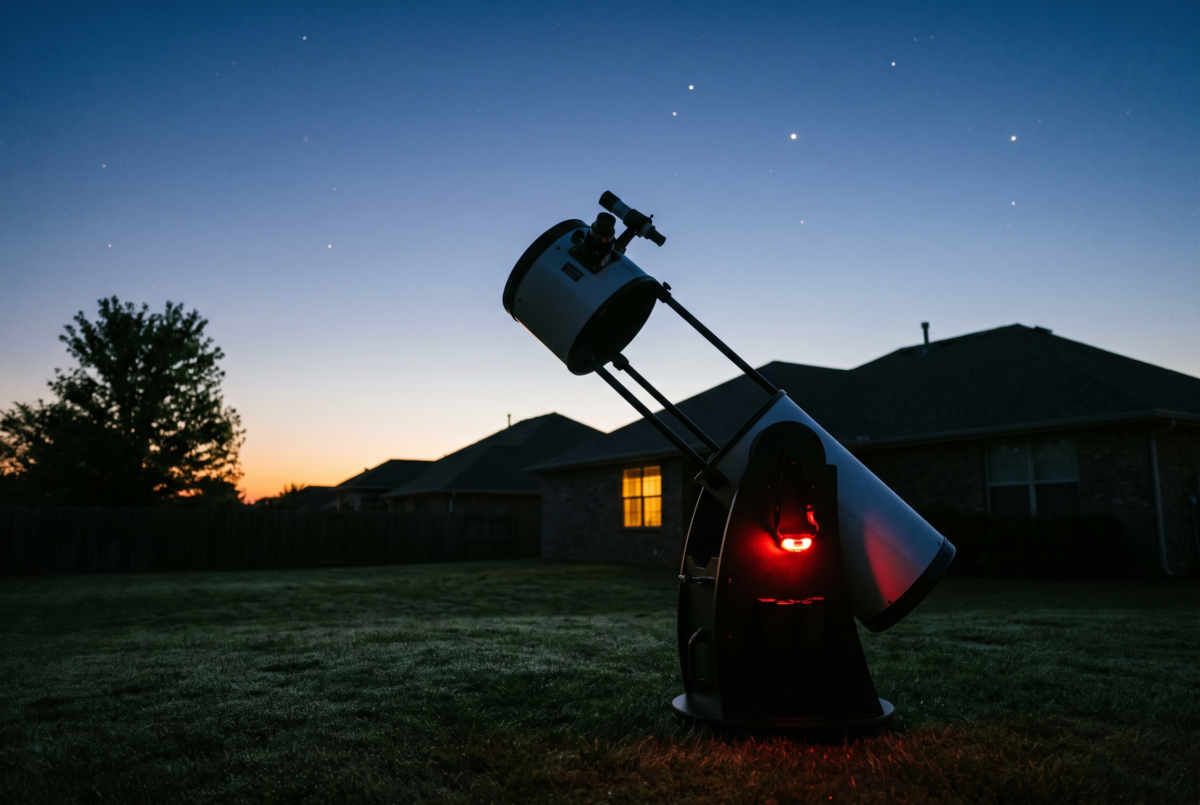
More planetary sessions are ruined by warm optics and bad placement than by inadequate telescopes. Three things matter before you look at anything.
Let the telescope cool. A telescope carried from a heated house into cold air has warm air churning inside the tube, and that turbulence sits directly in the light path. Give it 30 to 45 minutes outside before you expect a sharp planetary image. Larger mirrors take longer than small refractors.
Check collimation if you own a reflector. A Newtonian or Dobsonian that has been jostled will not hold high magnification, and planets are where miscollimation shows up first. Our guide to collimating a reflector covers the process.
Do not observe over a roof. Shingles, asphalt and brick radiate stored heat for hours after sunset, and that rising air will shred a planetary image no matter what you spent on the telescope. Point over grass where you can. Wait until the planet is more than about 30 degrees above the horizon — below that you are looking through several times as much atmosphere.
Seeing beats aperture — and it has a name
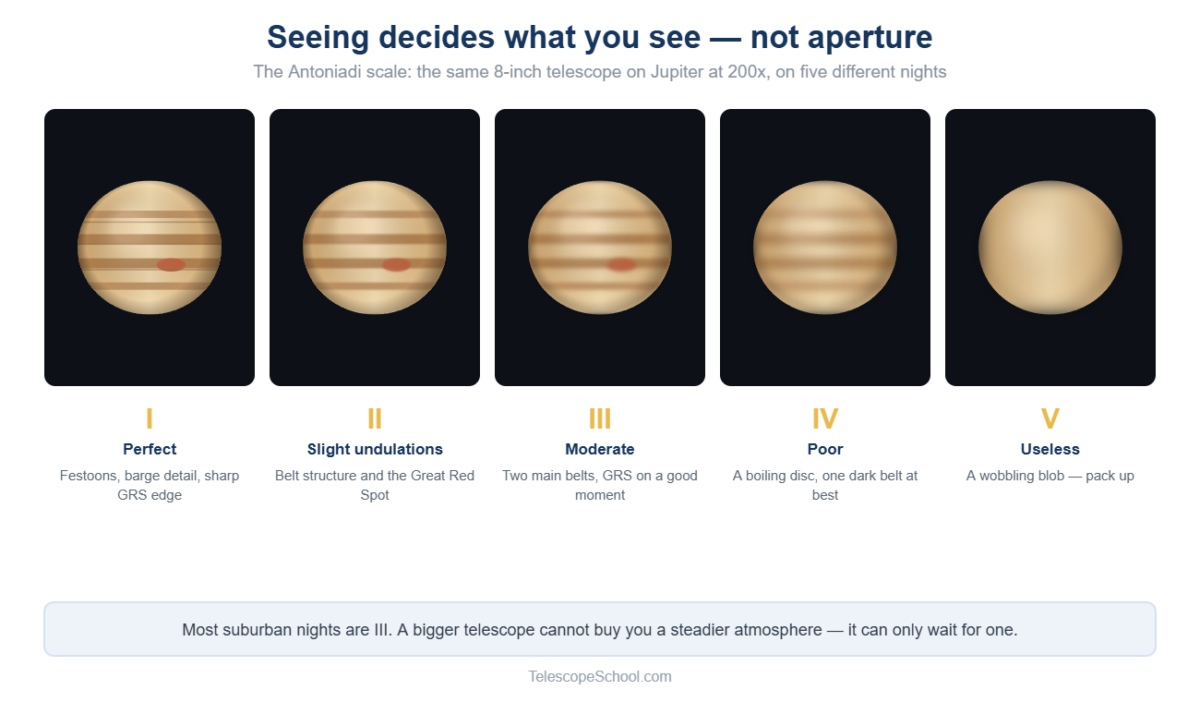
On most nights, the atmosphere — not your telescope — sets the limit on what you can see. Astronomers call this “seeing,” and it is the reason a 6-inch telescope can beat a 12-inch on a given evening.
The physics is straightforward. In all but the smallest apertures, resolving power is limited not by the optics but by turbulence in the air column above you. A 10cm telescope has a diffraction limit of roughly 1 arcsecond. Seeing at a premier mountain observatory runs 0.5 to 1.0 arcseconds. Ordinary suburban seeing is around 2 arcseconds. Above about 100mm of aperture, you are usually looking at the sky’s limit rather than the telescope’s, because a larger mirror collects more distorted wavefronts, not fewer.
Observers rate this on the Antoniadi scale, named for the Greek-French planetary observer Eugène Antoniadi:
| Class | What you see | What to do |
|---|---|---|
| I | Perfect, no quivering | Push the magnification — this is a rare night |
| II | Slight quivering, calm moments lasting seconds | Excellent. Wait for the calm moments |
| III | Moderate air tremors blur the image | Typical. Stay near 150x |
| IV | Constant troublesome undulations | Drop to 100x or observe the Moon instead |
| V | Very bad, barely stable enough to sketch | Pack up, or go wide-field |
Two practical tells: if the stars overhead are twinkling hard, seeing is poor. And seeing is often at its best in the hours before dawn, once the ground has finished dumping its heat.
How much telescope do you actually need for planets?
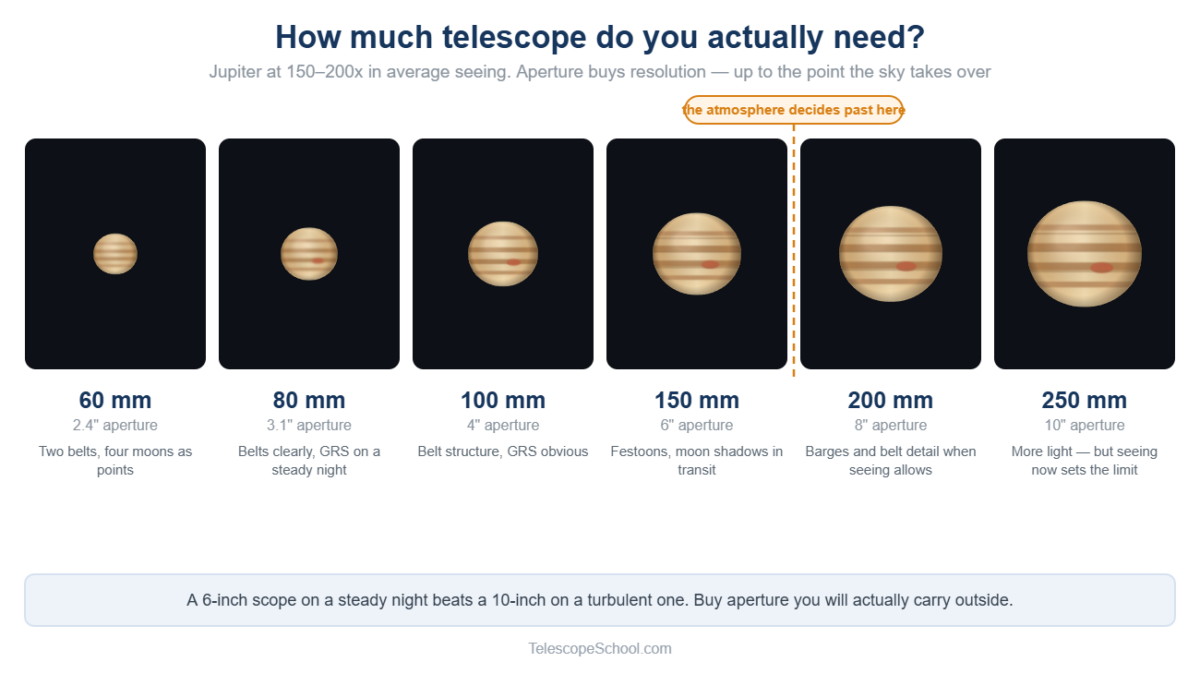
A 50mm refractor with a 25mm eyepiece is the honest bare minimum for seeing Saturn’s rings as rings and Jupiter’s two main belts as belts. Everything above that is a question of how much detail you want, not whether you will see anything at all.
| Aperture | What it reliably shows |
|---|---|
| 50–90mm | Saturn’s rings, Jupiter’s two equatorial belts and all four Galilean moons, phases of Venus and Mercury, Mars as a small orange disc with a polar cap near opposition |
| 100–125mm | The Cassini Division most nights, more belt structure on Jupiter, Titan easily, the Great Red Spot in good seeing, Uranus as a coloured dot |
| 150–200mm | Festoons and barges in Jupiter’s belts, four or five Saturnian moons, real albedo markings on Mars, Uranus showing a definite disc, Neptune findable |
| 250mm+ | The Encke gap in exceptional seeing, subtle Martian surface geography, faint cloud banding on Uranus — but only on the best nights, because seeing now limits you |
For planets specifically, a slower focal ratio — f/10 or longer — is easier to work with, because it delivers high magnification with comfortable, inexpensive eyepieces. That is why Maksutovs and Schmidt-Cassegrains have a reputation as planet scopes. A fast Dobsonian will still show you everything on the list; it just asks more of your eyepieces. If you are still choosing, our best telescopes for planets roundup breaks down the trade-offs.
From experience: I finally caught the Cassini Division with my Astronomers Without Borders 130mm and a 9mm Plössl, on a cool, calm night with no humidity. I was so tickled I told people to just call me NASA.
Magnification: there are two ceilings, not one
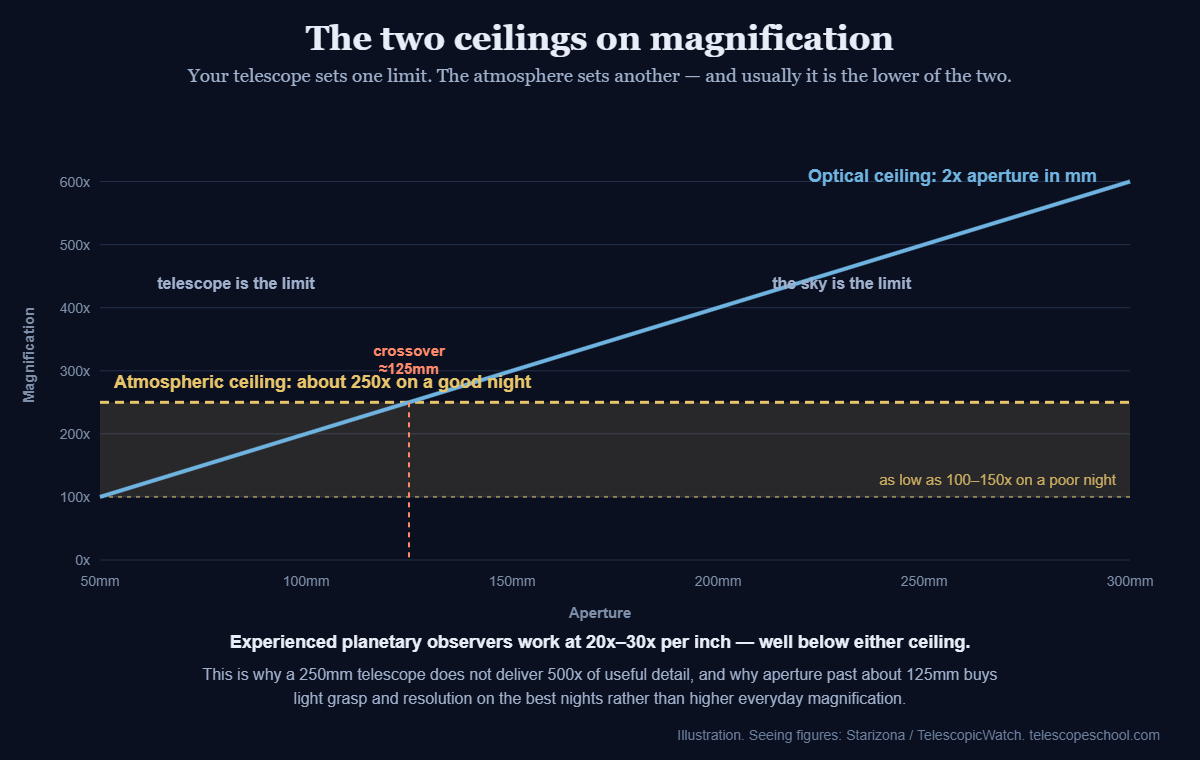
Your telescope has an optical ceiling and the sky has an atmospheric ceiling, and on almost every night the sky’s ceiling is the lower of the two.
The optical ceiling is the familiar rule of thumb: roughly 50x per inch of aperture, or 2x the aperture in millimetres. A 100mm telescope, by that rule, tops out around 200x.
The atmospheric ceiling is what you actually get. A realistic upper limit on an average night is about 250x no matter how large the telescope, and on a poor night you may not be able to exceed 100–150x. Experienced planetary observers spend most of their time at 20x to 30x per inch, not 50x.
The crossover sits around 100–125mm of aperture. Below it, your telescope is the limit. Above it, the sky is. This is why the “600x” printed on the box of a department-store 60mm refractor is not merely optimistic — it is meaningless. That telescope can resolve detail no finer than about 1.9 arcseconds, and no amount of eyepiece will invent detail the aperture cannot gather. We unpack this in the 50x rule explained.
Practical approach: start at about 100x to find and centre the planet, step up to 150–200x, and go higher only if the image stays sharp. If it gets bigger and mushier, you have passed your ceiling for the night. Come back down.
Planet by planet: what to expect
Mercury
Mercury shows phases and essentially nothing else. It has no contrasting surface features visible from Earth, so what you are looking for is the crescent or half-disc, between 4.5 and 13 arcseconds wide. The challenge is position: Mercury never strays far from the Sun, so it is observable only around greatest elongation, a handful of times a year, for no more than a week at a time, and always low in turbulent air. Seeing it at all is the achievement.
Venus
Venus goes through the full set of lunar-style phases, and its apparent size runs from about 10 arcseconds when full to over 60 when it is a thin crescent. The surface is permanently hidden beneath sulfuric-acid cloud, so nobody sees surface detail — in visible light the disc is essentially featureless white.
The expert tip that surprises most beginners: do not observe Venus in a dark sky. Against darkness it is so bright that glare swamps everything, and it is usually low in the sky where atmospheric dispersion smears the crescent into a small spectrum. Observe it in twilight, or even in full daylight, when it is higher and the contrast is gentler.
Mars
Mars is the most timing-dependent planet in the sky. It ranges from 3.5 to 25.1 arcseconds, and outside the months around opposition it is a featureless orange speck. Around opposition, even small telescopes show the polar cap, and larger instruments show dark albedo markings — wind-driven dust patterns, not vegetation.
Be warned about the next one: the 19 February 2027 opposition is an aphelic opposition, meaning Mars will be near the far end of its eccentric orbit. It will present a 13.8-arcsecond disc at magnitude −1.2. That is a perfectly good target, but it is roughly half the apparent area of the superb 2020 opposition. Anyone promising you a spectacular Mars in 2027 is overselling it.
Jupiter
Jupiter is the best beginner planet, full stop. Any telescope — and most binoculars — shows the four Galilean moons, and they visibly change position from night to night, and even over a couple of hours. The two main equatorial belts show in a 50mm scope. Because Jupiter rotates in just under ten hours, you can watch cloud features drift across the disc within a single hour at the eyepiece.
The Great Red Spot is the one to be honest about. Sources disagree on the minimum aperture — some claim it in a 90mm scope, experienced observers put the working minimum around 5 inches. It is also only facing Earth for part of each rotation, so timing matters as much as aperture. Our dedicated guide to seeing Jupiter and its moons goes into the detail.
Saturn
Roughly 25–30x is enough to resolve the rings as rings rather than a bulge, which is why Saturn is the target that converts sceptics. The Cassini Division — the gap between the A and B rings — is within reach of a small telescope on a decent night. The Encke gap needs 8 inches and exceptional seeing.
Titan, at magnitude 8, is visible in any telescope and even in binoculars. Rhea, Tethys, Dione and Iapetus come in with 4 inches or more; Mimas and Enceladus need 8. Saturn’s own cloud belts are far fainter than Jupiter’s and take patience.
One piece of current context: Saturn’s rings passed through their edge-on plane crossing in March 2025, and they are opening again. At the October 2026 opposition they are tilted about 7.5 degrees, and they will continue widening toward a maximum near 27 degrees over the coming years. So the rings look narrower right now than in the photographs you have seen — and they get better every season.
Uranus and Neptune
Uranus sits at magnitude 5.4 to 6.0 and shows a 3.3 to 4.1 arcsecond disc — a distinctly blue-green “fat star” that resolves into a small disc in a 6-inch at 150x or more. Neptune, at magnitude 7.7 and only about 2.3 arcseconds, is essentially a coloured point; confirming it as a disc takes 6 to 8 inches and steady air. Neither shows surface detail in amateur equipment. The reward is entirely in knowing what you are looking at.
When to look: the 2026–2027 planet calendar
A planet is at its best around opposition, when Earth passes between it and the Sun — it is closest, brightest, and visible all night. These are the dates worth putting in a calendar.
| Event | Date | Magnitude | Apparent size | Constellation |
|---|---|---|---|---|
| Saturn at opposition | 4 October 2026 | 0.3 | 19.7″ (globe) | Cetus |
| Jupiter at opposition | 11 February 2027 | −2.5 | 44.2″ | Leo |
| Mars at opposition | 19 February 2027 | −1.2 | 13.8″ (aphelic) | Leo |
| Saturn at opposition | 18 October 2027 | — | — | — |
Two things follow from that table. February 2027 is an unusually good month, with Jupiter and Mars reaching opposition eight days apart in the same constellation. And Saturn’s best window is right now — early October 2026 — which makes this autumn the time to get out with whatever telescope you own. Our 2026 planet viewing calendar covers the month-by-month detail.
Outside of opposition, planets are still worth observing; they are simply smaller. Jupiter and Saturn stay rewarding for months either side. Mars really does not.
Do filters help?
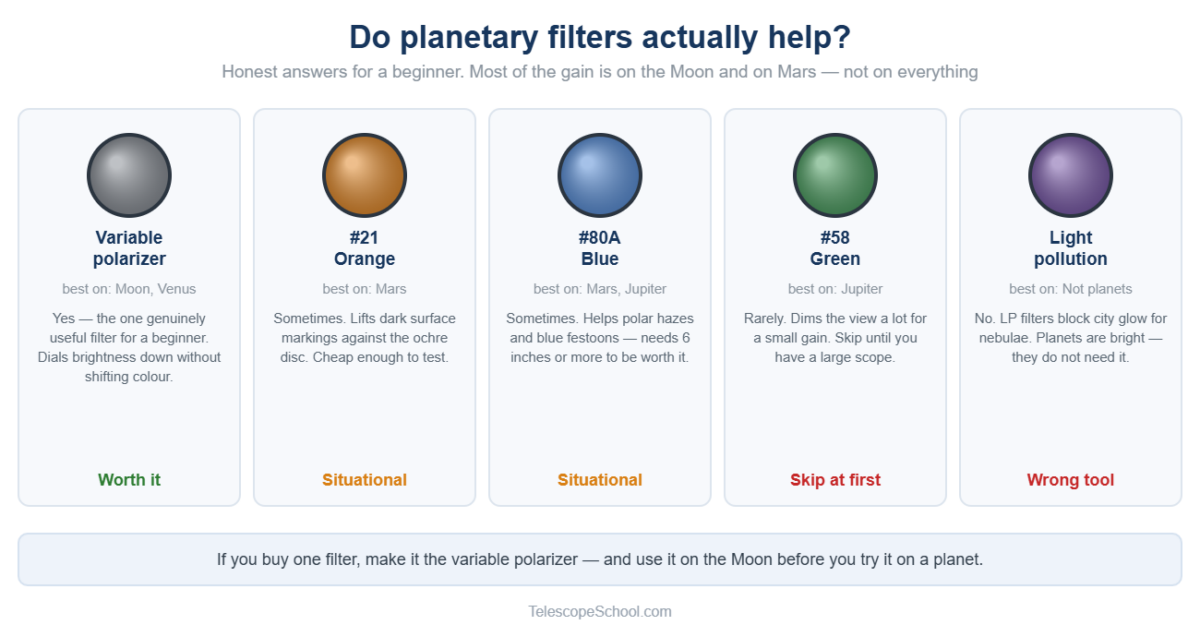
Colour filters are the most oversold accessory in planetary observing, and the honest answer is: sometimes, modestly, and less than the shopping lists suggest.
The uses that hold up across experienced observers are narrow. An orange or light-red filter (Wratten #21 or #23A) increases the contrast of dark surface markings on Mars. A blue filter (#80A) helps with Martian clouds and hazes. A yellow filter reduces glare on Venus. Beyond that, the gains are subtle enough that some very experienced planetary observers argue most colour filters deliver a negligible contrast boost and are not worth the money for a beginner.
If you are buying one thing to improve planetary views, buy a better eyepiece or a sturdier mount before you buy a filter set. A wobbling tripod costs you more detail than any filter will return. A variable polarizing filter is the one genuinely useful glass for a beginner, and it is for the Moon rather than the planets — it tames brightness without shifting colour.
Observing planets from a light-polluted city
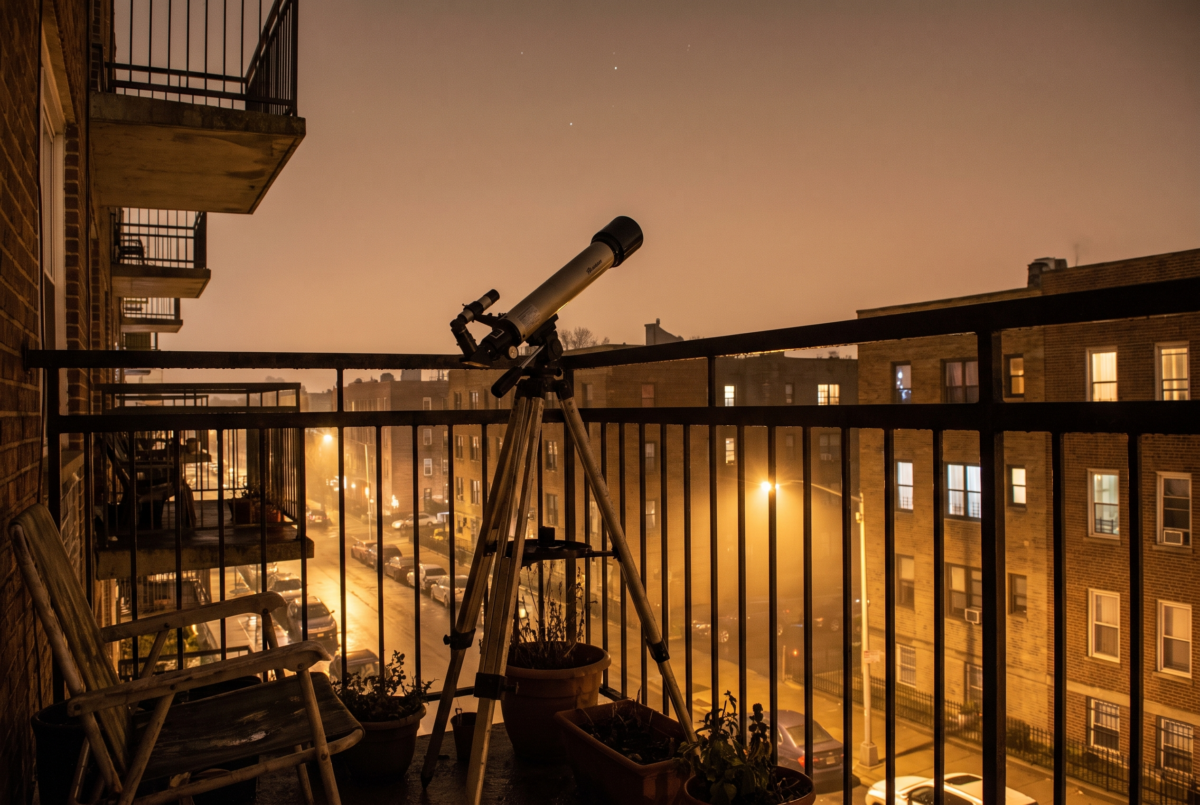
Planets are the one category of deep-sky-adjacent target that does not care about light pollution. They are bright enough that a city sky costs you almost nothing — the limiting factor downtown is the same as it is in the country: seeing, and how high the planet sits.
This is why planetary observing is the right entry point for anyone stargazing from a balcony, a driveway, or an apartment courtyard. If that is your situation, it is worth reading our apartment and balcony astronomy guide alongside this one, and our explanation of the Bortle scale for the targets that do care about your sky.
Frequently asked questions
What magnification do I need to see Saturn’s rings?
About 25 to 30x is enough to see the rings as rings rather than a bulge on either side of the planet. To see the Cassini Division — the dark gap within the rings — plan on 100 to 150x and a night of reasonable seeing. Going much beyond 200x rarely helps unless conditions are exceptional.
Can you see Jupiter’s Great Red Spot with a beginner telescope?
Sometimes, but it is not guaranteed. Experienced observers generally put the honest working minimum at about a 5-inch aperture, though some report it in smaller scopes under excellent seeing. The bigger obstacle is timing: the spot is only turned toward Earth for part of Jupiter’s ten-hour rotation, so you need to catch it on the right side of the planet.
Why do planets look so small in my telescope?
Because they genuinely are small in angular terms. Jupiter spans about 40 arcseconds at a typical opposition, and the full Moon spans about 1,800. At 100x, Jupiter appears roughly the size the Moon does to your unaided eye. That is normal and correct — the detail, colour and moons are the payoff, not the image size.
Which planet should I look at first?
Jupiter. It is bright, it is easy to find, it shows its cloud belts in even the smallest telescope, and its four moons are visible immediately and visibly move from night to night. Saturn is the more dramatic single view, but Jupiter gives a beginner more to come back to.
Can I see the planets from a city?
Yes. Planets are bright enough that light pollution barely affects them, which makes them the best targets for urban and suburban observers. What matters far more is atmospheric steadiness and observing when the planet is well above the horizon and not over a heat-radiating roof.
Why does the planet look like it is boiling or shimmering?
That is atmospheric seeing — turbulence in the air between you and space. It is usually worst near the horizon, over rooftops and pavement, and early in the evening before the ground has cooled. Wait for the planet to climb higher, let your telescope reach outdoor temperature, and watch for the brief calm moments when the image snaps into focus.
What to do next
Three things carry most of the result. Let the telescope cool before you expect sharpness. Judge the night before you judge the telescope — if the stars are twinkling hard, no instrument will save the view. And set your expectations against arcseconds rather than spacecraft photographs, because a sharp 40-arcsecond Jupiter with four moons strung out beside it is one of the genuinely great sights in amateur astronomy.
From here, the deeper guides at Telescope School go planet by planet: Jupiter and its moons, the 2026 viewing calendar, and choosing a telescope for planetary work. Start with whatever you own, on the next clear night, and go find Saturn while it is at its best.
I split the Cassini Division with a 130mm scope and a 9mm Plossl. The planets are where modest equipment still delivers something unforgettable.
These May Help Too...
Can You Use a Telescope Through a Window? (And Why You Should Not)
Using a telescope through a window ruins the view: bad glass, heat currents and reflections. Here is what actually happens, and what to do instead.
Telescope will not come to focus? The cause is almost always spacing, not optics. Work out whether you ran out racking in or out, then fix that end.