

Quick answer
For most planetary observing, 150x to 200x is the useful working range, and about 250x is the realistic ceiling on a good night regardless of telescope size. Magnification equals the telescope’s focal length divided by the eyepiece’s focal length. Your telescope sets one limit — roughly 50x per inch of aperture — but the atmosphere usually sets a lower one first.
Magnification is the most misunderstood number in amateur astronomy, and the one most aggressively abused in marketing. A telescope box promising 600x is not describing a capability; it is describing a mistake you can make with the eyepieces in the box.
This guide covers how magnification actually works, the two separate ceilings that limit it, what power each planet genuinely wants, and how to build a small eyepiece set that covers everything without waste.
Last Updated: September 2026 | Will Montgomery holds a B.S. in Engineering from Penn State and came back to amateur astronomy at 50, observing from suburban York, PA (Bortle 5-6).
How magnification is calculated
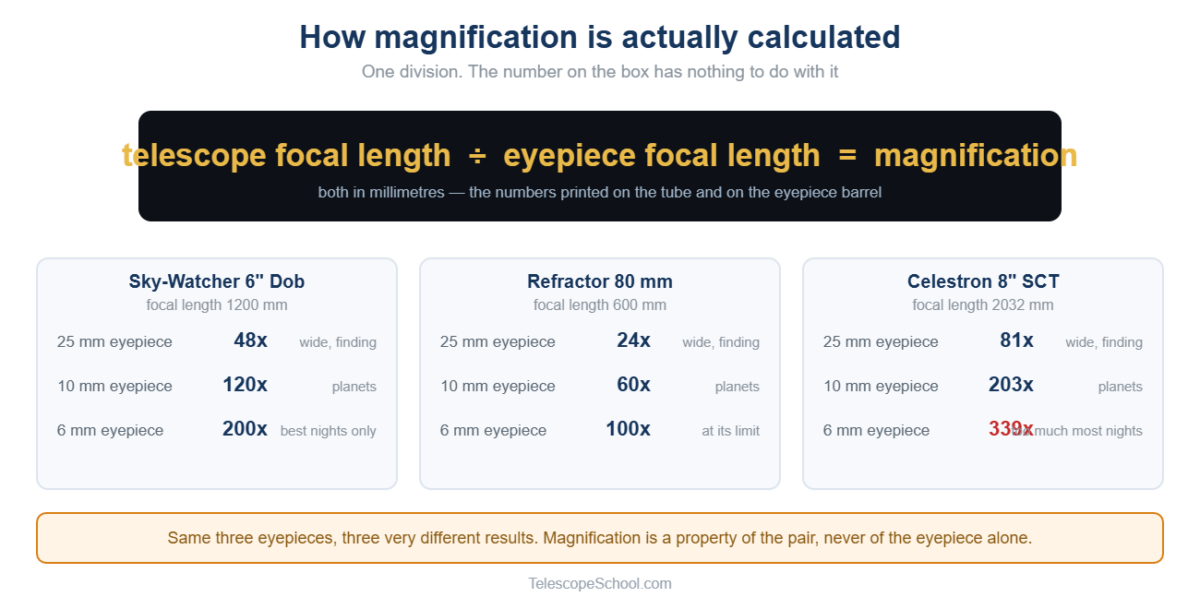
Magnification = telescope focal length ÷ eyepiece focal length. Both in millimetres.
A telescope with a 1,500mm focal length and a 15mm eyepiece gives 1,500 ÷ 15 = 100x. Swap to a 10mm eyepiece and you get 150x. Swap to a 25mm and you drop to 60x.
This is why magnification is not a property of a telescope. It is a property of the pairing. Any telescope can be made to produce any magnification — the question is whether the result is worth looking at.
A Barlow lens multiplies the telescope’s effective focal length, usually by 2x or 3x. A 9mm eyepiece behind a 3x Barlow behaves like a 3mm eyepiece. This is a cheap way to double your eyepiece set, and a good Barlow costs less than a good short-focal-length eyepiece.
What you are actually magnifying
Before choosing a power, it helps to know the size of the thing you are enlarging. Planets are measured in arcseconds; there are 3,600 in a degree, and the full Moon spans about 1,800 arcseconds.
| Planet | Apparent diameter | Magnification to match the naked-eye Moon |
|---|---|---|
| Jupiter | 29.8″ – 50.1″ | ~36x to 60x |
| Venus | 9.6″ – 66″ | ~27x to 190x |
| Saturn (globe) | 14.9″ – 20.8″ | ~86x to 120x |
| Mars | 3.5″ – 25.1″ | ~72x to 510x |
| Mercury | 4.5″ – 13.0″ | ~138x to 400x |
| Uranus | 3.3″ – 4.1″ | ~440x to 545x |
| Neptune | 2.2″ – 2.4″ | ~750x to 820x |
That last column explains a great deal. At 150x, Jupiter looks about four times the width of the naked-eye Moon — genuinely large. At the same 150x, Neptune is still five times smaller than the naked-eye Moon. Neptune is not disappointing because your telescope is weak. It is disappointing because it is 2.3 arcseconds wide, and no eyepiece changes that.
The two ceilings
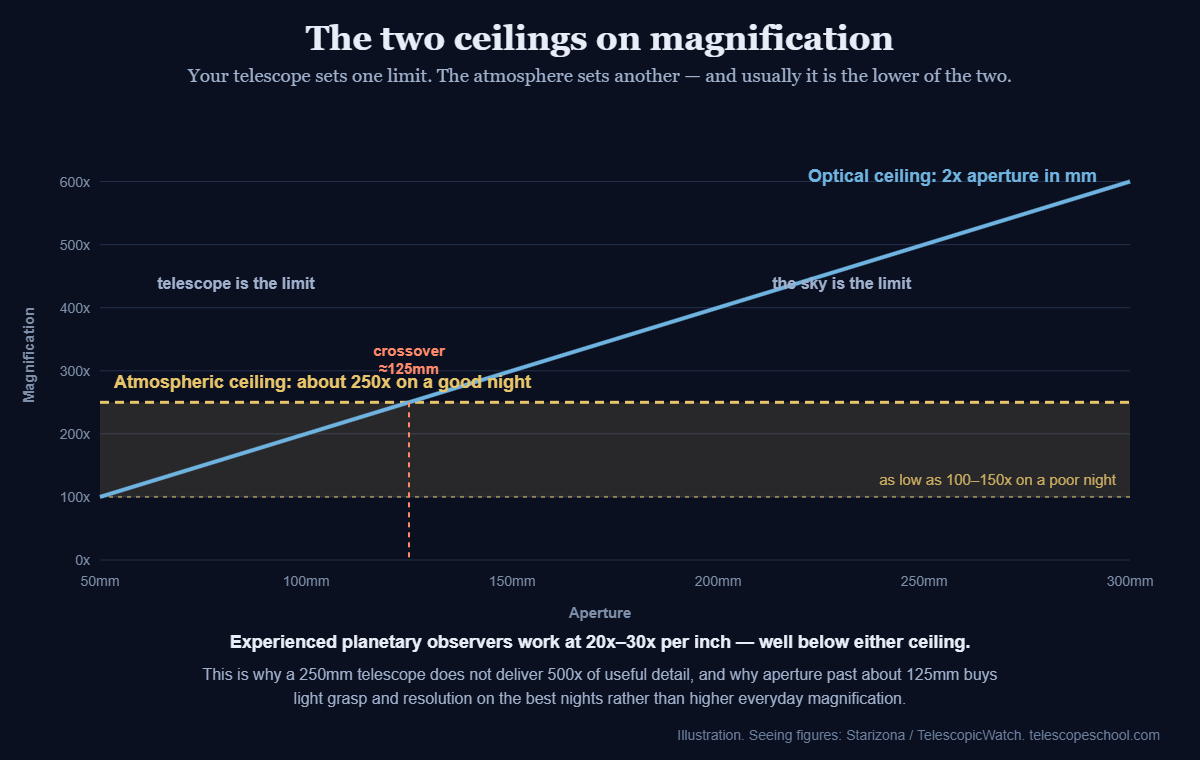
There are two separate limits on useful magnification, and beginners are usually taught only the first one.
Ceiling one: the optical limit
Your aperture determines how much detail the telescope can resolve. The standard rule of thumb is about 50x per inch of aperture, or 2x the aperture in millimetres.
| Aperture | Theoretical max (50x/inch) | Dawes limit (resolution) |
|---|---|---|
| 60mm (2.4″) | ~120x | ~1.9″ |
| 100mm (4″) | ~200x | ~1.14″ |
| 150mm (6″) | ~300x | ~0.76″ |
| 200mm (8″) | ~400x | ~0.57″ |
| 250mm (10″) | ~500x | ~0.46″ |
The Dawes limit — 4.56 ÷ aperture in inches, giving the result in arcseconds — is the empirical measure of the finest detail an aperture can separate. It comes from William Dawes’ 1867 double-star measurements and closely matches the theoretical diffraction limit. The related Rayleigh criterion, 5.5 ÷ aperture in inches, is slightly more conservative. Once magnification is high enough to show the diffraction pattern clearly, further magnification is “empty” — bigger, but carrying no new information.
Ceiling two: the atmosphere
This is the one that governs most nights. A realistic upper limit on an average night is about 250x no matter how large the telescope, and on a poor night you may not exceed 100 to 150x.
The reason is that you are looking through several miles of moving air. Above roughly 100mm of aperture, the atmosphere is typically the limiting factor rather than the telescope. A larger mirror gathers more of the distorted wavefront, so it does not automatically deliver proportionally more planetary detail.
The crossover matters. Below about 100–125mm, your telescope is the limit and buying more aperture genuinely buys more detail. Above that, the sky is the limit, and what buys you detail is a steady night, a cooled telescope, and patience for the calm moments.
Worth knowing: experienced planetary observers typically work at 20x to 30x per inch, not 50x. The 50x figure is a ceiling almost nobody actually reaches, not a target.
Exit pupil: the number that tells you when to stop
Exit pupil is the width of the beam of light leaving the eyepiece and entering your eye. It is the most useful diagnostic most beginners have never heard of.
Exit pupil = aperture ÷ magnification. Or equivalently, eyepiece focal length ÷ focal ratio. A 35mm eyepiece in an f/5 telescope gives a 7mm exit pupil.
| Exit pupil | What it means for planets |
|---|---|
| 2mm+ | Low power. Good for finding, too low for planetary detail |
| 1.0–2.0mm | Comfortable, bright, safe on mediocre nights |
| 0.5–1.0mm | The planetary sweet spot on a decent night |
| Below 0.5mm | Image dims noticeably; shake, turbulence and floaters become obvious |
Note that 50x per inch corresponds exactly to a 0.5mm exit pupil — which is why that rule marks a ceiling rather than a recommendation. Note also that doubling magnification makes the image four times dimmer, which matters less on Jupiter than it does on Uranus.
The “floaters” problem is real and under-discussed: at very small exit pupils, the debris drifting inside your own eyeball becomes visible as dark squiggles crossing the planet. If you start seeing them, you have gone past useful magnification for your eyes.
Magnification planet by planet
These ranges are observer consensus rather than measured thresholds — no primary source establishes them — but they are consistent across experienced sources.
| Planet | Useful range | Notes |
|---|---|---|
| Jupiter | 100–200x | Belts show from 25–50x. The Great Red Spot wants 100x or more. Beyond ~250x the low-contrast detail washes out |
| Saturn | 100–200x | Rings resolve at 25–30x; clean separation 80–100x; Cassini Division 100–150x; the Encke gap needs 200x+ and an 8-inch |
| Mars | 150–250x | Polar cap at 50x near opposition. Surface markings need real power. Near-worthless outside the opposition window |
| Venus | 30–100x | Phases show at 30–50x. There is no surface detail to chase, so high power adds nothing but glare |
| Mercury | 100–200x | Phase only. Always low in turbulent air, so the atmosphere usually decides for you |
| Uranus | 150–200x | A blue-green disc rather than a star. No surface detail in amateur scopes |
| Neptune | 150–250x | Enough to confirm a disc rather than a point. That is the whole prize |
The pattern worth noticing: the brightest, largest planets want less magnification than the small faint ones, but reward it with far more detail. Jupiter at 150x is a study in cloud structure. Neptune at 250x is a slightly larger dot.
Why “600x” on the box is meaningless
Take the classic department-store 60mm refractor advertised at 600x, and do the arithmetic.
A 60mm aperture has a Dawes limit of about 1.9 arcseconds — that is the finest detail it can resolve, ever, under perfect conditions. Its optical ceiling by the 50x-per-inch rule is about 120x. At 600x, the exit pupil is 60 ÷ 600 = 0.1mm, roughly a tenth of the usable minimum.
So 600x delivers five times the telescope’s own ceiling, on an aperture that cannot resolve anything finer than 1.9 arcseconds regardless. The image is dim, mushy, shaking on a light tripod, and drifting out of a pinhole field of view within seconds. Al Nagler — who has designed eyepieces for decades — called this class of telescope a malicious turn-off to budding amateur astronomers, and he is right. Any telescope marketed primarily on magnification should be treated as a warning label.
The useful version of that same 60mm telescope works at 40x to 100x, and at those powers it will genuinely show Saturn’s rings and Jupiter’s moons.
The three eyepieces that cover everything
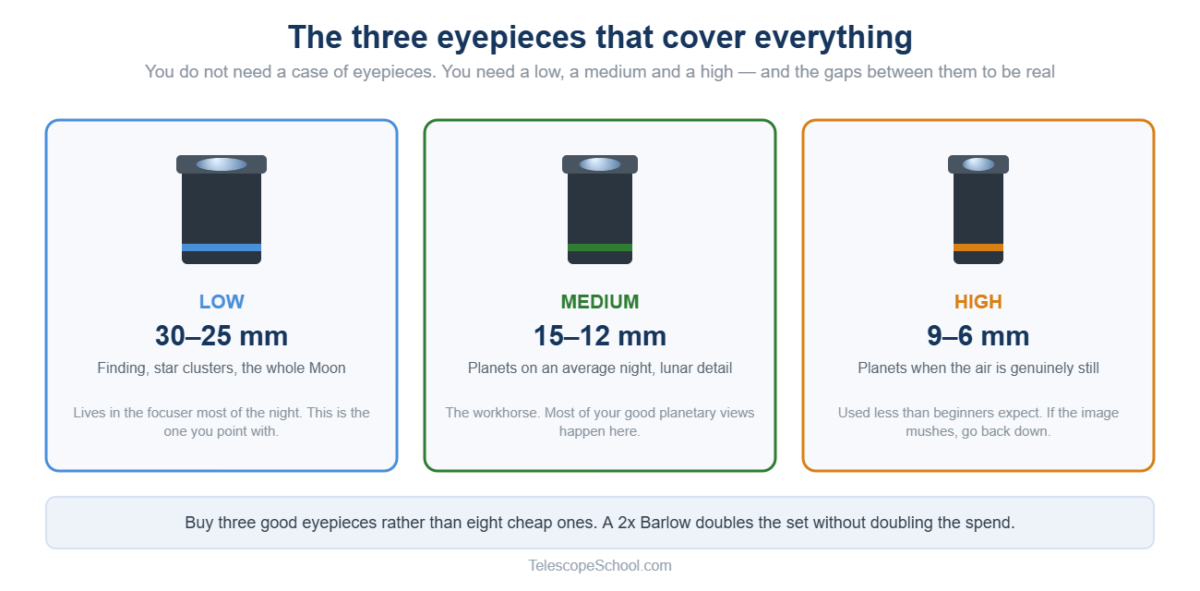
You do not need a large eyepiece collection. Three powers, chosen against your telescope’s focal length, cover essentially all planetary work:
- A low power (~40–60x) for finding targets and centring them. Usually a 25–32mm eyepiece.
- A medium power (~100–150x) — your default planetary eyepiece, the one you will use most nights.
- A high power (~200–250x) for the nights when seeing allows it. A 2x Barlow behind the medium eyepiece often produces this more cheaply than a dedicated eyepiece.
Spend on the medium one. It is where you will spend most of your observing life. Our guide to beginner eyepieces and the fuller eyepiece guide cover focal lengths and what the numbers mean.
From experience: this is exactly why I write about maximum magnification. Knowing what your scope, your Barlow and your eyepieces can actually deliver stops you wasting a night pushing past it. Two hundred times is my rule of thumb.
Frequently asked questions
What is the maximum useful magnification for my telescope?
Roughly 50x per inch of aperture, or 2x the aperture in millimetres — so about 200x for a 100mm telescope. But that is an optical ceiling, not a nightly target. Atmospheric conditions usually limit you to 150–250x on a good night and 100–150x on an average one, whatever the aperture.
What magnification do I need to see Saturn’s rings?
About 25 to 30x separates the rings from the globe. For the Cassini Division inside the rings, plan on 100 to 150x with steady seeing.
Does more magnification make the image brighter?
No — the opposite. Doubling magnification spreads the same light over four times the area, making the image four times dimmer. This matters little on Jupiter and Venus and a great deal on Uranus, Neptune and deep-sky objects.
Is a Barlow lens worth buying?
Usually yes. A good 2x Barlow effectively doubles your eyepiece collection for less than the price of one quality short-focal-length eyepiece. A poor Barlow degrades every eyepiece you own, so buy a decent one rather than the cheapest.
Why does my planet get blurrier when I increase magnification?
You have passed a ceiling — either your telescope’s or the atmosphere’s. If the image gets bigger and softer with no new detail, that is empty magnification. Drop back one eyepiece. On nights of poor seeing this can happen as low as 100x.
Can I use 300x or more?
Occasionally, if you have at least 6 inches of aperture and a genuinely steady night. Experienced observers do use 300x to 400x on Mars and double stars when conditions allow. It is not a normal working magnification, and on most nights it will show you less than 200x does.
The short version
Divide your telescope’s focal length by the eyepiece to get magnification. Treat 50x per inch as a ceiling you will rarely reach, and 150–200x as the range where most planetary detail actually lives. Watch the exit pupil, and let the image quality decide, not the number. When more power stops adding detail, you have found your limit for that night — and it will be different next week.
For the wider picture, see our complete guide to viewing planets and the deeper explanation of the 50x rule.
Two hundred times is my own rule of thumb before an image starts falling apart. Knowing your ceiling saves more nights than any eyepiece purchase.
These May Help Too...
Can You Use a Telescope Through a Window? (And Why You Should Not)
Using a telescope through a window ruins the view: bad glass, heat currents and reflections. Here is what actually happens, and what to do instead.
Telescope will not come to focus? The cause is almost always spacing, not optics. Work out whether you ran out racking in or out, then fix that end.