

Quick answer
Under $500 you can absolutely photograph the Moon and planets, and you can photograph deep-sky objects with either a smart telescope or a star tracker plus a camera lens you already own. What you cannot buy new under $500 in September 2026 is a complete telescope-plus-tracking-mount-plus-camera deep-sky rig. Anyone selling you that idea is either quoting old prices or recommending a product that is no longer made.
That last problem is worse than it sounds. At the time of writing, three of the highest-ranking “best astrophotography telescope under $500” articles still recommend the ZWO Seestar S50 — two of them as their number one pick. The Seestar S50 has been discontinued. Several others still recommend Orion telescopes; Orion’s parent company ceased operations in July 2024.
So this guide starts with what is actually buyable right now, states plainly what each route can and cannot do, and then makes recommendations. Prices below were checked on 1 September 2026 and will drift — verify before you buy.
Last Updated: September 2026 | Will Montgomery holds a B.S. in Engineering from Penn State and came back to amateur astronomy at 50, observing from suburban York, PA (Bortle 5-6).
First, what is no longer available
This matters more than any recommendation, because the stale advice is everywhere.
| Product | Status as of September 2026 | What to look at instead |
|---|---|---|
| ZWO Seestar S50 | Discontinued. Retailer pages carry the notice; only open-box and used units remain | Seestar S50 Pro ($999, above budget) or the DWARF mini |
| ZWO Seestar S30 (non-Pro) | Sold out at every major US retailer, no ETA, back orders not accepted | Seestar S30 Pro ($699, above budget) or the DWARF mini |
| Orion telescopes (entire brand) | Defunct. Parent company closed July 2024. Remaining stock carries no warranty | Sky-Watcher or Apertura equivalents |
| Sky-Watcher Star Adventurer Mini | No longer available | Star Adventurer 2i or an iOptron tracker |
| Vixen Polarie / Polarie U | Delisted at major retailers | iOptron SkyTracker Pro, Move Shoot Move NOMAD |
The short version: the smart telescope market moved upmarket in 2026. The two products that made “deep-sky astrophotography for $400–500” a genuine claim — the Seestar S50 and S30 — have both been replaced by Pro versions costing $699 and $999. That reshapes this entire category, and most published advice has not caught up.
“Astrophotography” means three different things
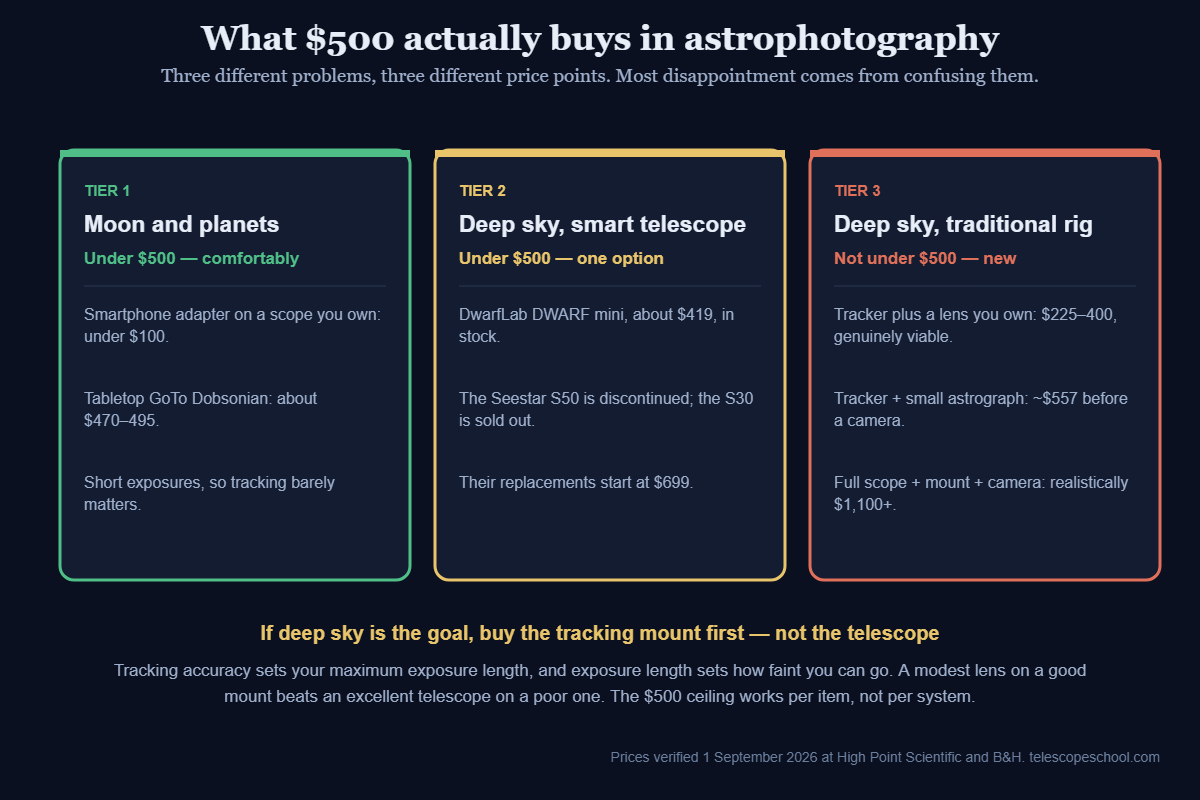
Almost every disappointment in this hobby traces back to this one confusion. These are three separate problems with three separate price points.
Tier 1: Lunar and planetary imaging
Short exposures — thousandths of a second — of bright objects. Tracking barely matters because you are shooting video and stacking the sharpest frames. Completely solvable under $500, and even under $100 if you already own a telescope.
Tier 2: Deep-sky with a smart telescope
Galaxies and nebulae, handled by a sealed all-in-one device that finds the target, tracks it, stacks the exposures and hands you a finished image. Solvable under $500, with real aperture limits.
Tier 3: Traditional deep-sky imaging
A telescope on an equatorial mount with a dedicated camera. This is what produces the images you have seen on Instagram. Not solvable new under $500 — not close. The honest entry point is around $1,100 to $1,500 once you count everything, and the correct first purchase is the mount, not the telescope.
The rest of this guide is organised by those tiers, because the right answer depends entirely on which one you actually want.
Tier 1: The Moon and planets under $500
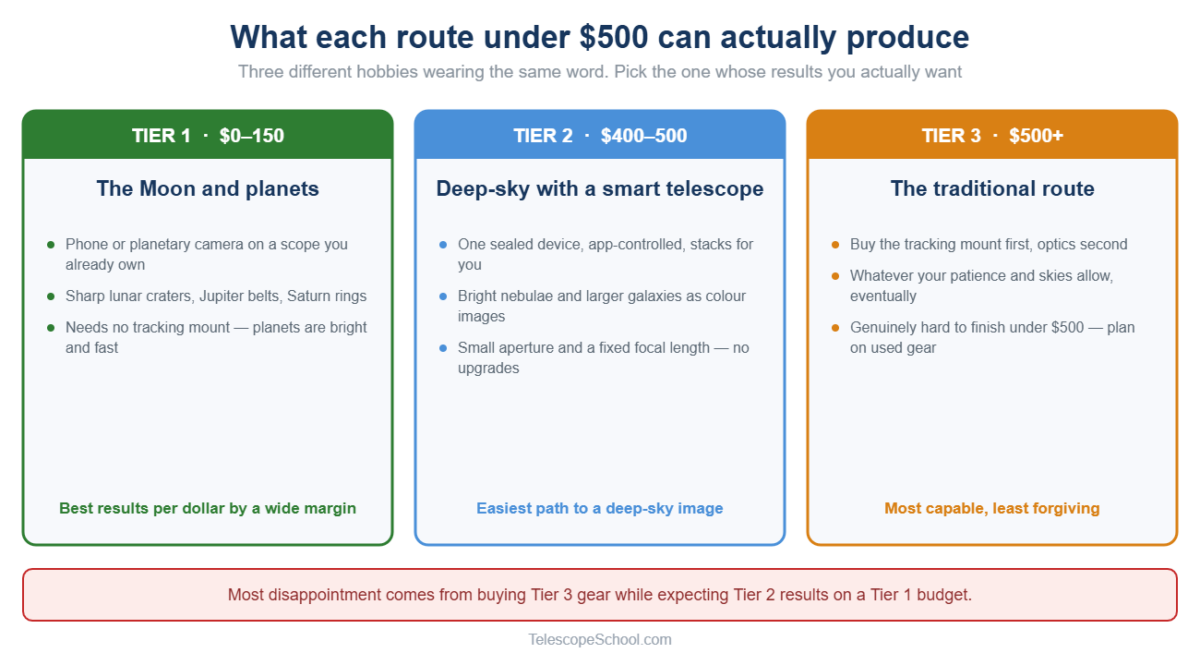
This is where the budget genuinely goes furthest, and it is the tier most beginners underrate. The Moon through a modest telescope, properly stacked, produces images that look extraordinary — and the technique transfers directly to Jupiter and Saturn.
If you already own a telescope, spend under $100. A smartphone adapter clamps your phone over the eyepiece. That is the whole purchase. A Celestron NexYZ 3-axis adapter is the well-regarded option at around $40 to $65 depending on the day, and simpler brackets start under $20. Our guides to photographing the Moon and smartphone astrophotography cover the technique in detail.
If you need the telescope too, a tabletop GoTo Dobsonian is the strongest value in this tier. The Sky-Watcher Virtuoso GTi 150P runs about $469 and the 130P version about $495, both with app-driven GoTo. They are superb visual instruments and perfectly capable lunar and planetary imagers with a phone or a planetary camera.
Be clear about what they are not. These are alt-azimuth mounts. Field rotation limits usable exposures to a few seconds, and the focuser often will not reach focus with a DSLR without modification. They are not deep-sky cameras, and any article that lists them as “best telescope for astrophotography” without that caveat is misleading you.
Tier 2: Deep-sky with a smart telescope under $500
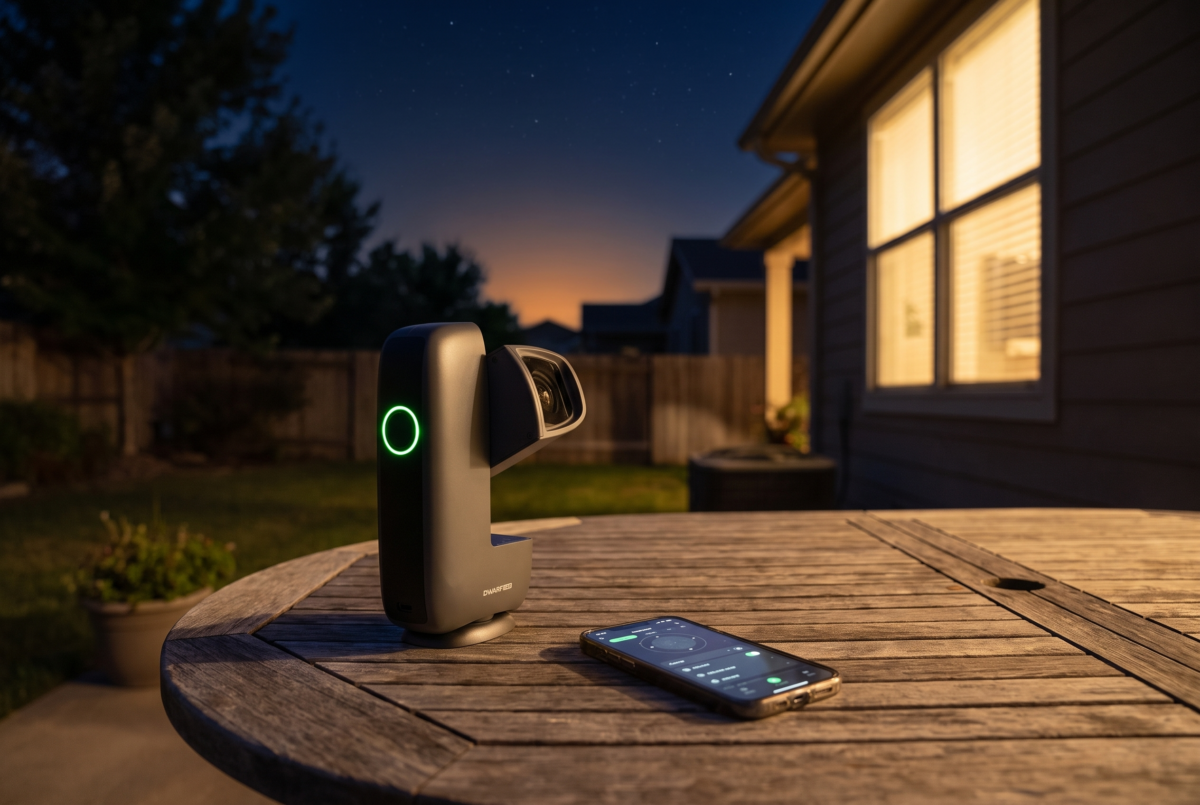
As of September 2026 there is exactly one motorized, GoTo smart telescope you can actually buy new under $500: the DwarfLab DWARF mini, at around $419 and in stock.
That is not a hedge — it is the state of the market. The Seestar S50 is discontinued, the S30 is sold out everywhere, and their replacements start at $699.
What the DWARF mini does well: it finds targets itself, tracks them, stacks exposures automatically, and delivers a processed image to your phone with nothing else to buy. No tripod, no camera, no adapters, no polar alignment. For a beginner who wants to see a nebula appear on a screen from a suburban backyard, that is a genuine result for $419.
The hard limit is aperture. At 30mm, it gathers a fraction of the light of the discontinued 50mm S50. It performs best on large, bright targets — the Orion Nebula, the Andromeda Galaxy, big emission nebulae — and it will not deliver on small faint galaxies. Judge it against a camera lens, not against a telescope.
There is also the Vaonis Hestia at around $300 (the Amazon Essential pack is quoting a six-to-seven-month ship date; B&H has the Standard pack on the shelf), which is worth understanding rather than dismissing. It is a passive optic — your phone does all the work, and there are no motors and no GoTo. It is a clever device for the Moon and the Sun with a proper filter, but it does not belong in the same category as a motorized smart telescope, and some roundups list it as though it does.
If you can stretch: the Seestar S30 Pro at about $699 and the DWARF 3 at about $549 are the next steps up, and the aperture difference is real. If deep-sky imaging is the actual goal, saving another few months is a better decision than buying at the ceiling.
Tier 3: The traditional route — buy the mount first
If you want the long-exposure deep-sky images that got you interested, here is the honest arithmetic. A tracking mount is not an accessory to a telescope; it is the foundation, and it is where the money should go first.
| Build | Cost | What is still missing |
|---|---|---|
| Star tracker + camera lens you already own | ~$225–$400 | Sturdy tripod, ball head — genuinely viable |
| Tracker + small astrograph (e.g. 30mm f/4.5) | ~$557 | Camera, tripod, ball head, T-adapters — realistically $700–900 all-in with a DSLR you own |
| Tracker + 60mm ED doublet + field flattener | ~$959 | Camera, tripod, power, dew control — $1,100+ all-in |
So the $500 ceiling works per item, not per system. Which points at the actual best advice in this tier: buy the tracker, and shoot with a lens you already own.
The iOptron SkyGuider Pro at about $359 is the strongest true sub-$500 deep-sky tracker currently in stock, with an 11-pound payload and an ST-4 guide port that leaves room to grow. The iOptron SkyTracker Pro at around $225 and the Move Shoot Move NOMAD at around $209 are lighter, cheaper and excellent with lenses up to roughly 135–200mm. The Sky-Watcher Star Adventurer 2i Photo Package at about $395 is the well-known alternative, right-ascension only, realistically good for 60 to 120 second unguided exposures with a short lens.
Pair any of them with a 50mm or 135mm lens and you can photograph the Andromeda Galaxy, the North America Nebula and the Milky Way core properly. That is real deep-sky astrophotography, done under $500, using glass you probably already have.
If you would rather put the money into optics later, the Askar FMA135 at around $198 and the Apertura 60EDR at around $400, though it is out of stock at High Point — its only US seller — as of September 2026 are genuine flat-field astrographs rather than visual telescopes pressed into service — but remember the 60EDR’s field flattener is a separate purchase.
The used market: the one route nobody covers
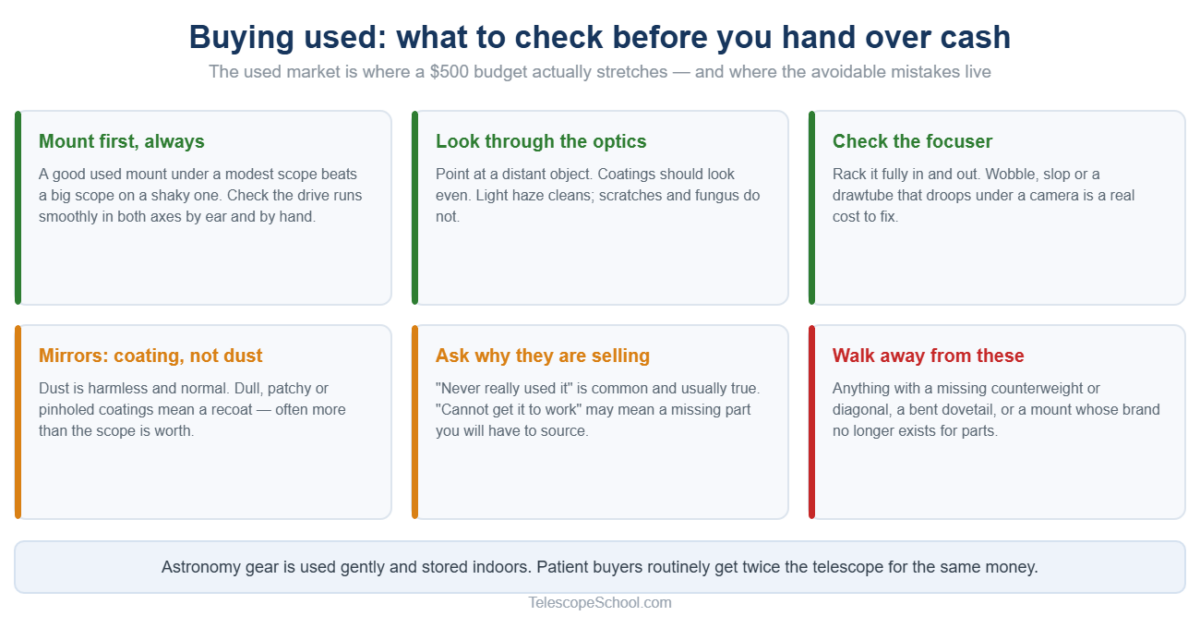
Every competing article mentions the used market in a sentence and then drops it, which is a shame, because it is the only way to assemble a conventional deep-sky rig for around $500.
A used EQ5-class or HEQ5 equatorial mount paired with a used 60–72mm ED doublet lands in that range on the astronomy classifieds, and it is a system you can grow into rather than out of.
What to check before buying used: run the mount’s motors through both axes and listen for grinding; check the worm gear for backlash; confirm the polar scope is present and its illuminator works; inspect optics for fungus between elements, not just dust; and confirm the tripod and counterweights are included, because replacing them separately erases the saving. Buy from established astronomy forums rather than general marketplaces — the seller pool knows what it owns.
From experience: I will buy used when there is nothing mechanical involved — a camera, filters, that kind of thing. A used motorised mount is the one to be careful with: check it is not too old, and that it runs without dragging or any inconsistency in the tracking.
The upgrade nobody mentions
If you observe from a suburban backyard, a light pollution filter will change your deep-sky results more than any telescope swap in this price range. A dual-narrowband filter isolates the two wavelengths most emission nebulae actually emit and rejects most of the skyglow between them.
Not one of the competing articles for this keyword mentions filters at all, which is a real gap — the sky you shoot from matters more than the aperture you shoot with. Our Bortle scale guide explains how to assess your own sky, and what to target from a bright one.
The picks, summarised
| Best for | Pick | Approx price | Honest limitation |
|---|---|---|---|
| You already own a telescope | Celestron NexYZ smartphone adapter | ~$67 | Moon and planets only |
| Easiest deep-sky result | DwarfLab DWARF mini | ~$419 | 30mm aperture — big bright targets only |
| Best long-term value | iOptron SkyGuider Pro | ~$359 | You supply the camera and lens |
| Lightest travel tracker | iOptron SkyTracker Pro | ~$225 | Short lenses only |
| Visual first, imaging second | Sky-Watcher Virtuoso GTi 150P | ~$469 | Alt-az — not a deep-sky imager |
| Best optics to grow into | Apertura 60EDR | ~$400 | Flattener extra; needs a mount |
If you want one recommendation rather than six: buy the iOptron SkyGuider Pro and use a lens you already own. It produces genuine deep-sky images tonight, it is the only purchase here that stays useful when you upgrade everything else, and it costs less than the smart telescopes that will be obsolete in two years.
Frequently asked questions
Is the ZWO Seestar S50 still available in 2026?
No. The Seestar S50 has been discontinued and retailer pages now carry that notice; only open-box and used units remain in circulation. It was replaced by the Seestar S50 Pro, announced in August 2026 at $999 list — well above a $500 budget. The smaller Seestar S30 is also sold out at major US retailers, with the S30 Pro replacing it at about $699.
Can you really do astrophotography for under $500?
Yes, with a clear caveat. Lunar and planetary imaging is fully achievable under $500, and often under $100 if you already own a telescope. Deep-sky imaging is achievable with either a smart telescope or a star tracker plus a camera lens you already own. What is not achievable new under $500 is a complete telescope, equatorial mount and camera system — that realistically starts around $1,100.
Should I buy the telescope or the mount first?
The mount, without question, if deep-sky imaging is the goal. A modest lens on a good tracking mount produces far better images than an excellent telescope on an inadequate one. Tracking accuracy sets your maximum exposure length, and exposure length sets how faint you can go.
Can you do deep-sky astrophotography without a tracking mount?
Only in a limited way. Without tracking, Earth’s rotation trails the stars within seconds at any meaningful focal length. You can stack many very short exposures to partly compensate, but the results fall well short of even an inexpensive tracker. Tracking is the single feature that separates snapshots from astrophotographs.
Is a Dobsonian good for astrophotography?
For the Moon and planets, yes — a Dobsonian’s aperture is an advantage for short-exposure video work. For deep-sky, no. Alt-azimuth mounts introduce field rotation that limits exposures to a few seconds, and many Dobsonian focusers cannot reach focus with a DSLR without modification. A Dobsonian is a superb visual telescope that happens to be able to image the Moon.
What is the cheapest way to photograph the Moon?
A smartphone bracket on a telescope you already own, for under $20. The Moon is bright enough that no tracking is needed and your phone’s automatic settings will get close. From there, the improvement comes from technique — shooting video and stacking the sharpest frames — rather than from spending more.
What to do next
Decide which of the three tiers you actually want before you spend anything, because the right purchase in one tier is the wrong purchase in another. If it is the Moon and planets, spend under $100 and put the rest toward eyepieces. If it is the easiest possible deep-sky result, the DWARF mini is currently the only sub-$500 option in stock. If it is real deep-sky imaging you intend to keep doing, buy the tracker first and shoot with a lens you own.
And whatever you read elsewhere on this topic, check the product is still made before you check the price. In September 2026 that single step rules out most of the recommendations currently ranking for this search.
From here: our guide to getting started in astrophotography covers technique, best smart telescopes covers the category above this budget, and best telescopes under $500 covers the visual side of the same price point.
I moved toward astrophotography because imagination cannot show up in an image. You do not need to spend much to find that out for yourself.
These May Help Too...
Can You Use a Telescope Through a Window? (And Why You Should Not)
Using a telescope through a window ruins the view: bad glass, heat currents and reflections. Here is what actually happens, and what to do instead.
Telescope will not come to focus? The cause is almost always spacing, not optics. Work out whether you ran out racking in or out, then fix that end.