

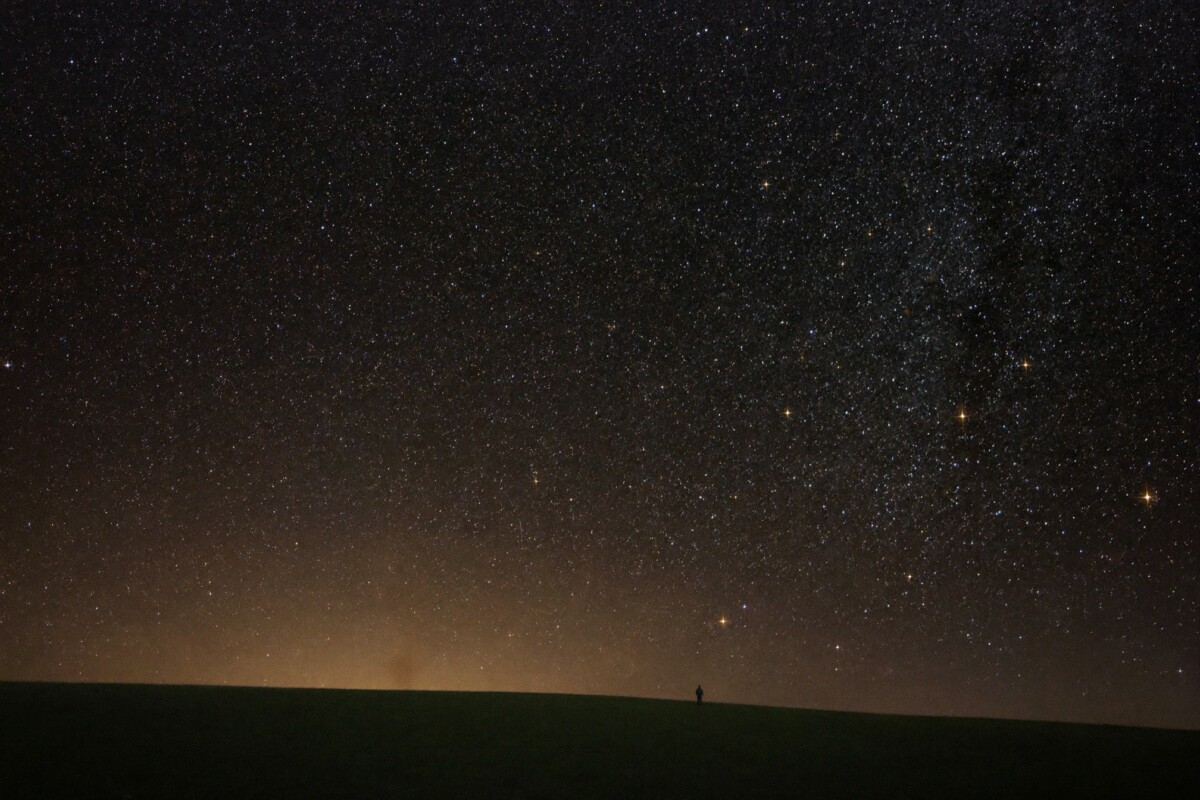
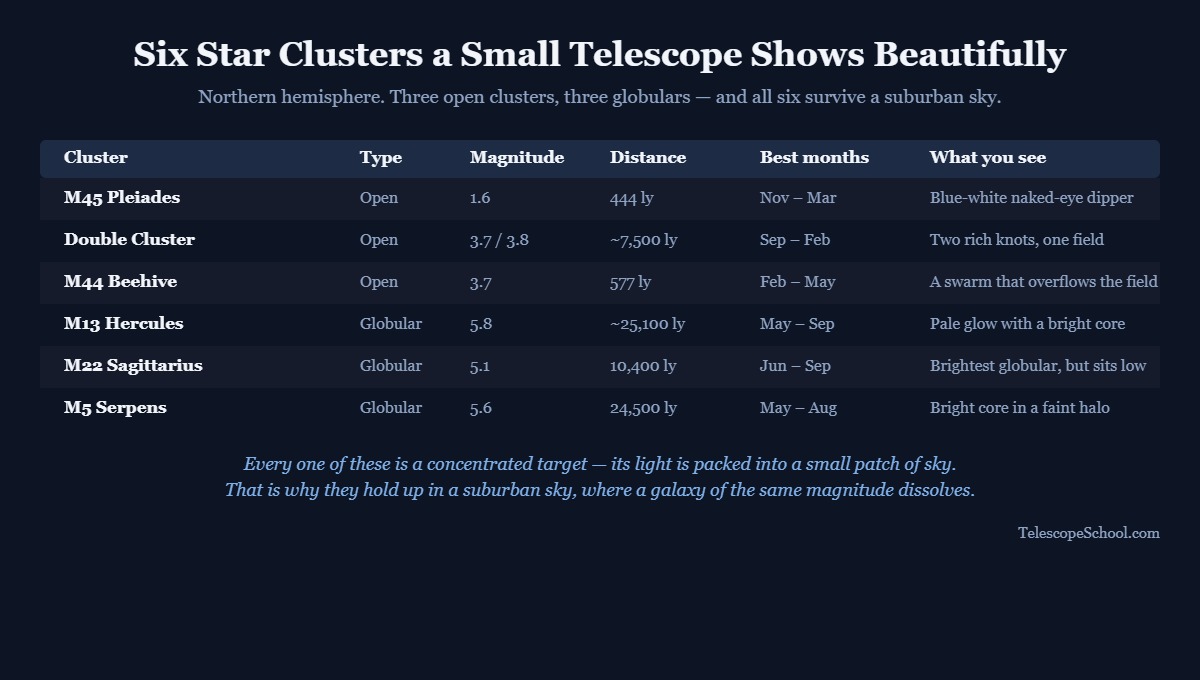
Quick answer: The best star clusters for a small telescope are M45 the Pleiades, the Double Cluster in Perseus, M44 the Beehive, M13 in Hercules, M22 in Sagittarius and M5 in Serpens. Clusters are the easiest deep-sky class for a beginner and the only one that survives suburban light pollution largely intact.
They are also the only deep-sky objects that look better through a telescope than they do in a photograph. Galaxies and nebulae are always going to lose that comparison — a camera collects light for hours and your eye cannot. But a cluster is made of stars, and stars are exactly what an eyepiece renders best: hard, clean points of light with real colour. A long exposure bloats them into blobs. Your eye does not. This guide from Telescope School covers which clusters to start with, how much magnification each type wants, and why these are the targets to fall back on when the sky is not cooperating.
Last Updated: September 2026 | Will Montgomery observes with an Astronomers Without Borders 130mm reflector and a 9mm Plössl, and writes Telescope School to give beginners the realistic version of what a telescope shows.
Open vs Globular Clusters — The One Difference That Matters
Open clusters are loose groups of a few dozen to a few hundred young stars, and you frame them at your lowest power. Globular clusters are dense spheres of hundreds of thousands of ancient stars, and they reward pushing the magnification up.
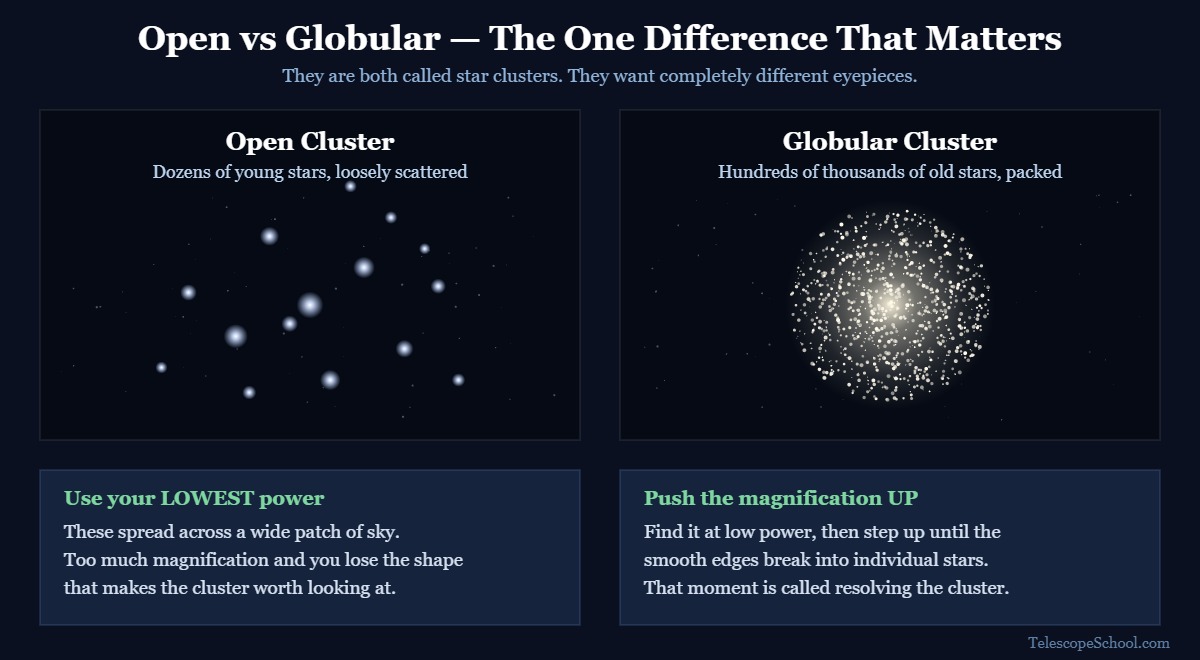
Open clusters sit in the disc of our galaxy, relatively nearby, and their members formed together from the same cloud of gas. They are young in astronomical terms and will eventually drift apart. Because they are close and spread out, they cover a lot of sky — which is why low power matters so much.
Globular clusters orbit out in the galactic halo, tens of thousands of light-years away, and contain some of the oldest stars known. They are so tightly packed that a small telescope at low power shows only a round, fuzzy glow that looks a bit like a comet. Increase the magnification and something happens that nothing else in the sky does: the smooth edges break apart into individual pinpoint stars. Observers call this resolving the cluster, and the first time it happens is one of the genuinely memorable moments in amateur astronomy.
The 6 Best Star Clusters for a Small Telescope
M45 — The Pleiades
At magnitude 1.6 and only 444 light-years away, the Pleiades is the brightest cluster in the sky and visible to the naked eye as a small misty dipper. Most people have seen it without knowing what it was.
The classic beginner mistake is pointing a telescope at it. M45 is too large for most telescopic fields — you end up looking at four or five stars and wondering where the cluster went. Use binoculars, or your widest-field eyepiece at the lowest power your scope allows. The colour is the reward: these are hot young stars and they are distinctly blue-white. Best November through March.
The Double Cluster — NGC 869 and NGC 884
Two rich open clusters, magnitudes 3.7 and 3.8, sitting roughly 7,460 and 7,640 light-years away in Perseus — close enough together that a low-power eyepiece frames both at once. This is the finest open-cluster sight in the northern sky for a small telescope, and it is badly underrated because it carries no Messier number.
Unlike M45, this one is sized well for a telescope. You get two dense knots of stars against a rich background field, with a few orange-tinted stars scattered through them for contrast. Best September through February.
M44 — The Beehive Cluster
Magnitude 3.7 at 577 light-years, in Cancer. Like the Pleiades, M44 is large and best at the widest field you can manage — binoculars are genuinely excellent on it. Under a dark sky it is visible to the naked eye as a faint patch, which is how it was known to ancient observers long before telescopes existed. Best February through May.
M13 — The Great Hercules Cluster
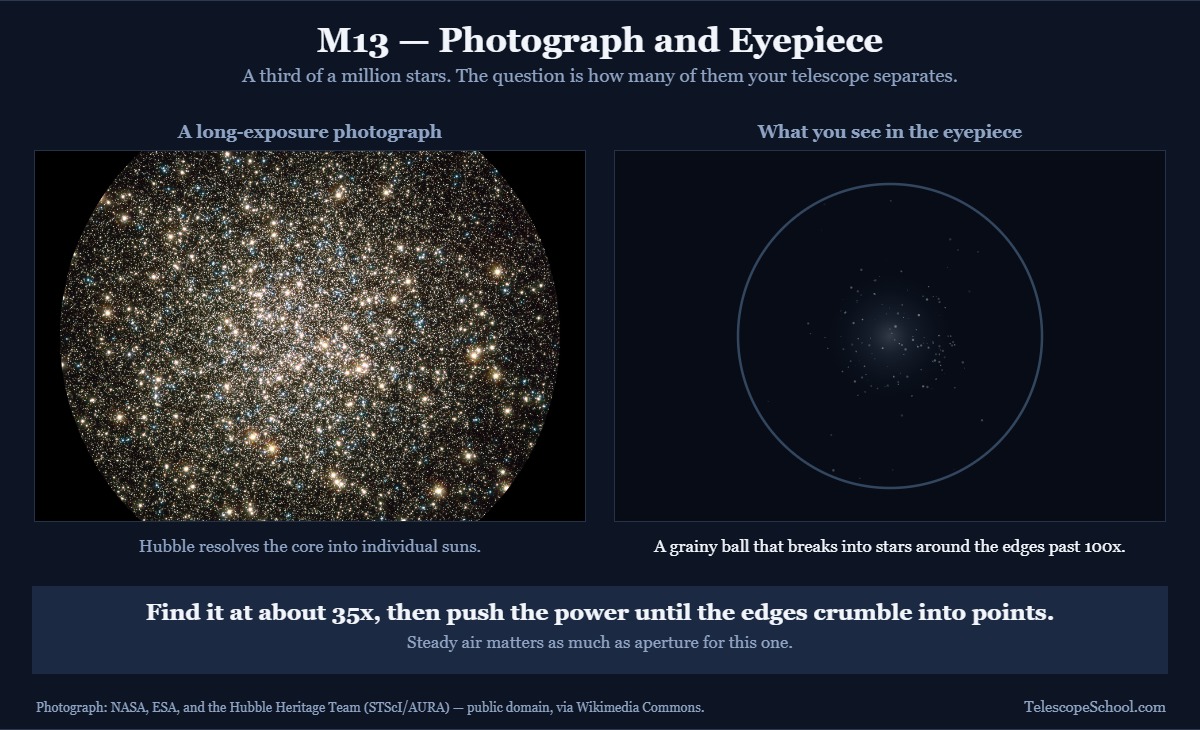
M13 is the globular most northern observers meet first: magnitude 5.8 at roughly 25,100 light-years. At around 35x it shows as a pale round glow with an obviously brighter core. Push past 100x in a 6-inch or 8-inch scope and the outer regions start to grain up into individual stars.
It is easy to find because it sits on one side of the Keystone, a distinctive four-star box in Hercules. Best May through September.
M22 — The Sagittarius Cluster
At magnitude 5.1 and only 10,400 light-years away, M22 is the brightest globular in the Messier catalogue — brighter than M13, and closer. It is also easier to resolve, because its stars are spread over a larger apparent area.
The catch is altitude. From mid-northern latitudes M22 never rises far above the southern horizon, so you are looking through thick, turbulent air and whatever light domes sit in that direction. Pick a night with a clean southern view and catch it near its highest point. Best June through September.
M5 — The Globular in Serpens
Magnitude 5.6 at 24,500 light-years, and a serious rival to M13 that far fewer beginners bother with. Even an 80mm telescope shows a bright glowing core wrapped in a fainter halo. Many experienced observers rate it above M13 for sheer visual quality. Best May through August.
Bonus: M11, the Wild Duck Cluster
Worth adding once you have the six above. M11 in Scutum is an open cluster, but it is so compact and so densely populated that at low power it looks almost like a globular. It is a good demonstration that the two categories sit at either end of a spectrum rather than in separate boxes. Best mid-summer into autumn.
How Much Magnification Each Type Wants
Use your lowest power on open clusters and step the power up on globulars. Getting this backwards is the most common reason a cluster night disappoints.
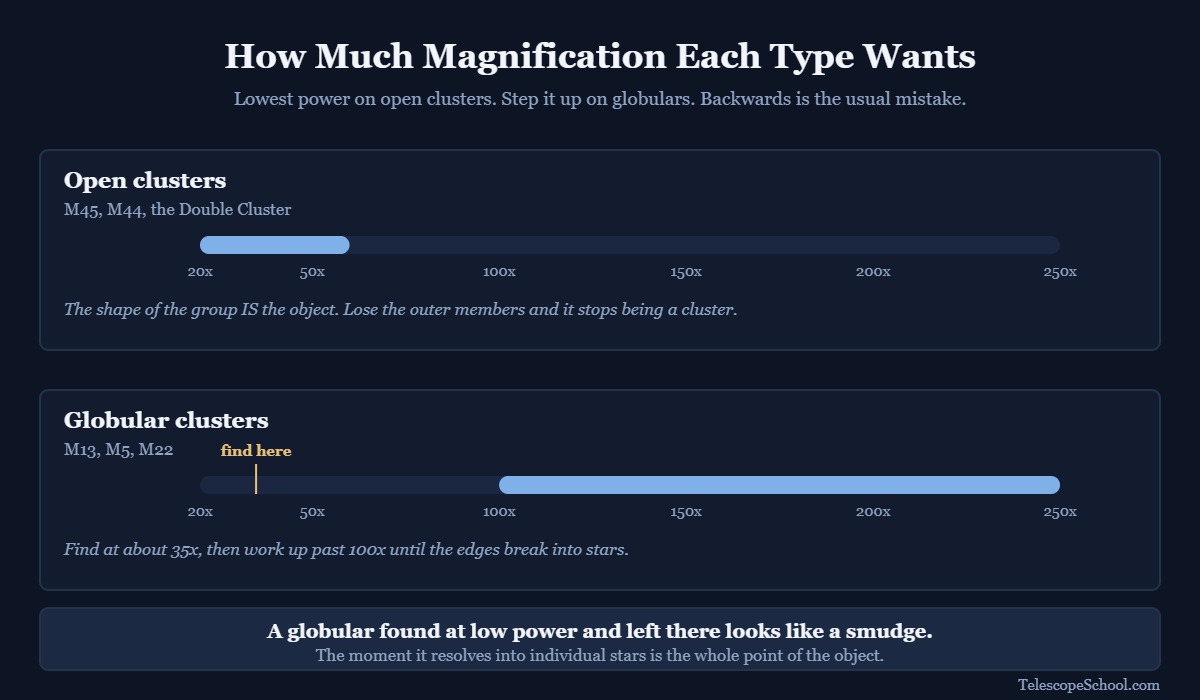
Open clusters need field of view, not magnification. The shape of the group is the object — lose the outer members off the edge of the field and you are just looking at scattered stars. A 25mm to 32mm eyepiece is usually right, and for the largest ones like M45 and M44, a pair of binoculars genuinely beats a telescope — a 10×50 like the Celestron UpClose G2 is the usual starting point, and B&H has a wider 10×50 range if you want glass that will outlast the hobby. Our guide to what you can see with binoculars covers that side of it. If you need a wide-field eyepiece, the Apertura 32 mm Plössl is the standard first upgrade for most beginner scopes, and B&H lists plenty of alternatives.
Globular clusters want the opposite. Find the cluster at low power, centre it, then work up through your eyepieces. Somewhere above 100x in a 6-inch or larger scope, a good globular stops being a smooth ball of light and starts showing texture at the edges. On a genuinely perfect night a 5-inch will do it too — a 130mm gets there, it just needs the sky to cooperate. Something like a 9 mm Plössl gets most beginner scopes into that range, and Amazon has other short eyepieces worth comparing. Keep increasing until the image gets soft, then come back one step. Steady air matters here as much as aperture — on a turbulent night a globular will refuse to resolve no matter what you do.
Working out what magnification your own eyepieces actually give is straightforward, and our complete guide to telescope eyepieces walks through the arithmetic.
Why Clusters Beat Galaxies and Nebulae in a Bad Sky
A cluster’s light is concentrated into individual stars, and light pollution cannot smear out a point of light the way it smears out a diffuse glow.
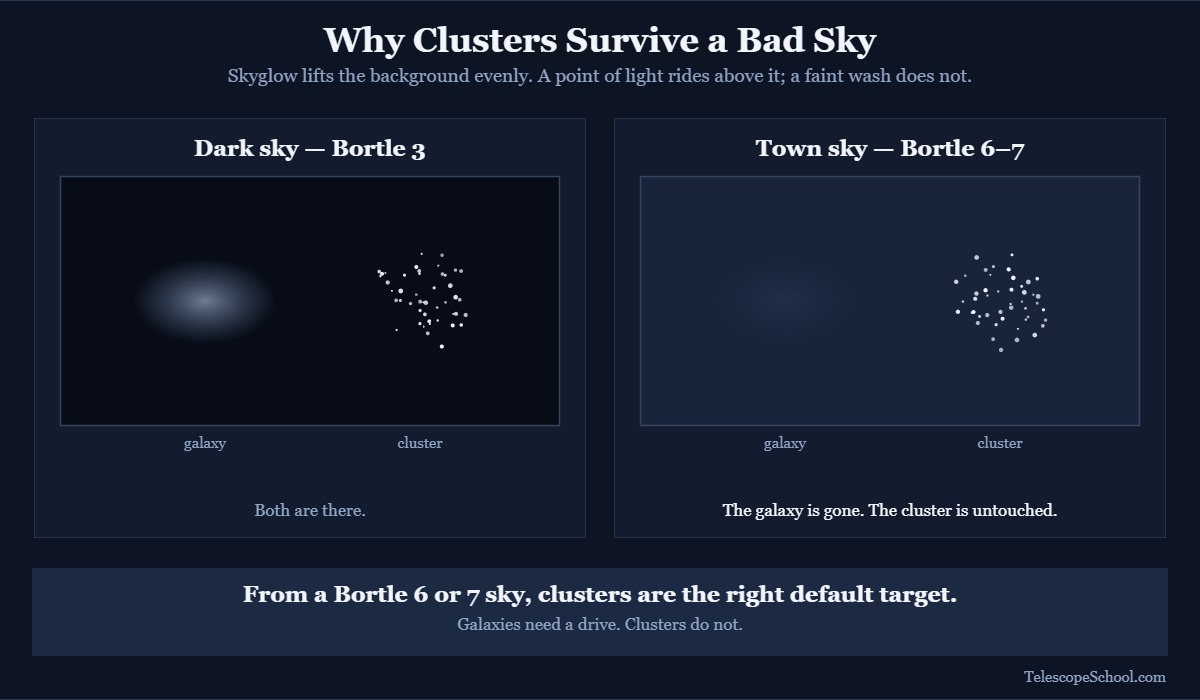
This is worth understanding because it changes how you plan a night. Skyglow raises the background brightness evenly across the whole sky. A galaxy or a large nebula is a faint wash spread over a wide area, and when the background rises to meet it, the contrast vanishes and the object simply disappears. A star is different. Its light arrives concentrated on a tiny patch of your retina, and it stays visible against a much brighter background.
The practical consequence: on a night when the Bortle scale puts your sky at class 6 or 7, galaxies are mostly off the menu and clusters are still excellent. That makes them the right default target for anyone observing from a town, an apartment balcony, or any of the situations covered in our guide to the best objects for light-polluted skies.
It also means clusters are what you should reach for when the Moon is up and the rest of the deep sky is out of reach.
A Cluster for Every Season
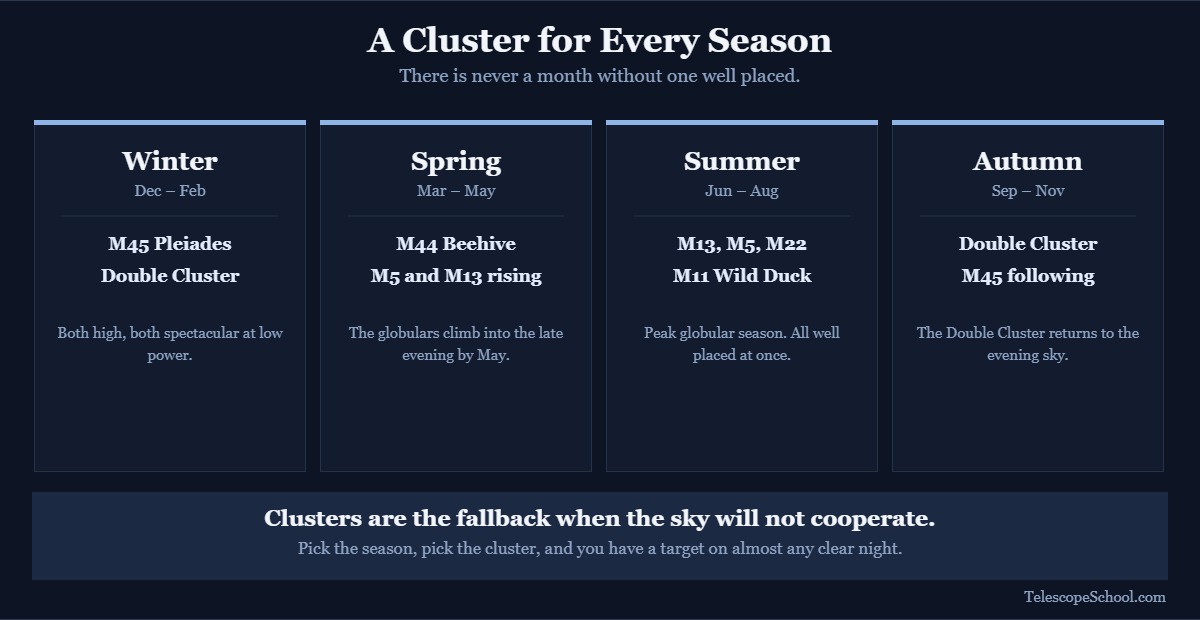
- Winter (Dec–Feb): M45 and the Double Cluster, both high and both spectacular at low power.
- Spring (Mar–May): M44 the Beehive, with M5 and M13 climbing into the late-evening sky by May.
- Summer (Jun–Aug): peak globular season. M13, M5 and M22 are all well placed, with M11 joining them.
- Autumn (Sep–Nov): the Double Cluster returns to the evening sky, and M45 follows it up.
For a fuller month-by-month plan that mixes clusters with the other deep-sky classes, see our guide to beginner deep-sky objects by season.
Finding M13 Without a GoTo Mount
M13 is the standard first star-hop for a reason: the target pattern is unmistakable.
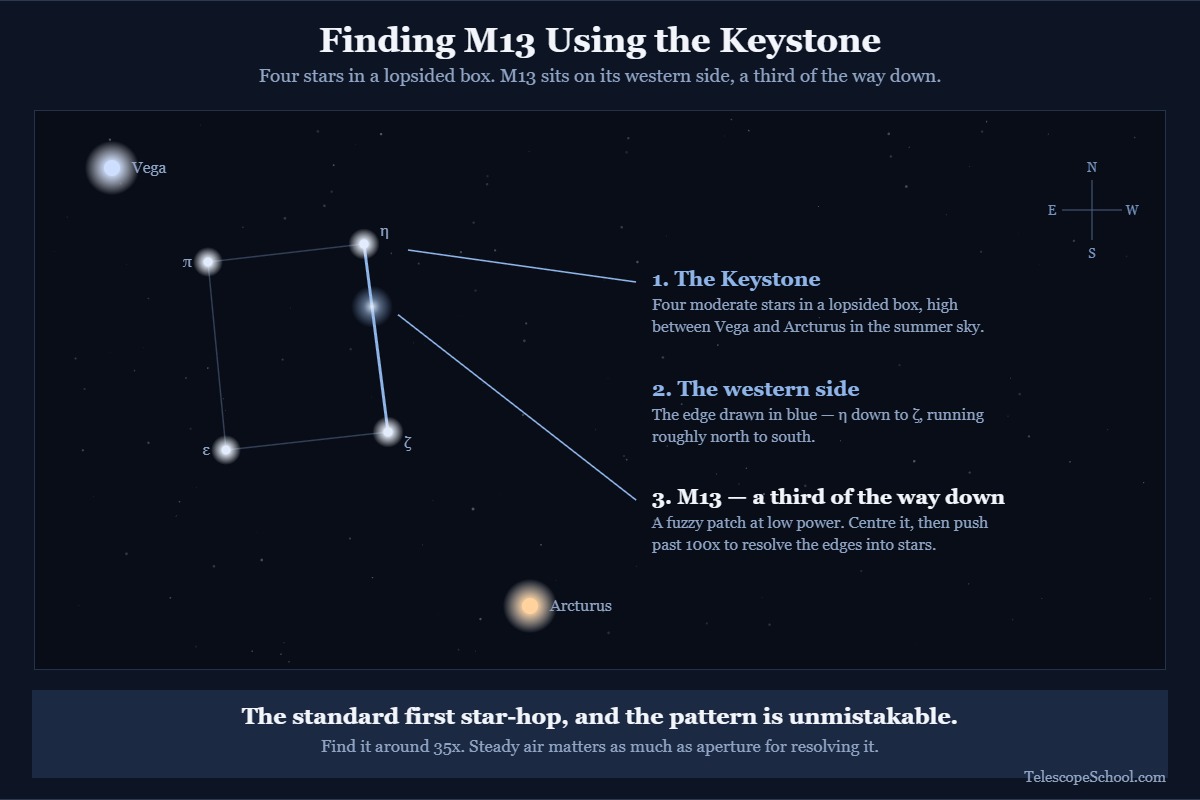
- Find Hercules, between the bright stars Vega and Arcturus in the summer sky.
- Look for the Keystone — four moderately bright stars forming a slightly lopsided box.
- Take the western side of that box, the one running roughly north to south.
- M13 sits on that line, about a third of the way down from the northern star.
- Sweep slowly at low power with your finder aimed there. It appears as a small fuzzy patch, quite unlike the stars around it.
Our beginner’s guide to star hopping covers the general technique if this is your first attempt.
From experience, working the power up on a globular in my own 130mm: at 72x it is a fuzzy, grainy ball with maybe a handful of tiny stars beginning to pop out. Between 100x and 130x the individual stars around the edges become noticeably more apparent. At around 150x, on a good night, you get that classic look — sparkles sitting on top of a fuzzy ball.
Frequently Asked Questions
What is the best star cluster to see with a telescope?
For a small telescope, the Double Cluster in Perseus is the best telescopic target — two rich open clusters framed together in one low-power field. M13 in Hercules is the best globular for northern observers, and M45 the Pleiades is the brightest cluster overall, though it is better in binoculars than a telescope.
What is the difference between an open and a globular cluster?
Open clusters are loose groups of a few dozen to a few hundred relatively young stars within the disc of our galaxy, spread across a wide area of sky. Globular clusters are dense spherical swarms of hundreds of thousands of very old stars orbiting in the galactic halo, tens of thousands of light-years away. Open clusters want low magnification; globulars want high.
Can you see star clusters from a city?
Yes — clusters are the most light-pollution-resistant deep-sky objects there are. Their light is concentrated into individual stars rather than spread as a diffuse glow, so skyglow cannot wash them out the way it erases galaxies and large nebulae. M13, M45 and the Double Cluster are all realistic from a suburban backyard.
What magnification do you need for M13?
Find it at around 35x, where it appears as a pale glow with a bright core. To resolve individual stars at the edges, work up past roughly 100x in a 6-inch or larger telescope, though on a perfect night a 5-inch such as a 130mm manages it. Steady air matters as much as aperture — on a turbulent night it will stay smooth at any power.
Can you see star clusters with binoculars?
Yes, and for the largest ones binoculars are the better instrument. M45 and M44 both overflow the field of a typical telescope eyepiece, and a pair of 10×50 binoculars frames them properly. The Double Cluster and M13 are also visible in binoculars, though a telescope shows them far better.
The Short Version
- Clusters are the beginner’s best deep-sky targets. Their light is concentrated rather than spread out, so they hold up under a suburban sky where a galaxy of the same magnitude dissolves.
- Match the power to the type. Lowest power for open clusters, and push past 100x on globulars until they resolve.
- Start with the Double Cluster and M13. One of each type, both easy to find, and both genuinely impressive in a small scope.
Clusters make up a large share of the Messier catalogue, which is the natural next project once you have these six logged. Our complete Messier catalog guide for beginners sorts all 110 objects by how realistic each one is from an ordinary backyard.
I observe from a Bortle 5-6 backyard in suburban York, Pennsylvania. Clusters are what I point people toward when the sky they actually have is a compromised one.
These May Help Too...
Can You Use a Telescope Through a Window? (And Why You Should Not)
Using a telescope through a window ruins the view: bad glass, heat currents and reflections. Here is what actually happens, and what to do instead.
Telescope will not come to focus? The cause is almost always spacing, not optics. Work out whether you ran out racking in or out, then fix that end.