

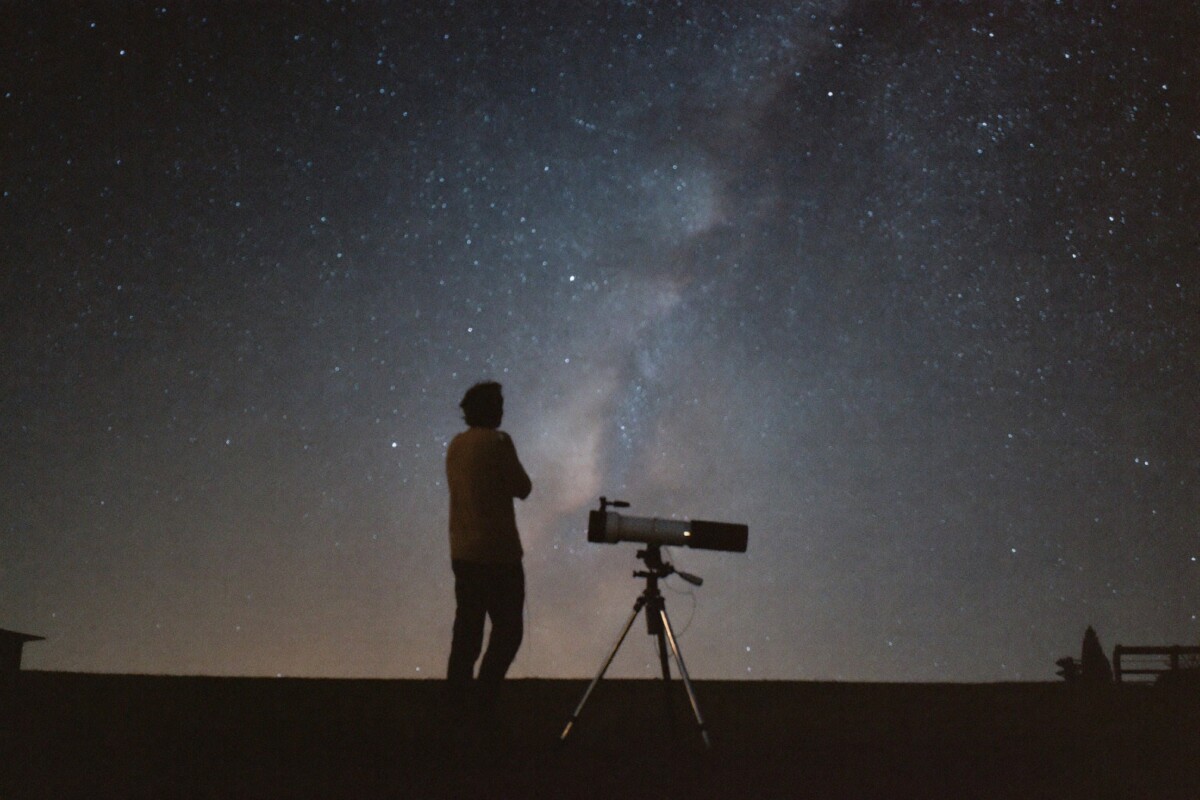
Quick answer: The realistic galaxy list for a small telescope is short: M31 in Andromeda, the M81 and M82 pair in Ursa Major, M51 the Whirlpool, M104 the Sombrero, the Leo Triplet, and — if your sky is genuinely dark — M33 in Triangulum. All six are within reach of a 4-inch to 8-inch scope, and every one of them will look like a soft grey smudge rather than a Hubble photograph.
That second sentence is the one most galaxy guides leave out, and it is the reason a lot of beginners quit on deep-sky observing after one frustrating night. At Telescope School we would rather set the expectation first and then show you how to get real satisfaction out of these targets. Galaxies are the most distant things you will ever see with your own eye. Once you understand what you are looking for, a faint oval of light that left its home twelve million years ago stops being a disappointment and starts being the best thing in the eyepiece.
Last Updated: September 2026 | Will Montgomery observes with an Astronomers Without Borders 130mm reflector and a 9mm Plössl, and writes Telescope School to give beginners the realistic version of what a telescope shows.
What a Galaxy Actually Looks Like Through a Small Telescope
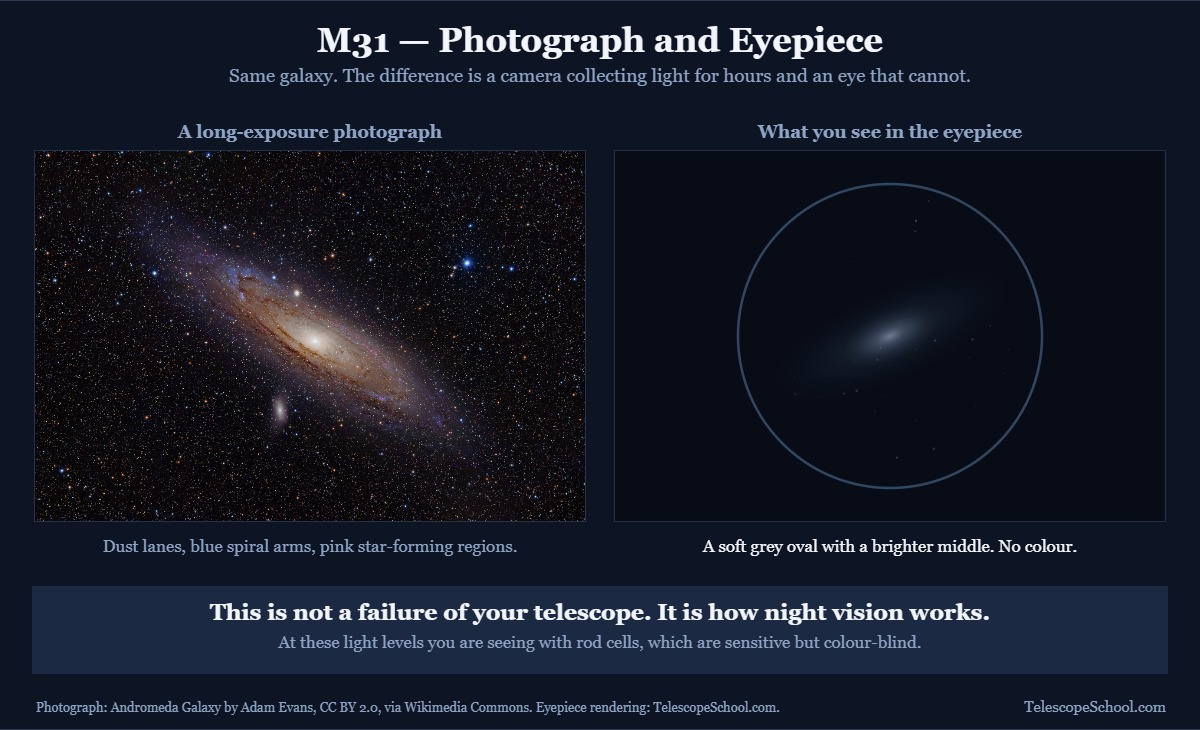
A galaxy in a small telescope looks like a faint grey oval with a brighter middle — no colour, no spiral arms, and no sharp edge. Experienced observers call these targets faint fuzzies or grey smudges, and the nicknames are affectionate rather than dismissive.
There is a physical reason for the grey. Your eye has two kinds of light receptor: cones, which see colour but need reasonable light levels, and rods, which are far more sensitive but colour-blind. At the light levels a galaxy delivers, you are seeing almost entirely with rods. The colour in every galaxy photograph you have admired comes from a camera sensor collecting light for minutes or hours. Your eye collects for a fraction of a second at a time and then starts over.
The first sighting is also often indirect. Many observers catch a galaxy at the edge of vision before they can see it dead centre — a sense that something is there when you look slightly away from it. That is averted vision, and it works because the rods are concentrated away from the centre of your retina. Look a little to the side of where you expect the galaxy and it will often brighten noticeably.
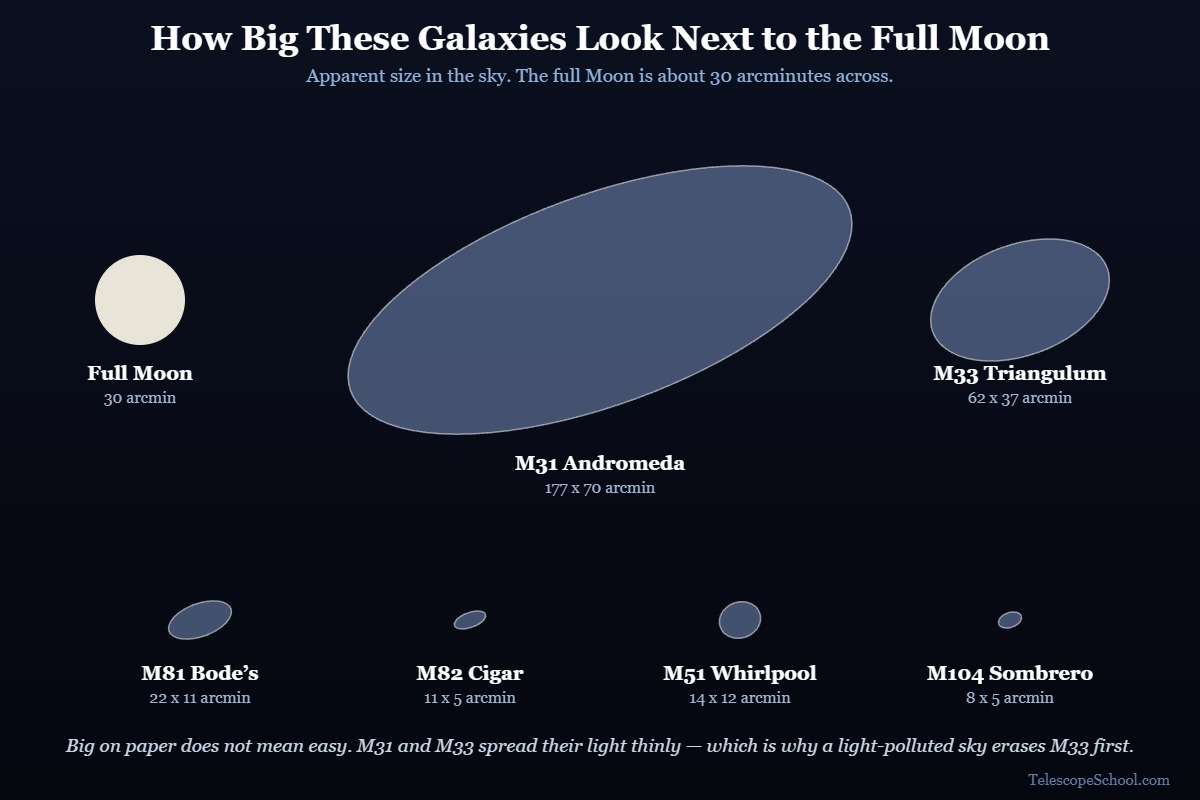
Size is the other surprise. Several of these targets are larger than the full Moon in the sky, which is why low magnification and a wide field are the right starting point rather than the high power most beginners reach for.
The 6 Best Galaxies to See with a Small Telescope
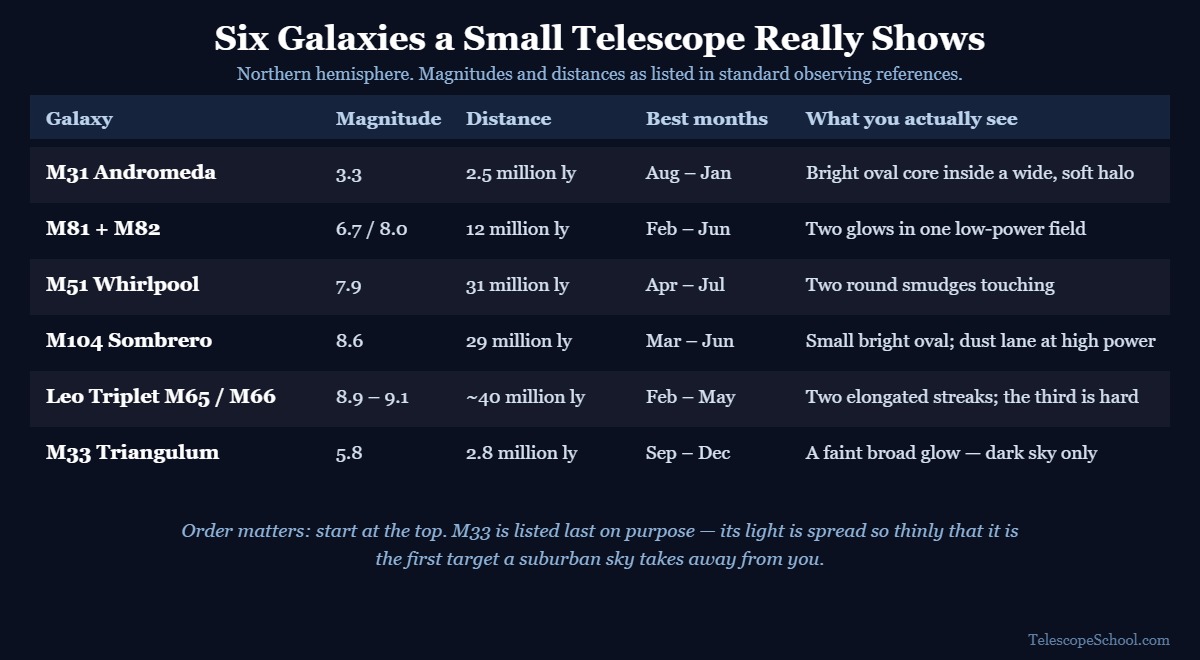
These six are ordered by how easy they are to find and how well they hold up in an imperfect sky. Work down the list rather than jumping to the famous names.
M31 — The Andromeda Galaxy
At magnitude 3.3 and about 2.5 million light-years away, M31 is the easiest galaxy in the northern sky and the one nearly every observer starts with. It is also the largest, covering roughly 177 by 70 arcminutes — around six full-Moon widths end to end. Your telescope will not show all of that. What you get is the bright central core surrounded by a soft oval halo that fades out before you reach the true edge.
Use your lowest power. At high magnification you are looking at an undifferentiated grey field and wondering what the fuss is about. Under a reasonable sky you may also pick up M32, a small companion galaxy that looks like a slightly fuzzy star just off the core. M31 is best placed from late summer through to January, and it is high in the evening sky in November.
M81 and M82 — Bode’s Galaxy and the Cigar Galaxy
This pair is the best value on the whole list, because a low-power eyepiece with about a one-degree field will frame both of them at once. Both sit roughly 12 million light-years away, near the Big Dipper, which makes them easy to locate by star hopping from a familiar asterism.
M81 is magnitude 6.7 and shows a distinctly bright core inside an oval haze. M82 is magnitude 8.0 and fainter, but its shape is the payoff: a narrow streak, which is exactly where the Cigar nickname comes from. Seeing two galaxies of visibly different shape in one field is the moment deep-sky observing usually clicks for people. From mid-northern latitudes both are circumpolar, so they never set, and they are highest in the evening sky around April.
M51 — The Whirlpool Galaxy
M51 is magnitude 7.9 at about 31 million light-years, which makes it the most distant object on this list that a small telescope shows comfortably. It sits face-on to us, and it is easy to find because it lies a short hop from the end star of the Big Dipper’s handle.
In the eyepiece you get two soft round glows almost touching — M51 itself and its smaller companion, NGC 5195. Spiral structure needs more aperture and a much darker sky than most backyards offer, so do not go hunting for arms on your first attempt. Best from April through July.
M104 — The Sombrero Galaxy
Magnitude 8.6 and roughly 29 million light-years out, M104 is small — about 8 by 5 arcminutes — which works in its favour. All of its light is packed into a compact oval, so it punches through a mediocre sky better than its magnitude suggests.
This is the one target on the list that rewards stepping up the magnification. Find it at low power, centre it, then increase power to look for the dark dust lane cutting across the bright oval. Whether you see it depends on aperture and steadiness, but the attempt is worth making. Best in April and May.
The Leo Triplet — M65, M66 and NGC 3628
Three galaxies in one field, midway between two stars in Leo. M66 is magnitude 8.9, M65 is 9.1, and both show as elongated streaks with brighter centres. NGC 3628 is also around magnitude 9.1 but has no concentrated core, which makes it the hardest of the three and often invisible from a light-polluted yard.
Treat this one as a progress test. If you can pick up all three, your sky and your dark adaptation are both doing their job. Best from February through May.
M33 — The Triangulum Galaxy
M33 is listed last deliberately. Its magnitude of 5.8 makes it look like the second-easiest galaxy on the list, and under a genuinely dark sky it is — visible in binoculars and occasionally to the naked eye. But it is about 62 by 37 arcminutes across, and that brightness is spread thinly over the whole area.
From a suburban backyard, M33 frequently shows nothing at all. If you have tried for it and failed, you have not done anything wrong. The next section explains exactly why.
Why Magnitude Lies About Galaxies
A galaxy’s listed magnitude is its total brightness added up across its entire area, so a large faint galaxy is far harder to see than its number suggests. The figure that actually predicts what you will see is surface brightness — how much light arrives per unit of sky.
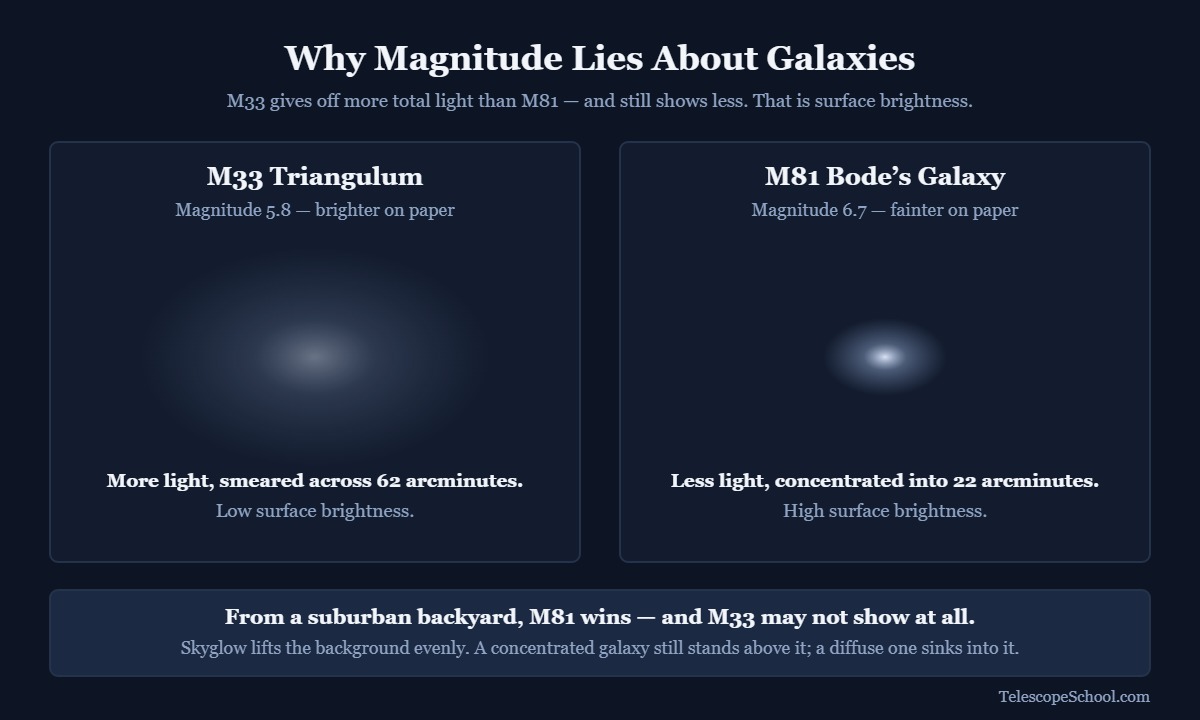
Compare the two galaxies in that diagram. M33 is magnitude 5.8 across roughly 62 arcminutes. M81 is magnitude 6.7 across roughly 22 arcminutes. On paper M33 is nearly a magnitude brighter. In practice M81 is the easier target from almost anywhere with streetlights, because its light is concentrated enough to stand above the background glow.
Light pollution works by raising that background evenly across the sky. A compact galaxy still sits above the raised floor. A diffuse one sinks into it and disappears. This is the same principle that governs which objects survive a city sky in general, which we cover in our guide to the best objects to observe from light-polluted skies, and it is measured by the Bortle scale.
The working rule: from a compromised sky, pick small and concentrated over large and diffuse. From a dark site, the large diffuse targets open up and become the more impressive sight.
The Gear That Actually Helps — and What Does Not
For galaxies, the things that matter are low magnification, a wide field of view, full dark adaptation and a moonless night. Aperture helps too, but sky darkness helps more.
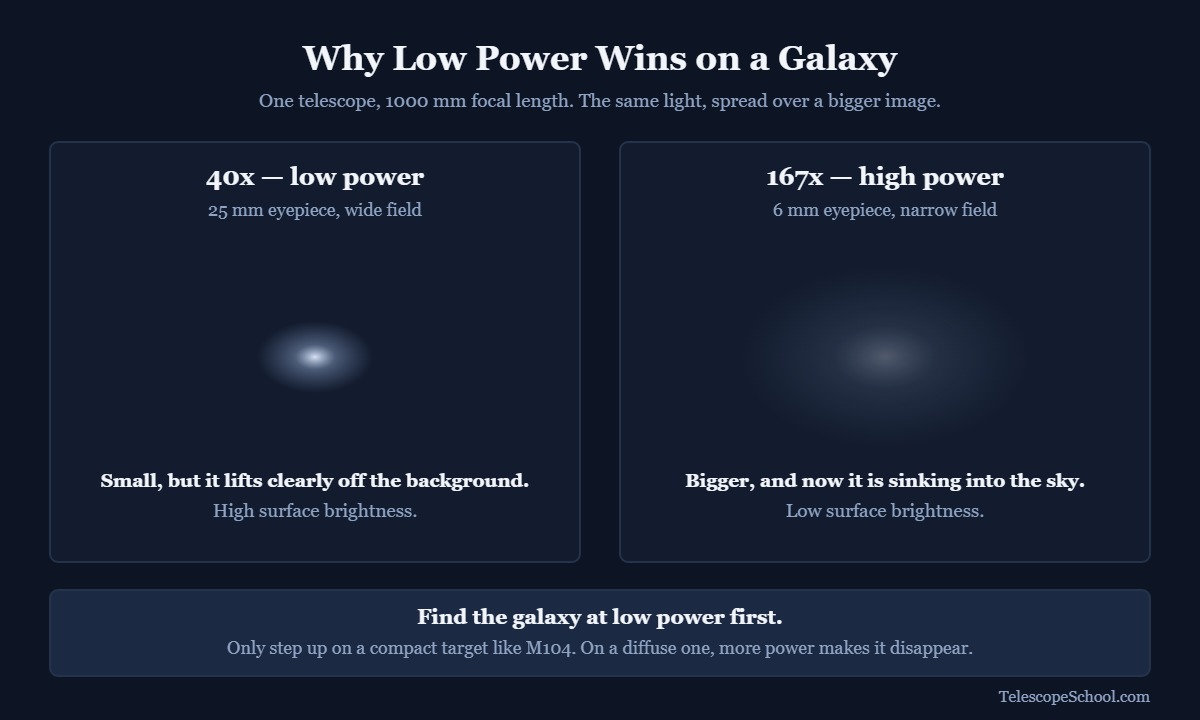
Start with your longest-focal-length eyepiece. Something around 25mm to 32mm in a typical beginner scope gives you a wide field and the highest contrast against the background — the Apertura 32 mm Plössl is the standard first buy here, and B&H lists other 32 mm Plössls if you want to compare. Magnification spreads the same light over a bigger image, which makes a faint object fainter. Find the galaxy at low power first; only then consider stepping up, and only on the compact targets like M104. Our complete guide to telescope eyepieces covers how to work out what focal lengths your scope actually needs.
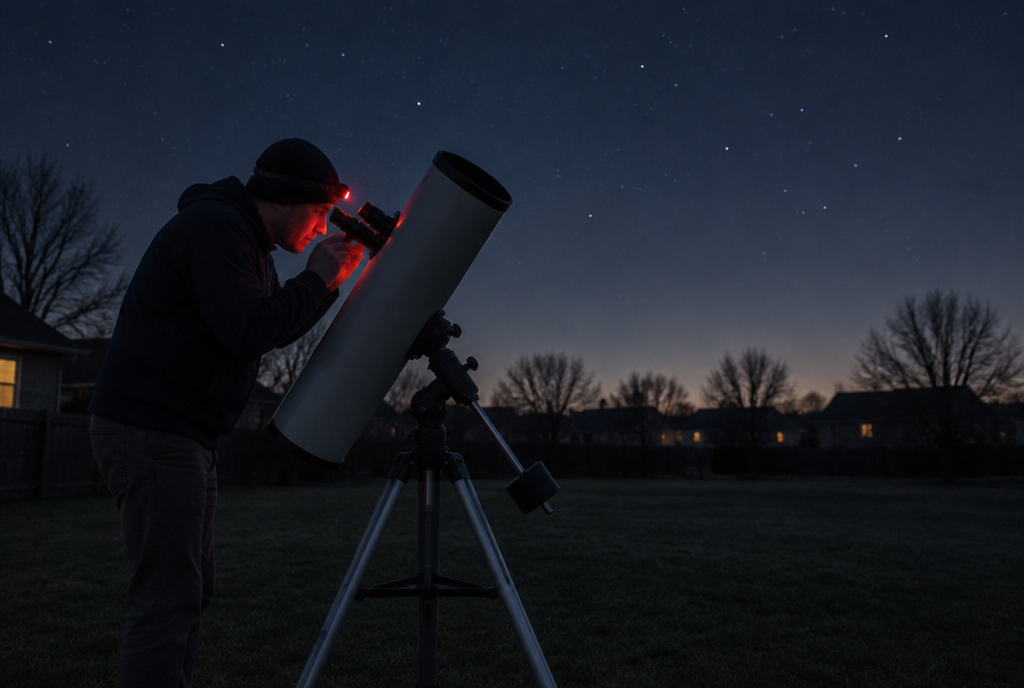
Give your eyes twenty minutes. Dark adaptation is free aperture. One glance at a phone screen resets it, so use a red light and keep the phone in your pocket — the Apertura Ember is built for this, and there are cheaper red headlamps on Amazon if you just want something that works.
Aperture does real work here. Galaxies are the class of object where a larger mirror pays off most obviously, which is why an 8-inch Dobsonian is the standard recommendation for deep-sky observers — the Apertura AD8 is the usual pick, and you can see what else is out there at that aperture. Our roundup of the best Dobsonian telescopes covers the trade-offs. That said, a 6-inch scope under a rural sky will beat a 10-inch scope in a bright suburb on every target in this article.
Nebula filters do not help galaxies. This is worth stating plainly because it costs people money. UHC and OIII filters work by passing the narrow wavelengths that emission nebulae glow at and blocking everything else. Galaxies shine in broadband starlight across the whole visible spectrum, so a narrowband filter dims the galaxy about as much as it dims the sky. There is no contrast gain. Save the filter budget for the nebula targets, where it genuinely transforms the view.
When to Look — Galaxy Season and Monthly Timing
Spring, roughly March through May, is galaxy season in the northern hemisphere. The reason is geometry: at that time of year the evening sky faces away from the plane of our own Milky Way, so you are looking out of the galaxy rather than through its dust and star clouds. The Virgo Cluster — a swarm of more than two thousand galaxies — rides high overhead, though most of its members need far more aperture than a beginner scope.
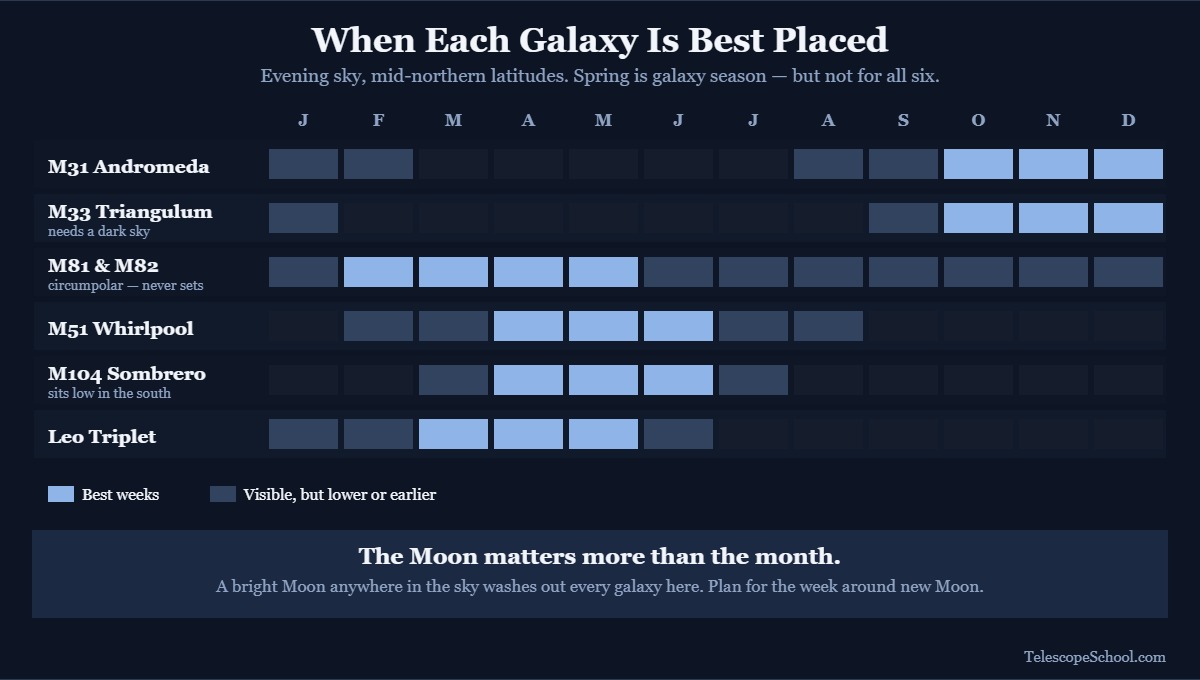
That said, you are not restricted to spring. M31 and M33 are autumn and winter objects. M81 and M82 are circumpolar from mid-northern latitudes and available in some form all year. If you want a broader seasonal plan that mixes galaxies with easier targets, our guide to beginner deep-sky objects by season lays it out month by month.
The Moon matters more than the month. A bright Moon anywhere in the sky will wash out every galaxy on this list. Plan galaxy nights for the week around New Moon.
A Realistic First Galaxy Night, Step by Step
- Check the Moon phase. Aim for the window from a few nights after last quarter to a few nights after new. This single decision matters more than your telescope.
- Align your finder in daylight and, if you have a reflector, check collimation. Hunting a faint smudge with a misaligned finder is how good nights get wasted.
- Pick one target, not five. M31 in autumn, M81 and M82 in spring. Learn the star-hop before you go outside.
- Use your lowest power and sweep slowly. Sweeping is how most galaxies are first noticed — the motion catches the smudge before your eye resolves it.
- Give it twenty minutes. Dark-adapt, use averted vision, and let the object grow on you. Galaxies reward patience more than any other class of target.
From experience: M42 was really the first thing I pointed at. For galaxies I went after M31 and its small companion M32 — and it took longer than I expected to get them tuned in.
Frequently Asked Questions
Can you see galaxies with a small telescope?
Yes. A 4-inch to 8-inch telescope will show M31, M81, M82, M51, M104 and the brighter members of the Leo Triplet. They appear as faint grey ovals with brighter centres rather than the colourful spirals seen in photographs. Sky darkness affects what you see more than aperture does.
What is the easiest galaxy to find?
M31, the Andromeda Galaxy. At magnitude 3.3 it is the brightest galaxy in the northern sky, it is visible to the naked eye as a faint smudge from a dark site, and it sits in an easily identified part of the autumn sky. Most observers find it on their first attempt.
Why do galaxies look grey instead of colourful?
Because at very low light levels your eye sees almost entirely with rod cells, which are highly sensitive but cannot detect colour. The colours in galaxy photographs come from a camera collecting light over minutes or hours. No visual telescope of any size will show you those colours directly.
Do you need a filter to see galaxies?
No, and narrowband nebula filters such as UHC and OIII actively make galaxies harder to see. Those filters pass only the narrow wavelengths emission nebulae glow at, while galaxies emit broadband starlight. A filter dims the galaxy as much as the sky background, so there is no contrast gain.
Can you see galaxies from a city or suburb?
From a suburb, yes — but only the concentrated ones. M31’s core, M81 and M104 survive moderate light pollution because their light is packed into a small area. Large diffuse galaxies such as M33 usually disappear entirely. From a true city centre, galaxy observing is not realistic, and a drive to darker skies will do more for you than any equipment upgrade.
The Short Version
- Start with M31 or the M81/M82 pair. Both are bright, easy to locate, and forgiving of an average sky.
- Judge a target by surface brightness, not magnitude. Small and concentrated beats large and diffuse from anywhere near a town.
- Low power, no Moon, twenty minutes of dark adaptation. Those three things will do more for your galaxy views than any purchase.
Once you have a few galaxies in the logbook, the natural next step is to work systematically through the rest of the deep sky. Our complete Messier catalog guide for beginners is the roadmap for that, and it sorts all 110 objects by how realistic each one is from an ordinary backyard.
I came back to this hobby at 50 and relearned it from a Bortle 5-6 backyard in suburban York, Pennsylvania. That is the sky these expectations are set for.
These May Help Too...
Can You Use a Telescope Through a Window? (And Why You Should Not)
Using a telescope through a window ruins the view: bad glass, heat currents and reflections. Here is what actually happens, and what to do instead.
Telescope will not come to focus? The cause is almost always spacing, not optics. Work out whether you ran out racking in or out, then fix that end.