

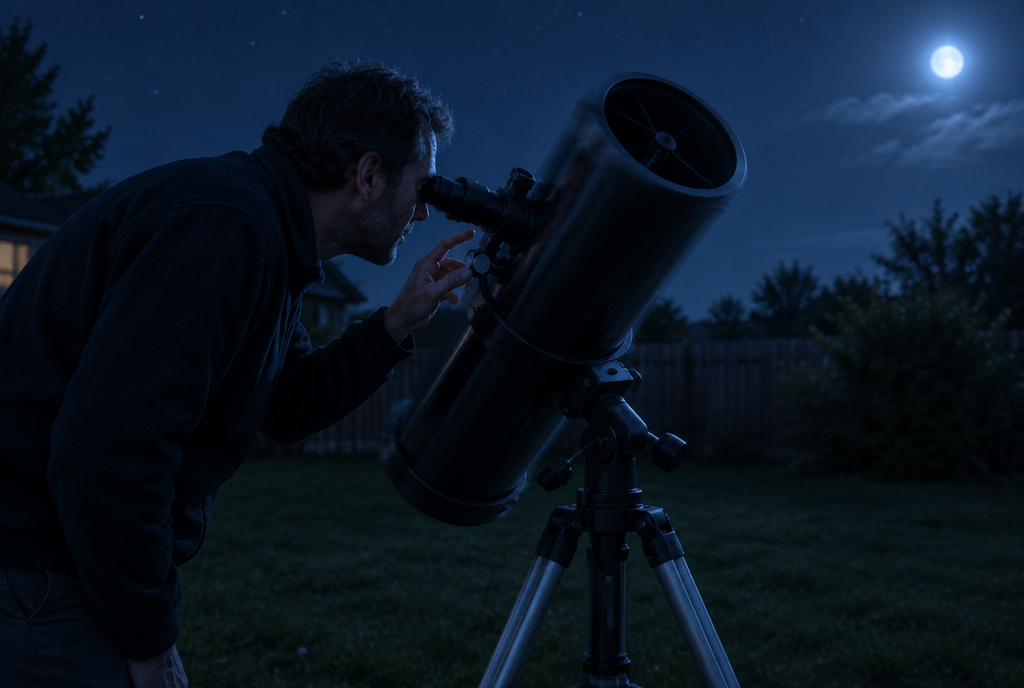
Quick answer: If your telescope shakes, the problem is almost never the telescope — it is the mount, the tripod, or the way you are touching it. A telescope magnifies everything in the light path, and that includes every wobble underneath it, so a movement you would never notice by eye becomes a view that swims for ten seconds after you nudge the focuser.
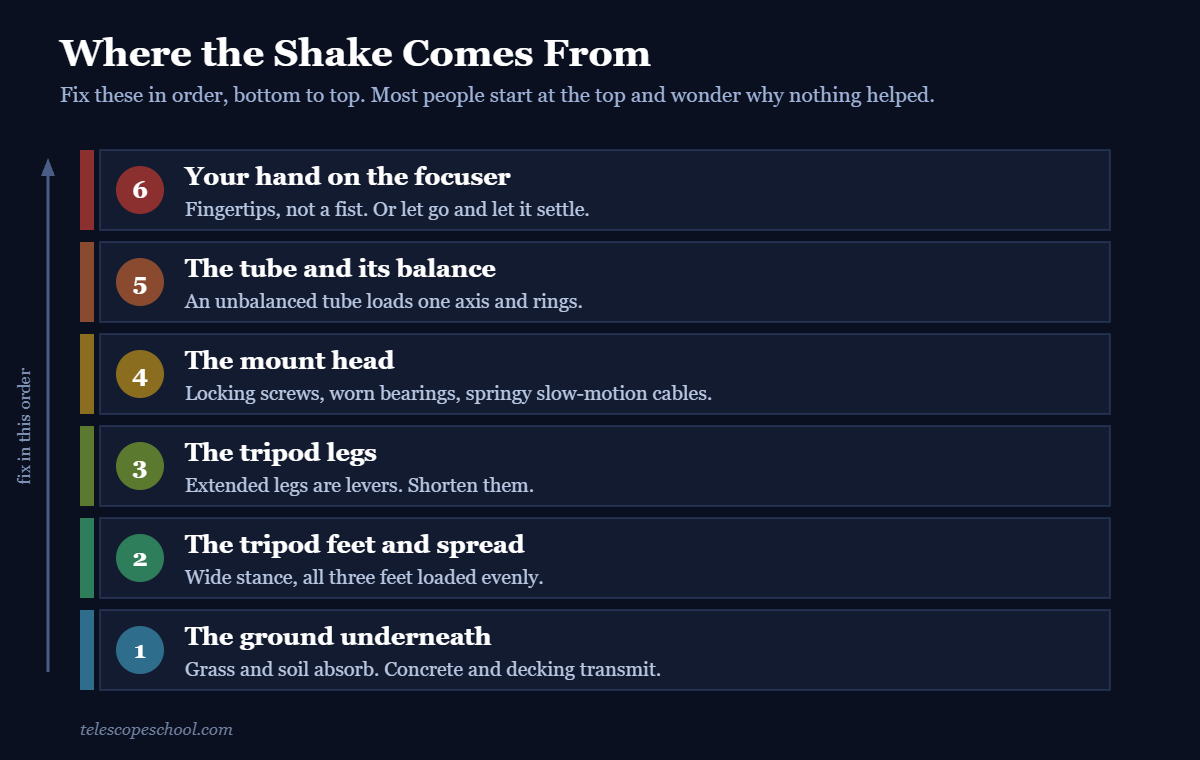
The good news is that shake is mechanical, which means it is measurable and fixable. This guide gives you a test that puts a number on your shake, then a fix order that starts at the ground and works upward. Most people do it backwards — they buy vibration pads first — and then wonder why nothing improved.
Last Updated: September 2026 | Will Montgomery observes with an Astronomers Without Borders 130mm reflector and a 9mm Plössl and uses 200x as his own rule-of-thumb ceiling for useful magnification. Telescope School exists to give beginners the realistic version of what a telescope actually shows.
A shaking telescope is a mount problem, not an optics problem
Your optics cannot shake. A mirror or a lens sitting in a tube has no way to produce a vibrating image on its own. What vibrates is everything the tube is bolted to, and the eyepiece faithfully magnifies that motion along with the target.
This matters because magnification multiplies the wobble by exactly the same factor it multiplies the planet. At 40x, a tremor in the tripod is a small quiver. At 200x, that identical tremor throws Jupiter clean out of the field. It is the same mount and the same shake — you have just made it five times easier to see.
So before you touch anything, understand the chain. Vibration enters at the ground, travels up the legs, passes through the mount head, into the tube, and finally into your eye. Anything you add or tighten works on one link of that chain. Fixing the wrong link accomplishes nothing.
The tap test: measure your shake before you fix anything
Point the telescope at any bright star at a moderate power, look through the eyepiece, tap the front end of the tube with a finger, and count how long the view takes to settle. This damping-time test is described by Sky & Telescope, and it is the single most useful thing you can do before spending money.
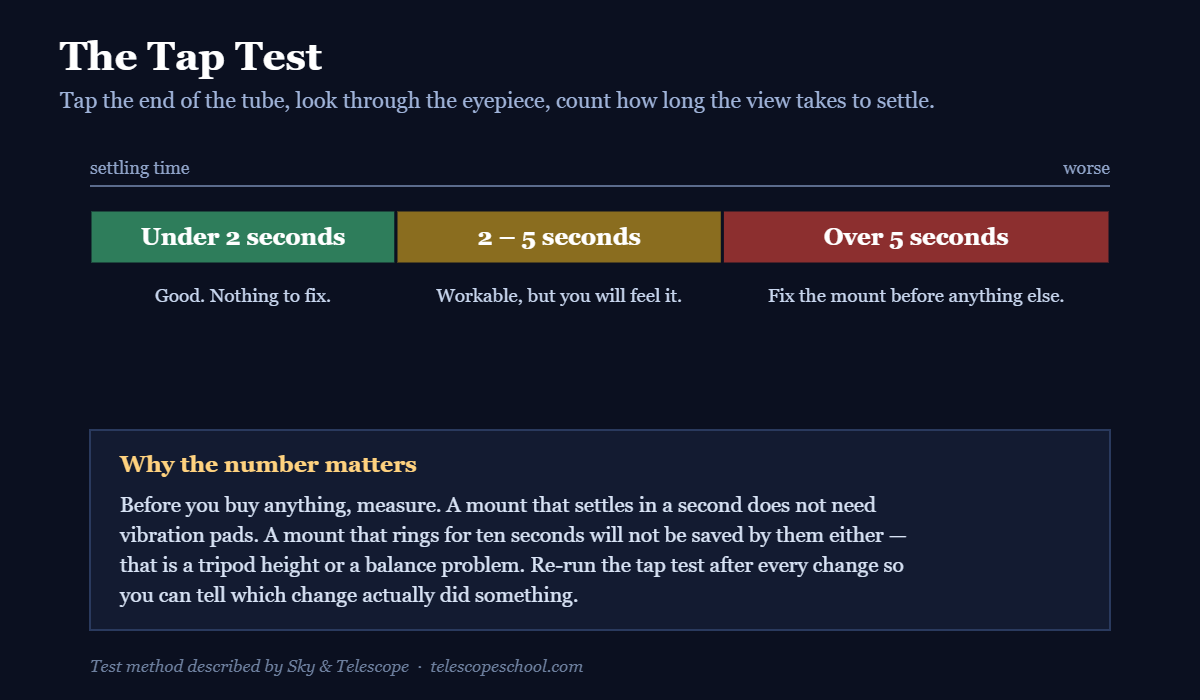
Roughly: under two seconds is fine and needs no attention. Two to five seconds is workable but you will feel it every time you focus. Beyond five seconds you are fighting the mount all night, and at ten seconds the mount is effectively unusable at high power.
Write your number down. Then re-run the test after each change below. This is what separates a real fix from a placebo — you will discover that some “improvements” do nothing at all, and occasionally that one makes things worse.
Fix it in order, from the ground up
1. Lower the tripod
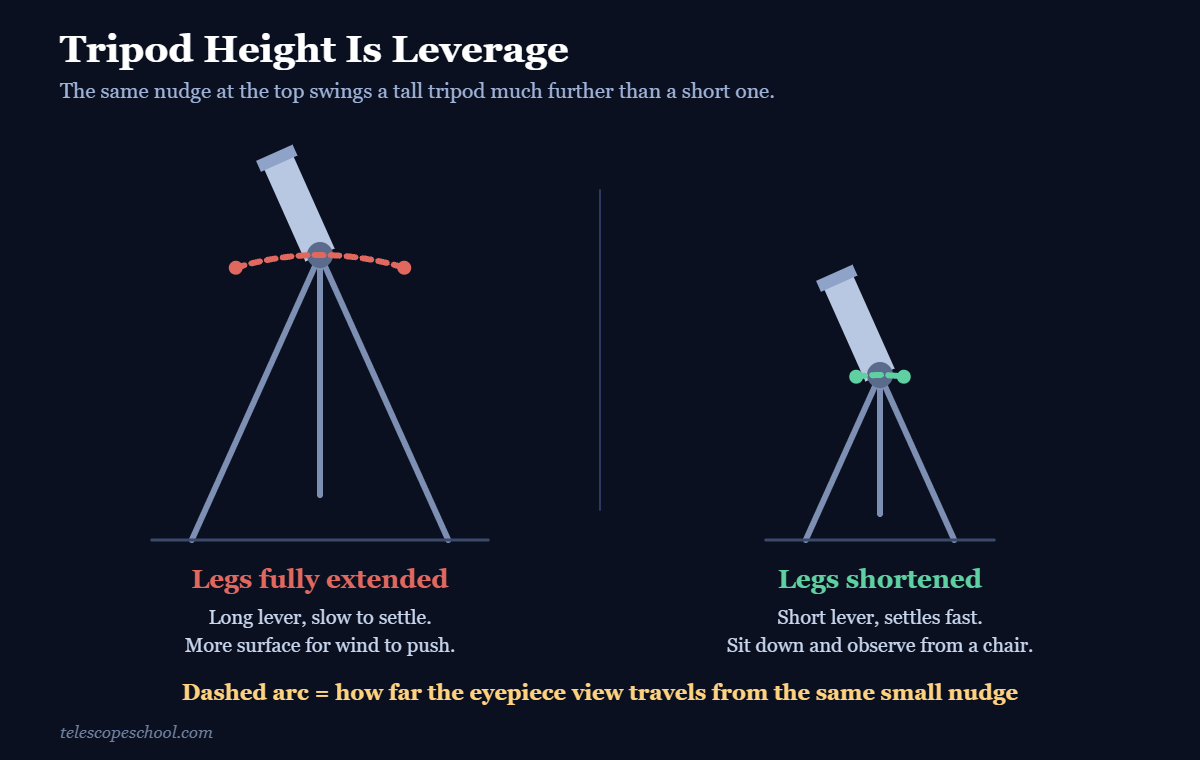
This is the biggest single win and it costs nothing. Extended tripod legs are long levers; the same small push at the top swings the eyepiece much further, and the whole assembly takes longer to settle. Retract the legs as far as your target’s altitude allows and observe seated. Sitting down also steadies your head, which is worth more than most people expect — and it is easier on your back over a long session.
2. Check the surface underfoot
Grass and bare soil absorb vibration. Concrete, asphalt, and especially wooden decking transmit it — a deck will shake every time you shift your weight, and it will keep ringing afterwards. If you have a choice of ground, take the grass. If you are stuck on a deck, stand as close to a supporting joist or the house wall as you can, and try not to move your feet while observing.
3. Tighten what should be tight — and leave a little slack where it helps
Go around the whole assembly and snug up every fastener you can find: the wing nuts or bolts where the legs meet the head, the leg clamps, the accessory tray, the bolts holding the tube rings, and the finder bracket. A loose accessory tray is a surprisingly common culprit because it braces all three legs against each other.
But do not simply crank everything down as hard as it will go. Sky & Telescope makes a point that sounds wrong and is not: the locking screws holding the tube in position should be secure enough that nothing flops, yet a little slack often helps dissipate vibration rather than transmit it. Over-tightening can also bind the axes, which makes smooth tracking impossible. Aim for secure but still smooth.
4. Balance the tube
An unbalanced tube leans permanently on one axis, and a loaded axis rings. Loosen the clamps and slide the tube in its rings — or adjust the counterweight on an equatorial mount — until the tube stays put wherever you leave it, in any orientation. Re-balance after you add a heavy eyepiece, a camera, or a dew shield, because any of those will throw it out again.
5. Add weight low
Hanging a weight from the centre of the tripod lowers the centre of gravity and gives the wind less to work with. A gallon jug of water, a sandbag, or your gear bag clipped to the centre column all work — or a purpose-made tripod stone bag if you would rather have something that lives on the tripod and does not need filling every time. One caution: it has to hang still. A bag swinging in a breeze is a pendulum, and a pendulum feeds vibration back into the mount instead of absorbing it. If it swings, let it rest against the ground.
6. Change how you touch the focuser
This is free, it takes one night to learn, and it is the step almost nobody tries. Most of the shake you see is being put there by your own hand. Use fingertips only, never a full grip, and turn the knob slowly. Better still, learn to make the adjustment, take your hand away, and wait for the view to settle before you judge whether the focus is right. If your mount has slow-motion controls on long flexible cables, those cables can jiggle in a breeze and feed oscillation straight into the mount — short, rigid knobs are a genuine upgrade.
From experience: the settling time really depends on what the scope is sitting on. Mine sits on a heavy, solid metal-and-glass patio table that I can roll into position without having to touch or lean on it.
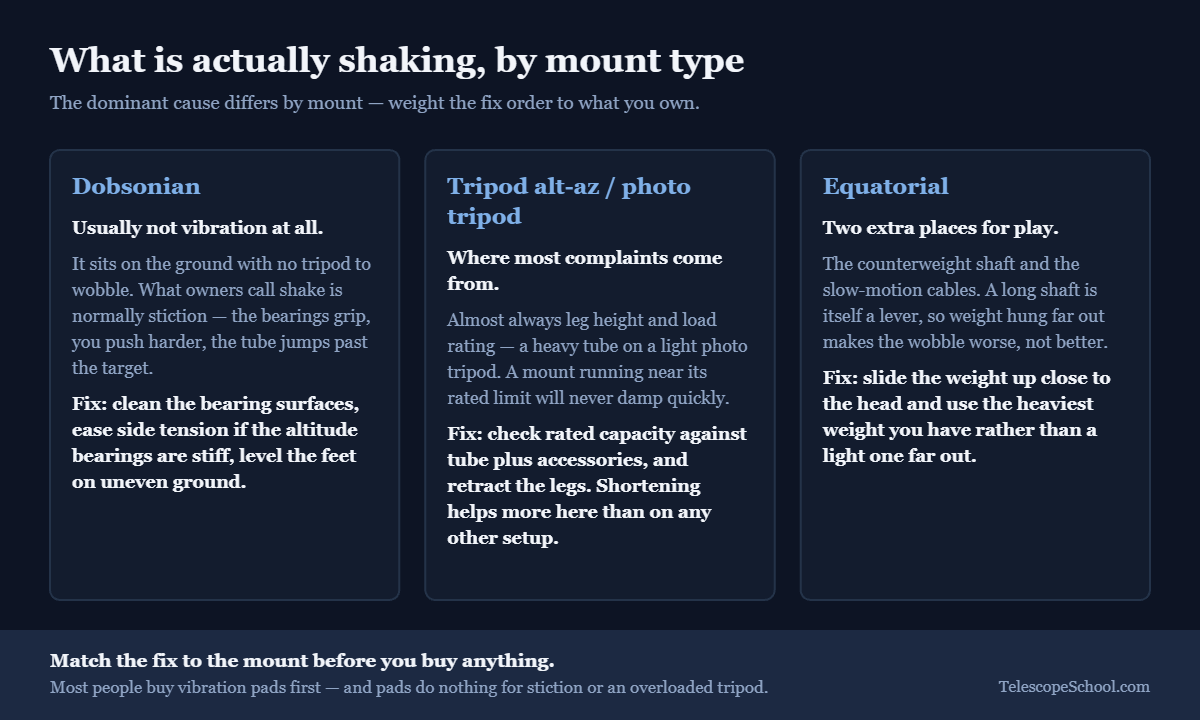
What is actually shaking, by mount type
The dominant cause differs by mount, so the fix order above should be weighted to what you own.
Dobsonians
A Dobsonian sits on the ground and has no tripod to wobble, so true vibration is rare. What Dobsonian owners usually call shake is really stiction — the bearings grip, you push harder, and the tube jumps past the target. That is a friction problem, not a vibration problem. Clean the bearing surfaces, and if the altitude bearings are too stiff, easing the side tension usually restores smooth motion. A Dob that rocks on its base normally just needs its feet levelled on uneven ground.
Tripod alt-az and photo tripods
This is where most complaints come from, especially with a heavy tube on a light photo tripod. The failure is almost always leg height and load rating. Check the tripod’s rated capacity against your tube plus accessories — a mount running near its limit will never damp quickly. Retracting the legs helps more here than on any other setup.
Equatorial mounts
Equatorial mounts add two more places for play to appear: the counterweight shaft and the slow-motion cables. A long counterweight shaft is itself a lever, so slide the weight up close to the head and use the heaviest weight you have rather than a light one far out. If you are still deciding between mount types, our guide to equatorial versus alt-az mounts covers the trade-offs.
When the shake is really the magnification
If every fix above helped a little and the view still dances, you may simply be over-magnified. Pushing past the useful limit for your aperture makes the image dim and soft and it amplifies every remaining tremor — so the mount gets blamed for a problem the eyepiece created.
Drop to the next-longer eyepiece and see whether the view improves. It usually does. Our guides to magnification for planets and the 50x rule explain where your own ceiling sits. And if the image is soft but perfectly steady, that is a different fault entirely — start with our guide to a blurry telescope instead.
What actually helps that you can buy
Do the free fixes first — genuinely, do them first, because they outperform most purchases. If your tap-test number is still poor afterwards, two things are worth the money.
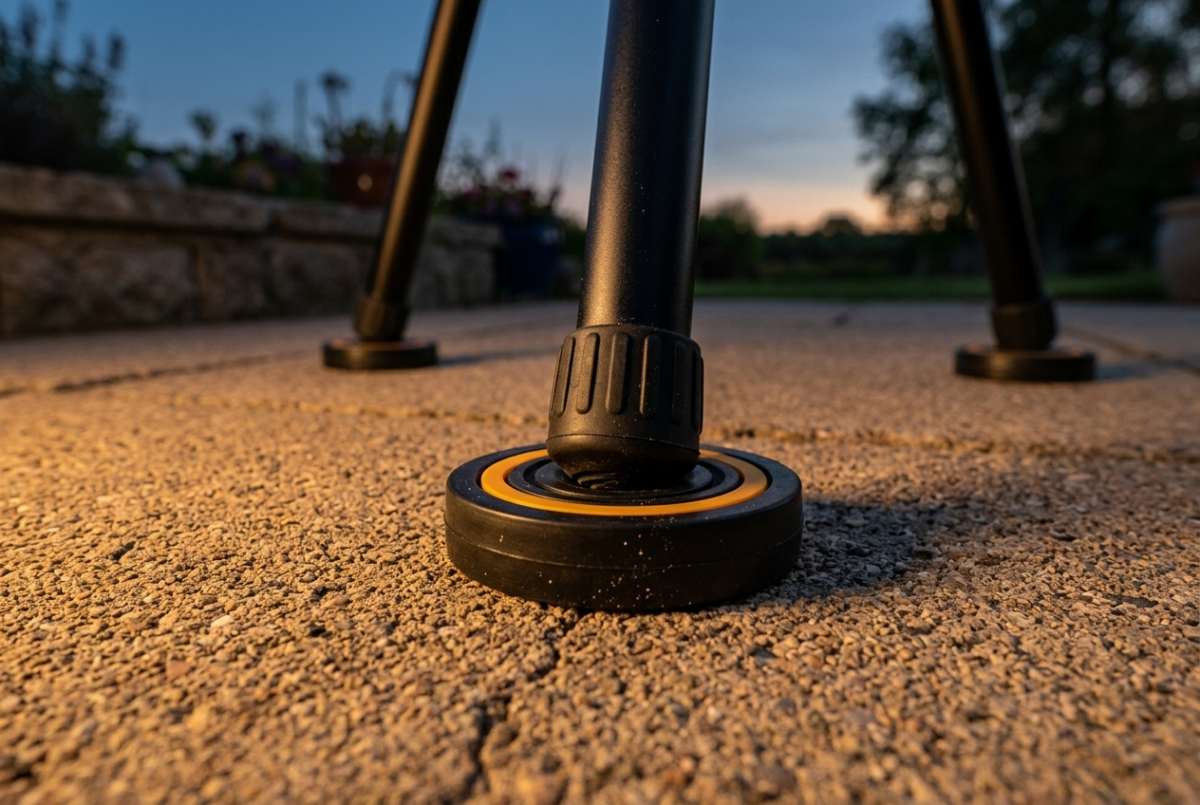
Vibration suppression pads. These are small damping pucks that sit under each tripod foot. They work best on hard surfaces, which is exactly where vibration is worst, and they do very little on grass because the ground is already absorbing. They are the one accessory that reliably shortens damping time on a concrete patio or a deck. A set of vibration suppression pads is inexpensive, and it is worth browsing a few options to fit your tripod’s foot size.
An adjustable observing chair. This is not marketed as a stability product, but it behaves like one. Seated observing lowers the tripod, steadies your head, and stops you leaning on the mount for balance — three of the six fixes at once. An adjustable observing chair changes long sessions more than almost anything else you can add, and there is a real physical benefit to it as well. Seat height matters more than brand here, so it is worth comparing a few height ranges against your own tripod before you buy.
What is usually not worth it: replacing a light tripod’s legs with heavier ones while keeping the same weak head, or buying pads in the hope they will rescue a mount that is badly over its load rating. If the tube is too heavy for the mount, the only real answer is a sturdier mount.
Frequently asked questions
Why does my telescope shake more at high magnification?
Because magnification enlarges the shake by exactly the same factor it enlarges the object. The mount is not moving any more than it was at low power — you have simply made the same motion five or ten times easier to see. This is why an unsteady mount sets a practical ceiling on usable magnification, regardless of what the optics could deliver.
Do vibration suppression pads actually work?
Yes, on hard surfaces. They shorten the settling time noticeably on concrete, paving, and decking. On grass or soil the improvement is much smaller because the ground is already doing that job. Run the tap test before and after and you will see for yourself which camp you are in.
Should I tighten every bolt as hard as I can?
No. Everything structural should be snug, but over-tightening can bind the axes and make smooth motion impossible, and a little slack in the tube clamps often helps dissipate vibration rather than transmit it. Aim for secure but still smooth.
Is my telescope shaking because it is cheap?
Often the mount is the weak part rather than the optics. Many inexpensive telescopes pair a reasonable tube with a tripod that is not rated to carry it. The fixes above will improve almost any mount, but if your tube is heavier than the mount’s stated capacity, no accessory will fully solve it — that is a case for a sturdier mount rather than more add-ons.
Why does the view shake even when I am not touching anything?
Wind is the usual answer, and a long tube catches a surprising amount of it. Passing traffic, a nearby road, a running furnace or air conditioner, and footsteps on a deck all do it too. Lower the tripod, add weight low down, and put a fence, hedge, or the house between you and the wind.
Getting to a steady view
Three things to take away. First, measure before you fix: the tap test turns a vague complaint into a number, and it tells you whether a change helped. Second, work from the ground up — tripod height and observing position beat every accessory on the shelf, and they are free. Third, watch your own hands, because a large share of what looks like mount shake is being introduced by the person at the eyepiece.
A steady view is the foundation for everything else. Once the mount settles quickly, higher magnification becomes usable, focusing stops being a fight, and faint detail you were never quite sure about turns out to have been there all along. For more ways to get more out of the setup you already own, see our 30 quick tips for improved telescope viewing here at Telescope School.
I hold an engineering degree, and vibration damping is one of the few parts of this hobby that behaves exactly the way the coursework says it should.
These May Help Too...
Can You Use a Telescope Through a Window? (And Why You Should Not)
Using a telescope through a window ruins the view: bad glass, heat currents and reflections. Here is what actually happens, and what to do instead.
Telescope will not come to focus? The cause is almost always spacing, not optics. Work out whether you ran out racking in or out, then fix that end.