

Quick answer
To see real surface detail on Mars you need roughly a 4-inch or larger telescope at 150–250x, and you need to observe within a few months of opposition. The next opposition is 19 February 2027, when Mars will be 13.8 arcseconds wide at magnitude −1.2 in Leo. As of September 2026 Mars is only about 5 arcseconds across — too small for surface detail, and worth waiting on.
Mars is the most timing-dependent target in amateur astronomy. Point a telescope at Jupiter on any random clear night and you will see something worthwhile. Point one at Mars on a random night and you will very likely see a small featureless orange dot, conclude your telescope is disappointing, and be wrong.
This guide is built around that problem: when to look, what the 2027 opposition will honestly deliver, and how to get the most out of a disc that is never going to be large.
Last Updated: September 2026 | Will Montgomery holds a B.S. in Engineering from Penn State and came back to amateur astronomy at 50, observing from suburban York, PA (Bortle 5-6).
Can you see Mars right now?
Not usefully. On 1 September 2026 Mars sits about 1.85 astronomical units from Earth — roughly 277 million kilometres — presenting a disc of about 5.1 arcseconds at magnitude +1.25, low in the pre-dawn sky in Gemini. At that size it is a tiny orange bead. No telescope will show meaningful surface markings.
The Association of Lunar and Planetary Observers treats the 2026–27 apparition as beginning on 14 October 2026, when the disc reaches 6.0 arcseconds — the point at which a 4- to 8-inch telescope can start doing useful work. It stays above 6 arcseconds until about 1 July 2027, giving roughly eight and a half months of observing, with the best of it clustered around opposition.
If you want a planet tonight, look at Saturn — it reaches opposition on 4 October 2026. Our 2026 planet calendar covers what else is up.
The 19 February 2027 opposition: honest expectations
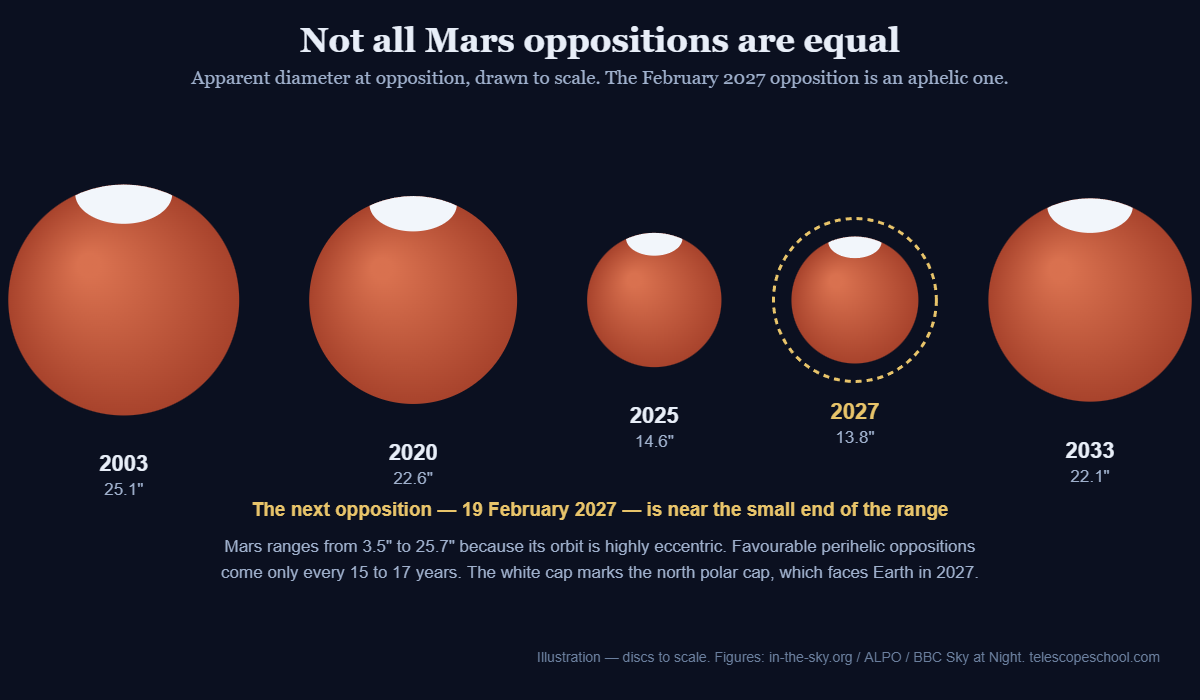
Mars reaches opposition at 15:44 UT on 19 February 2027, in Leo, at magnitude −1.2 and 0.68 astronomical units from Earth. Closest approach follows a few hours later, at 00:14 UT on 20 February, at about 63 million miles. The disc will be 13.8 arcseconds wide.
That last number deserves emphasis, because most articles about Mars oppositions imply every one is spectacular. This one is not. It is an aphelic opposition — Mars is near the far end of its orbit from the Sun when Earth catches up with it. Compare:
| Opposition | Apparent diameter | Quality |
|---|---|---|
| 2003 | 25.1″ | Closest in ~60,000 years |
| 2020 | 22.6″ | Excellent |
| 2022 | 17.2″ | Good |
| 2025 | 14.6″ | Modest |
| 2027 | 13.8″ | Aphelic — the small end of the range |
| 2033 | 22.1″ | The next genuinely good one |
So 2027 gives you a disc a little over half the apparent width of 2003, or roughly a quarter of the area. It is still very much worth observing — 13.8 arcseconds is comfortably enough for the polar cap and the major dark markings in a decent telescope — but anyone selling you a once-in-a-lifetime Mars in 2027 is overselling it.
There is one real compensation for northern-hemisphere observers. Mars sits at about +15° declination at this opposition, meaningfully higher in the sky than in 2025, and altitude buys you steadier air. A smaller disc seen through less atmosphere can beat a larger disc seen through more.
Why Mars oppositions vary so much
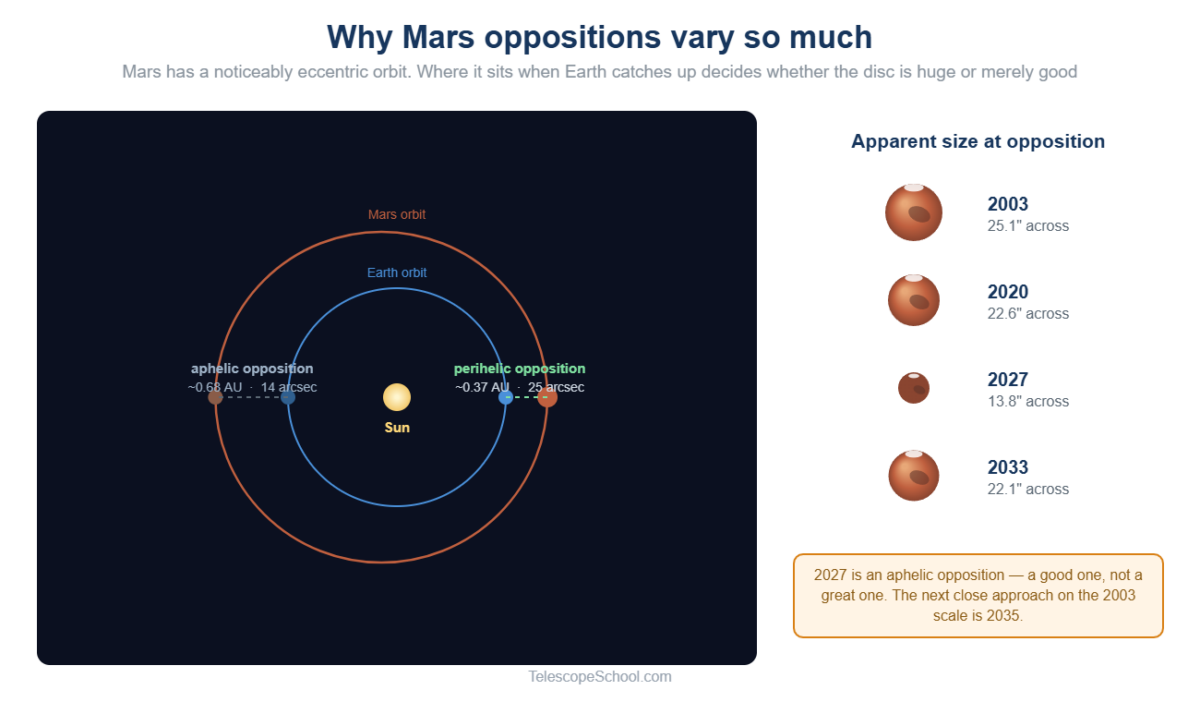
Oppositions repeat about every 26 months — the synodic period is 779.94 days — but they are not equivalent, because Mars has the second most eccentric orbit of any planet, ranging from 1.38 to 1.67 astronomical units from the Sun.
When opposition happens near Martian perihelion, Earth catches Mars at its closest and you get a 25-arcsecond disc. When it happens near aphelion, you get under 14. Across the whole orbit Mars varies in apparent size by more than a factor of seven, from 25.7 arcseconds down to 3.5.
Favourable perihelic oppositions come around only every 15 to 17 years. The underlying pattern is a roughly 15.8-year cycle of three or four aphelic oppositions followed by three consecutive perihelic ones, and that whole sequence repeats every 79 years. The February 2027 opposition falls just 4.5 degrees of orbital longitude from Martian aphelion — Mars actually reaches aphelion on 2 March 2027, less than two weeks later. That is about as aphelic as an opposition gets.
How much telescope do you need for Mars?
Mars asks more of an instrument than any other bright planet, because the detail is low in contrast and the disc is small.
| Aperture | What it shows near opposition |
|---|---|
| 60–90mm | A distinct orange disc, the polar cap with about 50x, hints of the largest dark markings in good seeing |
| 100–150mm | The polar cap clearly, Syrtis Major and other major albedo features, the gibbous phase away from opposition |
| 150–200mm | The practical sweet spot — multiple dark markings, cloud and haze, dust storm boundaries |
| 200mm+ | Finer albedo structure, polar hood detail, orographic clouds — seeing permitting |
Celestron’s own guidance is that a 60–90mm entry telescope reveals some surface markings at small image scale, while a 7-inch or larger gives noticeably better views. That matches what most observers report. Resolution scales linearly with aperture, so an 8-inch genuinely resolves twice as fine as a 4-inch — but only when the atmosphere cooperates.
A common and honest recommendation is 114mm to 200mm as the band where most people get the best return for the money on Mars. Below that, the disc is small and the contrast is marginal; above it, you are increasingly at the mercy of seeing.
Magnification and seeing
Start at about 200x if your telescope supports it. A rule of thumb used by BBC Sky at Night is 20x to 30x per inch of aperture, capped by conditions. Telescopes of 114mm and under should generally not be pushed past 200x. Experienced observers do use 300x to 400x on Mars when the seeing genuinely supports it — which is not most nights. Our guide to telescope magnification for planets covers where the useful ceiling actually sits.
The polar cap is the easy win: almost any telescope will show it at 50x or more around opposition. Everything else rewards patience at higher power.
Three things make more difference than magnification. Let the telescope reach outdoor temperature — 30 to 45 minutes, longer for a large mirror. Observe when Mars is high, not when it is first visible. And do not observe over a rooftop or a driveway, where stored daytime heat pours upward through your light path. For more on the magnification ceiling, see our guide to telescope magnification limits.
What you will actually see on Mars
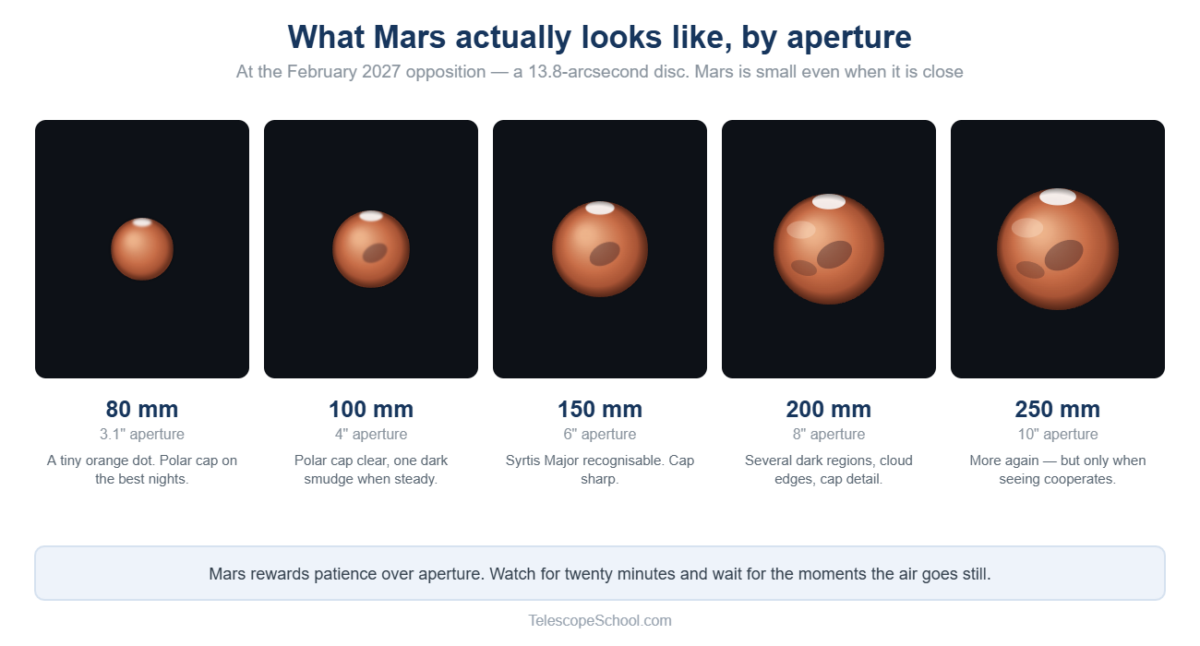
The polar cap. The most reliable feature, visible as a small brilliant white patch at one limb. For the 2026–27 apparition the north polar cap is the one tilted toward Earth — the sub-Earth latitude is about +20° at opposition — so this time you are watching the northern cap, not the southern. The terminator shadow clears the cap by late November 2026.
Dark albedo markings. These are wind-swept regions of darker rock and dust, not vegetation and not permanent geography in the everyday sense — they shift over years as dust is redistributed. Syrtis Major is the classic: a dark triangular wedge that is the easiest large marking to identify. Hellas, a huge impact basin, often appears as a bright oval and can be mistaken for a polar cap when it fills with frost or haze.
Clouds and hazes. Whitish patches near the limb or over high terrain. The 2027 opposition falls at about 65° solar longitude — northern spring on Mars — which is a cloudy, low-dust season. Good for clouds, less likely for dramatic dust events.
Phase. Away from opposition Mars shows a distinctly gibbous disc, like a Moon a few days from full. It is subtle but unmistakable once you notice it.
What you will not see: Olympus Mons, Valles Marineris and the rest of the named geology are not resolvable as landforms in amateur telescopes. What you see are broad tonal regions, not mountains and canyons.
Dust storms — and why 2027 is the quiet side of the cycle
Martian dust storms concentrate around southern summer, soon after Mars passes perihelion. A mature global storm turns the disc a blank bright orange and can hide the surface entirely for weeks. NASA has documented regional storms covering up to a third of the planet and lasting as long as three weeks, with fully planet-encircling events being rare.
The scheduling is unfortunate for this apparition: the dusty season for this Mars year runs from roughly late January 2026 to early August 2026 — precisely while Mars is too small and too close to the Sun to observe. By opposition in February 2027 Mars is in its northern spring, a low-dust part of the year. Dust cloud activity is more plausible later, around May 2027.
Prediction is close to impossible, so the practical advice is simply to look often. A dust event is one of the few things that can change the appearance of Mars overnight.
The rotation trick nobody tells beginners
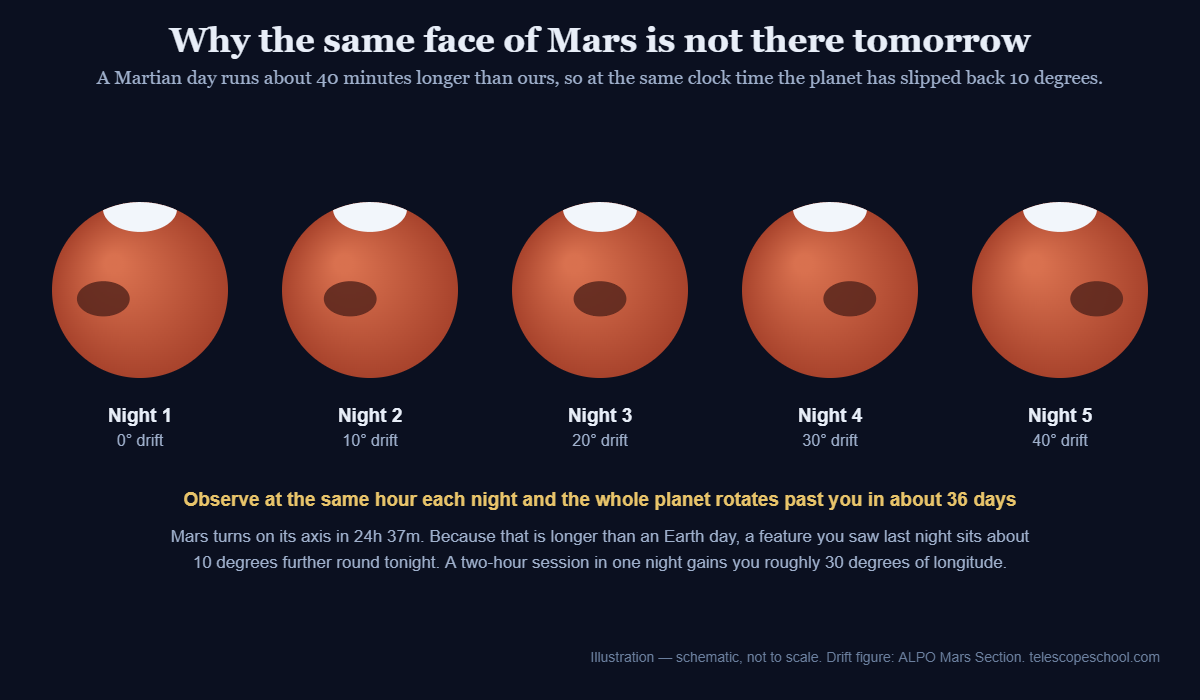
Mars turns on its axis in about 24 hours 37 minutes, and the Martian solar day — the sol — runs roughly 40 minutes longer than an Earth day. The consequence is elegant and genuinely useful.
Because Mars rotates through slightly less than a full 360 degrees in one of our days, a feature you saw last night appears about 10 degrees of longitude further east at the same clock time tonight. Observe at the same hour every night and the whole planet slowly rotates past you over about 36 days.
Two practical uses. If Syrtis Major was not facing you tonight, wait a few nights and it will be. And if you observe for two hours in a single session, you gain about 30 degrees of longitude — enough to watch a feature move measurably across the disc within one sitting.
From experience: I have looked at Mars with that same Astronomers Without Borders 130mm and I have never been as satisfied as I was with Saturn’s rings. It is still hard to separate what I am actually seeing from what I want to see. That is a good part of why I moved toward astrophotography — imagination cannot show up in an image.
Filters for Mars: what actually helps
Mars is the one planet where colour filters have a defensible case, because its dark markings differ from the bright deserts mostly in red-channel contrast.
| Filter | Use |
|---|---|
| #21 orange / #23A light red | Darkens the orange desert regions so dark albedo markings stand out. The most recommended single filter for Mars. |
| #25 red | Stronger version of the above; sharpens the polar cap edge and outlines dust clouds. Needs more aperture — it cuts a lot of light. |
| #80A blue / #38A | Brings out atmospheric clouds, hazes and the polar hood. Clouds appear bright, surface goes dark. |
| #56 / #58 green | Polar caps, low clouds and surface fog. |
An honest counterpoint is worth stating, because most articles do not: some very experienced planetary observers argue that colour filters deliver a negligible contrast boost on Mars and that a beginner’s money is better spent elsewhere, recommending at most a #21 orange. Both positions are held by people who observe a great deal. If you are buying one filter, make it the orange, and treat it as a modest improvement rather than a transformation. A 1.25-inch #21 orange filter is inexpensive enough to test the question yourself.
A practical observing plan for the 2027 apparition
- October–December 2026. Mars grows from 6 to about 9 arcseconds. Use this period to learn the field and get comfortable at high power. The north polar cap becomes clear of terminator shadow by late November.
- January 2027. Retrograde motion begins on 10 January and Mars brightens quickly. This is when serious observation starts paying off.
- Mid-January to late March 2027. The core window. Mars is above about 12 arcseconds, high in Leo for northern observers, and near its brightest.
- April–June 2027. Shrinking but still useful. Retrograde ends 1 April. Watch for dust cloud activity around late May.
- July 2027. Drops below 6 arcseconds. The apparition is over.
Frequently asked questions
What magnification do I need to see Mars?
The polar cap shows at around 50x in almost any telescope near opposition. For dark surface markings, plan on 150x to 250x. Telescopes of 114mm and smaller should generally stay at or below 200x. Higher powers of 300x or more only pay off on nights of genuinely steady seeing.
Why does Mars look like a plain orange dot in my telescope?
Almost always timing rather than equipment. Outside the months around opposition Mars can be as small as 3.5 arcseconds, which is smaller than Uranus. Check the current apparent diameter before blaming your telescope — in September 2026 it is about 5 arcseconds, and no instrument will show markings at that size.
When is the next Mars opposition?
19 February 2027, at 15:44 UT, in the constellation Leo, at magnitude −1.2 with a 13.8-arcsecond disc. The one after that is 25 March 2029. The next genuinely large opposition is 27 June 2033, at 22.1 arcseconds.
Can you see the polar ice caps on Mars with a small telescope?
Yes. The polar cap is the most accessible Martian feature and shows in small telescopes at about 50x when Mars is near opposition. For the 2026–27 apparition it is the north cap that faces Earth.
Can you see Phobos and Deimos?
Realistically, no, for most amateurs. Deimos is generally reported to need 8 inches or more, Phobos the same plus an occulting bar to block the planet’s glare; Celestron suggests 11 inches for both. They sit very close to a very bright planet, which is the whole difficulty.
Do I need a red filter to see anything on Mars?
No. The polar cap and the largest dark markings are visible without any filter. An orange or light-red filter improves contrast on the dark regions, and it is the one worth trying first — but plenty of experienced observers consider the improvement modest.
The short version
Mars rewards planning more than spending. Wait for the apparition window rather than checking randomly, get the telescope outside early, observe when Mars is high, and use the 10-degree nightly drift to work your way around the planet over a few weeks. The 2027 opposition is a small one, so go in expecting a crisp 13.8-arcsecond disc with a bright north polar cap and Syrtis Major swinging past — which is a genuinely good sight, honestly described.
For the wider context, our complete guide to viewing planets covers the other six, and choosing a telescope for planetary observing covers the hardware.
Mars has never fully satisfied me through the eyepiece; separating real detail from wishful thinking is genuinely hard. Expect subtlety.
These May Help Too...
Can You Use a Telescope Through a Window? (And Why You Should Not)
Using a telescope through a window ruins the view: bad glass, heat currents and reflections. Here is what actually happens, and what to do instead.
Telescope will not come to focus? The cause is almost always spacing, not optics. Work out whether you ran out racking in or out, then fix that end.