

Quick answer
Venus shows a full set of Moon-like phases through any telescope, and about 50x is enough to see them clearly. The counterintuitive part is when to look: Venus is best observed in bright twilight or even full daylight, when it sits higher in the sky and its overwhelming glare is tamed by a bright background. In a dark sky it is a dazzling white blob that hides its own shape.
Venus is the brightest object in the night sky after the Moon, reaching magnitude −4.9 at its best. It is also the planet beginners most often find disappointing, for a reason that has nothing to do with their telescope and everything to do with when they pointed it.
Right now that matters more than usual. Venus is an evening object through September 2026 and reaches greatest brilliancy on 18 September, at about magnitude −4.8, showing a large thin crescent roughly 40 arcseconds across. This is the best Venus will look for months.
Last Updated: September 2026 | Will Montgomery holds a B.S. in Engineering from Penn State and came back to amateur astronomy at 50, observing from suburban York, PA (Bortle 5-6).
Where Venus is right now: the 2026–27 apparition
Venus passed greatest eastern elongation on 15 August 2026, standing 46 degrees from the Sun, 49 percent lit and 24.5 arcseconds wide. Since then it has been swinging toward Earth — getting larger, thinner and briefly brighter.
| Date | Event | What you will see |
|---|---|---|
| 15 Aug 2026 | Greatest eastern elongation (46°) | Half-lit disc, 24.5″, highest in the evening sky |
| 14 Sep 2026 | Lunar occultation (parts of Asia, Africa, Europe) | Moon passes in front of Venus |
| 18 Sep 2026 | Greatest brilliancy, mag −4.8 | Large thin crescent, roughly 40″ |
| 24 Oct 2026 | Inferior conjunction | Between Earth and Sun — do not observe |
| Nov 2026 | Re-emerges as the morning star | Thin crescent before dawn, thickening |
| 29 Nov 2026 | Morning greatest brilliancy | Large crescent, brightest again |
| 3 Jan 2027 | Greatest western elongation | Half-lit disc in the pre-dawn sky |
The practical takeaway: the next six weeks are the best of this evening apparition, and after late October Venus moves to the morning sky. Note the caution on inferior conjunction — Venus is then very close to the Sun in the sky, and that is a period to stay away from with any optical instrument.
Why Venus has phases
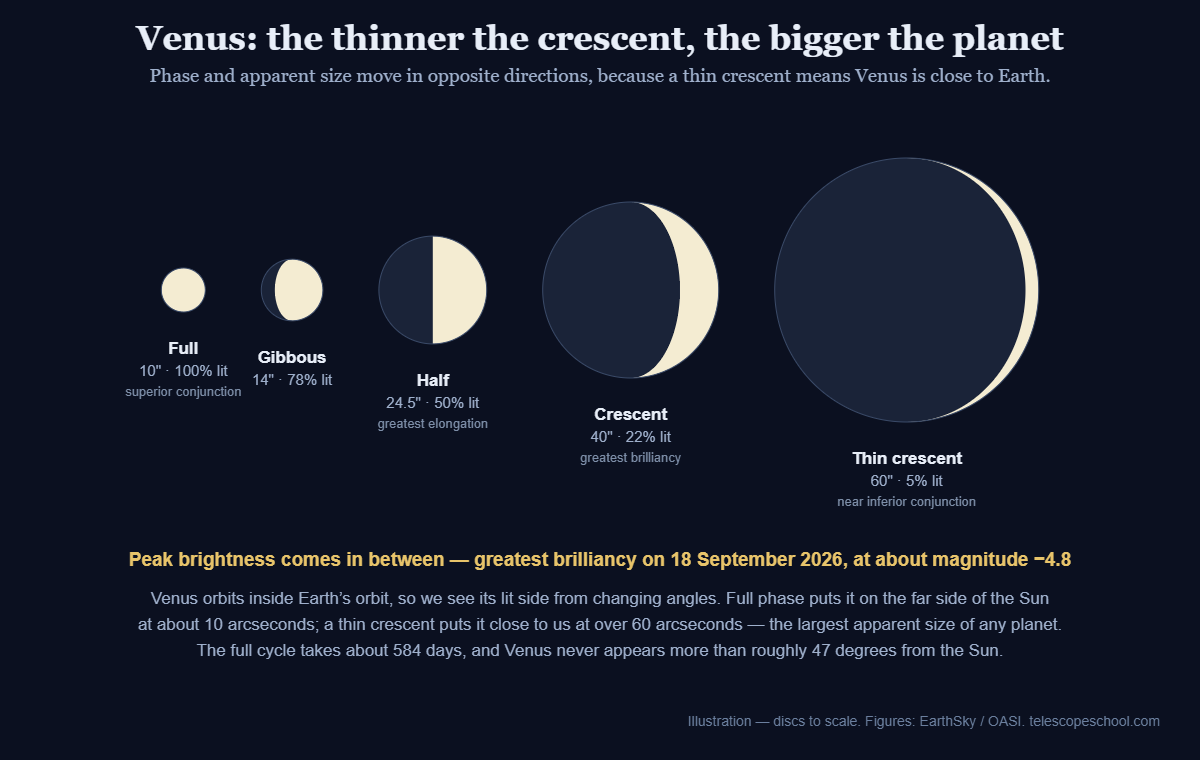
Venus orbits inside Earth’s orbit, so we see its sunlit side from constantly changing angles — exactly as we do with the Moon. Galileo’s observation of the full phase cycle in 1610 was direct evidence that Venus orbits the Sun rather than the Earth, which is a reasonable thing to think about while you are looking at it.
The part that surprises people is the inverse relationship between phase and size. When Venus is “full,” it is on the far side of the Sun from us — about 10 arcseconds across and unremarkable. When it is a thin crescent, it is close to Earth and over 60 arcseconds across, the largest apparent size of any planet.
So the thinnest crescents are the biggest and most dramatic views, and the full phase is the least interesting. Brightness peaks in between, at greatest brilliancy, where a fairly large crescent still catches enough sunlight — which is precisely where Venus sits on 18 September 2026.
The whole cycle takes about 584 days — Venus’s synodic period, roughly 19.5 months between one inferior conjunction and the next. Venus never appears more than about 47 degrees from the Sun, which is why it is always an evening or morning object and never visible at midnight.
The expert tip: stop observing Venus in the dark
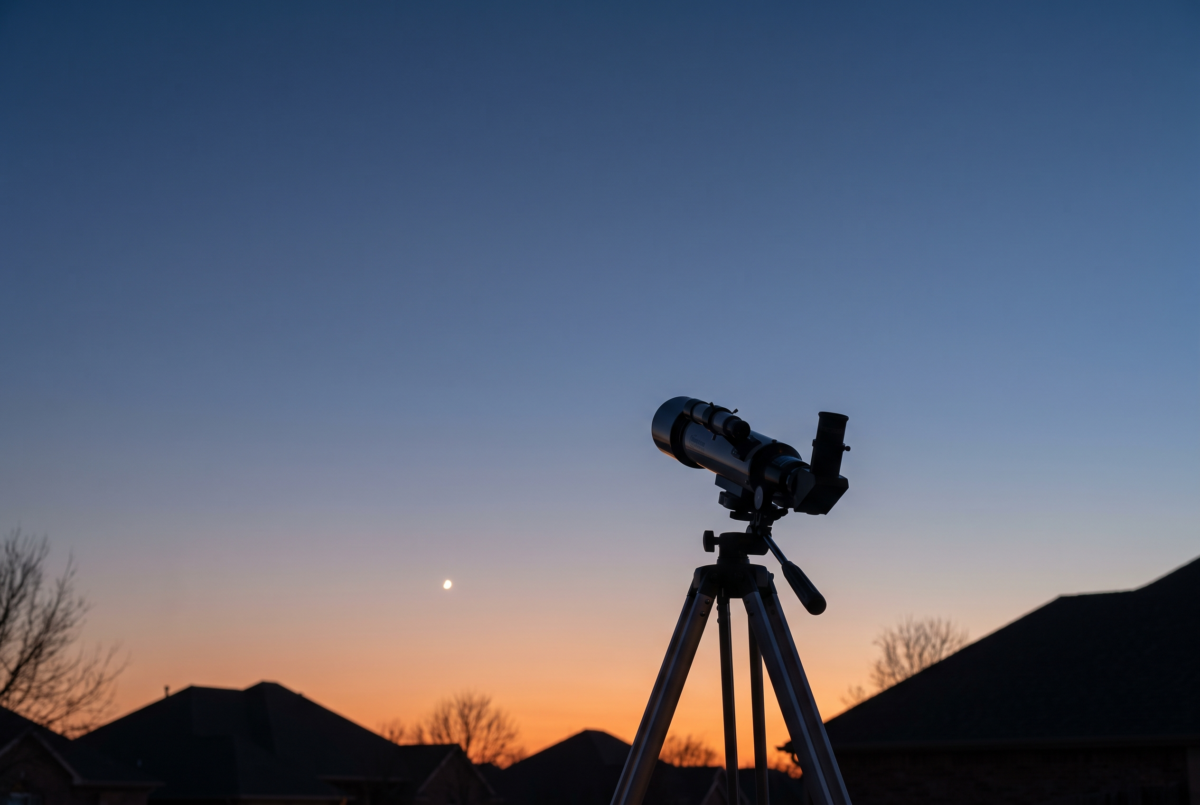
Most beginner guides send you outside after sunset. That is the worst time to observe Venus, for three compounding reasons.
Glare. Against a dark sky, Venus is so bright that it overwhelms the eye. William Herschel complained that it dazzles the sight and exaggerates every imperfection of the telescope, and that is still exactly right. Subtle shading vanishes and the disc blooms into a shapeless white blaze.
Altitude. By the time the sky is fully dark, Venus is usually low, and low means looking through several times as much turbulent air. Observing below about 30 degrees of altitude is not recommended for anything that demands detail.
Atmospheric dispersion. Near the horizon, the atmosphere acts as a prism and splits the crescent into a smeared spectrum, red along one edge and blue along the other. This has been documented as low as 7 degrees altitude and it destroys any chance of seeing the terminator cleanly.
The fix is to observe in twilight — or in full daylight, when Venus can be far higher in the sky. Against a bright blue background the contrast is gentle, the glare is gone, and the phase snaps into view. Experienced Venus observers do most of their work this way.
How to find Venus safely in daylight
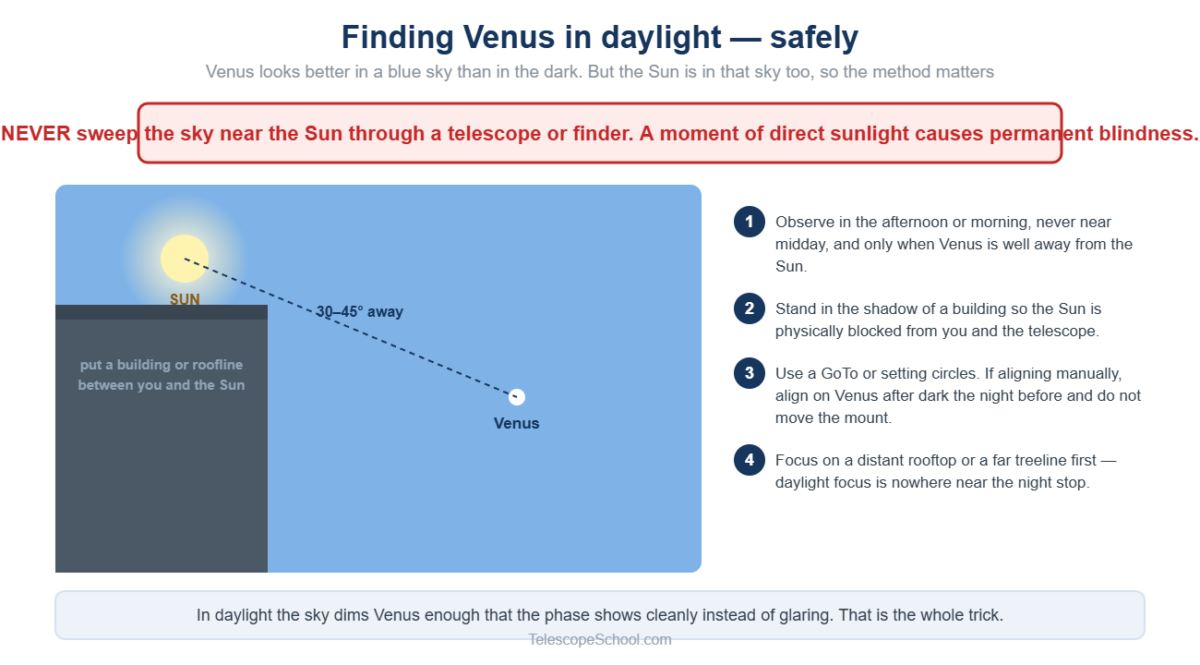
This needs stating plainly, because it involves pointing a telescope at a sky containing the Sun.
Never sweep the sky near the Sun looking for Venus, and never observe near inferior or superior conjunction. Sunlight through a telescope will cause permanent eye damage instantly, with no warning. If you cannot be certain the Sun is not in the field, do not look.
The safe methods are all about knowing where Venus is before you point:
- Observe from shade. Position yourself so a building, wall or roof edge physically blocks the Sun from the telescope and from you. This is the simplest safeguard.
- Use a GoTo mount or setting circles. Slew directly to Venus by coordinates rather than searching.
- Acquire it early and follow it up. Find Venus in twilight or before sunrise, then keep tracking it as the sky brightens.
- Use the Moon as a signpost. When the Moon passes near Venus — as on 13–15 September 2026 — find the Moon first, then work across.
What you will actually see
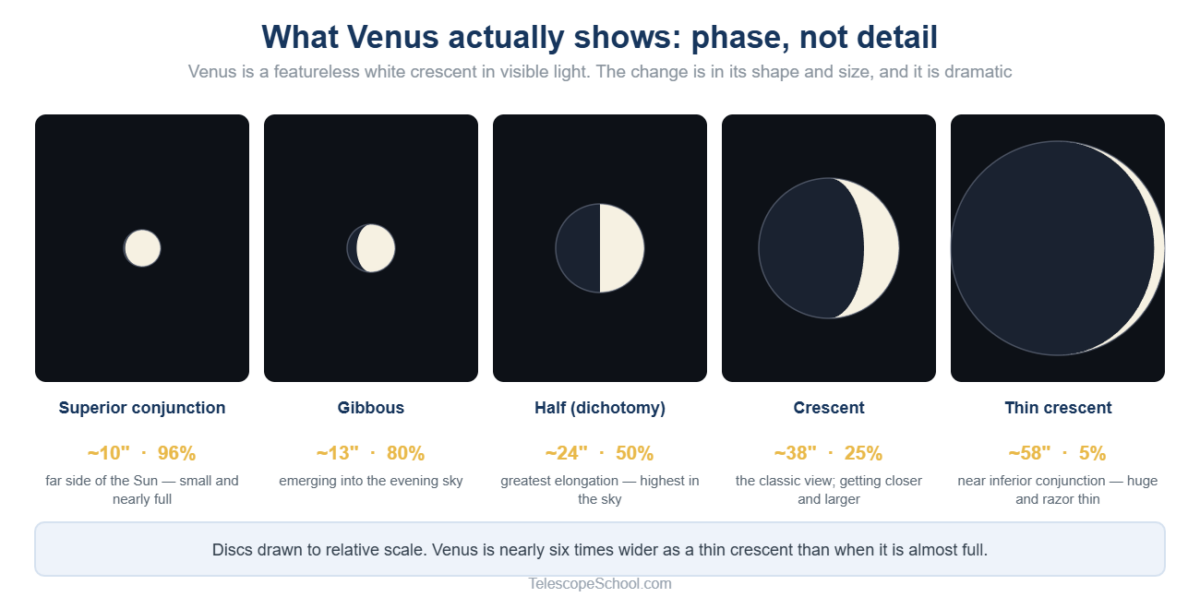
The phase. Crisp, unmistakable and the main event. About 50x shows it clearly; 50 to 100x is the comfortable working range. Venus takes high power poorly — beyond about 300x there is rarely any benefit, because there is nothing more to resolve.
Nothing on the surface. Ever. Venus is wrapped in a permanent deck of sulfuric-acid cloud, and in visible light the disc is essentially featureless white. Anyone who tells you they saw Venusian landscape did not. This is not a limitation of your telescope.
Occasionally, cloud shadings. Faint dusky Y-, C- or psi-shaped markings in the cloud tops are sometimes glimpsed, typically needing larger aperture and a violet or blue filter. Cusp caps — brighter patches at the horns of the crescent — and cusp collars are more attainable.
Two things worth chasing once the phase gets boring
The Schröter effect
Dichotomy is the moment Venus is exactly half lit. In theory it is predictable to the minute. In practice, the observed half-phase arrives several days early at evening (eastern) elongations and several days late at morning (western) ones. Johann Schröter first recorded the discrepancy in 1793; Patrick Moore named it.
The cause is light scattering in Venus’s dense atmosphere, which eats into the terminator. It shows more strongly in a blue filter and less in yellow or red — which is itself a nice piece of evidence for the mechanism.
You can observe this with a 3-inch telescope. The method: start watching about two weeks before predicted dichotomy and estimate the phase every clear evening. The terminator looks straight for about four days, so record the whole run rather than trying to catch a single night. The next opportunity is around the 3 January 2027 western elongation, where dichotomy should run late.
The ashen light
A faint glow reportedly seen on the unlit night side of the crescent, first described in 1643 by Riccioli. It has never been convincingly photographed, and after nearly four centuries it remains genuinely unresolved. Proposed explanations include lightning, airglow, aurorae, and the 460°C surface glowing faintly through thin cloud — the last of which gained some indirect support from Parker Solar Probe’s near-infrared imaging of the night side.
To look for it you need to hide the bright crescent. Observers use an occulting bar — in its simplest form a strip of foil or a fine wire taped across the field stop of the eyepiece, positioned so the lit crescent sits behind it while the dark limb stays visible. It is a genuinely fun DIY project and it costs nothing.
Treat any sighting sceptically. The eye invents a lot of faint glow next to a very bright object, which is precisely why the controversy has lasted this long.
Filters for Venus
Filter advice for Venus is frequently wrong, including on pages that rank well. Here is what holds up.
| Filter | What it is for |
|---|---|
| Yellow (W12 / W15) | Cuts glare and sharpens the terminator. W15 is the standard the British Astronomical Association uses for phase drawings |
| Neutral density / variable polarizing | Reduces overall brightness for comfort. Some observers find it adds nothing but comfort — which on Venus is still worth something |
| Violet (W47) | The classic cloud-marking filter. It dims heavily, so realistically 8 inches of aperture or more |
| Blue (W38A / W80A) | A gentler alternative for cloud shadings in smaller telescopes |
One correction worth making: orange and red filters are sometimes recommended for Venus, but their real use is cutting daytime sky brightness when you are observing against a blue sky — not reducing the planet’s own glare. For glare, reach for yellow or neutral density. A variable polarizing filter lets you dial the brightness down continuously, which suits Venus better than a fixed density.
From experience: I have never had a good Venus. It has always been too low for me, and the few times I have caught it at night it was just a bright sphere with no real detail.
A simple observing plan
- Check where Venus is in its cycle before you set up. Phase and size change week to week, unlike any other planet.
- Go out in twilight, not darkness. Start about 20–30 minutes before sunset if Venus is an evening object.
- Let the telescope cool for 30 to 45 minutes — Venus is a high-magnification target and warm optics will cost you the terminator.
- Start at about 50x to confirm the phase, then work up to 100x. Stop when the image softens.
- Try a yellow filter and compare directly with no filter. The difference on Venus is usually obvious.
- Sketch the phase. Even a rough circle with the terminator drawn in builds a record, and it is how amateurs have contributed to the Schröter effect question for two centuries.
Frequently asked questions
What does Venus look like through a telescope?
A brilliant white crescent, half-disc or small gibbous disc, depending on where it is in its 584-day cycle — very much like a miniature Moon. There is no surface detail and no colour beyond white, because the planet is permanently covered in cloud.
What magnification do I need to see the phases of Venus?
About 50x shows the phase clearly, and 50 to 100x is the practical working range. Venus does not reward high magnification, since there is no fine detail to resolve — beyond roughly 300x you are just magnifying glare.
Why does Venus look like a blurry white blob in my telescope?
Almost always glare plus low altitude. Observe in bright twilight rather than darkness, wait until Venus is more than about 30 degrees up if you can, and try a yellow filter. The phase usually appears immediately once the background sky is brighter.
Can you see Venus during the day?
Yes, and it is the preferred way to observe it, because Venus is much higher in the sky. It requires care: never sweep near the Sun, and use a GoTo mount, setting circles, or a building blocking the Sun to make it safe.
Why is Venus so bright?
It is close to Earth, close to the Sun, and wrapped in highly reflective cloud that returns more than two-thirds of the sunlight hitting it. At best it reaches about magnitude −4.9, bright enough to cast shadows in a dark location and to be seen with the unaided eye in daylight if you know exactly where to look.
Can you see any surface features on Venus?
No. The sulfuric-acid cloud deck permanently hides the surface at visible wavelengths. What can occasionally be glimpsed are faint markings in the cloud tops, usually with a violet or blue filter and a larger telescope, plus brighter cusp caps at the horns of the crescent.
The short version
Venus is easy to find and easy to get wrong. Observe it in twilight or daylight rather than a dark sky, keep the magnification modest, expect a phase rather than detail, and treat the Schröter effect and the ashen light as the long-game projects that make it interesting year after year. If you are reading this in September 2026, get outside before late October — greatest brilliancy on the 18th is the best view this apparition offers.
For the other planets, see our complete guide to viewing planets, and the 2026 planet viewing calendar for what else is up.
I have never had a good view of Venus from my own yard — it is always too low. That is honest, and it is why patience matters as much as optics here.
These May Help Too...
Can You Use a Telescope Through a Window? (And Why You Should Not)
Using a telescope through a window ruins the view: bad glass, heat currents and reflections. Here is what actually happens, and what to do instead.
Telescope will not come to focus? The cause is almost always spacing, not optics. Work out whether you ran out racking in or out, then fix that end.