

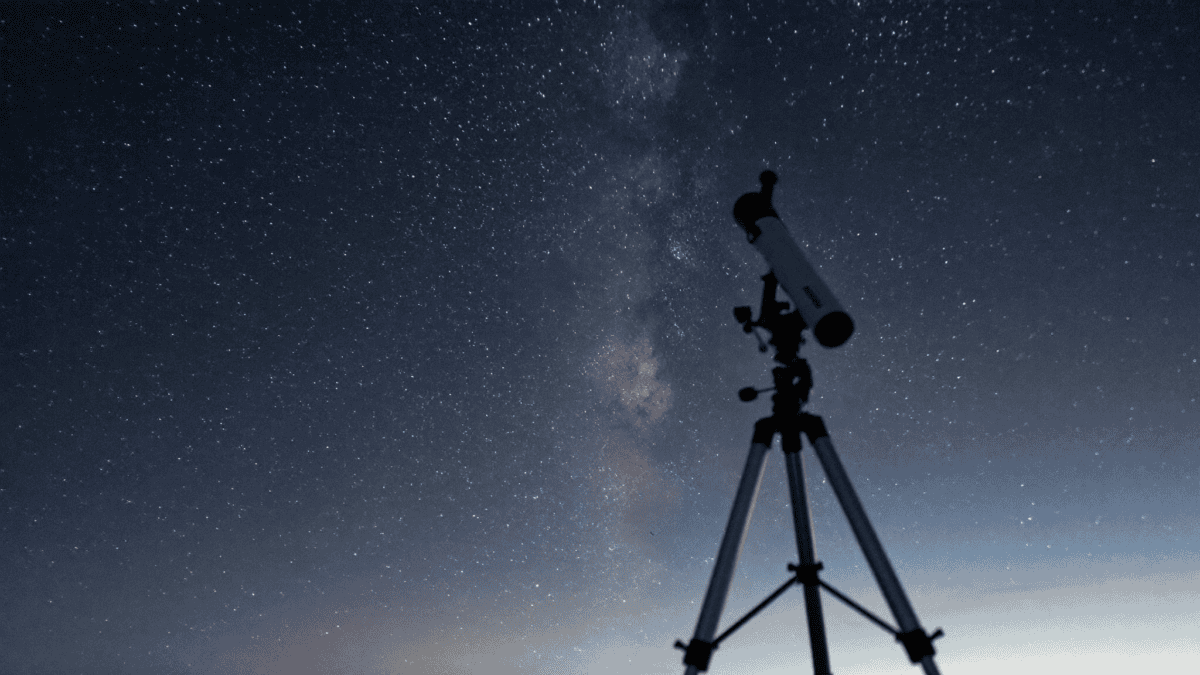
Quick answer: The Celestron AstroMaster 70AZ is a genuinely decent first refractor for the Moon, planets, and bright double stars, and at its usual street price it’s hard to beat for pure “point it up and see something real tonight” value. But the tripod is shaky, the eyepieces are basic, and the box’s magnification claims are fiction. It’s worth buying for a curious beginner or a gift, provided you go in with realistic expectations and budget maybe $30 more for a couple of upgrades.
I’m Will Montgomery. I’ve got a B.S. in engineering from Penn State, and I spent a manufacturing career doing one thing over and over: measuring whether a machine actually meets the spec printed on the sheet. That’s a useful habit to bring to a telescope review, because telescopes are one of the most spec-inflated products in consumer retail. I got back into astronomy at 50 after letting a scope sit dead in a closet for 25 years, and I now observe from my backyard in York, PA, which sits in a Bortle 5 to 6 light-dome. So when I tell you what this scope shows, it’s from real skies with real light pollution, not a dark-site fantasy.
The AstroMaster 70AZ is perpetually one of the best-selling entry refractors on Amazon, and that popularity is exactly why it deserves an honest, unhurried look. Let me measure it against its own spec sheet.
Last Updated: July 2026 | Will Montgomery holds a B.S. in Engineering from Penn State and came back to amateur astronomy at 50, observing from suburban York, PA (Bortle 5–6). This review reflects what the scope actually does under a real backyard sky.
What are the Celestron AstroMaster 70AZ’s specs?
Here are the numbers that matter, pulled from Celestron’s own documentation and confirmed against current retailer listings.
| Spec | Detail |
|---|---|
| Aperture | 70mm (2.76 inches) |
| Focal length | 900mm |
| Focal ratio | f/12.9 (Celestron rounds it to f/13) |
| Mount | Manual alt-azimuth (up/down, left/right) on a steel tripod |
| Eyepieces included | 20mm (45x) and 10mm (90x), 1.25-inch |
| Finder | StarPointer red-dot finder |
| Optical tube weight | 2.9 lbs |
| Total kit weight | ~10.8 lbs |
| Highest useful magnification | 165x (Celestron’s own figure) |
| Best for | Moon, planets, bright double stars, brighter star clusters |
Street price bounces around. Celestron’s MSRP is about $200, but on Amazon it typically lands in the $130 to $180 band and dips lower on sale events. Confirm the live price before you buy, because at $200 the value argument weakens and at $130 it gets very strong.
What can you actually see through the AstroMaster 70AZ?
You can see a lot more than a skeptic expects, and less than the marketing implies. That’s the honest middle ground, and it’s where most beginner refractors live.
The Moon is the star of the show. At 45x with the 20mm eyepiece, the whole disc snaps into a bright, high-contrast image, and along the terminator (the line between lunar day and night) you’ll see crater rims throwing shadows, mountain ranges, and the smooth dark maria. Bump to 90x with the 10mm and you can prowl individual craters. This is the view that hooks people, and the 70AZ delivers it cleanly.
Saturn is the second jaw-dropper. Under steady air at 90x, the rings resolve as an actual separate structure around the planet, not a fuzzy oval. It’s small, but it’s unmistakably Saturn, and seeing it live for the first time is a genuinely different experience than any photo. If Saturn is your goal, I wrote a full walkthrough on how to see Saturn’s rings through a telescope that applies directly to this scope.
Jupiter shows its disc plus the four bright Galilean moons strung out like tiny beads, and on a steady night you can catch the two main equatorial cloud belts as darker stripes. Venus shows phases like a miniature moon. Brighter star clusters like the Pleiades and the Beehive look terrific in the wide 45x field. Bright double stars split nicely. A handful of the brightest deep-sky objects, the Orion Nebula for instance, are visible as faint gray smudges, but that’s the honest ceiling.
What you will not see: colorful galaxies and nebulae like the Hubble pictures. A 70mm lens gathers roughly 100 times the light of your naked eye, which sounds huge until you remember how faint deep-sky objects really are. From my Bortle 5 to 6 backyard, faint galaxies are essentially off the menu with this aperture. That’s not a defect of this specific scope; it’s physics. If you set up and feel like nothing is there, read why you can’t see anything through your telescope before you blame the equipment, because nine times out of ten it’s technique, focus, or target choice.
What are the AstroMaster 70AZ’s real weaknesses?
The weaknesses are real and worth knowing before you buy, because every one of them is a solvable annoyance rather than a dealbreaker. As an engineer, I’d rather you hear them now than discover them cold in the dark.
The tripod is the biggest problem. It’s a lightweight steel affair, and while it holds the little tube up fine, it wobbles. Touch the focuser at 90x and the image bounces for two or three seconds before it settles. On a breezy night it’s worse. This is the single most common complaint about the 70AZ, and it’s legitimate. The good news is that it’s manageable: spread the legs wide, keep them low, and hang a small weight (a water jug or a bag of sand) from the accessory tray to damp the vibration.
The eyepieces are basic. The 20mm and 10mm that come in the box work, but they’re simple designs with a narrow apparent field and soft edges. The 10mm in particular is where you feel the cost-cutting, which is a shame because that’s the eyepiece you reach for on planets.
There’s no computer finding and no tracking. This is a fully manual scope. You aim it by hand using the red-dot finder, and because the sky drifts, you’ll re-nudge the tube every 20 to 40 seconds to keep a planet centered at 90x. For a beginner learning the sky, I actually consider this a feature, not a flaw. But if you were expecting to type in “Saturn” and have the scope point itself, this isn’t that.
The magnification claims are the one thing that genuinely annoys me. You’ll see this scope and its accessory bundles marketed with figures like “up to 300x” or higher. That is false advertising, full stop. A 70mm telescope has a hard physical ceiling of roughly 140x (the classic rule of about 50x per inch of aperture), and even Celestron’s own spec sheet honestly lists the highest useful magnification as 165x. Push past that and you get a big, dim, blurry blob, not a better view. Anyone selling you 300x on a 70mm tube is selling empty magnification. I explain the math in plain English in the 50x rule guide to magnification limits, and it’s the single most important thing a beginner can understand before shopping.
Celestron AstroMaster 70AZ pros and cons
Here’s the balance sheet, the way I’d write it up after a bench evaluation.
Pros
- Genuinely good optics for the price. The 70mm objective is fully coated and gives crisp, high-contrast Moon and planet views with well-controlled color.
- Long f/13 focal ratio is beginner-forgiving. Slow refractors are easy to focus, deliver sharp planetary views, and hide the flaws of cheap eyepieces better than fast scopes do.
- Sets up in minutes with no tools. The alt-az mount is intuitive: up, down, left, right. No polar alignment, no learning curve.
- Light and portable. At under 11 pounds for the whole kit, it’s easy to carry to the backyard or the car.
- Great real-world value. When it’s priced in the $130 to $160 range, little else shows you Saturn’s rings for the money.
Cons
- Shaky tripod. The mount vibrates and needs a stability tweak to be comfortable at higher power.
- Basic eyepieces. Functional but soft-edged, especially the 10mm.
- Fully manual, no tracking. Objects drift out of view and need constant re-nudging.
- Inflated magnification marketing. Advertised max powers are physically impossible; ignore them.
- Deep-sky is limited. 70mm and a light-polluted sky means faint galaxies and nebulae are largely out of reach.
Who should buy the AstroMaster 70AZ, and who should skip it?
From experience: I won’t call it useless — plenty of owners enjoy it as a lightweight Moon and grab-and-go scope. My honest take: it’s a reasonable little Moon scope for finding out whether a child is genuinely interested before you spend real money. It’s cheap, easy to find used, and a single better eyepiece improves it noticeably from day one.
Buy it if you’re a genuine beginner who wants a real, no-drama first look at the Moon and planets without spending much. It’s an excellent fit for a curious adult dipping a toe in, an older child or teen with an interested parent nearby, or as a gift for someone who’s always said “I’d love to see Saturn someday.” If you want to actually learn the night sky by hand, the manual alt-az mount is a good teacher. It also travels well, so it suits apartment dwellers and anyone who has to carry gear out to escape the streetlights.
Skip it if your real interest is faint deep-sky objects, galaxies, and nebulae, because 70mm simply doesn’t gather enough light for that. Skip it if you want astrophotography beyond snapping the Moon with a phone; this mount can’t track and isn’t built for it. And skip it if a shaky tripod would frustrate you into quitting rather than tinkering.
If either of those describes you, spend a little more. A small tabletop Dobsonian like the Sky-Watcher Heritage 100P or 130P gives you noticeably more aperture and a rock-steady base for a similar or slightly higher price, and it’s my usual “one step up” recommendation. The Gskyer 70mm is a comparable refractor if you specifically want the same form factor from a different brand. I compare the field broadly in my best telescope for beginners guide and in the best telescope under $200 roundup, both of which put the 70AZ in context against everything else at this price.
What upgrades are worth buying for the AstroMaster 70AZ?
A few cheap add-ons transform this scope, and none of them cost much. This is where the 70AZ punches above its weight, because the optics are good enough to reward better accessories.
- Stabilize the tripod first, and it’s free. Hang a weight from the accessory tray, keep the legs low and wide, and let go of the tube before you look. This alone fixes most of the wobble complaints.
- A better 6mm to 9mm planetary eyepiece (a “gold-line” or similar budget wide-field, roughly $25 to $40) gives sharper, higher-contrast views of Saturn and Jupiter than the stock 10mm and is the single best upgrade.
- A Moon filter (about $10 to $15) cuts the glare so you can study lunar detail without your eye watering. The full Moon through 70mm is genuinely dazzling.
- A proper star chart or a free app like Stellarium so you can actually find things. The scope has no computer; the sky knowledge is on you, and it’s the most rewarding part.
Notice what’s not on that list: a “3x Barlow to reach 270x.” Don’t. You’d be chasing magnification the optics can’t support. Better glass beats more power every time.
Is the Celestron AstroMaster 70AZ worth it in 2026?
Yes, with clear eyes about what it is. Measured against its own honest spec sheet, the AstroMaster 70AZ meets spec: 70mm of decent coated glass, a beginner-friendly f/13 tube, and views of the Moon, Saturn, and Jupiter that genuinely deliver. It falls short only where the marketing overreaches, on tripod stability and fantasy magnification numbers, and both of those are things you can manage or ignore. For a first telescope bought with realistic expectations and $30 in smart upgrades, it remains one of the safest entry buys on the market.
The scope that sits in a closet for 25 years, like mine did, isn’t the one that was too cheap. It’s the one nobody knew how to use. The 70AZ is simple enough that you’ll actually use it, and that matters more than any spec.
Check the current price of the Celestron AstroMaster 70AZ on Amazon
Frequently asked questions
Is the Celestron AstroMaster 70AZ good for beginners?
Yes. It’s one of the most beginner-friendly refractors available: it assembles in minutes with no tools, the alt-az mount is intuitive to aim by hand, and the long f/13 optics are easy to focus and forgiving of cheap eyepieces. Its main quirks, a shaky tripod and inflated magnification claims, are easy to work around once you know about them.
What can you see with the AstroMaster 70AZ?
You’ll get crisp views of the Moon’s craters and mountains, Saturn’s rings, Jupiter and its four bright moons, the phases of Venus, and brighter star clusters like the Pleiades. Faint galaxies and colorful nebulae are largely beyond a 70mm scope, especially from a light-polluted backyard. Set your expectations on the Solar System and you won’t be disappointed.
What magnification can the AstroMaster 70AZ really reach?
The realistic useful ceiling is around 140x to 165x, not the 300x or higher you’ll see advertised. A 70mm telescope tops out at roughly 50x per inch of aperture, and Celestron’s own spec sheet lists 165x as the highest useful magnification. Any power beyond that just gives you a big, dim, blurry image.
Why is my AstroMaster 70AZ so shaky?
The lightweight steel tripod is the culprit, and it’s the scope’s best-known weakness. Spread the legs wide and low, hang a weight from the accessory tray to damp vibration, and let go of the focuser before you look. Those free tweaks fix most of the wobble at high magnification.
Is the AstroMaster 70AZ good for astrophotography?
Not really, beyond snapping the Moon with a phone held to the eyepiece. The mount is fully manual with no motorized tracking, so stars and planets drift out of the frame during any real exposure. If astrophotography is your goal, you’ll want a tracking mount, which is a different and more expensive category of gear.
I judge a beginner scope on what it actually shows and how easily it sets up, so this is an honest, engineer’s take on the AstroMaster 70AZ.
These May Help Too...
Can You Use a Telescope Through a Window? (And Why You Should Not)
Using a telescope through a window ruins the view: bad glass, heat currents and reflections. Here is what actually happens, and what to do instead.
Telescope will not come to focus? The cause is almost always spacing, not optics. Work out whether you ran out racking in or out, then fix that end.