

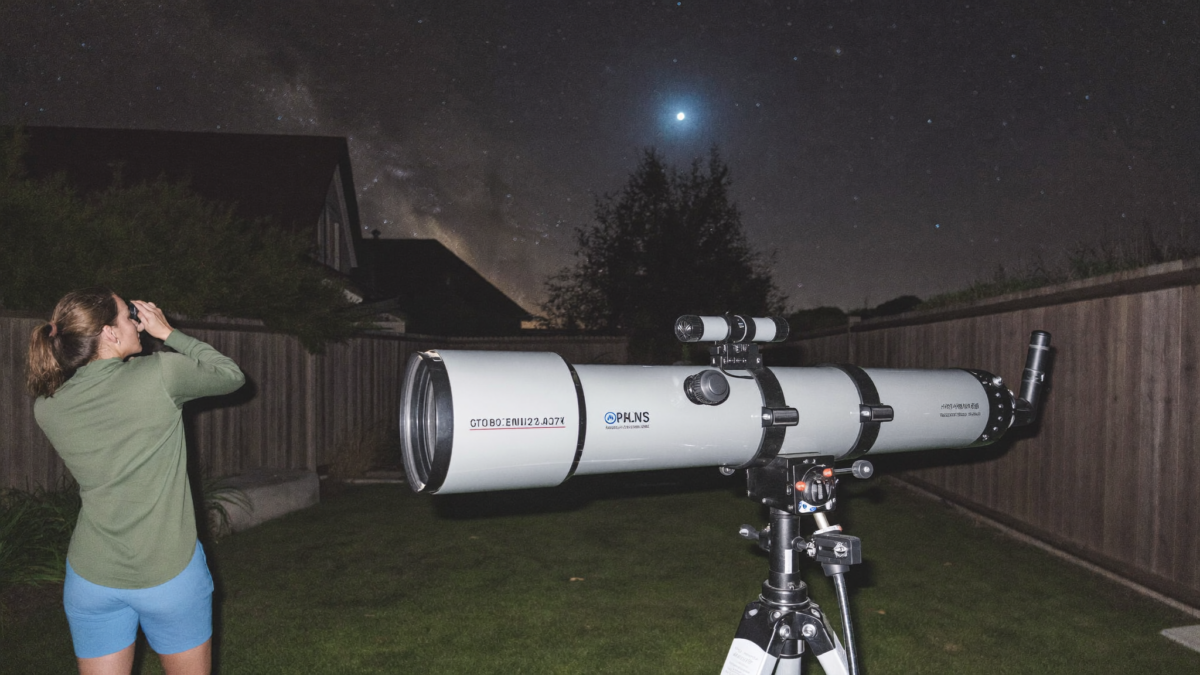
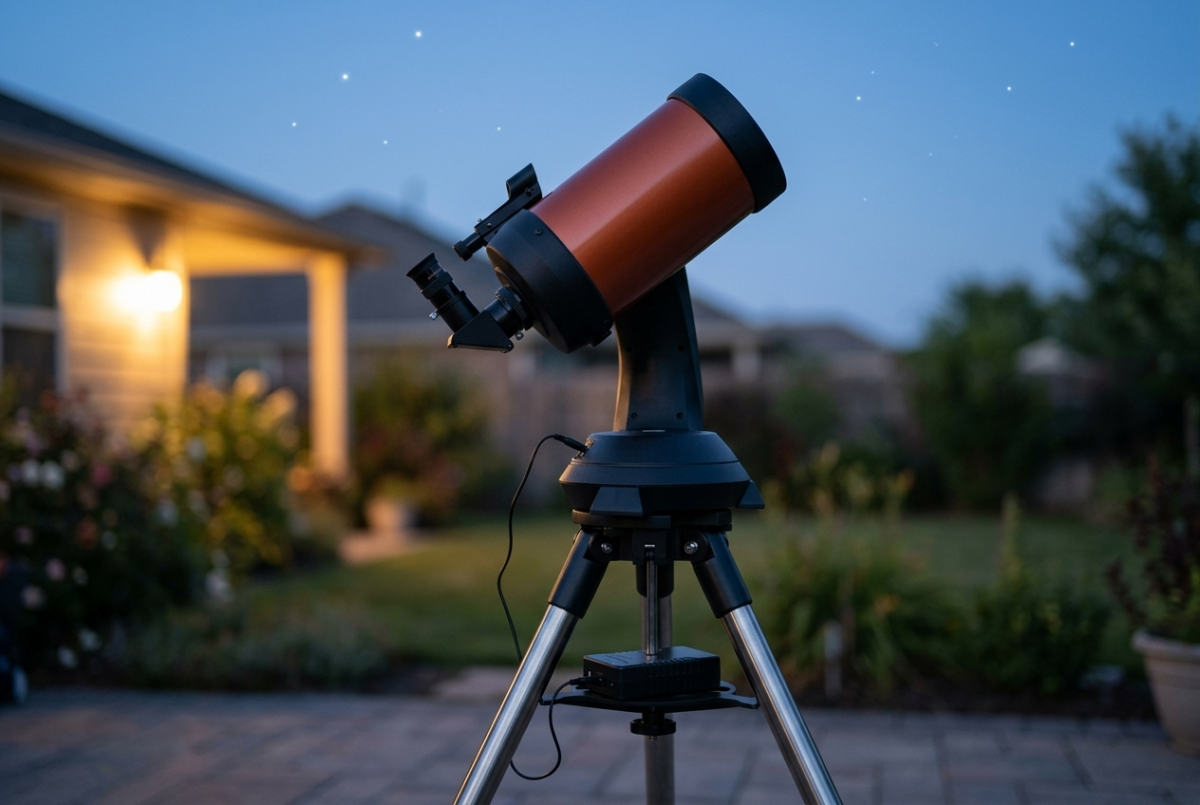
The Celestron NexStar 5SE is a genuinely good little Schmidt-Cassegrain with excellent optics and true motorized GoTo — but before you buy it, know two things: it drains AA batteries alarmingly fast, and you are paying a premium for only 5 inches of aperture. My honest verdict is “yes, but” — buy it for its portability and beautiful planetary views, plan immediately for an external power source, and seriously consider whether the 6SE is the smarter purchase.
I am an engineer (B.S., Penn State) who returned to astronomy at 50, observing from a Bortle 5–6 sky in York, Pennsylvania. I like the NexStar SE line, but I like it with clear eyes. Here is the review I wish more people read before they hit “buy.”
Quick Answer: The Celestron NexStar 5SE is a well-built 5-inch Schmidt-Cassegrain with excellent optics and true motorized GoTo, best suited to portable, high-quality planetary and lunar views. Before buying, budget for an external power source because it drains AA batteries fast, and seriously compare it against the 6SE, which adds aperture for a modest step up in price.
Celestron NexStar 5SE specifications
The 5SE is a 5-inch Schmidt-Cassegrain on a single-fork-arm motorized GoTo mount, and its folded optics make it remarkably compact for its focal length. Here are the verified numbers; note the price varies widely by retailer.
| Spec | Celestron NexStar 5SE |
|---|---|
| Optical design | Schmidt-Cassegrain (compound/catadioptric) |
| Aperture | 125mm (5 inch) |
| Focal length / ratio | 1250mm, f/10 |
| Coatings | StarBright XLT |
| Mount | Single-fork-arm motorized altazimuth GoTo |
| Alignment | SkyAlign (center any 3 bright objects) |
| Database | ~40,000 objects |
| Included eyepiece | One 25mm Plossl (50x), star diagonal, red-dot finder |
| Power | 8x AA (not included) or 12V external |
| Approx. price | ~$800–$1,030 depending on retailer/sales |
How good are the optics and views?
The optics are the best part of this scope — the StarBright XLT-coated Schmidt-Cassegrain delivers sharp, high-contrast views that punch above what the modest aperture suggests. On the Moon and planets it is a treat: I have seen the Cassini Division in Saturn’s rings, Jupiter’s cloud belts and the dance of its four Galilean moons, and the phases of Venus, all crisp and steady. It handles double stars beautifully and shows the brighter Messier objects — the Orion Nebula, the Hercules Cluster, the Dumbbell — though from a light-polluted suburb the faint galaxies stay dim. For a sense of what to expect on the ringed planet specifically, see my guide on how to see Saturn’s rings.
The 1250mm focal length is a double-edged sword: it gives you reach and magnification for planets, but it also means a narrow field of view, so wide star fields and large objects won’t fit. This is a planetary and lunar specialist first, a deep-sky scope second.
The GoTo mount and setup
Unlike a push-to system, the 5SE has a real motorized GoTo mount that slews to targets and tracks them automatically once aligned. Celestron’s SkyAlign makes first-light approachable: you center any three bright objects — you do not even need to know their names — and the mount figures out the sky and drives itself to whatever you select from the hand controller, keeping it centered as Earth rotates. For a beginner who wants the telescope to do the finding, that is a real gift, and it is the key difference from a manual scope. The tradeoffs are a somewhat dated hand-controller interface, a mount that can be bumped out of alignment (requiring a re-align), and the need to re-enter the time and date each session unless you add the GPS accessory.
The battery problem — and how to fix it
The single biggest complaint about the 5SE is that it burns through 8 AA batteries in roughly two to four hours, and it gets worse in the cold. This is not a minor gripe; it will end your night early and it wastes money. Rechargeable AAs actually make it worse, because their lower 1.2-volt output under-powers the mount. The fix that essentially every owner adopts is external 12V power: a Celestron PowerTank or PowerTank Lithium (roughly $100–$150), a generic 12V rechargeable jump-pack or LiFePO4 battery (roughly $30–$60), or a 12V AC adapter when observing at home. Budget for this on day one — treat it as a required accessory, not an optional one.
Should you buy the 5SE or the 6SE?
If you can stretch the budget, the 6SE is the better buy for a small increase in size, weight, and price. Aperture is the currency of astronomy, and stepping from 125mm to 150mm gains you roughly a third more light — enough to be the difference between a featureless smudge and the first hint of spiral structure in a galaxy like M51. The 6SE also adds HyperStar compatibility for fast astrophotography and shares the sturdier mount used by the 8SE. Here is the short comparison.
| NexStar 5SE | NexStar 6SE | |
|---|---|---|
| Aperture | 125mm | 150mm |
| Focal length | 1250mm, f/10 | 1500mm, f/10 |
| Light gathering | Baseline | ~30–44% more |
| HyperStar imaging | No | Yes |
| Portability | Slightly lighter | Slightly heavier |
The 5SE still makes sense if maximum portability or the lower price is decisive, but for most buyers I would bite the bullet and get the 6SE. If GoTo convenience isn’t essential to you and value is, a Dobsonian delivers far more aperture per dollar — compare in my best Dobsonian telescopes guide, and if you’re weighing brands, my Celestron vs Sky-Watcher comparison may help.
Is the Celestron NexStar 5SE worth it?
The NexStar 5SE is worth it if you specifically want excellent planetary and lunar views in a truly portable, motorized GoTo package and you go in knowing you’ll add external power and at least one more eyepiece. It is not the best value in raw aperture, and the battery appetite is real, but the optics are lovely, SkyAlign makes it beginner-friendly, and the removable orange tube gives you an upgrade path down the road. Buy it for what it is — a compact, capable Schmidt-Cassegrain — and it will reward you. That “buy it for what it is, with eyes open” honesty is the whole idea behind TelescopeSchool.
From experience: Eight AAs were bad enough that I stopped treating them as a real power source — they sag in voltage surprisingly fast, and then tracking, slewing, and alignment start acting strange. A small 12V 6000mAh TalentCell battery strapped to the mount is what most owners settle on: no cord wrap, and it usually powers the 5SE for two or three observing nights between charges.
Frequently asked questions
Does the NexStar 5SE need extra accessories?
Yes. Plan to buy at least one or two more eyepieces (it ships with only a 25mm/50x), an external 12V power source, and ideally a dew shield; a Wi-Fi or GPS add-on is optional.
What is the battery life and best power supply?
On 8 AA batteries it runs only about two to four hours and drains faster in the cold. Almost everyone switches to an external 12V rechargeable pack — a Celestron PowerTank or a LiFePO4/jump-pack — for full nights.
NexStar 5SE vs 6SE — which should I buy?
The 6SE is usually the better buy: meaningfully more aperture and resolving power plus HyperStar support and a sturdier mount, for only a small increase in size, weight, and price.
Is the NexStar 5SE good for astrophotography?
For lunar and planetary imaging and short exposures of bright objects, yes. For serious long-exposure deep-sky it is not suited — the altazimuth base, cosmetic wedge, long focal length, and lack of autoguiding are limiting.
Is a used NexStar 5SE worth it?
A used 5SE can be a smart buy if it is priced well — these are reliable scopes. Just budget for extra eyepieces and power, and confirm the seller includes the original accessories.
What can you see with a NexStar 5SE?
It is mainly a Moon, planet, and double-star instrument — lunar craters, Saturn’s rings with the Cassini Division, Jupiter’s belts and moons, Venus’s phases — plus brighter deep-sky objects like M42 and M13. Faint galaxy and nebula detail is limited, especially from the suburbs.
Options to consider: the Celestron NexStar 5SE, the step-up NexStar 6SE, and a Celestron PowerTank Lithium for power.
I read a spec sheet the way an engineer reads a drawing, looking for what is missing. This one carries a caveat worth knowing before you buy.
These May Help Too...
Can You Use a Telescope Through a Window? (And Why You Should Not)
Using a telescope through a window ruins the view: bad glass, heat currents and reflections. Here is what actually happens, and what to do instead.
Telescope will not come to focus? The cause is almost always spacing, not optics. Work out whether you ran out racking in or out, then fix that end.