

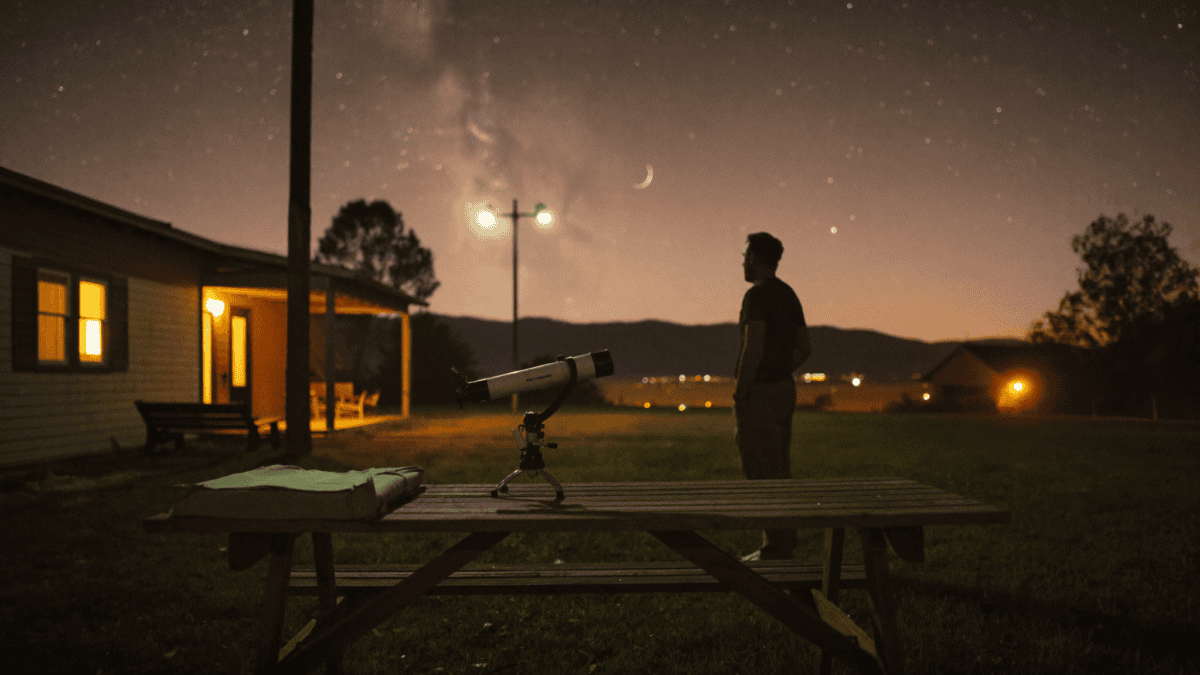
Quick answer: The best telescope under $300 in 2026 for most people is the Sky-Watcher Heritage 130P — a 130mm tabletop Dobsonian that gives you the most usable aperture per dollar and almost nothing to fight with. If it’s out of stock or over budget, the Zhumell Z130 is the same idea at a slightly lower price, and the Celestron StarSense Explorer DX 102AZ is the pick if you’d rather your phone do the star-hopping and you never want to touch a collimation screw.
Last Updated: July 2026 | Will Montgomery holds a B.S. in Engineering from Penn State and came back to amateur astronomy at 50, observing from suburban York, PA (Bortle 5–6). These picks reflect what actually holds up under a real backyard sky.
Why I trust aperture over everything else in this price range
In the $300 bracket, the single spec that changes your nights the most is aperture — the diameter of the main mirror or lens — so that’s what I optimize for first. I’m Will Montgomery. I’ve got a B.S. in engineering from Penn State, and I spent my whole career in manufacturing, which mostly meant one thing: taking a machine, putting it on a bench, and measuring whether it actually did what the spec sheet promised. It almost never did, exactly. That habit doesn’t switch off when the product is a telescope.
I came back to this hobby at 50, after my first telescope — a department-store refractor — sat in a closet for 25 years because it was frustrating garbage. So I have a low tolerance for scopes that look impressive in a marketing photo and disappoint at the eyepiece. I observe from a Bortle 5–6 backyard in York, Pennsylvania, which is to say a normal suburban sky with a glow over the horizon and maybe a couple hundred stars visible on a good night, not the thousands you’d get in the mountains. Everything I recommend here, I judge by what it does from a yard like mine, not from a dark-sky site you’ll visit twice a year.
Here’s the engineer’s-eye reality of this price band: for the same $300, you can buy a 130mm mirror on a simple base, or a 114mm mirror on a wobbly tripod loaded with plastic gears, or a 102mm lens with a smart phone app. The glass gathers the light; the mount just holds it still. Spend your money on the glass, and only pay for cleverness in the mount when the cleverness actually removes a problem you’d otherwise have.
The comparison: best telescopes under $300 in 2026
These are the models I’d actually shortlist right now. Prices move around, and a couple of these hover right at the $300 line, going a little over at full retail and dipping under on sale — I’ll flag which is which in the write-ups.
| Telescope | Type | Aperture | Price band | Best for |
|---|---|---|---|---|
| Sky-Watcher Heritage 130P | Tabletop Dobsonian (collapsible) | 130mm (5.1″) | ~$290–320 | Best all-around aperture-per-dollar; my top pick |
| Zhumell Z130 | Tabletop Dobsonian | 130mm (5.1″) | ~$230–270 | Same aperture, lower price — if you can find it in stock |
| Celestron StarSense Explorer DX 102AZ | Refractor + phone-finder app | 102mm (4″) | ~$240–290 | No collimation ever; phone guides you to targets |
| Celestron AstroMaster 114EQ | Reflector on equatorial mount | 114mm (4.5″) | ~$220–260 | Those set on an EQ mount — with real caveats |
| Sky-Watcher Classic 150P (stretch) | Floor-standing Dobsonian | 150mm (6″) | ~$380–420 | If you can push just past budget for the next tier |
Prices accurate at time of publication — check current pricing before buying.
Sky-Watcher Heritage 130P: the one I hand people first
The Heritage 130P is my top pick under $300 because it puts a real 130mm mirror over the widest possible spread of things you’d want to look at, with the fewest ways to go wrong. It’s a tabletop Dobsonian: a 130mm (5.1-inch) f/5 reflector, 650mm focal length, sitting on a simple rotating base you set on a table, a bench, or an overturned bucket. The tube collapses down to about 14 inches for storage and hauling, which matters more than you’d think — a scope that lives in a closet doesn’t get used.
Where the money went, from an engineer’s standpoint: into the mirror and into a base that just works. You point it by pushing the tube. There are no slow-motion knobs to strip, no counterweights to balance, no gears to bind. That mechanical simplicity is exactly why it’s beginner-friendly — there’s almost nothing between you and the sky.
What it does well: 130mm gathers roughly 345 times more light than your naked eye and enough to show real detail. From my Bortle 5–6 yard the Moon is jaw-dropping, Jupiter shows its cloud belts and four moons, Saturn’s rings are unmistakable, and brighter deep-sky objects — the Orion Nebula, the Andromeda Galaxy’s core, the big open star clusters — come through as genuine, if faint, smudges of light.
Where it’s honest about its limits: it’s a fast f/5 mirror, which means it needs occasional collimation (aligning the mirrors) — a five-minute job once you learn it, and I walk through it in the guide on how to collimate a reflector telescope. The open-tube collapsible design also lets in stray light and dew, so a homemade light shroud helps. And you truly need a sturdy table; the “tabletop” part isn’t optional. None of that is a dealbreaker — it’s just the trade you make for that much mirror at this price.
Check current price on the Sky-Watcher Heritage 130P
Zhumell Z130: the same smart idea, usually cheaper
The Zhumell Z130 is the Heritage 130P’s twin in every way that matters — a 130mm f/5 tabletop Dobsonian — usually sold for a bit less, so if it’s in stock and priced under the Sky-Watcher, it’s the better value. Optically they’re cut from the same cloth: same aperture, same focal length, same push-to-point simplicity, and the Z130 has traditionally shipped with a slightly more generous eyepiece set.
The catch, and it’s a real one: the Z130’s availability has been spotty. Stock comes and goes, and there’s been talk of the range being reshuffled, so verify it’s actually purchasable and not a months-long backorder before you get your heart set on it. If it’s sitting in a warehouse and shipping this week, buy it. If the listing says “notify me when available,” go with the Heritage 130P and don’t look back — you’re getting the same photons either way.
Check current price and stock on the Zhumell Z130 (Update, September 2026: no longer available — current alternative: Sky-Watcher Heritage 130 tabletop Dobsonian (~$305).)
Celestron StarSense Explorer DX 102AZ: the one that finds things for you
From experience: My blunt recommendation — get the Heritage 130P unless you have nowhere solid to set a tabletop scope, or you’re the type who’ll give up because you can’t find anything up there. In that specific case the StarSense DX 102AZ actually gets used more, and the scope that gets used beats the more capable one that sits in a closet.
The StarSense Explorer DX 102AZ is the pick if the part of astronomy that scares you off is finding anything, because it uses your phone to point you there. You dock your smartphone in a bracket, the StarSense app reads the star field through your camera, and a set of on-screen arrows walks you to whatever you asked for until it’s centered in the eyepiece. It genuinely works — this isn’t a gimmick that dies in the box — and for someone observing under light pollution, where you can’t see the faint “signpost” stars that star-hopping relies on, that’s a real advantage.
This is a 102mm (4-inch) refractor, meaning a lens up front instead of a mirror. Two engineering consequences follow from that. First: no collimation, ever. The optics are sealed and fixed, so there’s nothing to align — you take it out, you use it, you put it away. For someone who wants zero maintenance, that’s worth a lot. Second: 102mm of lens gathers less light than 130mm of mirror, so on the faintest fuzzies it gives up ground to the tabletop Dobs. The trade is convenience and low-maintenance reliability for a bit of raw aperture.
Understand what you’re paying for here, because it’s the honest tension of this scope: a chunk of the price is the app-and-bracket cleverness, not glass. You’re buying 102mm of aperture at roughly the price of 130mm elsewhere, and the difference is the guidance system. If finding objects is your wall, that’s money well spent. If you’re happy to learn the sky the old way, put the dollars into the bigger mirror instead. There’s a 130mm version of this same StarSense system, but at around $500 it’s well over this budget — I’ll come back to it.
Check current price on the StarSense Explorer DX 102AZ
Celestron AstroMaster 114EQ: only if you specifically want an equatorial mount
The AstroMaster 114EQ is a 114mm reflector on an equatorial (EQ) mount, and I recommend it narrowly — only if you already know you want to learn EQ tracking, because for pure viewing your money does more on a Dobsonian. An EQ mount is the tilted, geared setup that, once aligned to the pole, lets you track a star with a single slow-motion knob. It’s a legitimate skill and a stepping stone toward astrophotography. But it’s also more to learn, more to set up in the cold, and on a budget scope the mount is usually the flimsiest part.
The engineer in me has to flag two things. First, the mount at this price tends to be light and a little shaky — nudge the focuser and the image wobbles for a second or two, which gets old fast. Second, and more important: some versions of Celestron’s ~114mm scopes use a “Bird-Jones” optical design, which crams a corrector lens into the focuser tube to fake a longer focal length in a short tube. It saves shelf space and cost, but it’s fussy to collimate and rarely performs like a clean, “normal” 114mm Newtonian. Check the exact model and focal length before you buy; if it’s a short tube quoting a long focal length, that’s the Bird-Jones tell.
None of that makes it useless — plenty of people have had good nights with one. But if your goal is simply to see the most for $250, a tabletop Dob will out-show it with less aggravation. I’d only steer you here if the equatorial mount is the specific thing you want to learn.
Check current price on the Celestron AstroMaster 114EQ
The stretch pick: Sky-Watcher Classic 150P 6-inch Dobsonian
If you can push just past $300, a 6-inch (150mm) floor-standing Dobsonian like the Sky-Watcher Classic 150P is the single biggest jump in what you’ll actually see, and it’s where I’d point anyone who’s on the fence about budget. It usually lands in the high-$300s to low-$400s, so it’s over this article’s ceiling — but the difference between 130mm and 150mm is real, and a full-height Dob means no hunting for a sturdy table. It sits on the ground and you sit or stand beside it.
A 6-inch is often called the “forever scope” of beginner astronomy because plenty of people never feel a strong need to upgrade past it. If your budget has any give, read up on what these do in my explainer on what a Dobsonian telescope is before you settle. And if $300 is a hard ceiling, don’t sweat it — the Heritage 130P is not a consolation prize. It’s a genuinely good telescope.
How to choose the right one for you
Start by being honest about which problem you’re solving, because every scope here trades one thing for another. Work through these in order:
- Maximize what you see: buy aperture. The Heritage 130P or Zhumell Z130 win, full stop. 130mm of mirror beats 114mm or 102mm on almost every target.
- Finding objects is your wall: the StarSense Explorer DX 102AZ. Under light pollution, where you can’t see the faint guide stars, having your phone walk you to a target changes the whole experience.
- Zero maintenance, no fiddling: a refractor (the DX 102AZ) never needs collimation. A reflector will, occasionally. If tinkering sounds like a chore rather than fun, weight this heavily.
- Storage and portability: the collapsible Heritage 130P wins for closet-and-car life. A 6-inch Dob is bulkier; an EQ scope has the most pieces to lug.
- You want to learn tracking / dabble in photography later: the equatorial mount of the AstroMaster 114EQ is the only entry here built for that, with the caveats above.
One number to keep in your head: useful magnification tops out at roughly 50x per inch of aperture. A 130mm (about 5-inch) scope maxes out near 250x to 300x on a steady night, and a 102mm closer to 200x — and that’s a ceiling, not a target. Any box promising “525x!!” is selling you empty magnification on blurry glass. I break down why in the piece on the 50x rule and magnification limits. Ignore the big number on the box; look at the aperture.
If you’re not sure you’re even in the right price bracket, it’s worth a look at both the best telescopes for beginners overview and the tier below this one, the best telescopes under $200, to see what an extra hundred dollars buys you. Short version: in this hobby, the jump from $200 to $300 mostly buys aperture, and aperture is the thing you’ll never regret paying for.
What you’ll really see from a light-polluted backyard
Let me set honest expectations, because managing them is the difference between a scope you love and one that ends up in a closet for 25 years like my first one did. From a Bortle 5–6 suburban yard — a normal backyard with a sky glow and streetlights around — here’s the real picture with any of these 100–130mm scopes.
What looks genuinely great: the Moon is spectacular, every single time, and light pollution doesn’t touch it — you’ll see craters, mountain shadows, and the terminator line in crisp detail. The planets punch through the glow too: Jupiter’s cloud bands and its four Galilean moons, Saturn’s rings clearly separated from the ball of the planet, Venus’s phases, Mars as a small orange disk when it’s close. These are the objects that make people gasp, and your backyard is fine for all of them.
What’s a faint gray smudge, not a color photo: here’s the part nobody tells beginners. Nebulae and galaxies are real and reachable, but from a light-polluted yard they show up as pale gray patches of light, not the swirling pink-and-blue Hubble images you’ve seen. That’s not your scope failing — that’s physics and your local sky glow. Your eye can’t collect color from faint light the way a long-exposure camera can. The Orion Nebula will be a lovely misty glow with structure; the Andromeda Galaxy will be a soft oval haze. Once you accept them for the ancient photons they actually are, they’re thrilling. Expecting a poster, you’ll be let down.
Two cheap things that help more than a bigger scope would: let the telescope cool to outside temperature for 20–30 minutes before you observe — warm optics shimmer, and it’s free — and dark-adapt your eyes for 15–20 minutes with a red flashlight. Chasing the faint stuff, the honest move is to drive 30–40 minutes to a darker site: same telescope, three times the objects. Light pollution, not aperture, is the real limit on deep-sky from most backyards.
Frequently asked questions
What is the best telescope under $300 for beginners?
For most beginners, the Sky-Watcher Heritage 130P is the best telescope under $300 because it delivers the most aperture per dollar with almost nothing to set up or break. You point it by hand, it collapses for storage, and its 130mm mirror shows the Moon, planets, and brighter deep-sky objects clearly. The Zhumell Z130 is an equally good alternative when it’s in stock at a lower price.
Is a bigger aperture always better in a telescope?
For seeing more, yes — aperture determines how much light your telescope gathers, and more light means more detail and fainter objects become visible. A 130mm mirror will out-show a 102mm one on nearly every target. The trade-offs are size, weight, and cost, so the real question is the largest aperture you’ll comfortably carry outside and actually use.
Can I see galaxies and nebulae with a $300 telescope?
Yes, but set your expectations correctly: from a light-polluted backyard, galaxies and nebulae appear as faint gray smudges, not the colorful photographs you’ve seen. Your eye can’t capture color from dim light the way a camera can. The brighter targets like the Orion Nebula and the Andromeda Galaxy are clearly visible, and driving to a darker sky dramatically increases how many you can find.
Do telescopes under $300 need collimation?
Reflector telescopes like the Heritage 130P and Zhumell Z130 do need occasional collimation, which means aligning the mirrors — it’s a quick job once you learn it, taking about five minutes. Refractors like the StarSense Explorer DX 102AZ never need collimation because their optics are sealed and fixed. If you want zero maintenance, choose a refractor; if you want maximum aperture, a reflector is worth the small learning curve.
Should I avoid Orion telescopes in 2026?
The Orion Telescopes brand was discontinued, so you can no longer buy new Orion scopes with a warranty or support, and I don’t recommend chasing leftover stock in this price range. Stick with brands that are actively sold and supported, like Sky-Watcher, Celestron, Zhumell, and Apertura. You’ll get current warranties, available accessories, and models you can actually get help with.
At the $300 mark I weigh aperture, mount, and ease of use the way I did for my own gear — an engineer’s honest picks for a beginner budget.
These May Help Too...
Can You Use a Telescope Through a Window? (And Why You Should Not)
Using a telescope through a window ruins the view: bad glass, heat currents and reflections. Here is what actually happens, and what to do instead.
Telescope will not come to focus? The cause is almost always spacing, not optics. Work out whether you ran out racking in or out, then fix that end.